How Far Can You Trust Your Eyes on Depth? | Illusion Lab #08
How it works
- Bumps, front and back, and height can appear even when the images do not specify a unique depth.
- Light assumptions, adaptation, and attention may contribute, but the mechanisms remain under study.
- Rotate discs, overlay squares, and inspect rings from the side to check what is actually drawn.
Also calledcrater illusionNecker cubestereokinetic effectdepth illusion
Video

Pressing play loads the YouTube player on this page. Watch on YouTube
Try it
Explained
In the video
A disc looks raised until you turn the board upside down. A wireframe box changes which face seems closer. Spinning rings acquire a height that was never drawn.
These demonstrations share a precise limitation: the flat image does not uniquely determine the depth. That is something we can check mathematically. Why a particular interpretation wins is a separate research question. You may see the effects differently, or not see a switch at all.
Shaded discs: a bump and a dent can be the same image
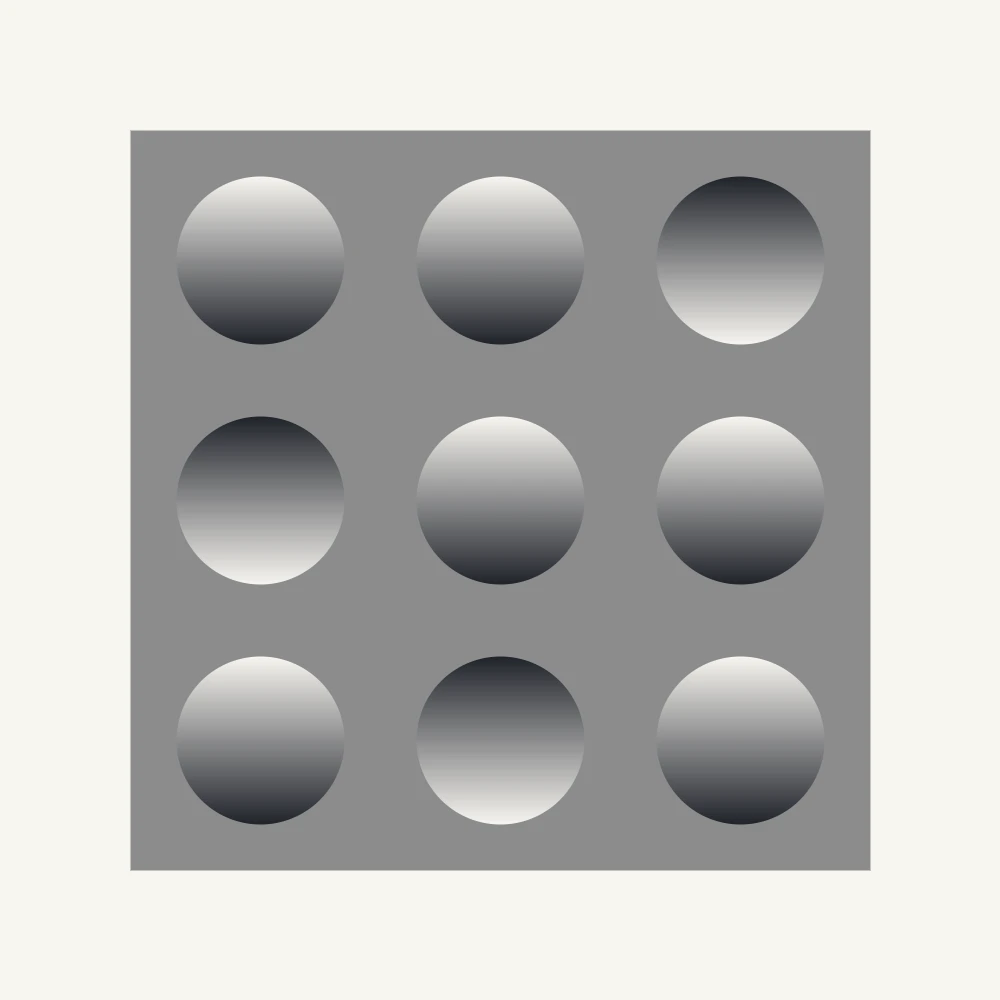
Choose the discs that look like bumps before pressing “Turn the board upside down” on the experiment page. Many viewers see a bump when its bright side is above, and a dent when it is below. Turning the board can reverse those impressions.
All nine discs use the same design. Six have their bright side above; three are turned halfway around. We rotate the whole board without redrawing any disc.
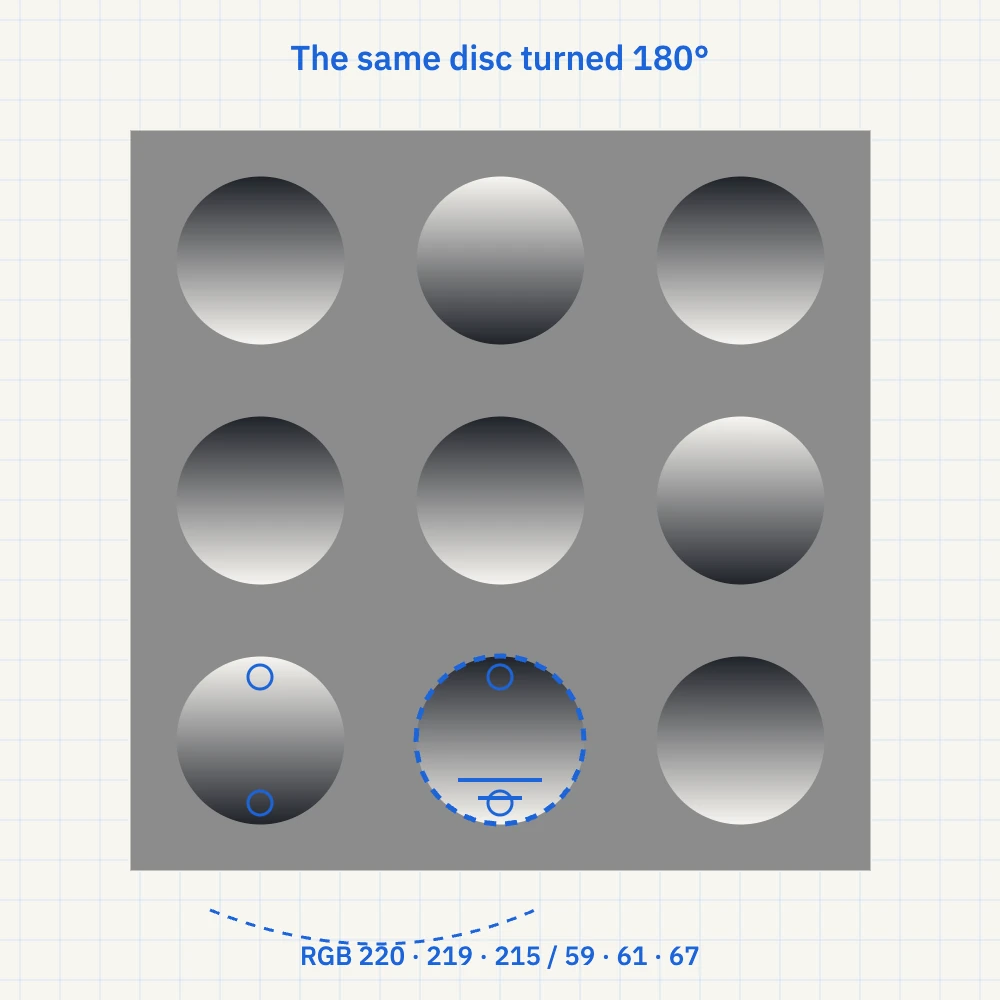
A copy of one disc fits its neighbor after a half-turn and a translation. At the upper and lower sampling points, the red, green, and blue values are (220, 219, 215) and (59, 61, 67). In the neighboring disc, those values swap places. We read them from the same uncompressed image and check video compression separately.
Zero means black and 255 means white. Within each disc, the color values change linearly from the paper color to the ink color. The surrounding board is approximately their average gray. These are calculated gradients, not photographs of illuminated solid objects.
A tendency to assume light comes from above
This is the crater illusion, a term used in English research, including Mamassian and Goutcher (2001). The Japanese researcher Akiyoshi Kitaoka describes the corresponding phenomenon as raised and sunken parts exchanging appearances when an image is inverted. Ramachandran’s 1988 study is a central reference for shape perception from shaded discs.
The shading can be interpreted as a bump lit from one direction or a dent lit from the opposite direction. A tendency to assume overhead lighting can favor one reading. Its direction and strength are not universal constants.
| Study | What it tested | Finding and limitation |
|---|---|---|
| Sun & Perona, 1998 | Preferred lighting direction | A bias left of above; this does not establish a fixed direction for everyone |
| Mamassian & Goutcher, 2001 | Shape judgments of embossed strips | About 26° left on average for the 16 of 20 observers who saw depth; the stimuli were strips, not these discs |
| Morgenstern et al., 2011 | Competition with lighting cues | The overhead-light assumption could be weak and readily overridden |
| Adams et al., 2004 | Experience with touch | Experience could change the assumption; we do not use a numerical training effect here |
These findings do not justify saying that everyone’s visual system “knows” light comes from the upper left. Your estimate on the experiment page describes your answers under its conditions.
Sideways shading and a tilted head
What happens when the bright side moves sideways? Try it before deciding. Kleffner and Ramachandran (1992) found a difference in visual search: a disc with different vertical shading could stand out among distractors, whereas left-right shading differences did not produce the same result. That is not a direct finding about whether a single sideways disc must look flat, raised, or sunken.
What defines “above” also matters. Howard and colleagues (1990) found that assumptions about lighting were predominantly head-relative. Adams (2008) found a mainly retinal reference frame, with partial compensation for body orientation in shape judgments. A slight head tilt might therefore change your estimate. It need not do so on every attempt.
Earlier reports involved optical instruments
Brewster’s 1826 historical account describes a guinea coin seen through a compound microscope, and Gmelin’s 1744 report of deeply engraved parts of a seal appearing raised through an optical instrument. Rittenhouse’s paper, published in 1786, describes brick paving viewed through a tube containing convex lenses. He related the reversal to the inverted image and its apparent lighting.
Those are reports about microscopes and lens tubes, not reports of turning this kind of board upside down. The distinction matters when telling the history of the illusion.
The Necker cube: two solids fit one drawing
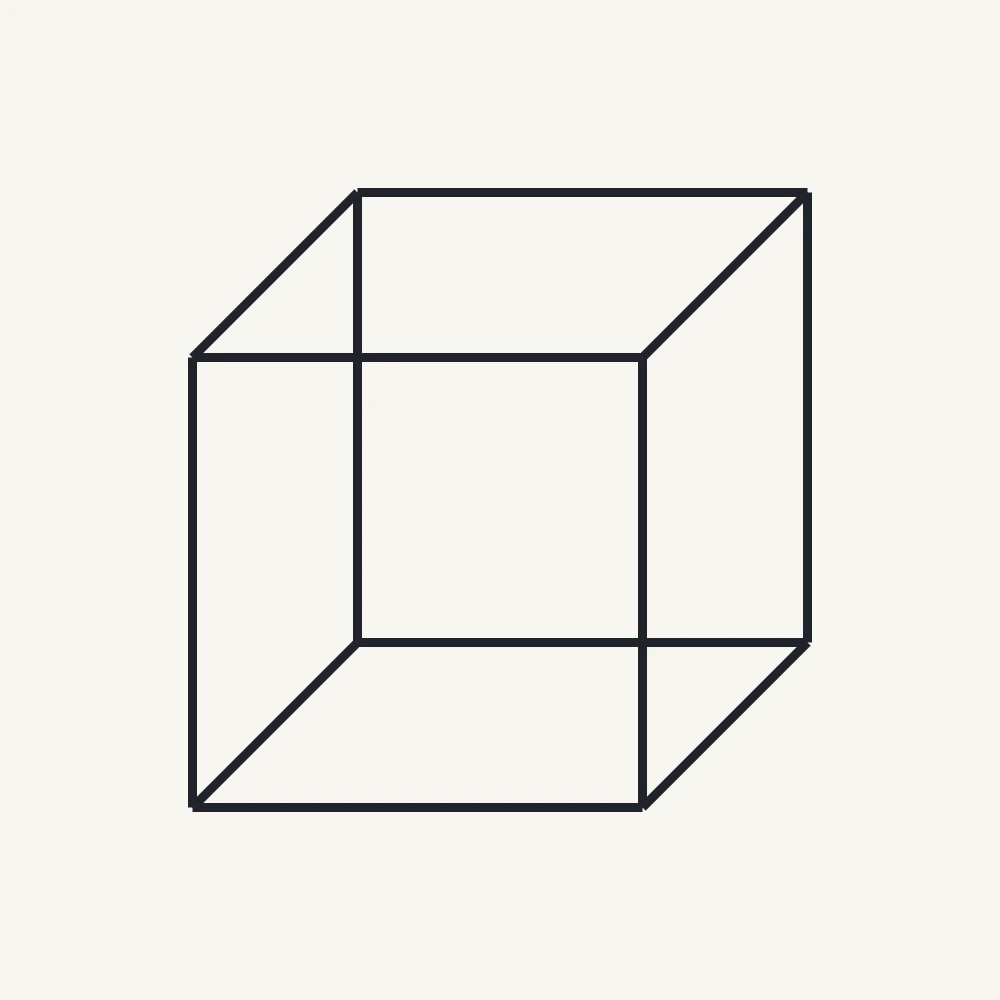
Does the lower-left square seem closer, or the upper-right square? As you watch, front and back may swap. The drawing remains completely still.
The figure contains two equal squares, offset diagonally, with corresponding corners joined. A real box viewed up close usually gives a size cue: the nearer face looks larger. This drawing uses parallel projection, so that cue is absent.
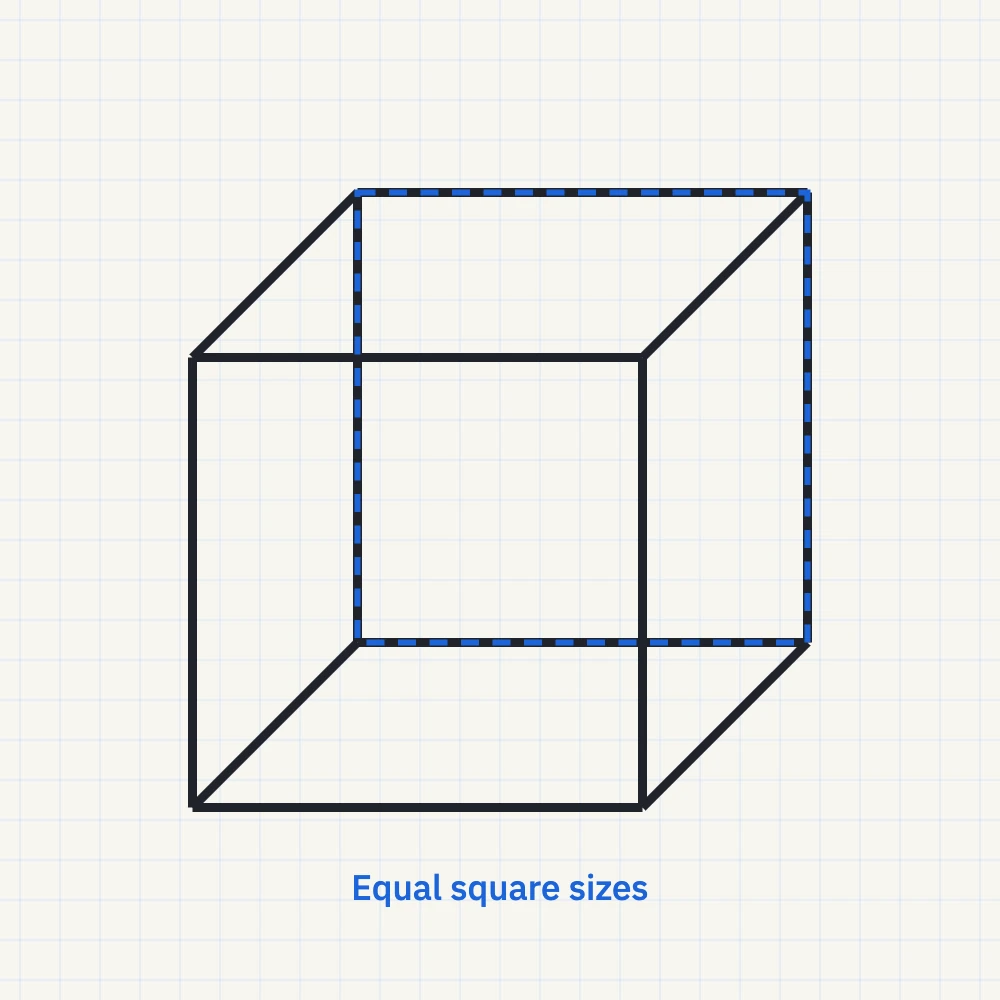
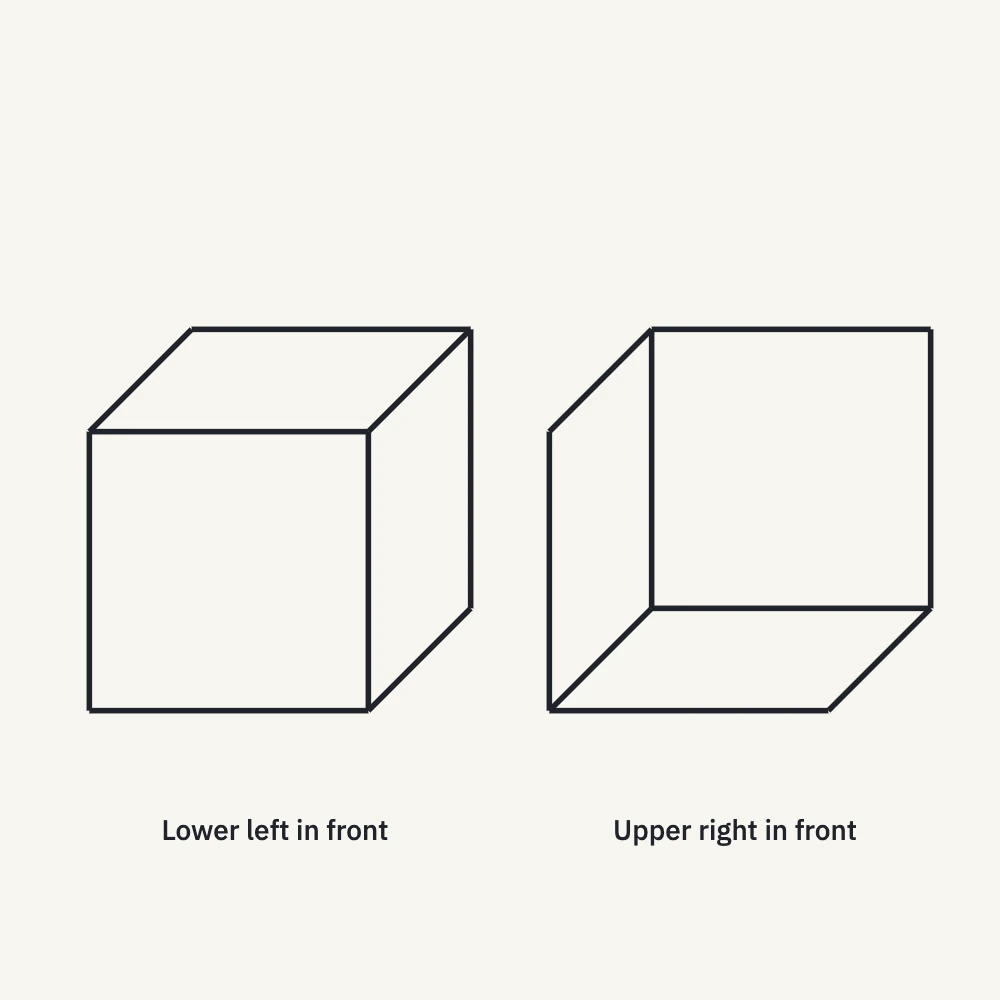
A lower-left-in-front interpretation hides one set of three edges. An upper-right-in-front interpretation hides another set. Overlay the two drawings and the original lines return. We are checking that both interpretations fit the drawing, not promising that removing three lines will force a particular percept.
Louis Albert Necker reported the phenomenon in 1832. He was a Swiss mineralogist teaching in Geneva, and his original crystal drawing was a rhomboid rather than a strict cube. He described a reversal that could occur with one eye or both, and wrote that attending to different corners could favor different readings. His explanation in terms of focusing was his own historical account, not a settled modern mechanism.
Why a switch may take time
Kornmeier and Bach’s 2012 review gives an average interval of roughly five to six seconds during passive viewing, with substantial variation within and between people. The video therefore tells you that a reversal can happen before giving you about ten seconds to watch.
Knowing an alternative interpretation exists can matter. In Girgus and colleagues’ 1977 work, 11 of 20 uninformed observers reported no reversal during a thirty-second view of a vase-face figure. That number concerns that figure and those conditions. It should not be presented as the corresponding proportion for this cube.
Looking somewhere and trying to hold a view
Fixation can have a small biasing effect. In one of Toppino’s 2003 experiments, reducing cube size eliminated the fixation effect, while an effect of intention remained. Trying to maintain a preferred interpretation extended its duration, but did not prevent reversals.
Several studies report a preference for a view from above; Meng and Tong (2004) found nearly equal proportions under their combined conditions. Task and viewing conditions matter. Research points to contributions from both sensory adaptation and attention, rather than one fully established explanation for every switch.
Spinning rings: height is missing from the image
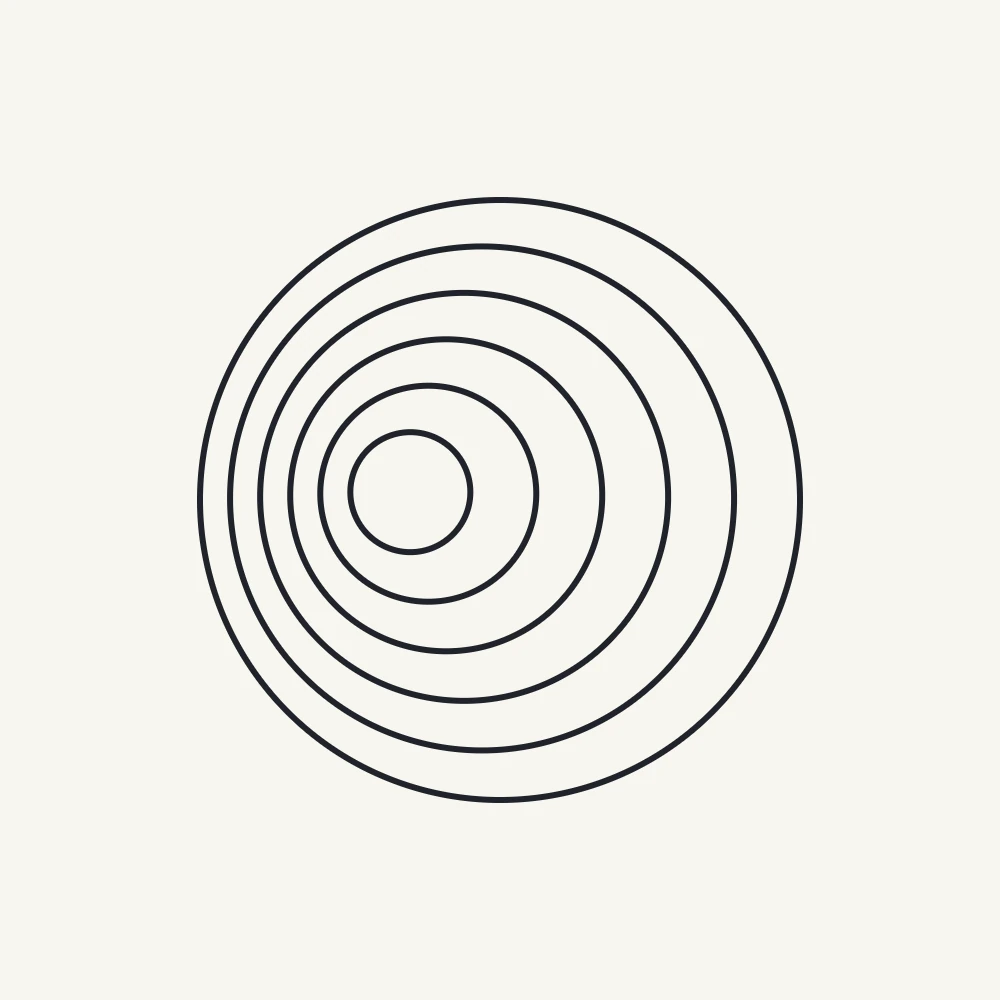
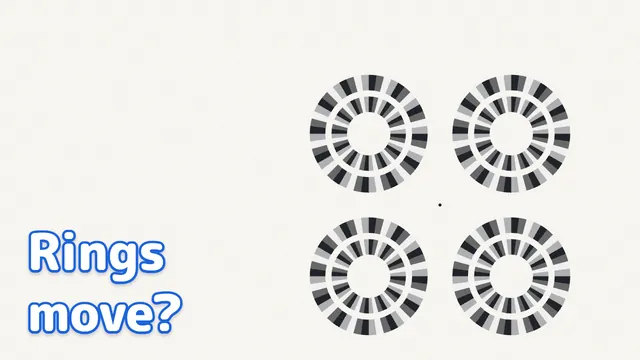
The moving rings may look like a projecting cone, a receding tunnel, or flat rings. If the motion makes you uncomfortable, look away and stop it.
Benussi named the stereokinetic phenomenon, and his student Cesare Musatti reported it in 1924. We do not assign a year to Benussi’s original discovery because we could not establish one reliably.
The outermost ring stays still. The smaller rings’ centers follow progressively larger circular paths, but their radii never change. Unmarked circles provide no identifiable feature for tracking motion along their outlines. Stop the display, and its flat construction becomes easier to inspect.
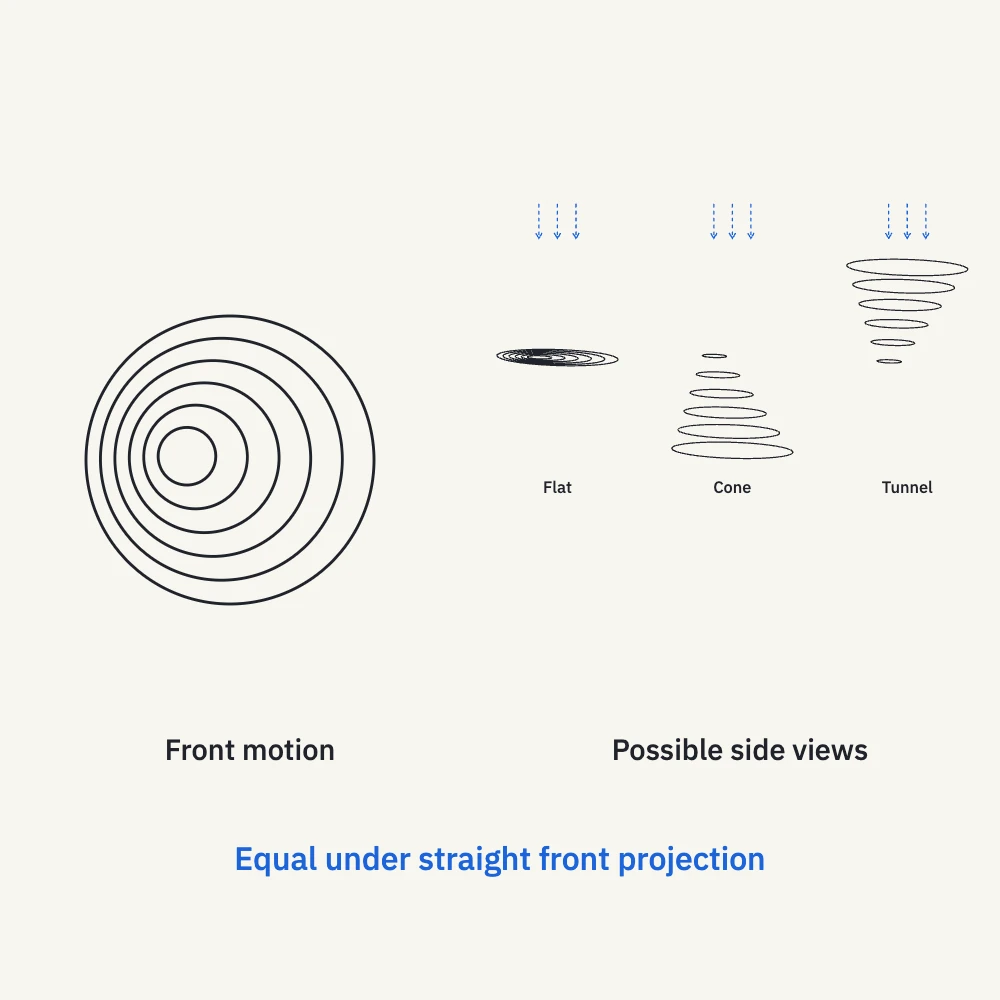
The side-view candidates assign different heights to the same rings. Rotate them around an axis perpendicular to the screen and project straight onto the front: they all produce the same image sequence. Our calculation also includes a low cone and compares every frame over eight seconds. The remaining numerical difference is rounding error.
This equality depends on parallel projection. A perspective camera, which changes apparent size with distance, is different. In our numerical example with a viewing distance of 2,000 diagram units, the smallest ring of the cone would be enlarged by about 1.3 times. We are not claiming equality under every camera model.
A definite height can still appear
Caudek and Proffitt (1993) explain that without contour foreshortening, stereokinetic motion does not geometrically specify depth magnitude. Their account summarizes Proffitt and colleagues’ 1992 observations as apparent heights roughly 0.7–1.2 times the base width.
That is a research report, not the true height of the drawing or a promise that everyone sees the same thing. Wallach and Centrella (1990) found considerable variability. Xing and Liu (2026) report that measurements can be consistent within an observer while differing across measurement methods. The height matches in our experiment page should likewise be read as records under particular conditions.
Another check exposes the mismatch with a conventional solid. If this display represented a straight cone with a wobbling axis and a height equal to its base width, the outer ring would be foreshortened by about 1.8% in our calculation. The actual ring stays circular. A strong impression of depth does not require a physically exact projected cone.
Why that particular height remains unsettled
One proposal favors a shape that reduces differences in motion. The gray arrows below explain velocities when hypothetical identifiable points are followed through rotation in the image plane. Points farther from the rotation center move faster. The actual illusion contains no such tracking marks.
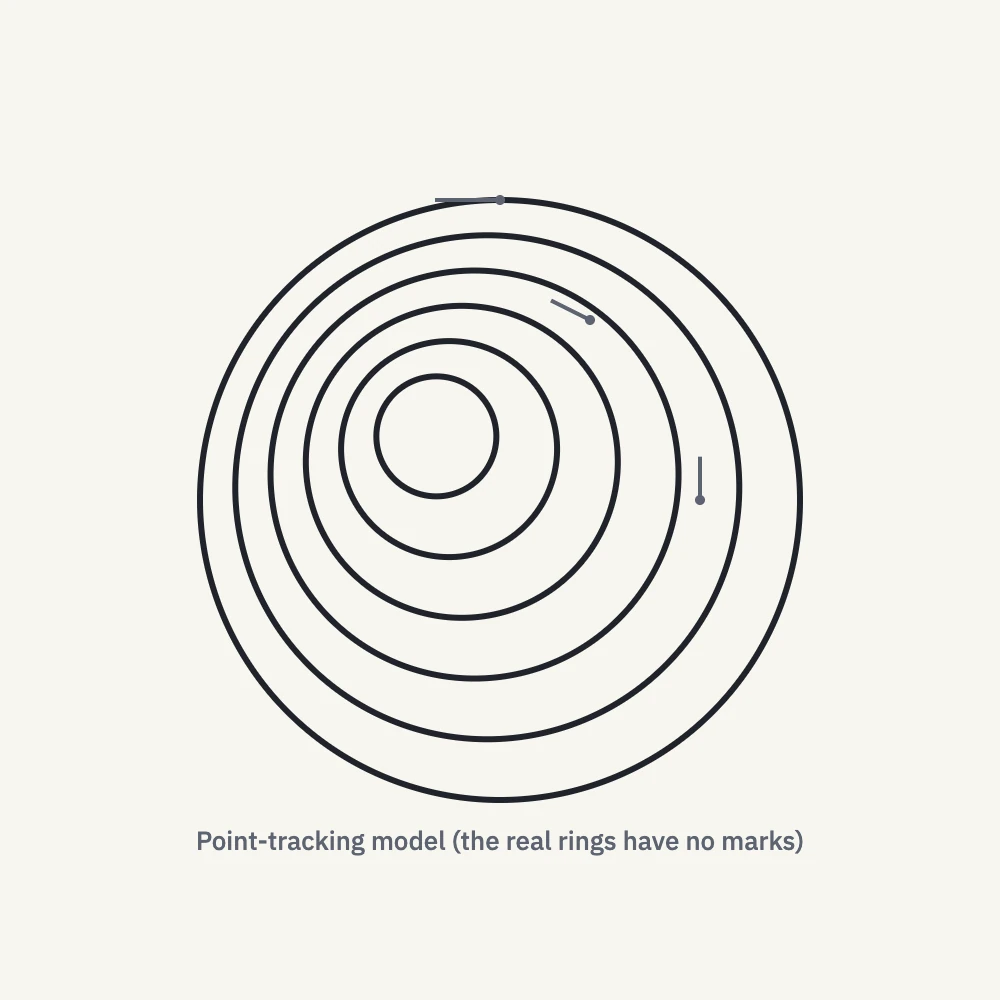
Zanforlin (1988) developed a minimum-motion account, followed by analytic models from Beghi and colleagues (1991). Liu (2003) criticized those models as unable to explain some perceptual phenomena. Masini and colleagues (1994) also reported findings inconsistent with minimizing distances or velocities. The mechanism determining apparent height remains unsettled.
Rotation-induced depth has also been explored in art. Marcel Duchamp made his Rotoreliefs in 1935. We mention the work without reproducing its images; our rings are independently calculated.
What the three examples establish
The verified fact is that several depth interpretations fit the flat images. Research investigates how assumptions about light, adaptation, and attention affect the interpretation we see. Their contributions vary across conditions, and a complete common mechanism has not been established.
You may still see bumps after checking that the discs are identical under rotation. Checking a property of an image is not the same as learning every mechanism that produces its appearance.
Frequently asked questions
Is it abnormal to see the bumps and dents the other way around?
People and viewing conditions differ. These answers cannot diagnose eyesight, health, personality, or intelligence.
Will turning my phone upside down change the effect?
With automatic screen rotation disabled, turning the phone upside down reverses the image orientation relative to your eyes, just as rotating the board does. Try it only in a comfortable position.
Why does the Necker cube not switch for me?
Switching times vary widely. Knowing the alternative view and changing fixation can matter, but neither guarantees a reversal.
Why can this look solid without 3D glasses?
Shading and motion can provide depth information too. These effects can occur with one eye, so they do not require the binocular image differences used by stereo displays.
What is the cone’s real height?
It is not specified by this sequence. Under straight parallel projection, different heights, flat rings, and a tunnel all fit the same motion.
Try the experiment page
The interactive experiment page offers a thirty-six-answer estimate of light direction, two rounds of reporting when a cube face looks closer, and three height matches. It reveals results only after each complete set.
The light estimate adds signed direction vectors from your answers. If consistency is below 0.30, it reports no single direction. Simulations suggest that repeated estimates for the same person can differ by roughly 10–30°. Try tilting your head slightly or halving the contrast, then compare the conditions in your notebook.
Records remain on your device. Share links contain only figure settings, without results or personal identifiers. These are experiments in appearance, not eyesight tests or rankings of people.
Materials and production
Figures, calculations, and animations: Tamelabo. Fonts: IBM Plex Sans JP, IBM Plex Sans, Inter (SIL Open Font License). Voice, music, and sound effects are credited in the video description.
Sources
Where the facts and numbers in the video and on this page come from.
References
- Ramachandran, V. S. (1988). Perception of shape from shading. Nature 331:163–166.
- Kornmeier, J. & Bach, M. (2012). Ambiguous figures: what happens in the brain when perception changes but not the stimulus. Frontiers in Human Neuroscience 6:51.
- Proffitt, D. R., Rock, I., Hecht, H. & Schubert, J. (1992). Stereokinetic effect and its relation to the kinetic depth effect. JEP: Human Perception and Performance 18:3–21.
Links
- Ramachandran, V. S. (1988). Perception of shape from shading. Nature 331:163–166.nature.com/articles/331163a0
- Kleffner, D. A. & Ramachandran, V. S. (1992). On the perception of shape from shading. Perception & Psychophysics 52:18–36.pubmed.ncbi.nlm.nih.gov/1635855
- Imura, T. & Yagi, A. (2005). Two constraints in shape-from-shading perception: three experimental approaches. Jinbun Ronkyu 55(2):61–74 (in Japanese).kwansei.repo.nii.ac.jp/record/15957/files/552-4.pdf
- Kitaoka, A. Crater illusion (18 January 2013, in Japanese).psy.ritsumei.ac.jp/akitaoka/craterillusion.html
- Sun, J. & Perona, P. (1998). Where is the sun? Nature Neuroscience 1:183–184.nature.com/articles/nn0798_183
- Mamassian, P. & Goutcher, R. (2001). Prior knowledge on the illumination position. Cognition 81:B1–B9.mamassian.free.fr/papers/mamassian_goutcher01.pdf
- Morgenstern, Y., Murray, R. F. & Harris, L. R. (2011). The human visual system’s assumption that light comes from above is weak. PNAS 108:12551–12553.pubmed.ncbi.nlm.nih.gov/21746935
- Adams, W. J., Graf, E. W. & Ernst, M. O. (2004). Experience can change the light-from-above prior. Nature Neuroscience 7:1057–1058.nature.com/articles/nn1312
- Howard, I. P., Bergström, S. S. & Ohmi, M. (1990). Shape from shading in different frames of reference. Perception 19:523–530.pubmed.ncbi.nlm.nih.gov/2096370
- Adams, W. J. (2008). Frames of reference for the light-from-above prior in visual search and shape judgements. Cognition 107:137–150.pubmed.ncbi.nlm.nih.gov/17950264
- Brewster, D. (1826). On the optical illusion of the conversion of cameos into intaglios, and of intaglios into cameos. Edinburgh Journal of Science 4:99 onward.archive.org/download/edinburghjournal04edin/edinbur…
- Rittenhouse, D. (1786). Explanation of an optical deception. Transactions of the American Philosophical Society 2:37–42.archive.org/download/transactionsofam02aamer/transa…
- Necker, L. A. (1832). Observations on some remarkable optical phænomena seen in Switzerland; and on an optical phænomenon which occurs on viewing a figure of a crystal or geometrical solid. Philosophical Magazine, Series 3, 1:329–337.zenodo.org/records/1430991
- Kornmeier, J. & Bach, M. (2012). Ambiguous figures: what happens in the brain when perception changes but not the stimulus. Frontiers in Human Neuroscience 6:51.frontiersin.org/journals/human-neuroscience/articles/10…
- Meng, M. & Tong, F. (2004). Can attention selectively bias bistable perception? Differences between binocular rivalry and ambiguous figures. Journal of Vision 4:539–551.pmc.ncbi.nlm.nih.gov/articles/PMC1403736
- Girgus, J. J., Rock, I. & Egatz, R. (1977). The effect of knowledge of reversibility on the reversibility of ambiguous figures. Perception & Psychophysics 22:550–556.link.springer.com/article/10.3758/BF03198762
- Toppino, T. C. (2003). Reversible-figure perception: mechanisms of intentional control. Perception & Psychophysics 65:1285–1295.pubmed.ncbi.nlm.nih.gov/14710962
- Long, G. M. & Toppino, T. C. (2004). Enduring interest in perceptual ambiguity: alternating views of reversible figures. Psychological Bulletin 130:748–768.pubmed.ncbi.nlm.nih.gov/15367079
- Musatti, C. L. (1924). Sui fenomeni stereocinetici. Archivio Italiano di Psicologia 3:105–120; reprinted 2024.rivisteweb.it/doi/10.1421/112893
- Gerbino, W. (2024). The early Musatti on stereokinetic phenomena. Giornale italiano di psicologia 1:127–134.rivisteweb.it/doi/10.1421/112892
- Proffitt, D. R., Rock, I., Hecht, H. & Schubert, J. (1992). Stereokinetic effect and its relation to the kinetic depth effect. JEP: Human Perception and Performance 18:3–21.uva.theopenscholar.com/dennis-proffitt/publications/stereokine…
- Caudek, C. & Proffitt, D. R. (1993). Depth perception in motion parallax and stereokinesis. JEP: Human Perception and Performance 19:32–47.doi.org/10.1037/0096-1523.19.1.32
- Wallach, H. & Centrella, N. M. (1990). Identity imposition and its role in a stereokinetic effect. Perception & Psychophysics 48:535–542.link.springer.com/article/10.3758/BF03211599
- Zanforlin, M. (1988). The height of a stereokinetic cone: a quantitative determination of a 3-D effect from 2-D moving patterns without a rigidity assumption. Psychological Research 50:162–172.link.springer.com/article/10.1007/BF00310177
- Beghi, L., Xausa, E. & Zanforlin, M. (1991a). Analytic determination of the depth effect in stereokinetic phenomena without a rigidity assumption. Biological Cybernetics 65:425–432.doi.org/10.1007/BF00204655
- Beghi, L., Xausa, E., De Biasio, C. & Zanforlin, M. (1991b). Quantitative determination of the three-dimensional appearances of a rotating ellipse without a rigidity assumption. Biological Cybernetics 65:433–440.doi.org/10.1007/BF00204656
- Liu, Z. (2003). On the principle of minimal relative motion: the bar, the circle with a dot, and the ellipse. Journal of Vision 3:625–629.pubmed.ncbi.nlm.nih.gov/14640886
- Masini, R., Ferraro, M. & Costa, T. (1994). Stereokinetic effects with sharp and fuzzy illusory contours. Perception 23:1437–1445.pubmed.ncbi.nlm.nih.gov/7792133
- Xing, Y. & Liu, Z. (2026). Quantifying stereokinetic depth: Divergence across methods despite robust within-subject precision. Vision Research 244:108817.doi.org/10.1016/j.visres.2026.108817
- Museum Boijmans Van Beuningen. Marcel Duchamp, Rotoreliefs (Optical Disks), 1935.boijmans.nl/en/collection/artworks/85583/rotorelief…
Voice, music, art
- Music (OpenTracks): “さみしいおばけと東京の月” by しゃろう; “日曜の午後” by KK.
- Sound effects: Kenney Interface Sounds (CC0); synthesized sounds by Tamelabo.
- Fonts: IBM Plex Sans JP, IBM Plex Sans, Inter, MPLUSRounded1c ExtraBold (SIL Open Font License).