How Far Can You Trust Your Eyes on What's There? | Illusion Lab #07
How it works
- Dots and discs that stay drawn can vanish from sight while you stare at the center.
- A leading idea is that responses to unchanging things weaken, but the three effects are not one mechanism.
- You can check by counting the dots and by comparing the pixels of the first and last frames.
Also calledvanishing illusionTroxler effect whymotion-induced blindness12 dots illusionNinio extinction illusion
Video

Pressing play loads the YouTube player on this page. Watch on YouTube
Try it
Explained
Something can stay drawn on the screen and still vanish from your sight. This episode compares three figures that disappear in different ways: twelve dots, pale discs, and black circles among turning crosses. Each one is built so you can check, with counts and with pixels, that it really was there the whole time.
The question: how many can you see at a glance?
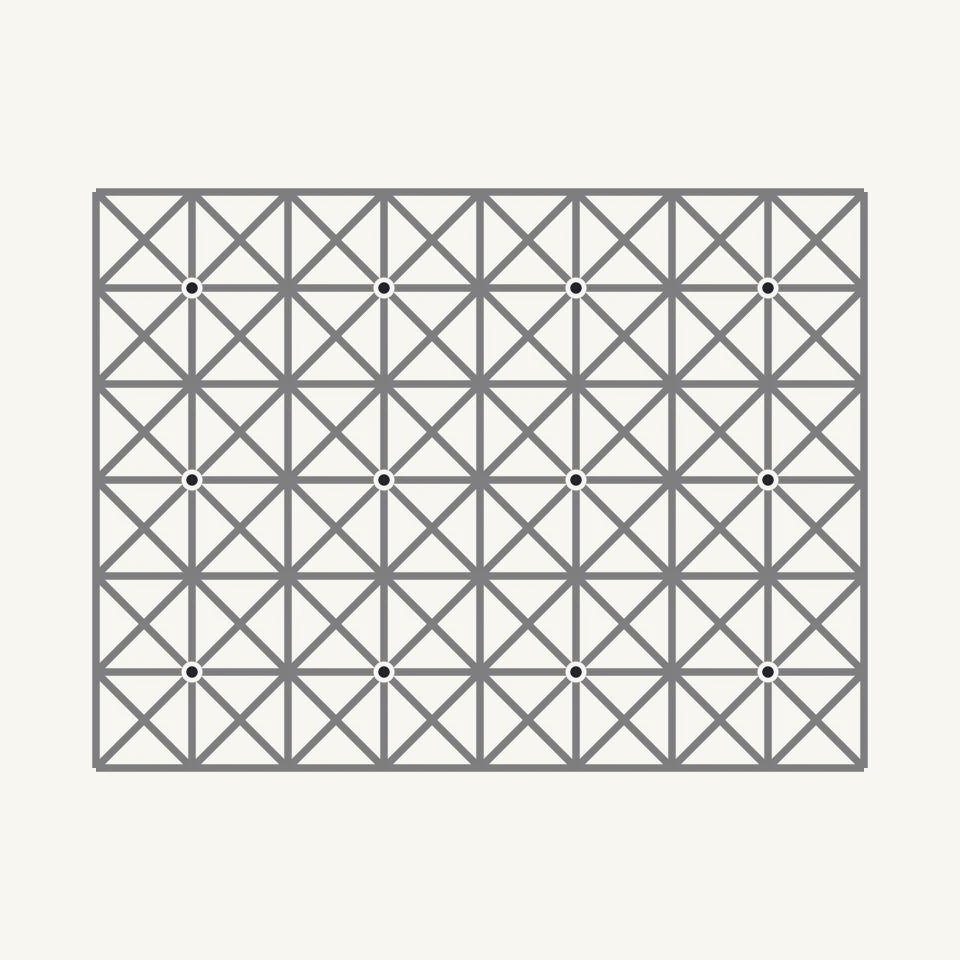
There are black dots where the grid lines cross. Without counting, can you see them all at once? Look at one dot, and the dots farther away tend to drop out, as if they had melted into the grid. No waiting is needed. From the first moment, you cannot take them all in together.
Count and check
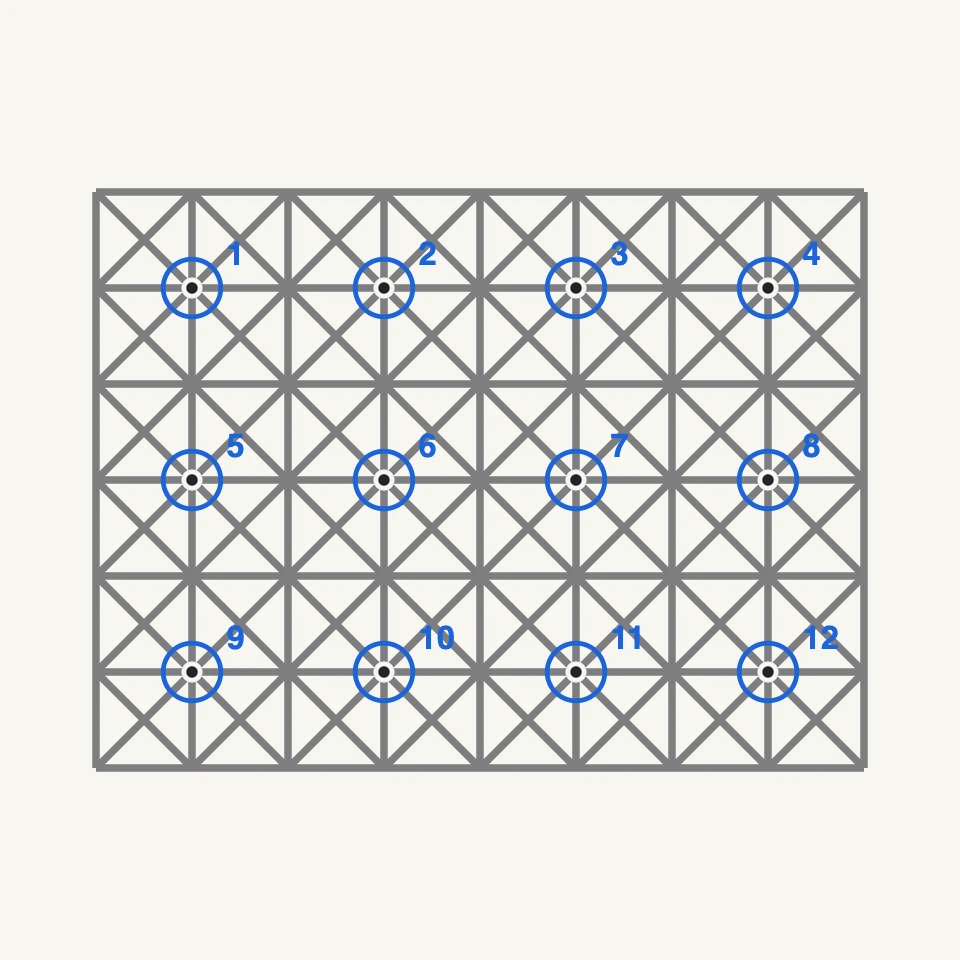
Add a blue ring and a number to each dot, and there are twelve. All twelve have the same size (radius 6 on a 1000-by-1000 stage) and the same ink color, and every gap between them is 200 units. Make the dots bigger, or bring them closer together, and all twelve become easy to see at once. Whether they vanish depends on the conditions of the figure, not on how good your eyes are.
This is Ninio's extinction illusion, reported by Ninio and Stevens in 2000 as a variation on the older Hermann grid.
Pale discs that fade as you stare

Keep looking at the cross in the center. Do not look at the discs themselves. Within a few seconds, or up to about twenty, the pale discs around the cross fade away for most people. Move your eyes, and they come back.
That scene is a still image. In the video, the first and last frames of the staring period are pixel-for-pixel the same. The screen did nothing. Only your seeing changed. Wiggle the discs just a little, and they stop fading so easily.
This is the Troxler effect, reported by the Swiss physician Ignaz Troxler in 1804. The six discs sit 290 units from the center, in a color only slightly darker than the paper (a brightness difference of about 18 percent). A soft-edged pale disc fades more readily than a shape with a crisp outline.
Black circles among turning crosses
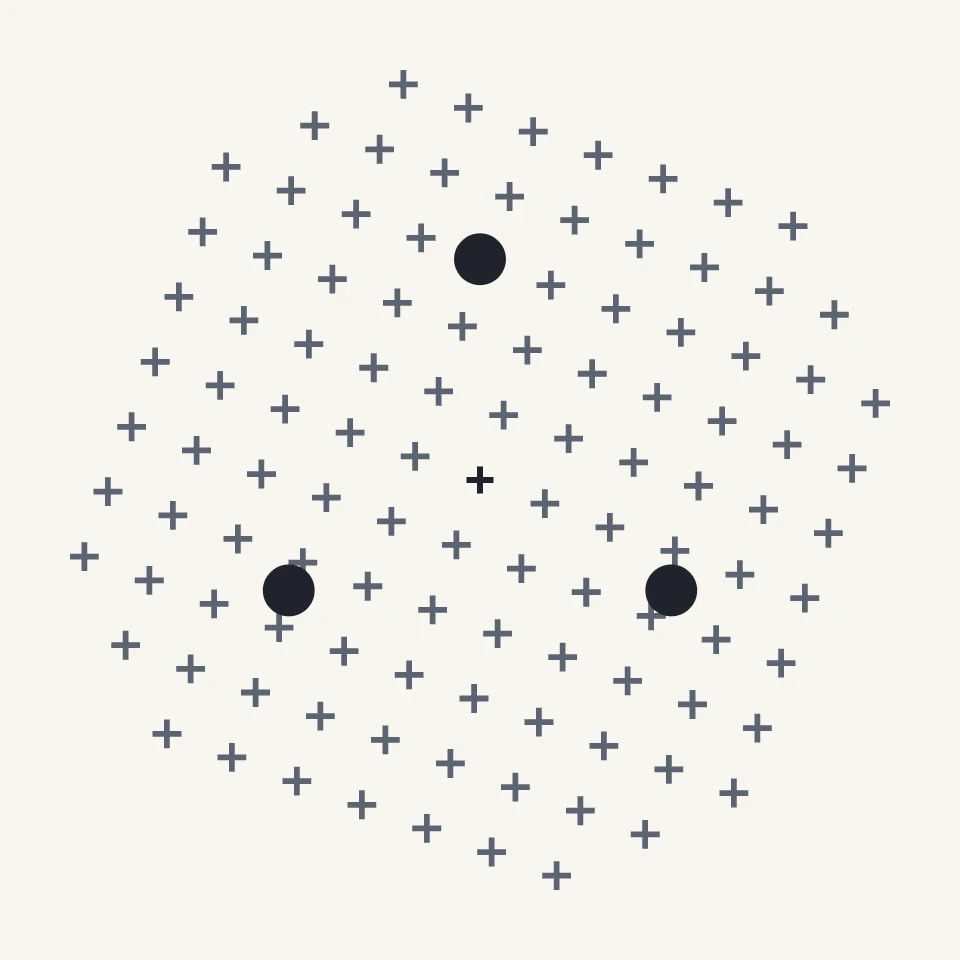
Now the targets are three clear black circles. Around them, 108 small grey crosses in a regular grid turn as one rigid pattern. Keep looking at the center cross, and the black circles vanish for seconds at a time, then return. The circles are drawn in the same place, in the same color, in every frame. Only the crosses move.
Stop the crosses turning, and the circles become easier to keep in view. Even then, we cannot promise they will stay visible forever: keep staring at a still screen, and things can still fade in the Troxler way.
This is motion-induced blindness, reported by Bonneh, Cooperman and Sagi in Nature in 2001.
A pale disc and a darker disc, at the same time

On the left, a pale disc (about an 18 percent brightness difference). On the right, a darker one (about 55 percent), at the same distance from the center and the same size. Stare at the center cross, and many people lose only one of them — usually the pale one first.
This is the heart of the episode. In 2014, Bonneh and colleagues compared Troxler fading and motion-induced blindness directly, in the same setup. As targets were made darker, the number of disappearances went down in Troxler fading and up in motion-induced blindness. Only the count went in opposite directions. The share of time spent vanished went down in both. Mixing the two measures into a single claim like "darkness works in reverse" would misstate what the study found.
Why does this happen?
Troxler fading: responses to the unchanging grow weaker
A leading explanation is adaptation: the nervous system's response to a stimulus that never changes gradually weakens. Experiments have shown that the tiny unconscious eye movements called microsaccades counteract that fading (Martinez-Conde and colleagues, 2006), which fits with the discs returning when you move your eyes. The finer details — where exactly the response weakens, in the retina or in the brain — are still being studied.
Motion-induced blindness: adaptation is not the whole story
Adaptation is thought to play a part here too. The 2014 comparison concluded that both effects are influenced by contrast adaptation in similar ways, but that the rate of disappearances in motion-induced blindness involves an additional mechanism. Candidates include the visual system filling in the background pattern over the target, and a role for attention. No single mechanism has won.
Ninio's dots: coarse detail away from the center
One proposed explanation is that, away from the center of view, a dot and its bright surround blur together until they cannot be told apart from the grid. Researcher-written explainers caution that this does not fully account for the effect. This one is not settled either.
We will not sum the three up as "the brain gets lazy." When even the count of disappearances moves in opposite directions, vanishing is not one thing.
What changing the conditions does
- Bigger dots, narrower spacing, or a different grid brightness: all twelve dots become visible at once.
- Darker discs, moving your eyes, or a slight wiggle: the pale discs resist fading.
- Stopping the rotation weakens motion-induced blindness. Making targets darker reduced the count of disappearances in Troxler fading and increased it in motion-induced blindness (2014 study). The share of time vanished went down in both.
- The smaller the screen, the smaller the angle between the center and a disc — its eccentricity. In this episode's design that angle is about 3.6 degrees on a phone, 7.7 degrees on a laptop, and 6.0 degrees on a television. That is why full screen helps.
Frequently asked questions
Nothing vanished for me. Is something wrong?
No. People differ, and so do screens, distances, and room brightness. Nothing here tests your eyesight.
Why is it weaker on a phone?
A smaller screen puts the discs at a smaller angle from the center of your view (their eccentricity), and things nearer the center resist fading, so a larger angle is what helps. Moving farther away makes the whole screen look smaller and that angle smaller still, so stepping back works against the effect. Making the figure itself larger — full screen on the same device — puts the discs farther from the center of your view at the same distance, which increases the angle. That is a design guide, not a guarantee.
Are the three effects the same mechanism?
They cannot simply be called the same. The count of disappearances responded to darkness in opposite ways in Troxler fading and motion-induced blindness. A shared ingredient (adaptation) is likely, with something extra in motion-induced blindness, and the question remains open.
Can things vanish like this while driving?
This episode does not cover that. Extending these laboratory effects to daily life is an active research topic. Please do not try these experiments while walking or driving.
Try it on the experiment page
On this episode's experiment page you can change the conditions of all three figures and measure your own vanishings by holding a button while anything is gone. It records both measures the study separated: how many times things vanished, and what share of the time they spent vanished. Records stay only on your device and are never sent anywhere. The measurement is not a diagnosis, and you should rest your eyes whenever they feel tired.
Sources
Where the facts and numbers in the video and on this page come from.
References
- Ninio, J. & Stevens, K. A. (2000) Variations on the Hermann grid: an extinction illusion. Perception 29(10):1209–1217
- All sources are on the episode page. Troxler (1804) is introduced in Martinez-Conde et al. (2006) Neuron 49:297–305, among others.
- Martinez-Conde, S. et al. (2006) Microsaccades counteract visual fading during fixation. Neuron 49:297–305
Links
- Bonneh, Y. S., Cooperman, A. & Sagi, D. (2001) Motion-induced blindness in normal observers. Nature 411:798–801nature.com/articles/35081073
- Bonneh, Y. S. et al. (2014) Motion-Induced Blindness and Troxler Fading: Common and Different Mechanisms. PLOS ONEjournals.plos.org/plosone/article
- Bach, M. Ninio's extinction illusion (researcher explainer and demo)michaelbach.de/ot/lum-NinioDots
Voice, music, art
- Music (OpenTracks): “さみしいおばけと東京の月” by しゃろう / “日曜の午後” by KK. Used under the OpenTracks terms of use.
- Sound effects: Kenney “Interface Sounds” (click_001, tick_002, confirmation_001; CC0) https://kenney.nl/assets/interface-sounds . The sliding sound and the room tone were synthesized in code.
- Fonts: IBM Plex Sans JP, IBM Plex Sans, Inter, M PLUS Rounded 1c ExtraBold (SIL Open Font License 1.1).