Optical Illusion: Why Do Still Rings Look Like They Move? | Illusion Lab #05
How it works
- The rings look as if they slide or rotate, but they are still images whose coordinates never change.
- It is apparent motion: the peripheral drift, Ouchi, and Pinna–Brelstaff illusions — what you see changes with the shade order.
- Try it yourself: compare the still image, the moving checkerboard, and the expanding Pinna pattern in the interactive experiments.
Video

Pressing play loads the YouTube player on this page. Watch on YouTube
Try it
Explained
Do these rings look as though they are moving? Test optical illusions against changes in the diagram. Compare a still image, whole-pattern translation, and expansion and contraction using blue outlines and guides.
A ring can seem to turn. An inset can seem to slide free of its background. But “Does it move?” is only the first question. We also need to ask which positions change, whether two regions move relative to each other, and whether anything travels around the center.
This episode uses three optical illusions to separate those questions: peripheral drift, the Ouchi illusion, and the Pinna–Brelstaff illusion. People see these effects differently. There is no need to force an effect to appear. If a diagram makes you uncomfortable, look away and take a break.
Start with a ring that never changes position
Gently shift your gaze between the center dot and the rings. The image below is a still image; its shapes and shades do not change over time.
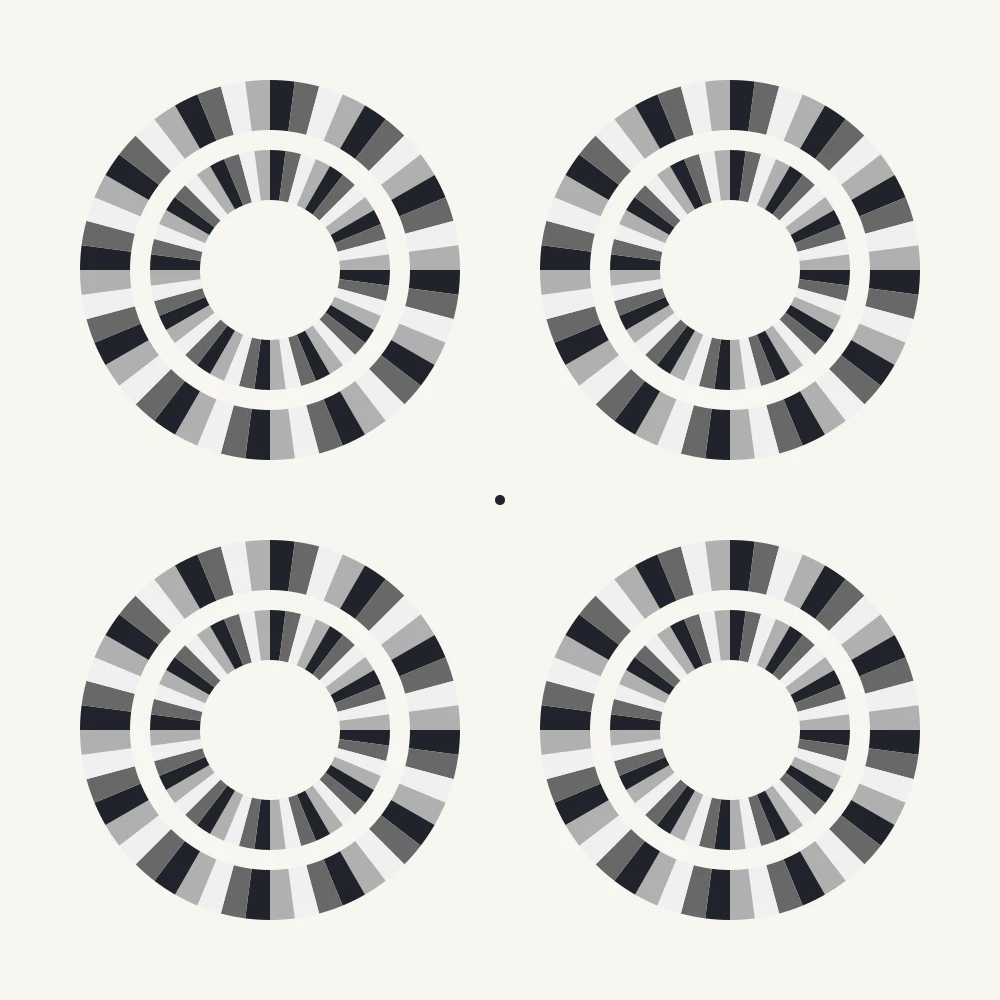
If you sense motion, you are experiencing peripheral drift. “Peripheral” refers to vision around the place you are looking at. The feeling of motion and a change in the image’s coordinates are two things we can check separately.
In the next image, blue dashed outlines trace the first dark segment of each ring. They come from the same coordinates as the segments themselves. Look at the boundaries between shades as well as the circular edges: all of them line up. The episode uses these outlines to compare the segments before and after the viewing interval.
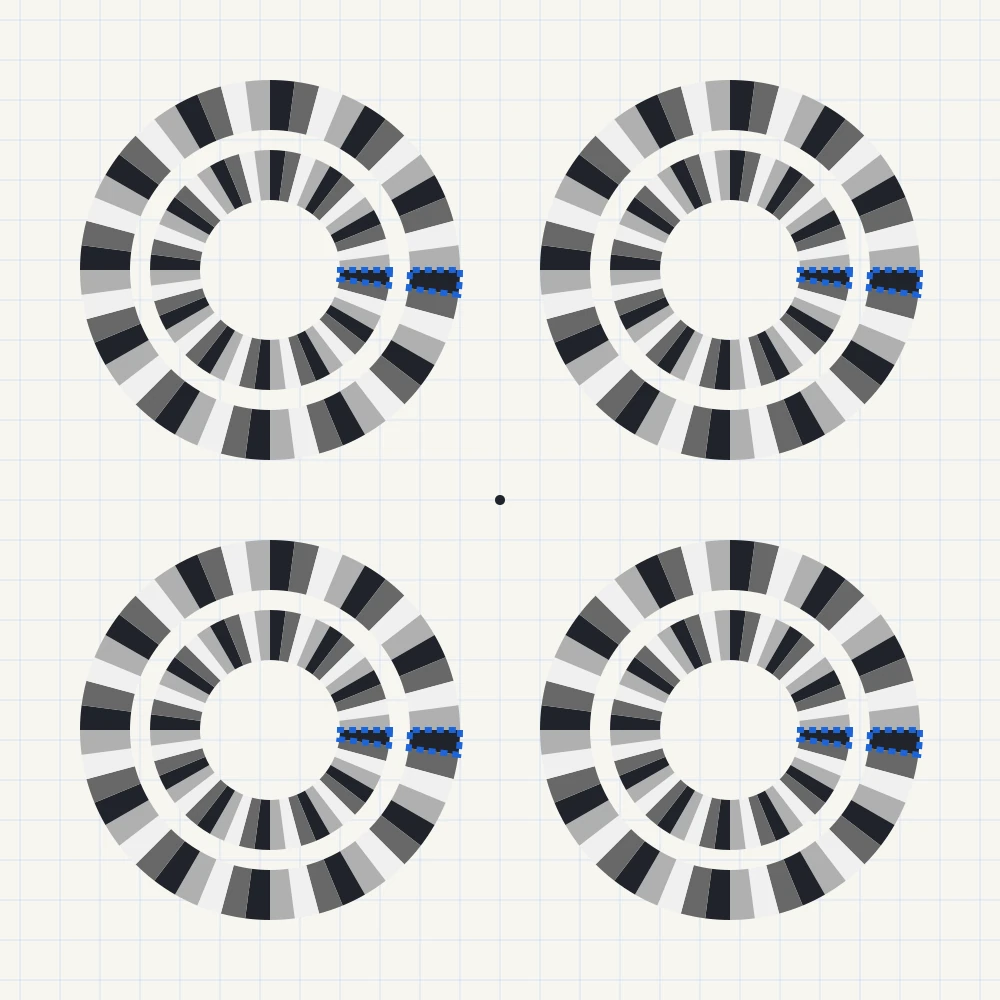
Zero position change does not mean zero perceived motion. It describes the drawing. We have not measured your experience and assigned it a score of zero.
All three diagrams use a square coordinate stage with a side length of 1000 units. These are drawing units, not screen pixels or millimeters. Each of the four pairs contains annuli spanning radii 70–120 and 140–190. Each annulus has 48 segments, making 384 segments in total. The article figures use the same drawing code and coordinates carried over from the episode.
Peripheral drift: what do shade order and eye movements tell us?
Change the shades without moving the shapes
The repeating clockwise sequence is dark, dark gray, light, light gray. Kitaoka and Ashida’s 2003 study is the basis for this arrangement: the order of regions with different brightness matters to apparent motion.
In the Still image tab, try Shade order. Reversing the order keeps the same four shades, segment shapes, and area occupied by each shade. Compare the feeling and direction of motion, then return to the original. A reversal of perceived direction is something to look for, rather than a guaranteed result.
The symmetric option repeats dark, dark gray, light, dark gray. It also changes the shade proportions because light gray is no longer used. A weaker effect here cannot be attributed to order alone.
You can also reduce Light–dark contrast. At zero, all segments become the same gray and the boundaries between them disappear. Compare this condition with the original and identify what has changed in the image.
An observed relationship is different from a complete explanation
Otero-Millan, Macknik, and Martinez-Conde (2012) examined small, rapid eye movements and blinks in the Rotating Snakes illusion. They found a relationship with subsequent illusory rotation. That result concerns the stimulus and observations in their study. We have not tracked your eyes or measured eye movements while people view our own pattern.
One proposed explanation involves differences in the timing of visual responses to contrast: different light–dark differences can produce responses with different timing, contributing to apparent motion. The 2012 paper discusses this account as earlier research in its Introduction. Its eye-movement findings do not, by themselves, establish the entire timing account.
Likewise, Kitaoka and Ashida’s report mainly establishes properties of the effect and rules for designing a pattern. Those rules are useful without being a complete account of the underlying mechanism. How far one explanation covers the different conditions is still not fully understood.
The Ouchi illusion: a moving pattern with no independent inset motion
The long checkerboard cells below point in different directions inside and outside the central disc. This article image is a single, stationary snapshot. To see the episode’s imposed motion, open Inset and surround in the experiments and press Start motion. The whole square moves diagonally back and forth. Does the inset seem to slide separately?
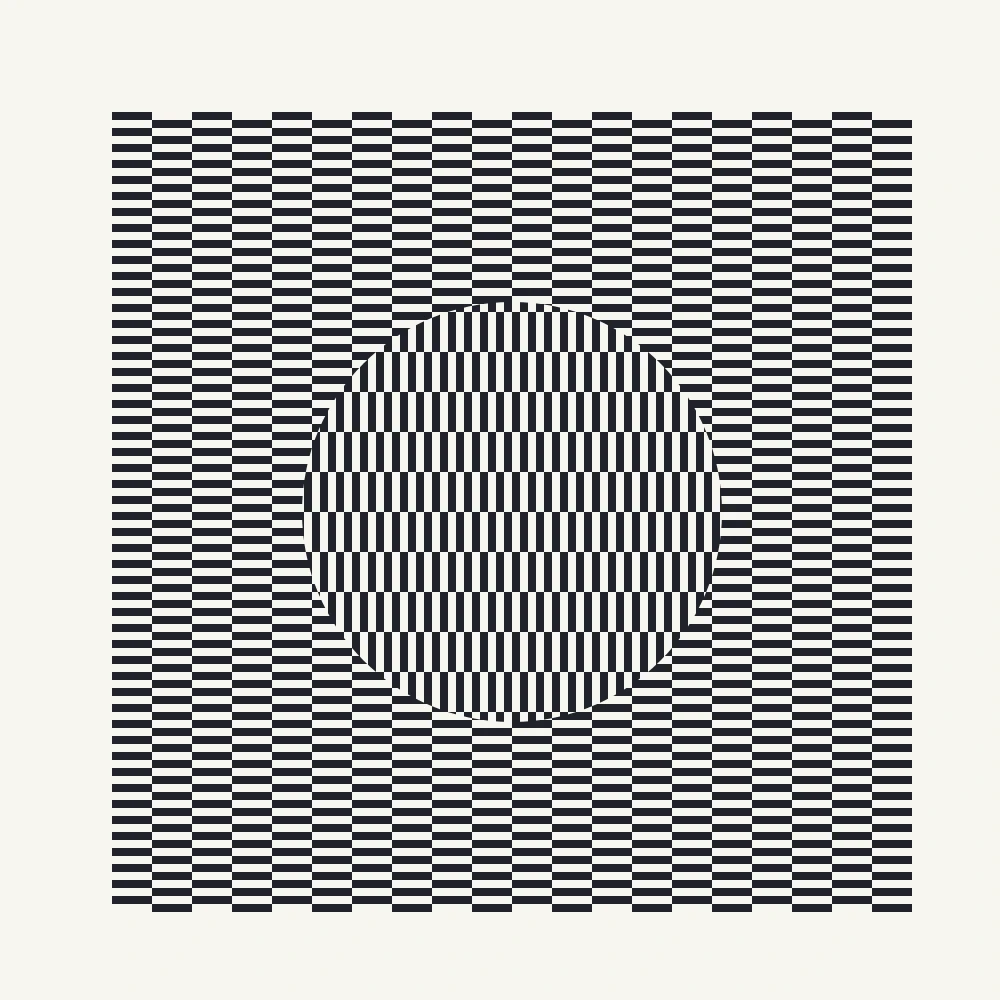
This is the Ouchi illusion. Our square is 800 × 800 drawing units, with cells measuring 40 × 8: a 5:1 ratio. The inset has a radius of 210 units and uses the same texture rotated by 90°.
At the default setting, displacement reaches 12 units from the reference position on each axis, with a complete back-and-forth cycle every 3.2 seconds. The inset, surround, and circular boundary all receive exactly the same translation. No additional movement is applied to the inset.
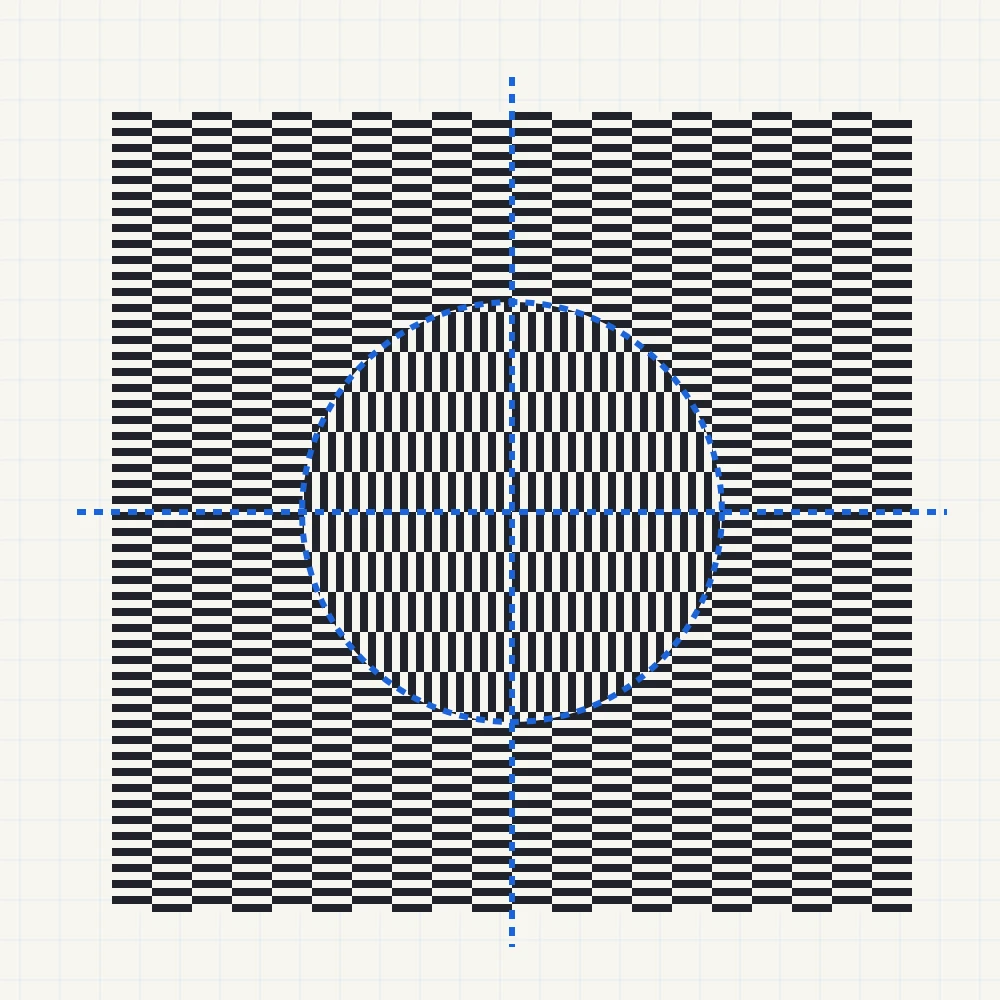
Here, zero means zero change in the inset’s position relative to the surround. The whole drawing really does move across the screen. The guides move with it. These two still figures show the geometry; use the experiments to check that the parts stay connected throughout the motion.
Why a small piece of a pattern can leave motion uncertain
Imagine horizontal stripes seen through a window, with their ends hidden beyond its edges. Moving the stripes sideways leaves the pattern inside the window unchanged. Moving them up or down shifts the light and dark bands. A small piece of a stripe does not provide every clue needed to determine the whole pattern’s movement.
Fermüller, Pless, and Aloimonos (2000) proposed a computational model explaining the Ouchi illusion through biases in combining local motion information. “Local” means information from small parts of the image. In this account, differently oriented textures can lead to different motion estimates even when their actual translation is identical. It is a proposed explanation, rather than a uniquely settled mechanism.
Hine, Cook, and Rogers (1997) studied simplified stripe patterns and found that the effect depended on the angle between the patterns and their fineness. Their stimulus was different from our perpendicular checkerboards. We cannot label our 90° arrangement the strongest possible condition on that evidence.
Aligning the textures changes more than their angle
Try changing Inset orientation from 90° to 0°, keeping the motion amplitude the same. In our drawing, the two textures then join seamlessly and the visible circular boundary disappears.
If the sliding feeling changes, orientation alone does not explain what you have demonstrated: the boundary changed too. Return to 90° and compare again. The useful question is both what you deliberately changed and what else changed with it.
Pinna–Brelstaff: expansion and contraction that can seem to rotate
For the third experiment, open Ring rotation and press Start motion. Let your gaze rest comfortably near the center dot. The pattern expands and contracts. Does it also seem to turn?
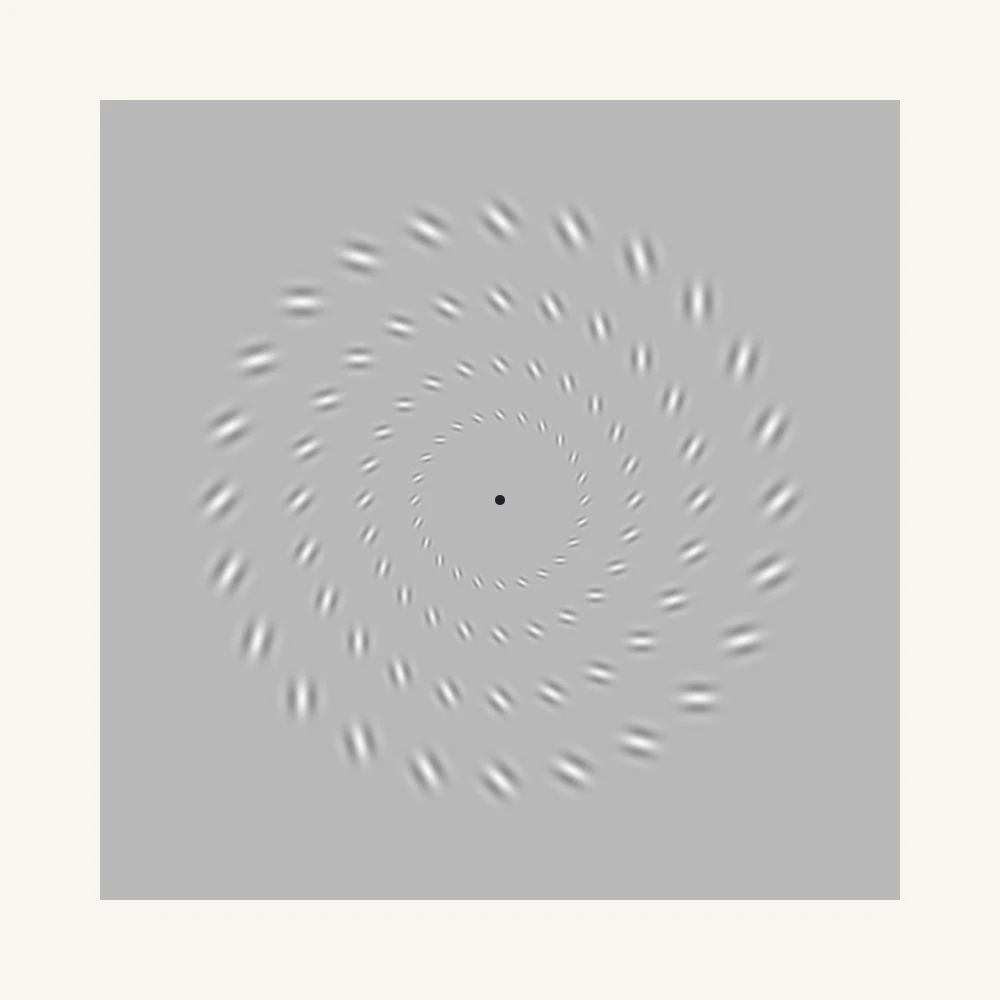
Pinna and Brelstaff reported their relative-motion illusion in 2000. Our display uses blurred stripe patches informed by the form studied by Luo and colleagues (2019). All four rings use the same tilt; this display is not presented as neighboring rings rotating in opposite directions. Battaje, Brock, and Rolfs (2023) also discuss a version in which on-screen expansion and contraction produces apparent rotation.
The reference radii are 85, 135, 200, and 280 drawing units. Each ring contains 24 patches, for a total of 96. At the default setting, scale varies from 0.90× to 1.10× and back over six seconds. Each patch’s position and size receive the same scaling. Its angle around the center stays fixed.
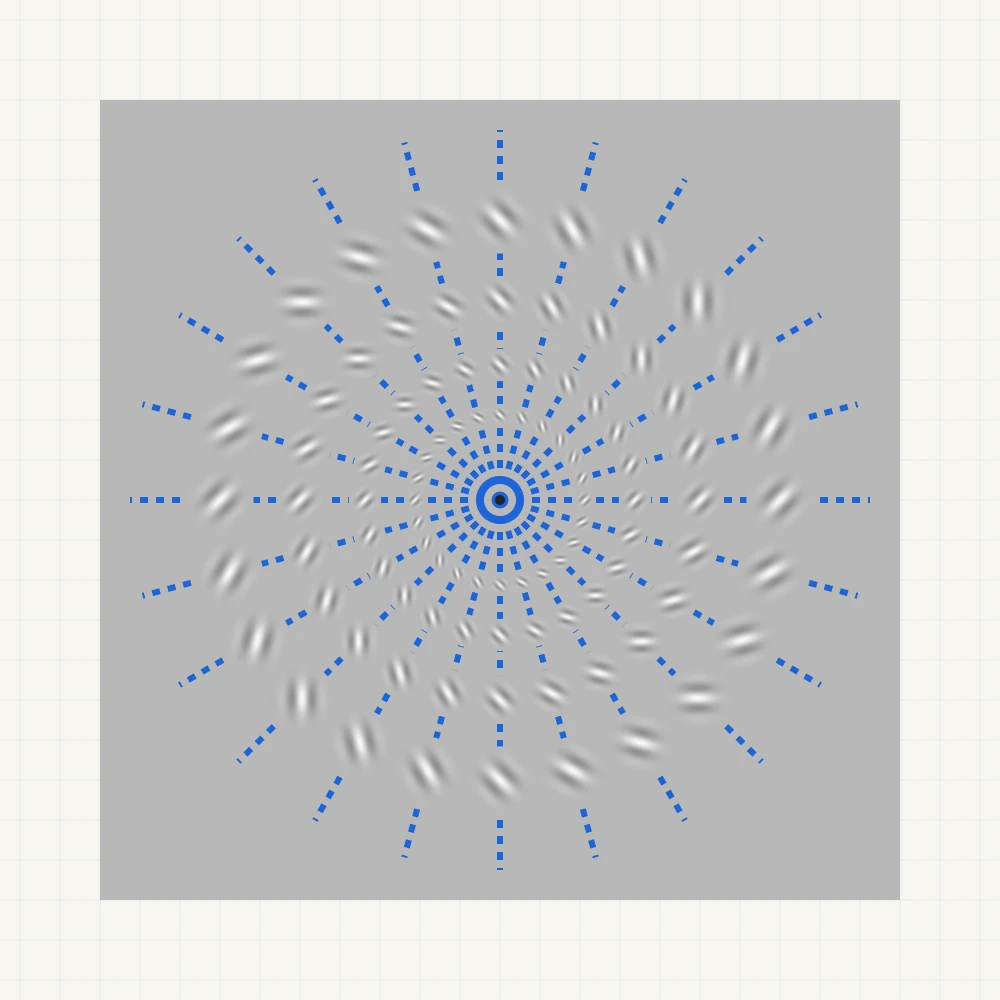
In the moving experiment, each patch center travels outward and inward along its own blue guide. Rotation would carry it sideways off that guide. Zero rotation describes the angle around the center; it does not mean the pattern is stationary. Expansion and contraction are real changes in this display.
Stripe orientation is a clue, not a measurement of perceived rotation
As with the horizontal stripes, a small part of a tilted stripe can leave the direction of movement uncertain. Research examines how those local signals are combined into an impression of the whole pattern’s motion. This provides an account of apparent rotation, not something we can prove simply by checking our drawing’s coordinates.
The default Stripe orientation setting is +45°. The angle describes the direction across the light and dark bands, measured relative to the outward radial direction. It is not the angle of the stripe lines themselves. Compare 0° with +45°, using the same expansion range, then restore the original setting.
Luo and colleagues compared tilted and zero-tilt conditions. Their results do not guarantee the same experience for every person, device, or version of the pattern. Also distinguish the setting change from the trial: the patches change orientation while you switch settings. The zero-rotation claim applies while orientation is fixed and the pattern expands and contracts.
Three different meanings of “zero change”
| Diagram | What actually changes | What stays fixed |
|---|---|---|
| Peripheral drift | Nothing during a trial with fixed shade settings | Segment positions and shades; position change is zero |
| Ouchi | Whole-pattern translation; default maximum displacement is 12 units per axis, with a 3.2-second cycle | Inset–surround position relationship; its change is zero |
| Pinna–Brelstaff | Expansion and contraction; default scale is 0.90×–1.10×, with a six-second cycle | Patch-center angles around the center during a fixed-condition trial; rotation is 0° |
These numbers are drawing settings, not measurements of the strength or speed of anyone’s perceived motion. Research considers eye movements, responses to brightness, and the combination of orientation information. How far the three effects can be covered by a single mechanism is still not fully understood.
FAQ
Does seeing no motion mean something is wrong with my eyes?
This display cannot tell you that. People see the effects differently, and it provides no threshold for classifying someone’s vision as abnormal. You can still compare positions, relative movement, and angles without experiencing an illusion.
Will the motion disappear once I know the image is still?
It need not. Return to the first rings and compare your experience after learning how they are drawn. An unchanged position and a reported feeling of motion are separate observations.
Is it okay if the blue guides weaken the illusion?
Yes. The guides add visible landmarks to check geometry, so the viewing conditions change when they appear. A weaker impression is not a reason to add actual rotation to the pattern.
Does trying this on a phone replicate the research?
No. Display width and viewing distance change how fine the pattern looks. These are original demonstration settings informed by research, not a standardized reproduction of the studies’ viewing conditions.
Try one change, then restore the original
Use Motion experiments in this episode page’s Try it section. Start with the original, change one setting, then reset and compare. Begin with Shade order under Still image, Inset orientation under Inset and surround, or Stripe orientation under Ring rotation. The last two require Start motion. Use Check to add the blue guides.
You can save a condition with Add this condition to notebook. Notes stay on the device, are not sent elsewhere, and do not automatically sync to another device. People see these effects differently; checking or recording an experience here is not a measurement or diagnosis of eyesight, health, or personality. There is no need to continue if you see no effect. Hide diagram is available whenever you want a break.
Sources
Where the facts and numbers in the video and on this page come from.
- Ritsumeikan University — author-hosted paper (Kitaoka, A., & Ashida, H. (2003). Phenomenal characteristics of the peripheral drift illusion. VISION, 15(4), 261–262. Shade arrangement and stimulus design rules)psy.ritsumei.ac.jp/akitaoka/PDrift.pdf
- PubMed — paper record and abstract (Otero-Millan, J., Macknik, S. L., & Martinez-Conde, S. (2012). Microsaccades and blinks trigger illusory rotation in the “rotating snakes” illusion. The Journal of Neuroscience, 32(17), 6043–6051. Eye-movement findings; the response-timing account is earlier work discussed in the Introduction)pubmed.ncbi.nlm.nih.gov/22539864
- University of Maryland — author-hosted paper (Fermüller, C., Pless, R., & Aloimonos, Y. (2000). The Ouchi illusion as an artifact of biased flow estimation. Vision Research, 40(1), 77–96. A model of combining local motion information)users.umiacs.umd.edu/~fermulcm/postscript/ouchi-main.pdf
- PubMed — Ouchi study abstract (Hine, T., Cook, M., & Rogers, G. T. (1997). The Ouchi illusion: an anomaly in the perception of rigid motion for limited spatial frequencies and angles. Perception & Psychophysics, 59(3), 448–455. Angle and pattern-fineness effects in simplified gratings; used within the abstract’s scope)pubmed.ncbi.nlm.nih.gov/9136274
- PubMed — original report record and abstract (Pinna, B., & Brelstaff, G. J. (2000). A new visual illusion of relative motion. Vision Research, 40(16), 2091–2096. Relative motion in a direction different from physical motion; used within the abstract’s scope)pubmed.ncbi.nlm.nih.gov/10878270
- PMC — open-access paper (Luo, J., et al. (2019). Going with the Flow: The Neural Mechanisms Underlying Illusions of Complex-Flow Motion. The Journal of Neuroscience, 39(14), 2664–2685. Stripe-patch arrangements and tilt comparisons; our display uses its own demonstration settings)pmc.ncbi.nlm.nih.gov/articles/PMC6445985
- PMC — demonstration-format paper (Battaje, A., Brock, O., & Rolfs, M. (2023). An interactive motion perception tool for kindergarteners (and vision scientists). i-Perception, 14(2), 1–6. The use of on-screen expansion and contraction)pmc.ncbi.nlm.nih.gov/articles/PMC10064475
Voice, music, art
- Music (OpenTracks): “さみしいおばけと東京の月” by しゃろう; “日曜の午後” by KK. Previously downloaded by the operator and used under the OpenTracks audio-use terms.
- Sound effects: Kenney Interface Sounds (click_001, confirmation_001 / CC0) https://kenney.nl/assets/interface-sounds
- Fonts: IBM Plex Sans JP, IBM Plex Sans, Inter, and M PLUS Rounded 1c ExtraBold (SIL OFL 1.1). Web font subsets are distributed under distinct family names.