Which Circle Looks Bigger? The Ebbinghaus Illusion, Tested | Illusion Lab #02
How it works
- In the Ebbinghaus, Delboeuf, and Jastrow illusions, equal circles and strips look different in size.
- Removing the surrounds or overlaying copies changes the look; the edges are one candidate explanation.
- On the web experiment bench you can change the surrounds and spacing, then match a circle until it looks equal.
Video

Pressing play loads the YouTube player on this page. Watch on YouTube
Try it
Explained
In the video
- 0:00Which circle looks bigger?
- 0:17What is Illusion Lab?
- 0:37What if we remove the surrounds?
- 0:56What if the gaps get wider?
- 1:12Which curved strip is bigger?
- 1:31What if we overlay the whole shapes?
- 1:55What if we swap A and B?
- 2:13What if the strips move apart?
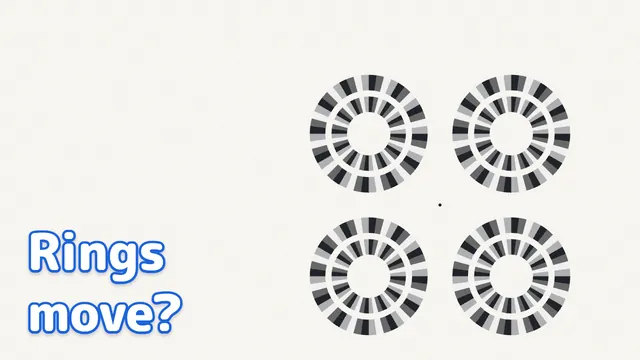
- 2:35How does a ring change a circle?
- 2:51What if only the rings match?
- 3:09Could the edges explain it?
- 3:27Were the first circles the same?
- 3:44Can you try the experiments yourself?
- 4:12How will you check your own eyes?
Which center circle looks bigger? Which curved strip? Try making a judgment before checking the blue guides. Then remove the surroundings, overlay a copy, or change a ring while keeping the center circle fixed.
Appearance alone cannot establish that two shapes have equal dimensions. In this episode, the center circles have equal diameters, and the curved strips have identical geometry. The experiment is to notice how they look, then check what actually matches.
The Ebbinghaus illusion: which center looks larger?
Look at the two center circles below. Choose left, right, equal, or not sure. Keep that first impression in mind before moving on to the measurement.
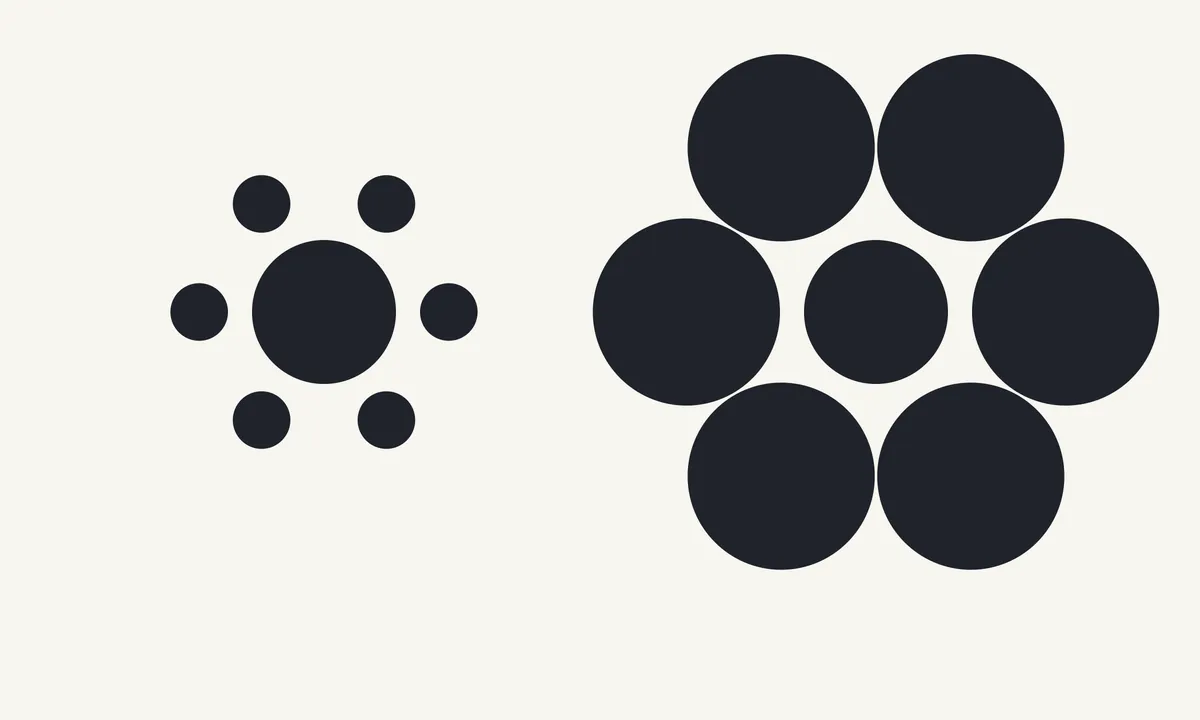
In this familiar arrangement, many people see the center with smaller surrounding circles as the larger one. This is the Ebbinghaus illusion, a visual illusion in which apparent size can differ from the figure's dimensions.
The name refers to Ebbinghaus. Urale and Schwarzkopf's 2023 paper, one of this episode's research sources, cites his 1902 work. The historical reference listed below is traced through that paper rather than a direct reading of the original.
Check the diameter, then the outline
Both center circles have a diameter of 120 u. Here, u is a diagram unit, not a millimeter or a physical pixel on your screen. When the whole diagram is resized, the two comparison shapes receive the same scale factor.
The blue dashed outline is a copy of the right center circle moved onto the left one. It fits without resizing. The original right circle remains in place.
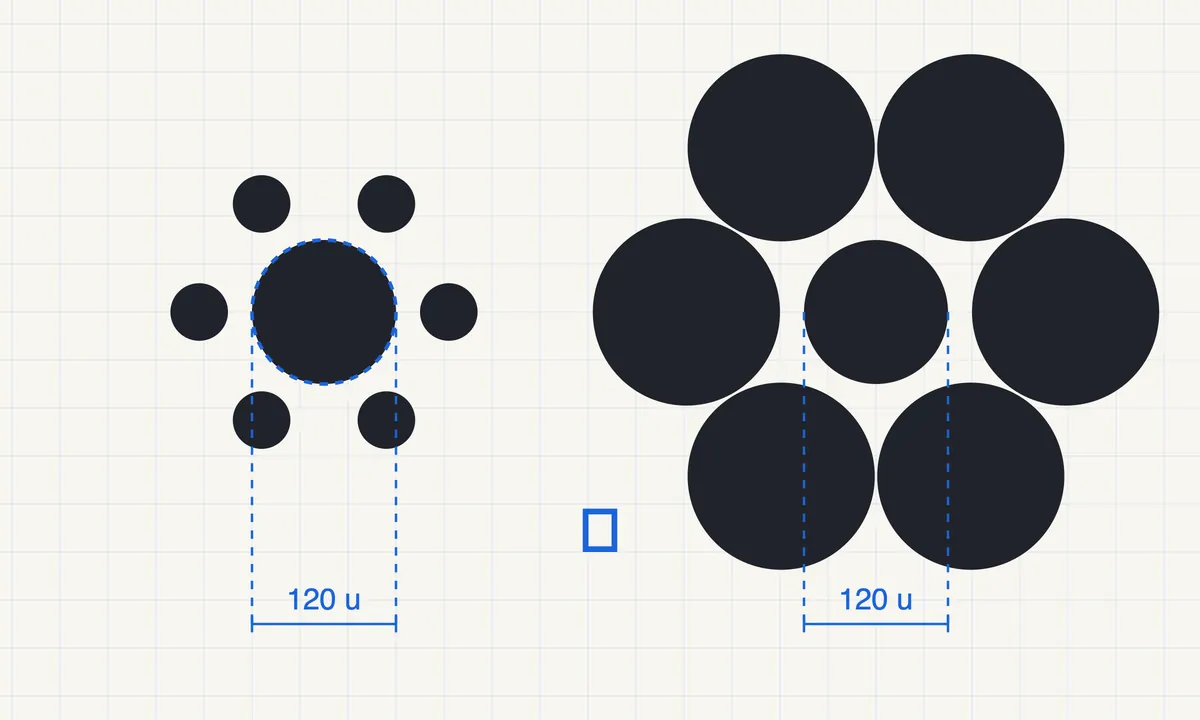
| Setting in this figure | Left | Right |
|---|---|---|
| Center diameter | 120 u | 120 u |
| Surrounding-circle radius | 24 u | 78 u |
| Number of surrounding circles | 6 | 6 |
| Nearest edge-to-edge gap from the center | 20 u | 20 u |
A radius runs from a circle's center to its edge. The gap in this table is between edges, not between centers. Keeping that gap fixed while enlarging a surrounding circle also moves its center outward.
Why does it happen—and what would a simple explanation miss?
“The center looks large compared with small neighbors” describes the familiar effect. It leaves a further question: why does this arrangement produce that comparison, and when will it stop doing so?
Knol, Huys, Sarrazin, and Jirsa (2015) varied target size, surrounding-circle size, and distance. Their combinations changed whether an illusion occurred and its direction. A rule that small neighbors must always make a center look larger cannot cover those results.
Interactions between contours—the edges of shapes—are another proposed explanation discussed by Urale and Schwarzkopf (2023). These accounts have limits, too. The full mechanism is still not understood. Establishing equal diameters in our figure does not establish which explanation causes a particular viewer's impression.
Change the surround while leaving the centers alone
On the experiment page, hide the surrounding circles, bring them back, then widen the shared edge-to-edge gap from 20 u to 50 u. At each setting, compare the two centers as they look now. Increasing the gap does not guarantee that an illusion will disappear.
You can also change the size of one surround. Keep in mind that larger surrounding circles cover more of the space around the target. That operation cannot isolate circle size from every other feature of the surround. Our filled-circle demonstration is not an exact replication of the research conditions, and it does not predict an illusion strength for you.
The Jastrow illusion: check the whole curved strip
Now compare the upper and lower strips. Make a judgment about the whole shape, rather than choosing one particular length to inspect.
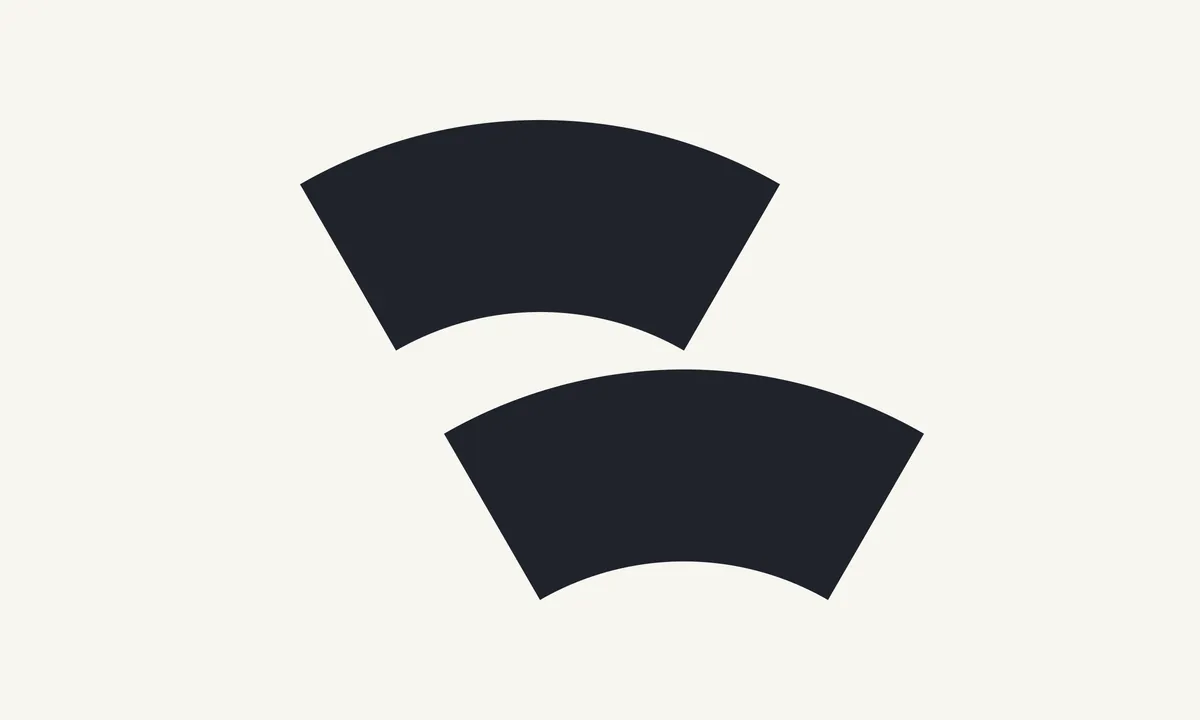
Identical curved shapes can look different in size when arranged this way. This is the Jastrow illusion. Michael Bach's account reproduces a figure from Joseph Jastrow's 1892 work; that is the historical reference used here.
Equal widths are only the first check
The strips are duplicates of the same section of a circular ring. Their inner radius is 240 u, their outer radius is 400 u, and the section runs from −120° to −60°. Each strip is 400 u wide, with straight cut ends 160 u long.
Equal width alone would leave open whether the rest of the shapes match. To check that, leave the lower strip in place and move a copy onto the upper one.
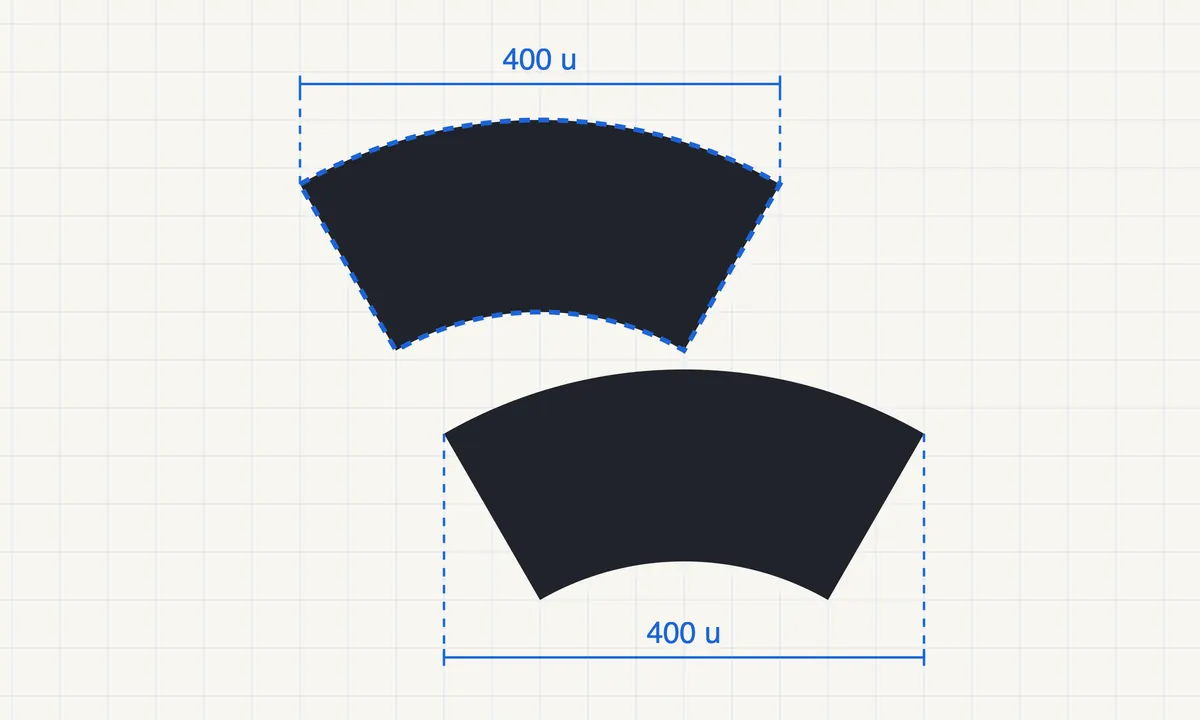
The copy moves 120 u left and 120√3 u up. There is no rotation, enlargement, or reduction. Both curved edges and both straight ends coincide. This establishes the same shape and size across the whole outline.
Does comparing a long edge with a short edge explain it?
One proposed account focuses on the nearby edges: the shorter inner edge of the upper strip and the longer outer edge of the lower strip. Comparing those lengths may affect the impression of the whole shape. The episode presents this as a possible explanation.
Bach cautions that invoking a local comparison does not, by itself, explain the illusion through a general account of how vision works. The mechanism remains incompletely understood.
Imai (1960) investigated factors including the inner and outer radii, opening angle, cut ends, separation, and arrangement. We use the abstract to identify the variables studied. We do not adopt a supposedly optimal angle or a numerical illusion strength from that study.
For a useful follow-up, call the original upper strip A and the lower strip B, then exchange their positions. The labels stay with the shapes. Does your impression follow A or B, or the position they occupy? Moving the strips farther apart offers another comparison without changing their geometry.
The Delboeuf illusion: change the ring, keep the center
Replace the surrounding circles with a single ring around each center. Which center looks larger now?
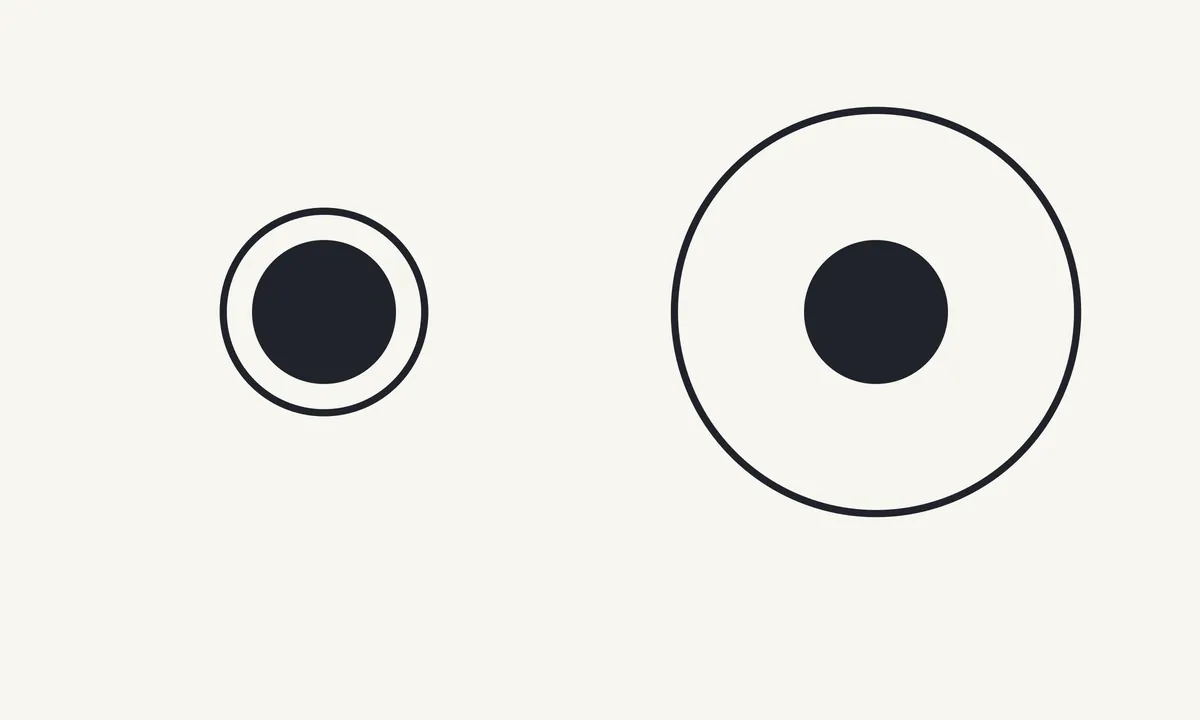
This is the Delboeuf illusion. Urale and Schwarzkopf (2023) cite Delboeuf's 1865 work. In standard examples, many observers see the center within the nearer ring as larger than the center within the farther ring.
Ring radius and visible gap are different measurements
Removing only the rings reveals the same two 120 u center circles. The centers were not resized.
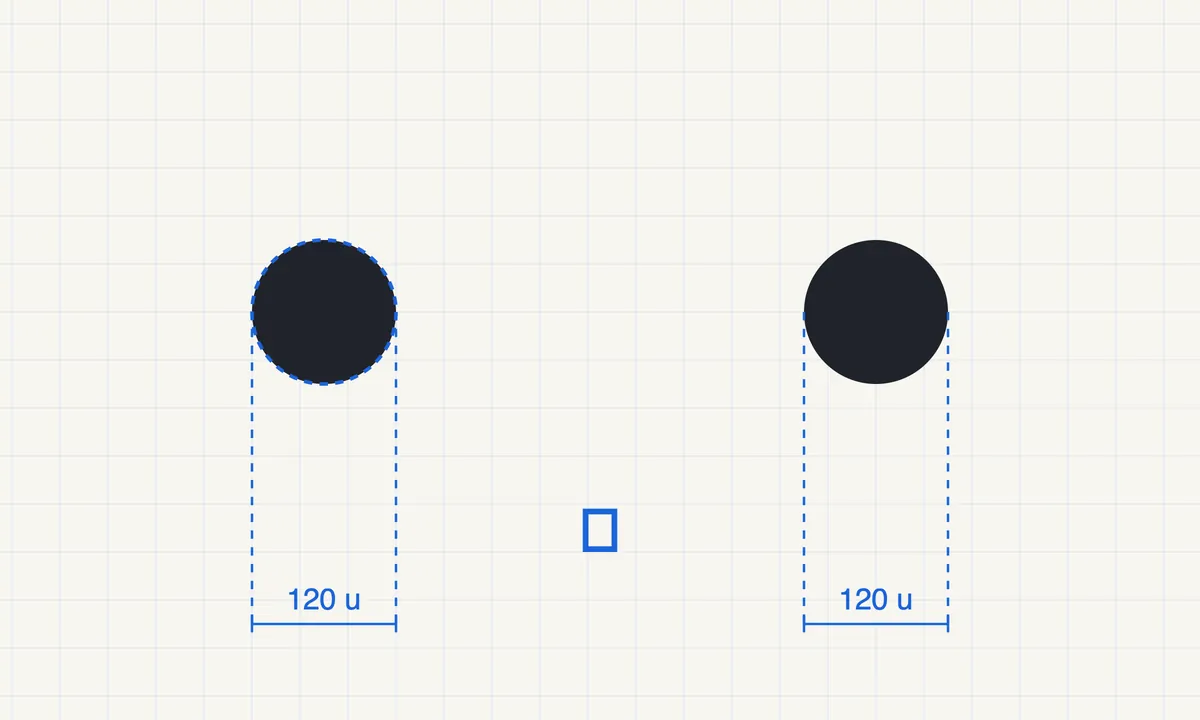
| Initial setting | Left | Right |
|---|---|---|
| Center diameter | 120 u | 120 u |
| Radius to the middle of the ring's stroke | 84 u | 168 u |
| Ring stroke width | 6 u | 6 u |
| Gap from the center circle's edge to the ring's inner edge | 21 u | 105 u |
The ring is a line with thickness. For the left figure, subtract half the stroke width and the center-circle radius: 84 − 3 − 60 = 21 u. The right gap is 168 − 3 − 60 = 105 u. Measuring to the middle of the stroke would give a different gap.
Expand only the left ring from a radius of 84 u to 168 u. The two center-and-ring arrangements now have matching geometry. A copy of the left pair fits the right pair. Notice how they look to you at this setting as well.
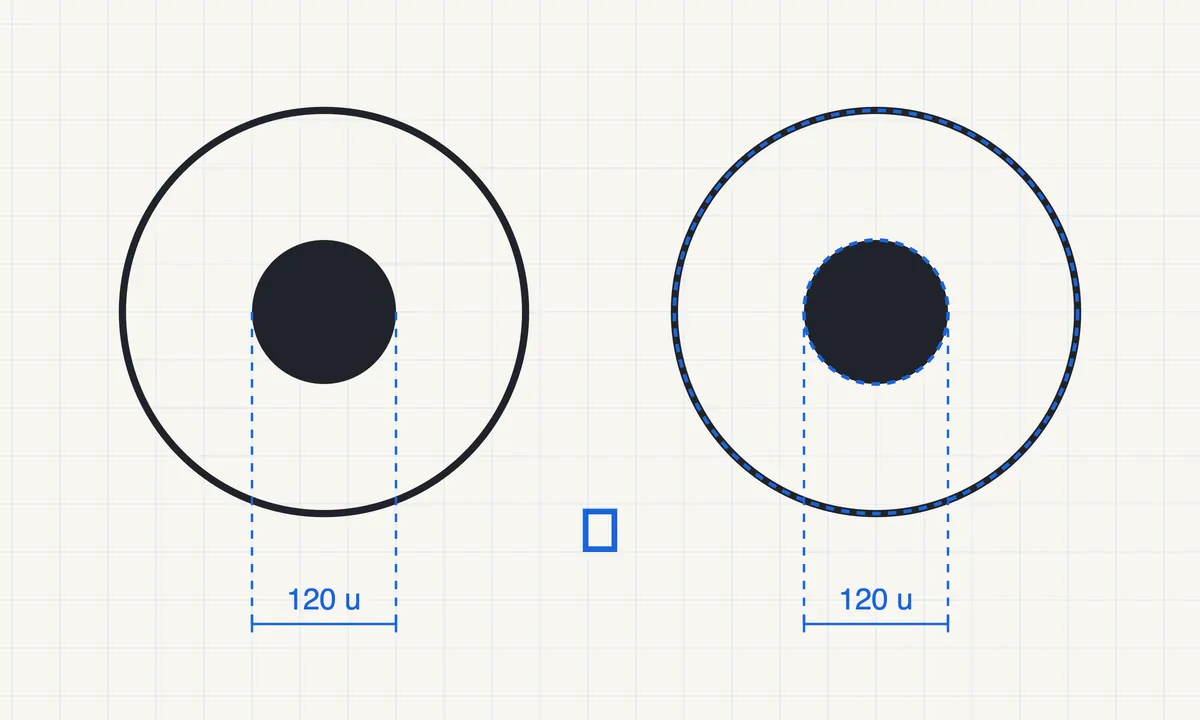
A proposed pull on the perceived edge
One possible account is that a nearby ring pulls the circle's perceived edge outward toward it. That describes a proposed change in appearance; the black circle itself does not expand.
Urale and Schwarzkopf (2023) discuss contour interactions as a candidate explanation, with limits on what they account for. The full mechanism is still unknown. Making the rings equal checks the geometry, but that observation alone cannot select a single causal explanation.
FAQ
What if the shapes look equal to me?
That is a valid observation. The effects differ between people, and we have not measured their strength in viewers of these particular diagrams. Experiencing a strong illusion is not a requirement for taking part.
What if they still look different after I know they are equal?
Keep both observations: your impression and the dimensions checked by the ruler or overlay. You can ask how a shape looks and whether its geometry matches without requiring the answers to feel the same.
Can this figure tell me the illusion is a certain percentage strong?
No. The diagram supplies dimensions, not a measurement of your perceived difference. A percentage reported in a research experiment cannot simply be assigned to this figure or to your experience of it.
Are all three illusions caused by the same mechanism?
The sources used for this episode do not establish a single mechanism for all three. Changing surrounds, distances, and positions gives us useful ways to explore them, but sharing an experimental approach does not establish a shared cause.
Is matching the circles a test of eyesight or health?
No. It records how you matched sizes under the conditions shown on your screen. It does not diagnose vision, health, or personality, and it does not rank your ability.
Try the experiments and read your matches
Open the experiment on this episode page and choose “Circles around,” “Curved strips,” or “Rings.” First look without guides, then select “Check with the blue ruler.” Change a setting and compare again. “More experiments” opens options such as hiding the surround or changing the spacing.
The numerical matching task is available only for the Ebbinghaus circles. Choose “Match the size that looks equal.” The reference is above, and the adjustable plain circle is below. You make six matches: two with a small surround, two with a large surround, and two without a surround. Each condition has a smaller and a larger starting size, and the order is shuffled.
Those rounds use different settings from the initial free-experiment figure. The reference diameter is chosen from 112, 120, and 128 u, and the edge-to-edge gap to the surround is 24 u. Each recorded percentage is:
(matched plain-circle diameter ÷ reference diameter − 1) × 100
For a reference diameter of 120 u, matching at 132 u gives +10.0%; matching at 108 u gives −10.0%. These are examples for explaining the formula, not a person's measured results or predictions of what you will see.
Two comparisons matter when reading the graph. The blue 0% line marks equal diameters for the adjustable and reference circles. The mean marker in the “No surround” row marks your average match without surrounding circles. A condition's mean to the right of that marker means you chose a larger size relative to the reference, on average; a mean to its left means you chose a smaller relative size. Inspect the two individual points in each row, too.
These are brief records of your matches, with individual differences in perception. A different display size or viewing position may produce different results. Start in a comfortable orientation; if the diagram's display size changes during the session, restart the six matches. You can save completed records in the notebook on your device. The measurement is not a diagnostic test.
Shorts
Sources
Where the facts and numbers in the video and on this page come from.
- Frontiers in Psychology (Knol, H., Huys, R., Sarrazin, J.-C., & Jirsa, V. K. (2015). Quantifying the Ebbinghaus figure effect: target size, context size, and target-context distance determine the presence and direction of the illusion. Frontiers in Psychology, 6, 1679. DOI: 10.3389/fpsyg.2015.01679. Used for the dependence of the effect's presence and direction on the configuration)frontiersin.org/journals/psychology/articles/10.3389/fp…
- PubMed Central (Urale, P. W. B., & Schwarzkopf, D. S. (2023). Effects of cortical distance on the Ebbinghaus and Delboeuf illusions. Perception, 52(7), 459–483. DOI: 10.1177/03010066231175014. Used for standard examples, proposed contour interactions, and their limits)pmc.ncbi.nlm.nih.gov/articles/PMC10291393
- SAGE — full paper PDF (Historical references as cited in the preceding paper: Ebbinghaus, H. (1902). The principles of psychology)journals.sagepub.com/doi/pdf/10.1177/03010066231175014
- J-STAGE — The Japanese Journal of Psychology (Imai, S. (1960). Experiments on Jastrow Illusion. The Japanese Journal of Psychology, 30(5), 350–356. DOI: 10.4992/jjpsy.30.350. Used only for the variables listed in the English abstract; no optimal angle or effect size is adopted from the paper or its corrections)jstage.jst.go.jp/article/jjpsy1926/30/5/30_5_350/_articl…
- Michael Bach — Visual Phenomena & Optical Illusions (Jastrow Illusion. Used for arrangement, overlay checks, and the limitations of local-comparison explanations. Historical reference presented there: Jastrow, J. (1892). Studies from the laboratory of experimental psychology of the University of Wisconsin – II. The American Journal of Psychology, 4(3), 381–428 (Figure 28, p. 398). The original paper was not directly consulted)michaelbach.de/ot/geom-Jastrow/index.html
Voice, music, art
- Music: “さみしいおばけと東京の月” by しゃろう / “日曜の午後” by KK
- Sound effects: Kenney Interface Sounds