Why Do Parallel Lines Look Tilted? Café Wall & Zöllner Illusions | Illusion Lab #04
How it works
- In the café wall, Zöllner, and Hering illusions, straight or parallel lines look tilted or bent.
- Sliding only the tiles, whitening the lines, or rotating the figure changes how the illusion looks.
- A ruler checks the truth, and the experiment bench lets you change tile offset, line brightness, and stroke angle.
Video

Pressing play loads the YouTube player on this page. Watch on YouTube
Try it
Explained
In the video
- 0:00Are the gray lines parallel?
- 0:22What is Illusion Lab?
- 0:50What happens if only the tiles slide?
- 1:17What if the lines are white?
- 1:42Are the long slanted lines parallel?
- 2:27What changes when we rotate the figure?
- 2:49What happens to two lines on the rays?
- 3:32Are these two lines straight?
- 4:16Why do they look tilted?
- 5:15Do you still see the tilt?
- 5:46Can you test it yourself?
Do the gray lines between the tiles look parallel, with the same gap all the way along? What about long slanted lines, or two lines on top of rays?
The café wall, Zöllner, and Hering illusions let you compare two things: the shape you see and the shape you can measure. Start with the plain figures, then check them against the blue guides. We will also separate findings about when an illusion changes from ideas about why it happens. If a figure looks straight to you from the start, you can still make every comparison below.
The café wall illusion: are the mortar lines level?
Take in the whole pattern. Compare the gray lines between the rows of tiles: do the gaps seem to widen or narrow as you look along them? Before moving to the checked figure, make a mental note of what you see.
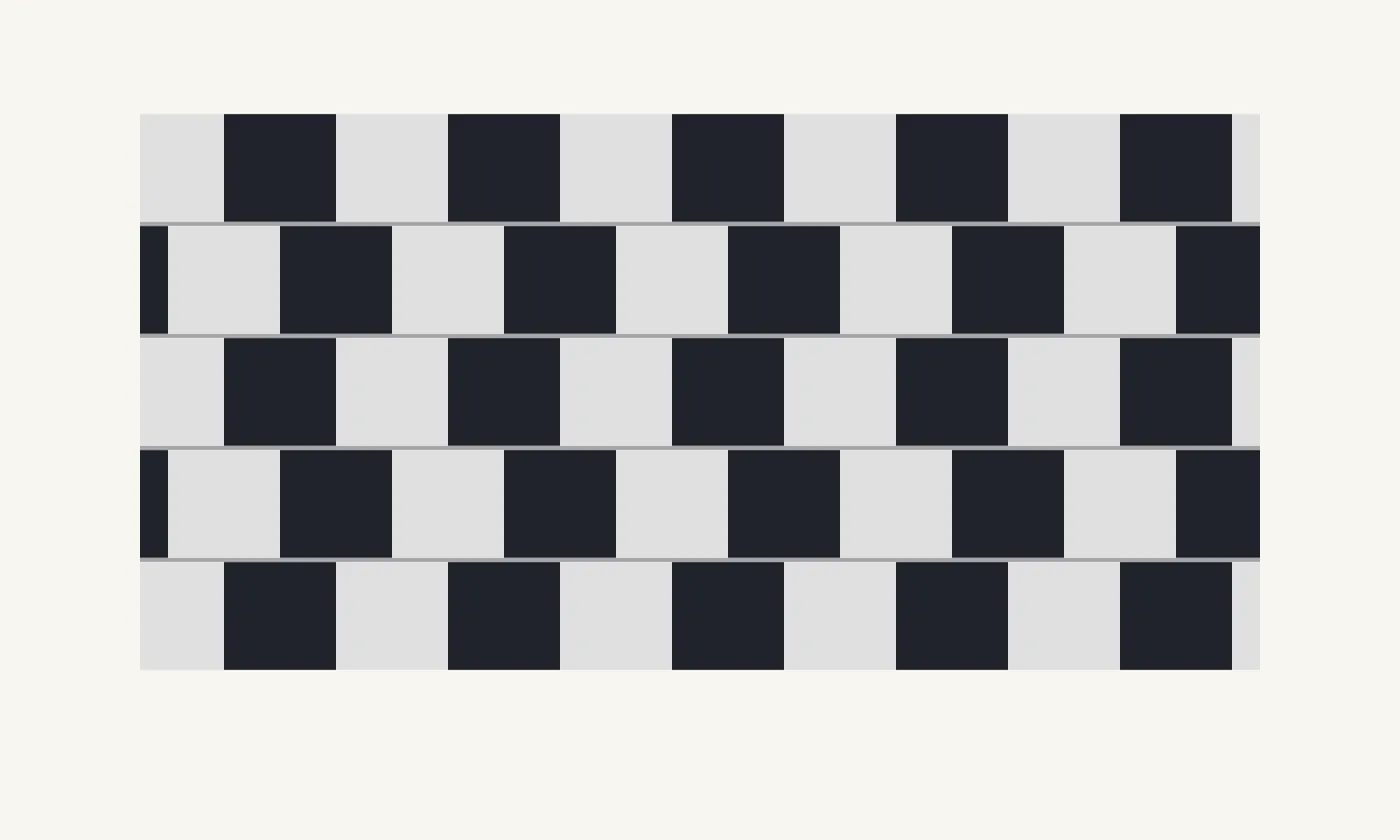
Now compare the lines with the blue dashed guides. All four gray lines are level, at 0° to the horizontal. Their spacing is constant, so they are parallel. The gaps in the dashes let you see the original gray lines underneath.
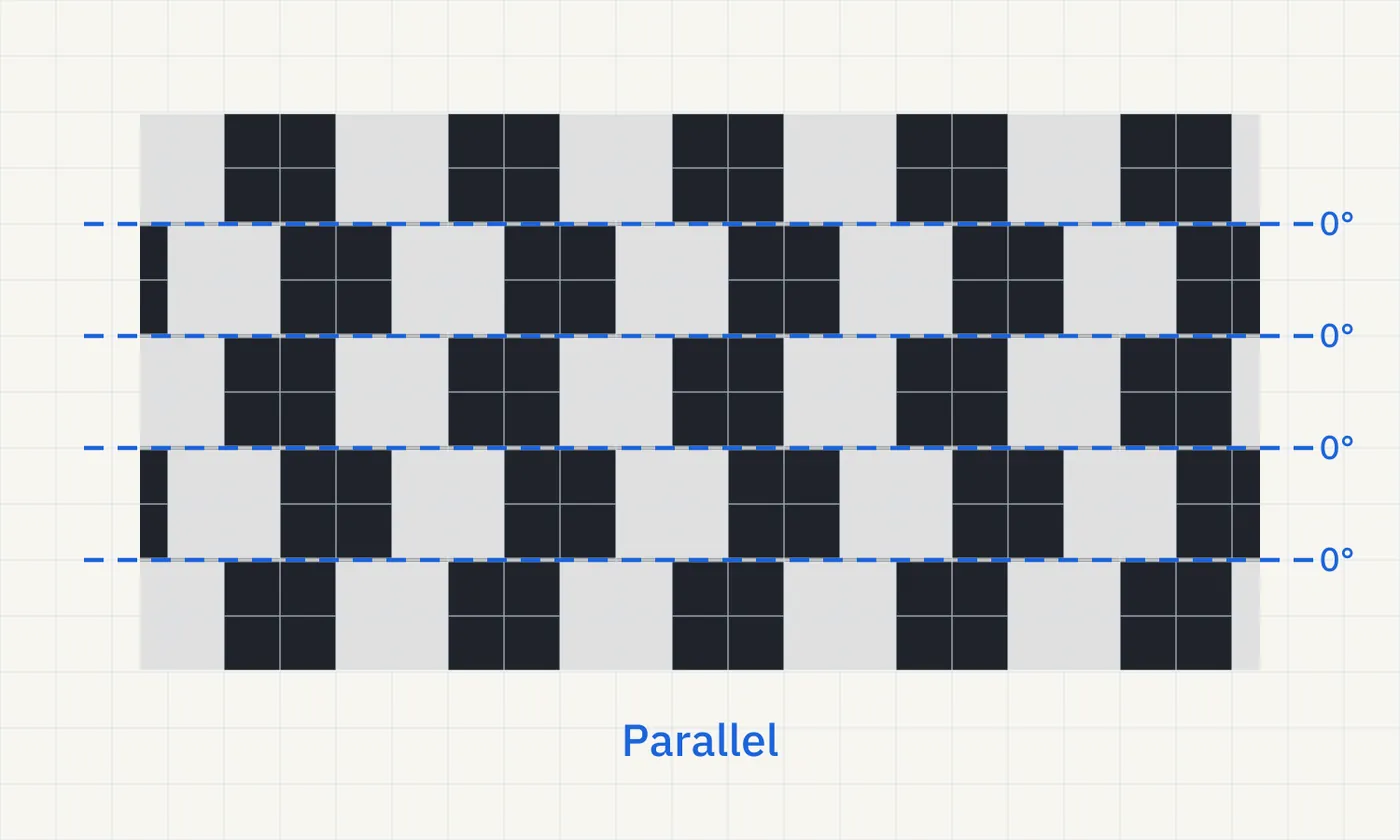
The apparent tilt of these separators is the café wall illusion. Researchers often call the separators “mortar,” borrowing the word for the material between real tiles.
Gregory and Heard's 1979 paper describes how Steve Simpson, a member of their laboratory, noticed the effect on a café wall in Bristol, England. The paper gave the illusion its café wall name. That is the origin of the name, rather than the first appearance of the phenomenon: Akiyoshi Kitaoka's 2007 review credits an earlier demonstration to Fraser in 1908.
Slide the tiles while keeping the lines still
In the episode, only the second and fourth rows of tiles slide to the right. The initial offset is half a tile. When the rows form a checkerboard, the apparent tilt has been reported to disappear. Moving farther reverses its apparent direction; aligning the tiles in columns has also been reported to remove the tilt.
The gray lines never move. Their positions, angles, and spacing stay fixed throughout. On the experiment bench, change only Tile offset first. That gives you a clear comparison between a change in the surrounding pattern and a change in how the same lines look.
Does white mortar always remove the illusion?
Mortar brightness matters too. Gregory and Heard reported the illusion when the mortar's brightness lay between that of the dark and light tiles, with its strength also depending on mortar width. The episode's light tiles are pale gray; changing the mortar to white makes it brighter than those tiles.
This is a condition to test, not a guarantee that white will remove every trace of tilt. In the same study, very narrow mortar lines could still produce an illusion when their brightness fell a little outside the tile range. The reported width was below about 2.7 arcminutes. An arcminute is one sixtieth of a degree: it describes how wide something appears from your viewing position, taking both its physical size and your distance into account.
The study also reported a weaker illusion as the mortar grew wider, with little effect above about 10 arcminutes. These are findings under the study's conditions. A width in screen pixels alone cannot tell you how strong the illusion will look to you.
The Zöllner illusion: can short strokes change a long line's apparent direction?
Focus on the five long lines. The short strokes crossing them alternate in direction. Do the long lines themselves look parallel, or do some seem steeper than others?
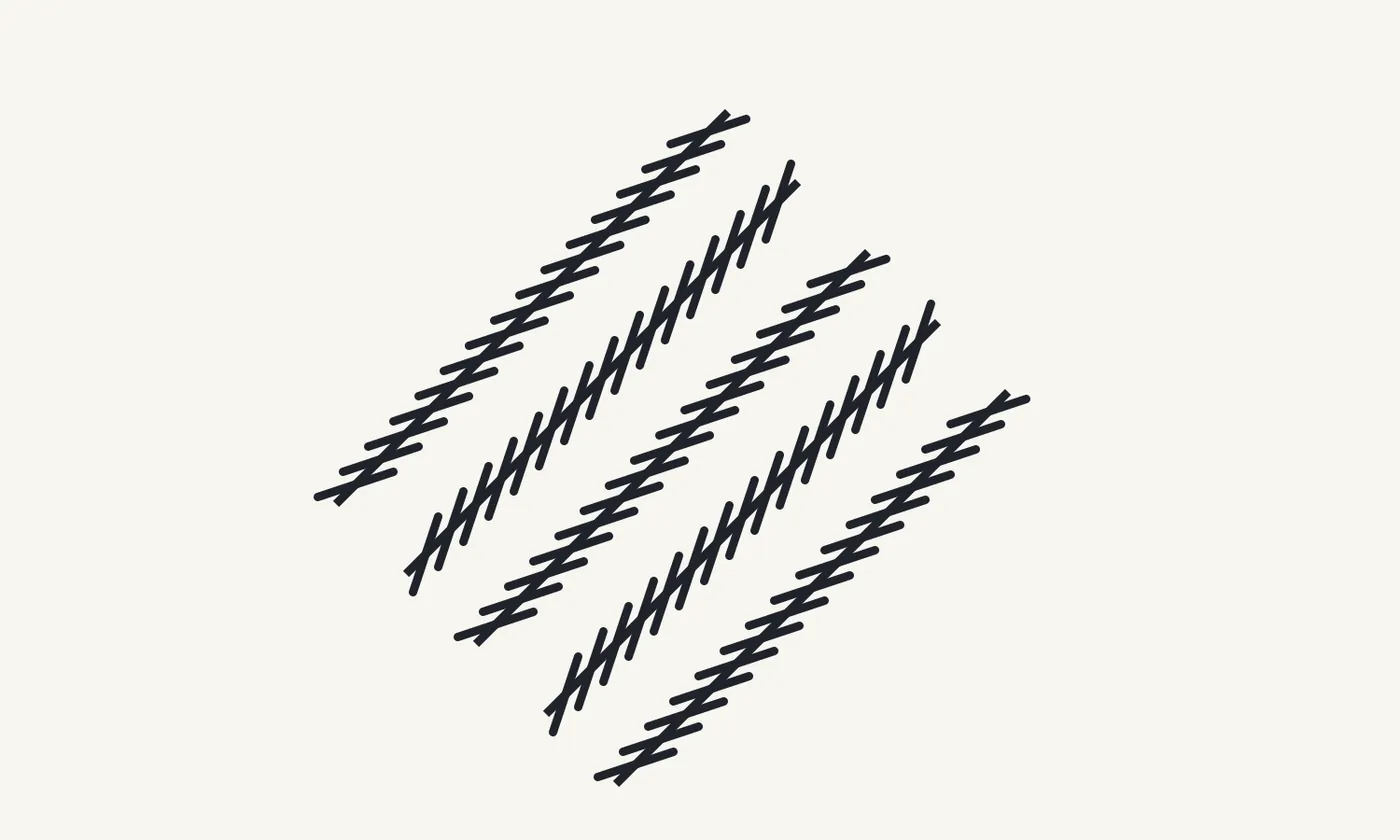
On the experiment bench, turn Show short strokes off, look at the long lines alone, then switch it back on. The long lines remain in place. Check with a ruler afterward: all five rise to the right at 45° to the horizontal, and all five are parallel.
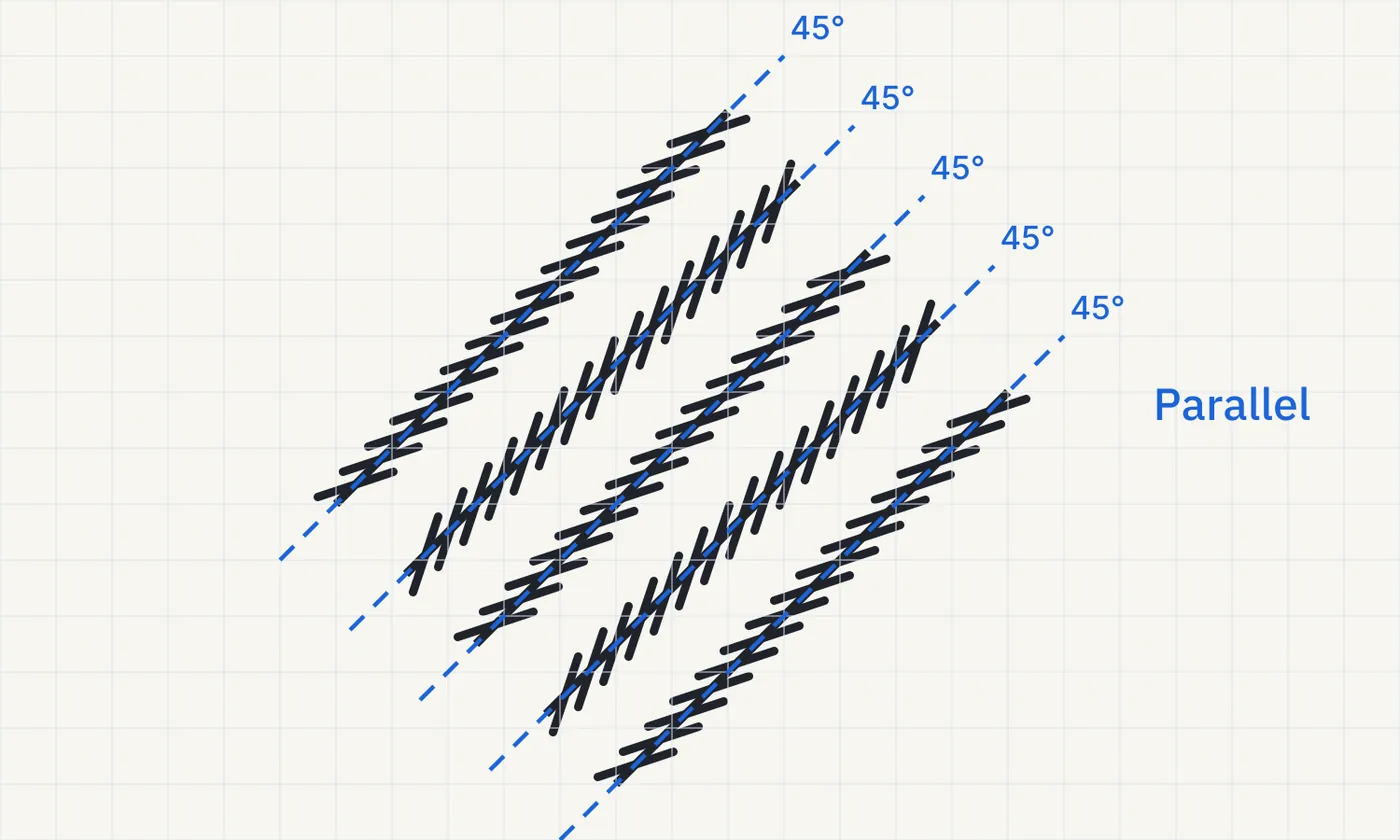
This is the Zöllner illusion. In his 1860 paper, F. Zöllner wrote that he had noticed it in a design intended for printing on cloth. He also pointed out that measurement easily establishes the lines' parallelism. Comparing appearance with geometry was part of the original account.
Two different angles to keep track of
The long lines' 45° angle is their orientation relative to the horizontal. The smaller angle between a long line and a short stroke is about 26.6° in this figure. The web control rounds that initial value to 27°.
Kitaoka's 2007 review reports a strong Zöllner effect for crossing angles in the 10–30° range. It also describes research finding a stronger effect for diagonally oriented long lines than for horizontal or vertical ones. Zöllner himself had written that the effect was strongest around 45° and weakest at horizontal and vertical orientations.
Rotating the whole figure preserves every crossing angle while changing its overall orientation. The experiment bench lets you change Stroke angle and Figure orientation separately, so you can compare these two conditions without changing both at once.
The Hering illusion: do the rays bend the lines?
Here, two horizontal lines lie over rays spreading from the center. Does the upper line seem to bow upward and the lower one downward, away from the center? Or do both look straight?
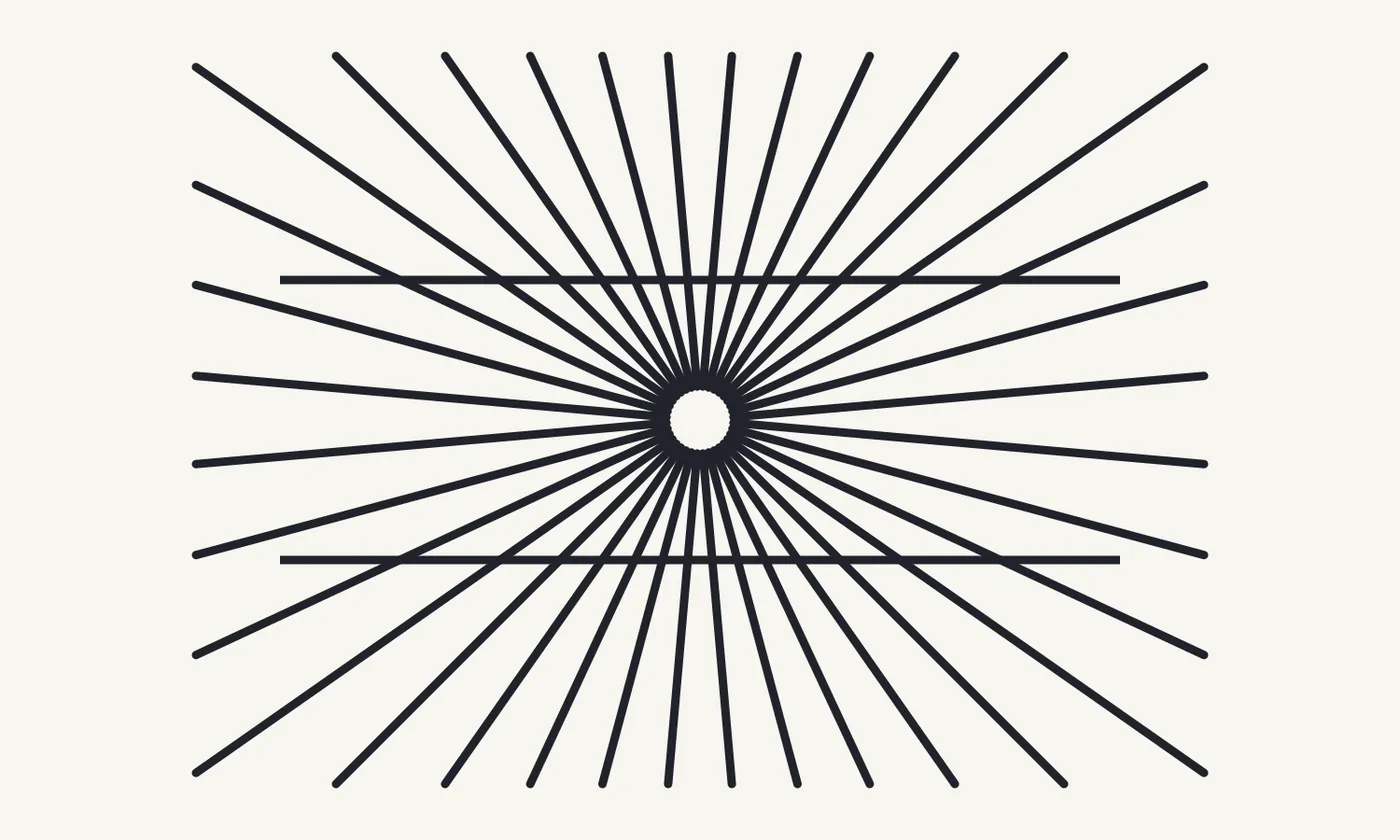
Try setting Rays to None on the experiment bench, then bring them back. Check with the blue guides afterward. Both lines coincide with the straight lines joining their endpoints. Their actual bend is 0%.
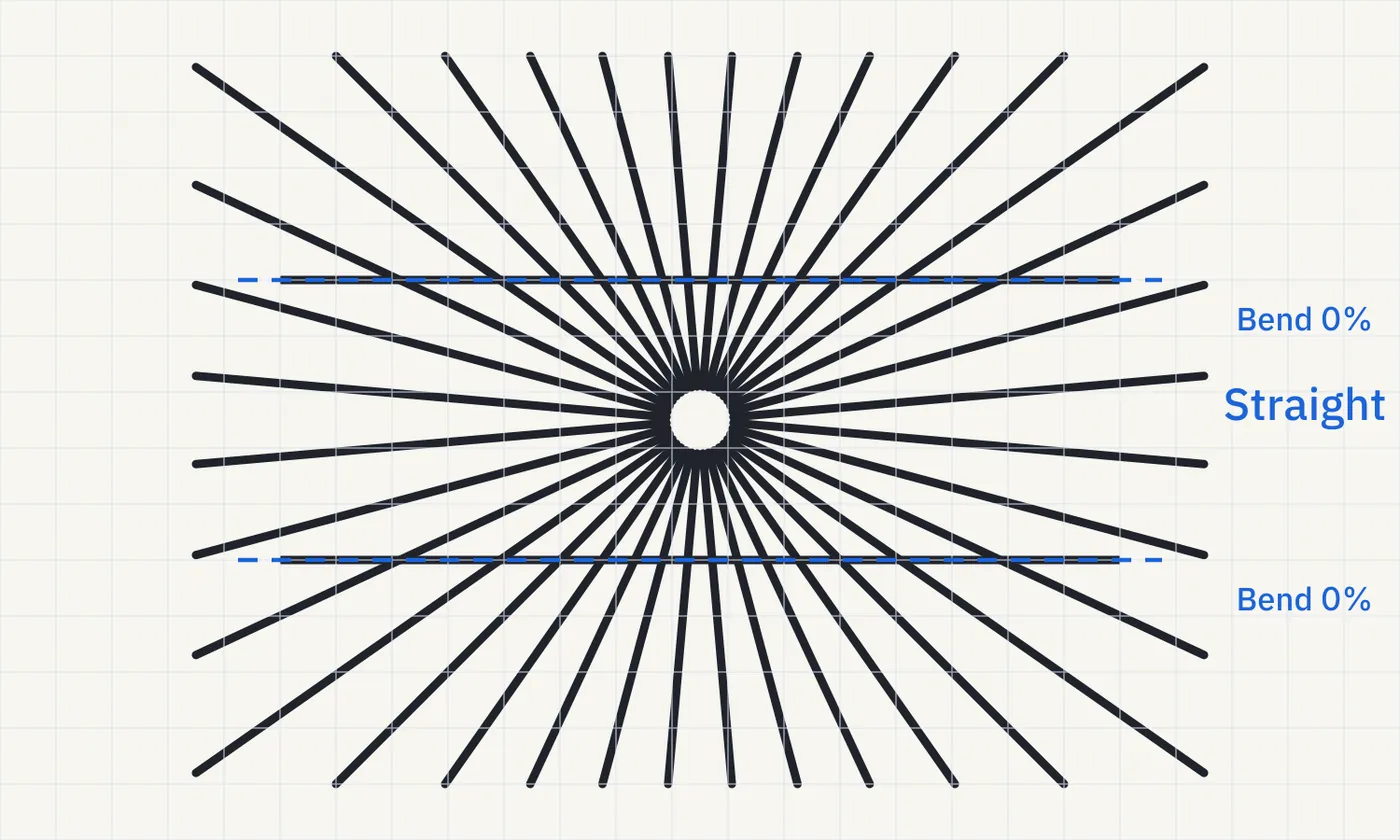
This apparent outward bowing is the Hering illusion. The physiologist Ewald Hering presented it in his 1861 book Beiträge zur Physiologie (Contributions to Physiology). Removing the rays leaves the target lines unchanged, letting you compare the surrounding pattern's contribution to their appearance.
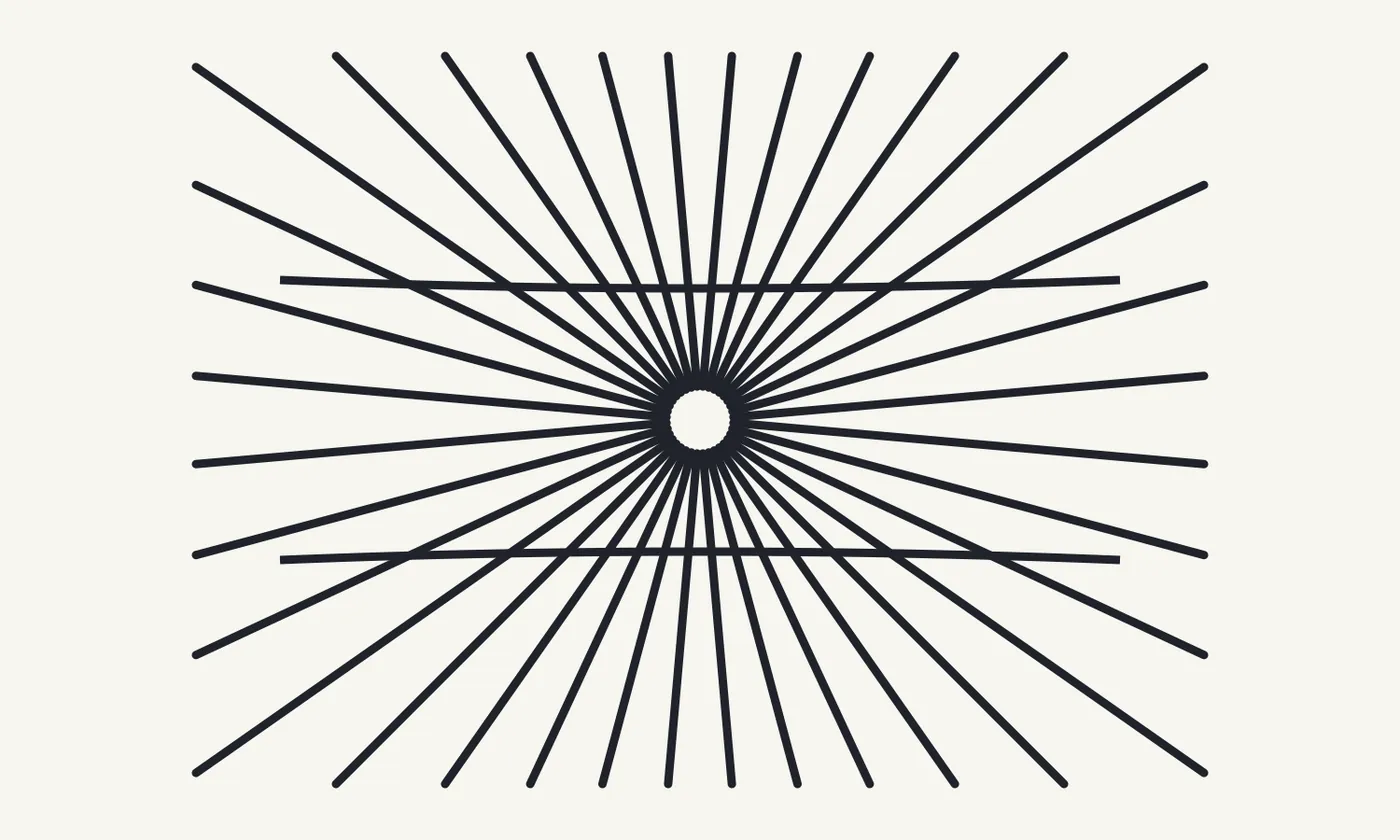
Turn the question around: can bent lines look straight?
Keep the same rays and try another pair of lines. Do these look straight? You do not need to spot the difference from the previous figure; just judge the shape you see now.
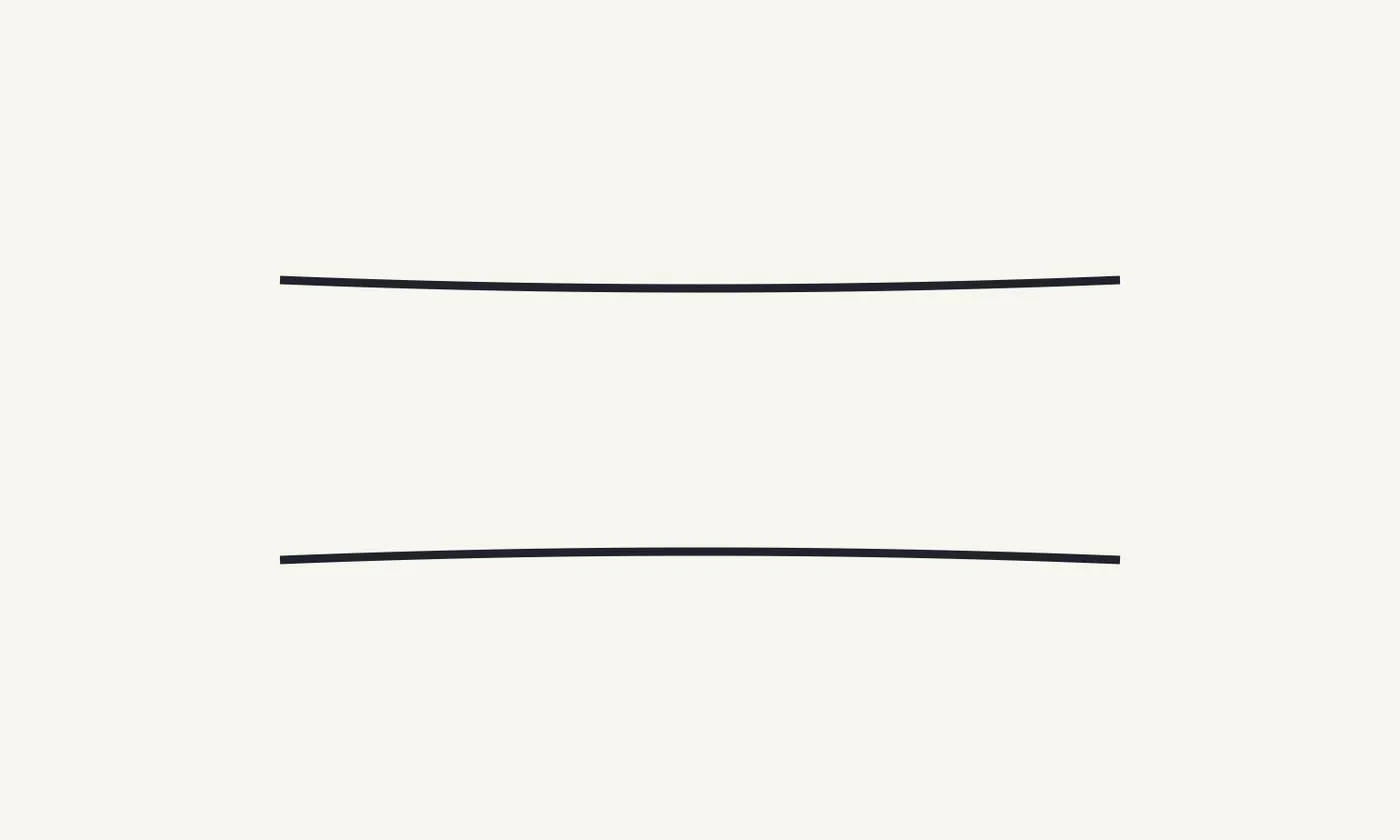
Below, only the rays have been removed. There is still no grid or blue guide. Compare the middle of each line with its ends.
These lines have been bent inward: the upper one downward and the lower one upward. The blue guides join their endpoints, making the displacement at the middle visible. The inset magnifies the same detail three times.
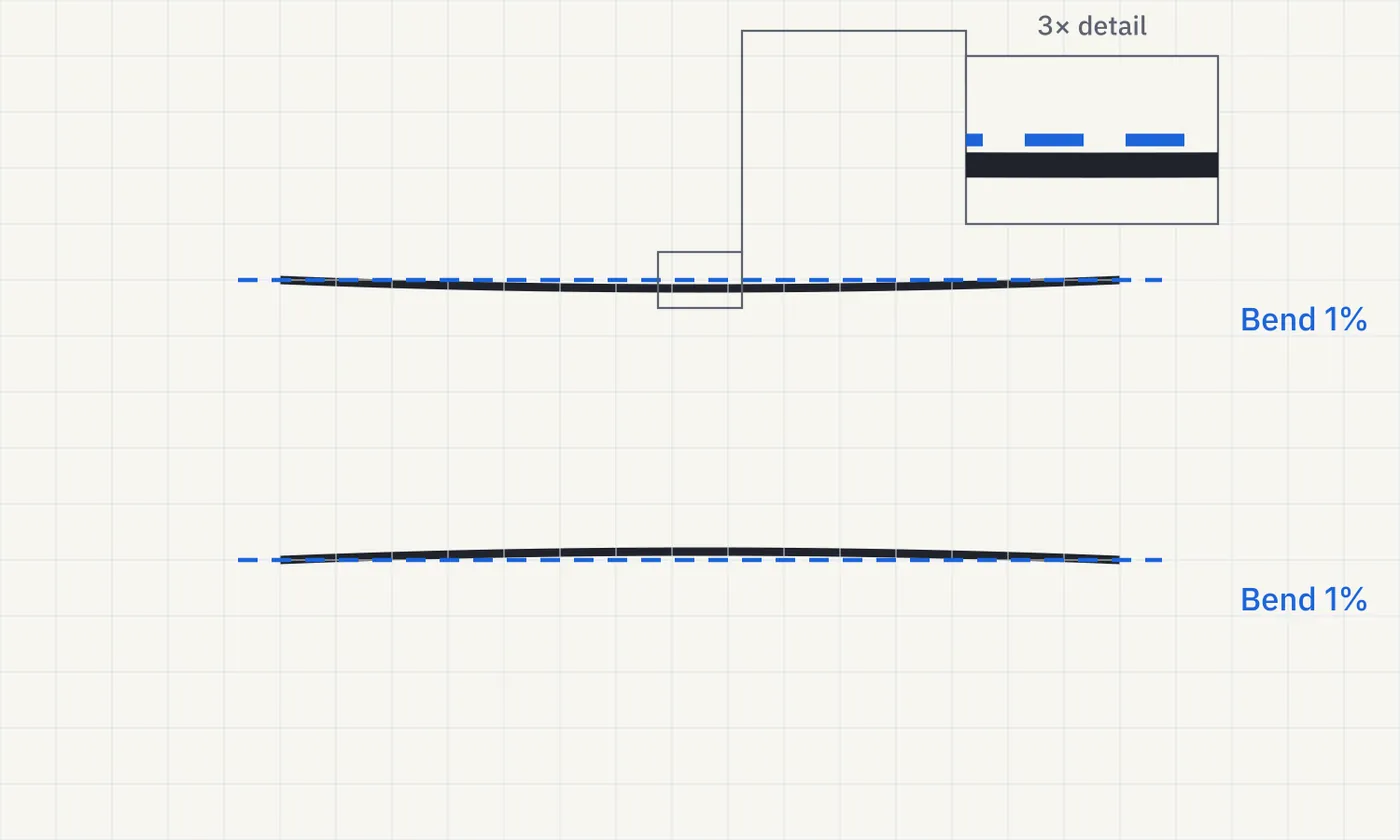
Here, bend (%) = midpoint displacement from the straight guide ÷ endpoint-to-endpoint distance × 100. The endpoint distance is 600 drawing units and the displacement is 6, giving exactly 1%. This is neither a one-degree angle nor a measurement saying your illusion is “1% strong.”
If the version with rays looked straight to you, inward-bent lines looked straight under those conditions. Another viewer may still see a bend. A setting of 1% is not expected to match everyone.
Vaughn and Eagleman's 2013 study used a related method: participants adjusted the bend until the lines looked straight. The episode's 1% setting was informed by an approximate reading and conversion of a graph in that study. It is an exact setting in our drawing, not an exact universal matching value reported by the researchers.
What is actually drawn?
These are specifications of the episode's landscape figures, not averages of viewers' answers. A “drawing unit” is a coordinate unit within the figure, not a pixel or a millimeter. Resizing a figure preserves its angles and length ratios.
| Figure | Actual geometry | What the blue guides check |
|---|---|---|
| Café wall | Four gray lines, all at 0°. Their center heights are 160, 240, 320, and 400 units, spaced 80 units apart | Each stays level from left to right; all are parallel |
| Zöllner | Five long lines, all rising rightward at 45° | All share the same direction and are parallel |
| Straight Hering pair | Both midpoint displacements are 0 units: 0% bend | Each coincides with the line joining its endpoints |
| Inward-bent pair | Endpoint distance 600 units; midpoint displacement 6 units: 1% inward bend | The endpoints meet the guide while the middle lies inward |
Why do they look that way? Findings and hypotheses
The idea that sharp angles look larger
The Zöllner and Hering figures share a feature: other lines cross the target lines at a slant. The smaller, sharp angle at a crossing is called an acute angle. A longstanding explanation is that this angle appears larger than it really is, shifting the apparent direction of a line.
In the Hering pattern, the rays meet a target line at different angles in different places. Hering proposed that these local shifts in apparent direction accumulate into the impression of a curve.
This offers a way to connect the crossings with the apparent shape. It does not settle why acute angles should appear larger in the first place. That remains an open research question.
Where a simple angle account falls short
Rotating the whole Zöllner figure leaves its crossing angles unchanged, yet studies report a change in illusion strength with overall orientation. Our comparison therefore suggests that the crossing angle alone is insufficient to specify the full effect.
The café wall figure presents a further limit to applying the same account everywhere: it contains no slanted lines. Its tile edges and mortar lines are all horizontal or vertical. An explanation based directly on slanted crossings cannot simply be transferred to this pattern.
For the café wall, findings establish conditions that affect the illusion: row offset, tile contrast, and mortar brightness and width. Knowing those conditions is different from identifying the mechanism that produces the apparent tilt. Vision researcher Michael Bach acknowledges in his explanation that he does not understand how the tilt comes about. There are still unresolved questions; these figures alone do not establish a particular process in the eye or brain as the cause.
Frequently asked questions (FAQ)
Will knowing the lines are parallel make the illusion disappear?
They may still look tilted after you know. Return to the first figure without blue guides and compare “I know they are parallel” with “they look parallel.” Either appearance is compatible with the same measured geometry.
Why can I still see tilt after making the mortar white?
Brightness is only one condition. Gregory and Heard reported that sufficiently narrow mortar could still produce an illusion a little outside the tile brightness range. Screen size and viewing distance affect how narrow the lines appear. Try brightness first, then thickness, changing one control at a time.
Will adding more rays always make the lines look more bent?
Retsa and colleagues' 2024 study reported larger matching bends with more rays in conditions using 7, 11, and 15 rays. The experiment bench uses different settings: 36, 18, and none. Those research findings do not guarantee the same values or ordering in your own results. Compare your matches with the no-rays condition.
Can I take part if I barely see an illusion?
Yes. People see these figures differently, and screen size and viewing distance can change their appearance. The matching task records where the lines look straight to you under those conditions. It is not a diagnosis or a test of eyesight, health, personality, or resistance to illusions.
Find your own “straight” on the experiment bench
Use the experiment bench in this episode page's Try it section. Choose Open full screen to open the bench on its own. Each experiment starts in viewing mode, without the guides. Try this sequence to keep track of what you changed:
- Under Tiles, check with a ruler, then choose Back to viewing. Change tile offset first; afterward, try line brightness and thickness separately.
- Under Slanted lines, remove and restore the short strokes. Explore stroke angle and figure orientation separately, then check with the ruler.
- Under Rays, remove and restore the background. Adjust the bend until the lines look straight to you, then reveal the ruler.
Find your straight (6 rounds) gives you two matches each with 36 rays, 18 rays, and no rays. The target lines' length, spacing, thickness, and position remain fixed. Presentation order and starting bend also vary, so use your judgment of the lines rather than treating the center of the control as an answer cue.
In the results, compare each ray condition with No rays. Dots on the inward side record occasions when inward-bent lines looked straight under those conditions. There are only two matches per condition, so the dots may be far apart. Choose your screen orientation before starting, and avoid directly comparing records made with different figure sizes.
People's matches differ, and this measurement is not a diagnosis. Saved records stay on your device; the page's functions do not send them to an outside server. Look first, change the surrounding pattern, then check the geometry: the bench lets you make that comparison yourself.
Shorts
Sources
Where the facts and numbers in the video and on this page come from.
- Richard Gregory's author-hosted paper (Gregory, R. L. & Heard, P. (1979). Border locking and the Café Wall illusion. Perception, 8, 365–380. Naming history and conditions involving mortar brightness and width)richardgregory.org/papers/cafe_wall/cafe-wall_all.htm
- Akiyoshi Kitaoka's author-hosted PDF, Ritsumeikan University (Kitaoka, A., Pinna, B. & Brelstaff, G. (2004). Contrast polarities determine the direction of Café Wall tilts. Perception, 33, 11–20. The direction of apparent café wall tilt)psy.ritsumei.ac.jp/akitaoka/CafeWall.pdf
- Michael Bach's explanation (Bach, M. Café Wall Illusion. Tile alignment, mortar brightness, and uncertainty about the mechanism)michaelbach.de/ot/ang-cafewall
- Internet Archive scan of the original paper (Zöllner, F. (1860). Ueber eine neue Art von Pseudoskopie und ihre Beziehungen zu den von Plateau und Oppel beschriebenen Bewegungsphänomenen. Annalen der Physik und Chemie, 110, 500–523. The cloth-printing design, parallelism, and orientation effects)archive.org/details/sim_annalen-der-physik_1860_110_7
- Akiyoshi Kitaoka's author-hosted PDF, Ritsumeikan University (Kitaoka, A. (2007). Tilt illusions after Oyama (1960): A review. Japanese Psychological Research, 49, 7–19. A review covering Zöllner angles and orientation, and café wall history)psy.ritsumei.ac.jp/akitaoka/tiltillusionreview2007.pdf
- Internet Archive scan of the original book (Hering, E. (1861). Beiträge zur Physiologie. Erstes Heft. Leipzig: Engelmann, p. 74, Fig. 25. The figure and Hering's account of the crossing angles)archive.org/details/beitrgezurphysi00herigoog
- Full paper at PubMed Central (Vaughn, D. A. & Eagleman, D. M. (2013). Spatial warping by oriented line detectors can counteract neural delays. Frontiers in Psychology, 4, 794. Matching by adjusting bend; the episode's reference value came from an approximate graph reading)pmc.ncbi.nlm.nih.gov/articles/PMC3814518
- Full paper at PubMed Central (Retsa, C. et al. (2024). A psychophysically-tuned computational model of human primary visual cortex produces geometric optical illusions. Current Research in Neurobiology, 7, 100140. Ray count and the bend required for a straight-looking match)pmc.ncbi.nlm.nih.gov/articles/PMC11621505
- Illusions Index (Hering Illusion. Outward bowing and the unresolved explanation of acute-angle expansion)illusionsindex.org/i/hering-illusion
Voice, music, art
- Music: “さみしいおばけと東京の月” by しゃろう / “日曜の午後” by KK.
- Sound effects: Kenney Interface Sounds (CC0). Quiet room tone by Tamelabo.