Maihime by Mori Ōgai: Did Toyotarō Say Goodbye Himself? | Classics in 5 Minutes #09
The story in brief
- A young official sent to Berlin lives with Elise, a dancer, then chooses career and the voyage home.
- After answering the minister “As you command,” he sinks onto a snowy bench and lies ill for weeks.
- It ends with gratitude toward the friend who saved him — and one point of resentment to weigh.
Also calledMaihime summaryMaihime plotMori Ogai MaihimeThe Dancing Girl summaryMaihime charactersMaihime ending explained
Video

Pressing play loads the YouTube player on this page. Watch on YouTube
Explained
In the video
- 0:00Did Toyotarō say goodbye himself?
- 0:34The blank diary on the ship home
- 0:54A model official reaches Berlin
- 2:00Elise at the church door, and a watch
- 2:57Dismissed, and two letters about his mother
- 3:53The winter of Meiji 21, and a letter from Aizawa
- 4:22Elise’s question, answered with a laugh
- 4:48At the Kaiserhof: the first yes
- 5:09To Russia: the second yes
- 5:57The third yes, on a bench in the snow
- 6:33Who told Elise about the farewell?
- 7:09The last line
- 7:38Three yeses and a blank card
A young Japanese official, Ōta Toyotarō, is sent to Berlin and comes to live with Elise, a dancer at the Victoria Theatre. When a visiting minister takes him into service and carries him home to Japan, the promise and the consent reach Elise not from Toyotarō, but — while he lies ill — through his friend Aizawa. This page follows the plot in order, then counts exactly how many yeses the text preserves, and to whom each was given. Spoilers to the very last line.
A note on the language: Maihime (1890) is written in literary Japanese (bungo), the classical written style taught in Japanese classrooms, which even today's Japanese readers approach with a dictionary close at hand. That density is why a generation knows the title without ever opening the novella. All facts below come only from the Aozora Bunko text of Maihime (library card No. 682, in the original old character forms). Short quotations are our translations. We treat the work as fiction: nothing here claims a real-life model for Elise, and Toyotarō is not identified with his author.
The story in 30 seconds
Sent to Germany on government orders — the standard path for a picked young Meiji official, sent to study European institutions for a few years — Toyotarō rescues Elise, a theatre dancer weeping at a church door, and eventually shares her attic. Lifted back into favor by a visiting minister, he accepts posts that take him first to Russia, then home to Japan, collapses in the snow, and wakes weeks later to find that Elise has learned everything from his friend Aizawa and has lost her mind. On the ship home, he begins the memoir we are reading. Whom the famous last line of resentment is aimed at — that is what the count at the end of this page lets you weigh.
The characters
- Ōta Toyotarō — a brilliant young official (degree at nineteen) sent to Germany, and the narrator. Everything reaches us through his sentences.
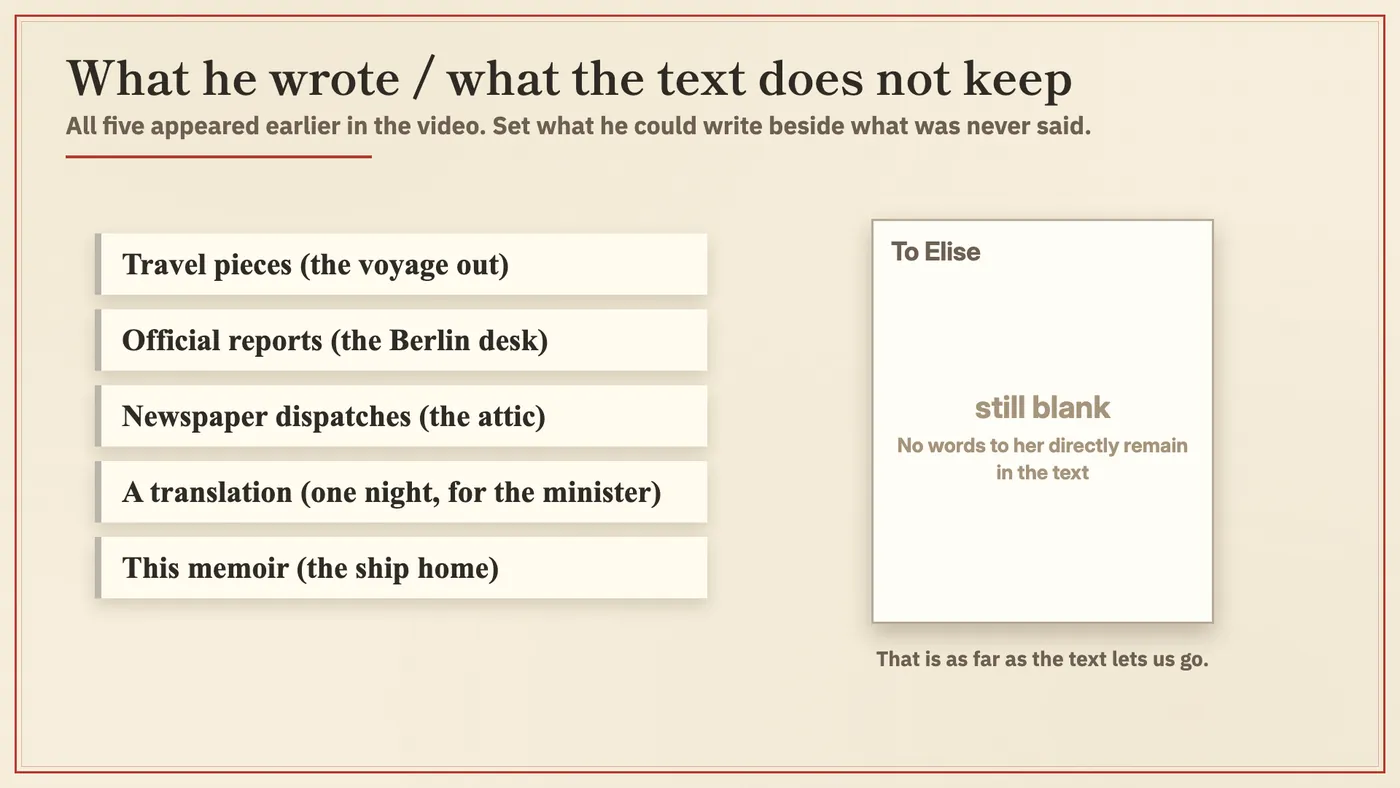
- Elise (Japanese text: Erisu) — a dancer at the Victoria Theatre. The text says she looked about sixteen or seventeen to Toyotarō; it does not state her age as fact. She began dance training at fifteen, stands second in the company, and is nonetheless poorly paid, with rehearsals by day and the stage by night. The text never specifies what kind of dancing she performs, and neither do we. Her father, Ernst Weigert (transcribed from the Japanese kana on his door), was a tailor.
- Elise's mother — half-gray, her face marked by poverty. She first suspects the pregnancy, and she brings the fateful letter in.
- Aizawa Kenkichi — Toyotarō's capable friend, secretary to Count Amakata. He finds the dismissed Toyotarō newspaper work, and later reintroduces him to power.
- Minister Count Amakata — the visiting minister who takes Toyotarō into his suite. The text presents him only under this name and title.
The plot, episode by episode
The novella has no chapter breaks; we follow its episodes, giving the Japanese search phrase for each anchor passage in the Aozora text.
The memoir on the ship
The story opens at night in the port of Saigon (now Ho Chi Minh City), aboard the ship home. Five years earlier, outbound, Toyotarō wrote travel pieces thousands of words a day and saw them praised in print. The diary he bought for the return voyage is still blank. "There is a reason," he writes — twice — and tonight he sits down to write that reason out ("いで、其概略を文に綴りて見む"). The whole novella is that memoir.
Three years in Berlin
Degree at nineteen, about three years in a ministry, then Berlin. Report after report goes home. After about three years, at twenty-five ("今二十五歳になりて"), his heart moves from the letter of the law to its spirit, and at the university from law to history and literature. Of what his mother and his chief wanted of him, he writes that they meant to make him "a living dictionary," "a living law." His self-diagnosis is famous: "My heart is like the leaves of the silk tree: touched, it shrinks away" ("合歡といふ木の葉"). A nature that folds at a touch will matter later.
The church door
One evening he finds Elise crying at the door of the old church in Kloster alley. Her father has died; there is no money for the funeral; the theatre manager Schaumberg, she says, used her trouble to press a selfish demand — the text says no more than that, and we invent nothing beyond it. Toyotarō follows her to the fourth-floor attic across the street. His coins are not enough, so he unfastens his pocket watch — no small thing for a young gentleman of standing in the 1880s — and leaves it to be pawned: "With this, get through the emergency for now" ("これにて一時の急を凌ぎ玉へ"). Lending her books, he becomes something like her teacher before anything else.
Dismissal, and two letters about his mother
Gossip about the dancer reaches his superiors and he is dismissed: passage home if he leaves at once, no public support if he stays. In his week's grace, two letters arrive — one in his mother's own hand, one from a relative announcing her death. The text says they were sent at almost the same time ("殆ど同時にいだしゝ"); it does not claim they arrived together. At this point, by his own account, he and Elise became inseparable.
The correspondent in the attic
Aizawa finds him newspaper work. He moves into the attic and they pool their incomes: reading rooms by day, manuscript pages by lamplight. He reports in detail the upheaval as two emperors die in succession and a new reign begins ("維廉一世と佛得力三世との崩"). "My scholarship went to ruin," he admits — but as a writer, these are his liveliest days.
The winter of Meiji 21, and a letter
"The winter of Meiji 21 arrived" ("明治廿一年の冬は來にけり") — 1888, and the first year the text ever names. (The arrival in Berlin is carefully not dated; do not let anyone tell you he landed in 1888.) Elise collapses on stage and is sick at food; her mother first suspects pregnancy, and a doctor later confirms she is "in no ordinary condition" ("常ならぬ身なり"). By the little iron stove comes a letter: Aizawa is in Berlin with Minister Amakata, who wishes to meet Toyotarō. Dressing to go out, Elise ties his cravat and asks her clearest question: "Even if the day comes when you are rich and honored, you will not abandon me." His whole answer is a laugh — "Riches? Me?" It never becomes a promise.
Russia
At the Kaiserhof Hotel, Aizawa urges the practical course: serve the minister, recover your career — and break with Elise. Toyotarō promises Aizawa that he will break the bond ("この情縁を斷たんと約しき"). A translation finished in one night wins the minister over. "I leave for Russia at dawn. Will you come with me?" — "How could I not obey your command?" ("いかで命に從はざらむ"). He himself later names the mechanism: asked suddenly, he assents at once, "without weighing the scope of his answer" ("其答の範圍を善くも量らず"). Between court lights and the snowy train, her letters arrive daily.
New Year, and white cloth
He is back in Berlin on New Year's Day. The attic desk is spread with white cotton ("白き木綿"): Elise has been sewing clothes for the coming baby, and speaks happily of "the day we go into the church" — their wedding. It is the warmest scene in the book, and it comes last among the happy ones.
Consent, and the night he fell
The minister now proposes taking him back to Japan, adding that Aizawa has assured him there are "no such ties" ("さることなし"). Elise's existence has been cleared away without Toyotarō ever speaking of her. His answer: "As you command" ("承はり侍り"). That night, not knowing east from west, he sinks onto a bench by the park the text calls the animal garden ("倒るゝ如くに路の邊の榻に倚り") — a bench, not the ground — and wakes to find snow "a full inch deep on his hat brim and the shoulders of his coat." Past midnight he collapses at home, before her sewing. "It was some weeks before I knew anything again."
What he only heard afterward
Everything between is hearsay, and he marks it as such. Elise met Aizawa and learned of the promise to Aizawa and the consent to the minister ("彼は相澤に逢ひしとき"). One cry of hers survives: "My Toyotarō — how could you have deceived me so?" The doctor names an illness in the terminology of the day and gives no hope of cure; we do not translate that into a modern diagnosis. She screams rather than be taken to the institution at Dalldorf, and will not leave his bedside.
To the ship
Before sailing, he and Aizawa settle capital on her mother "enough to make a living" ("生計を營むに足るほどの資本") and leave provision for the unborn child. The child's fate is not in the text. Neither is the destination of the memoir itself: the book ends where the writing begins.
The ending
Full spoilers for the final passage.
The novella closes with gratitude and resentment in a single breath:
"Ah — a good friend like Aizawa Kenkichi would be hard to find again in this world. And yet, in my mind, one small point of resentment toward him remains to this day."
Note the strength of the first half: the Japanese says such a friend would be hard to find again — not that finding one is impossible. And still the resentment lands on the friend, though the promise and both consents were Toyotarō's own. Why? Count first.
Counting in the text: three yeses and a blank card
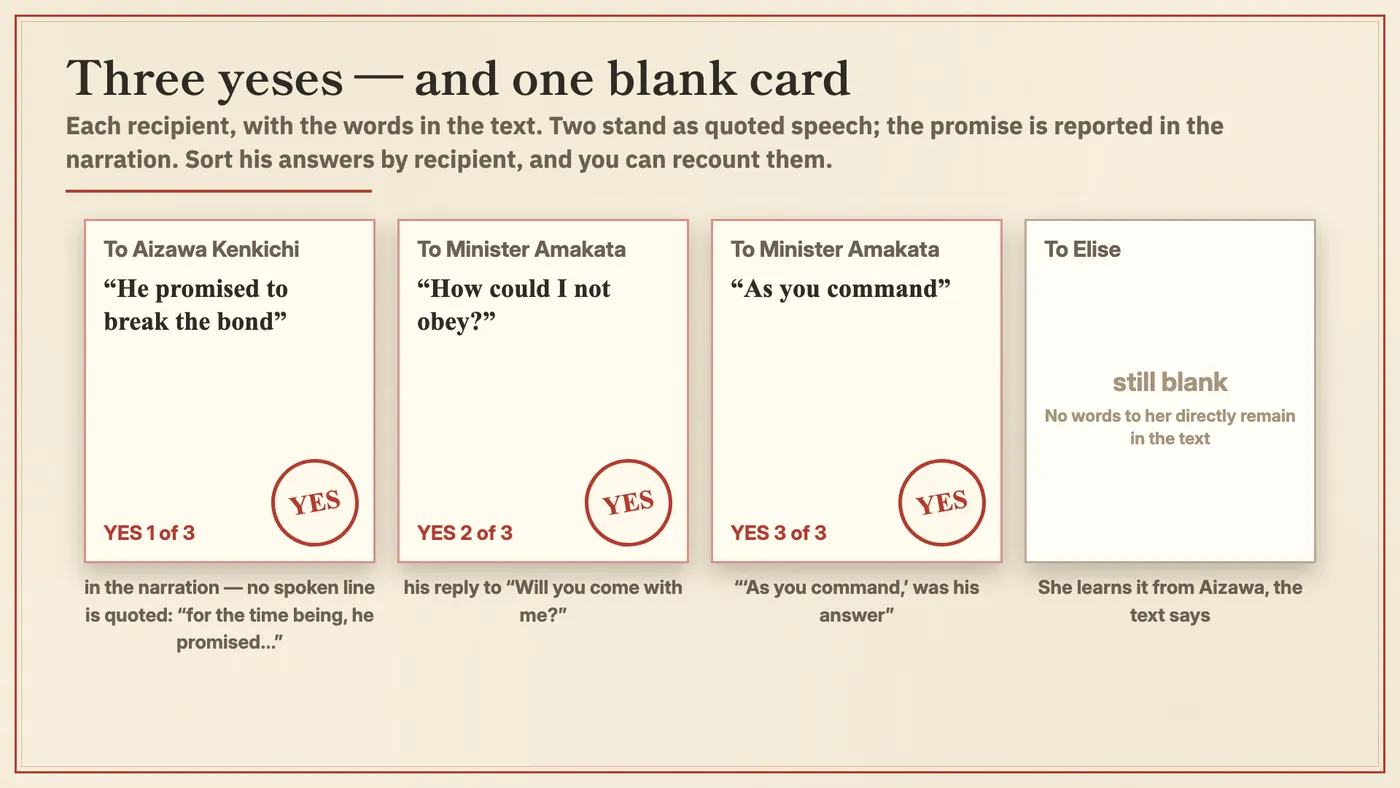
The method needs no scholarship. Open the Aozora Bunko text and pick out the moments when Toyotarō answers a request put to him. One point of form matters: two answers stand as quoted speech, inside the Japanese quotation marks 「」; the third — the promise — is never given as a spoken line at all, only reported in the narration. Listing the 「」 passages alone will not give you three:
- To Aizawa (reported, not quoted) — no spoken line is given; the narration states: "for the time being, following my friend's words, I promised to break this bond" ("この情縁を斷たんと約しき").
- To Minister Amakata (quoted speech) — "How could I not obey?" in reply to "Will you come with me [to Russia]?"
- To Minister Amakata (quoted speech) — "‘As you command,’ was my answer," accepting the voyage to Japan.
And the direct speech the plot is remembered for — Toyotarō telling Elise himself that it is over — is not in the text. The novel contains no scene in which he tells her himself; she learns it from Aizawa. Hold the conclusion exactly there: the evidence does not license the stronger claim that, inside the fiction, he "never told her" off the page. What can be checked is what the writing keeps: three yeses to other men, and a blank where the words to Elise would stand.
The years on one band
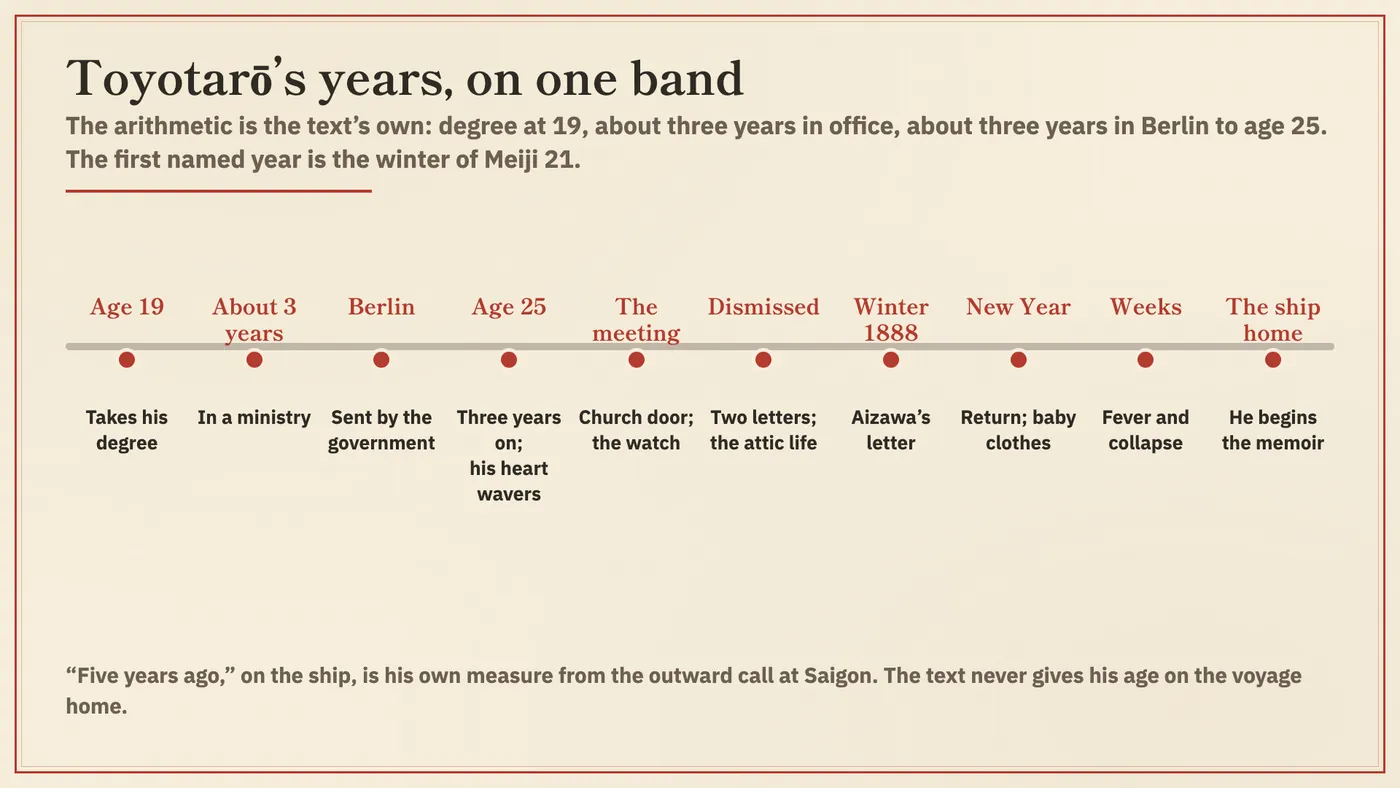
The arithmetic is internal and it checks out: degree at 19, "about three years" in office, "about three years" in Berlin, "now I am twenty-five" — 19 + 3 + 3 = 25. Beyond that, resist invention: his age on the voyage home is nowhere stated, and the "five years ago" of the opening is his own measure from the outward call at Saigon. The first dated moment is the winter of Meiji 21 (1888), well after the meeting, the dismissal, and the move into the attic.
The places
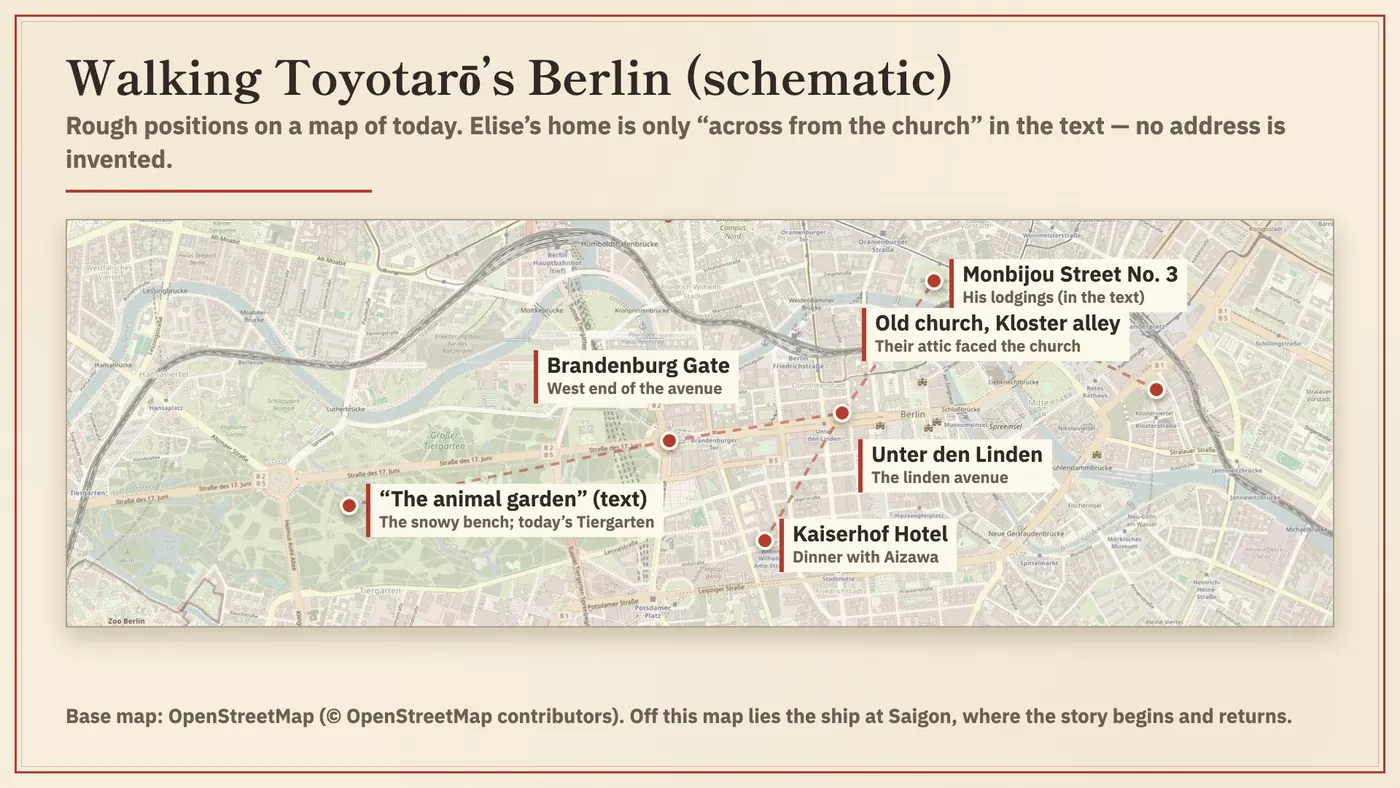
We keep the text's own names: the Unter den Linden avenue and the Brandenburg Gate; the park it calls "the animal garden" (jūen in the text — the schematic map places it at today's Tiergarten, and says so); the old church in Kloster alley, with the attic simply "across from the church" and no address invented; Monbijou Street No. 3, named in the text as his former lodgings when he directs the pawnbroker's messenger; the Kaiserhof Hotel, a real hotel name that we do not pursue into the present day. The frame of the whole book, meanwhile, is nowhere near Berlin: a cabin table in Saigon (now Ho Chi Minh City), where the memoir begins.
Questions to read with
These are not questions with one correct answer. Each comes with the sentences to weigh.
Why does the resentment land on the friend?
Read the last line against two things: his own mechanism ("without weighing the scope of his answer, he assents at once") and the sequence of addressees (Aizawa, minister, minister — never Elise). Is he resenting how smoothly Aizawa arranged his rescue? Or must the resentment sit on the nearest friend for him to look at his own three yeses at all? The balance you strike changes how the final line sounds.
Why "there is a reason" — twice?
In the opening pages he twice starts to explain the blank diary — a acquired indifference? a new awareness that feelings change? — and twice stops himself: no, "there is a separate reason." Read the opening again after the ending, and the repetition itself starts to look like the portrait of a man who cannot say the thing straight. Weigh the first two paragraphs against "now, let me try to set down an outline of it."
Why is the book named for the dancer, not for him?
The dancing itself is barely shown. Elise exists in the text as rehearsal hours, thin wages, and company rank ("晝の温習、夜の舞臺" — practice by day, the stage by night). The title's dancing girl turns out to be a working woman. That gap between the glittering title and the labor inside is one of the novella's deliberate effects — and one reason summaries that make her a glamorous stage star miss the book.
Frequently asked questions
Did Toyotarō ever tell Elise it was over?
The novel contains no scene in which he tells her himself, and no such line of dialogue. She learns of the promise and the consent from Aizawa, in events Toyotarō only reports as heard afterward. The text does not prove what may have passed off the page; what it proves is the count and the addressees of the words it keeps.
What happened to the baby?
The text never narrates a birth. Before sailing he settles living capital on the mother and leaves provision for the child to be born. Anything beyond that is invention.
Is Aizawa the villain?
The text refuses that simplicity. Aizawa rescued him once (the newspaper post) and engineers his restoration; the memoir calls him a friend hard to find again — in the same breath as the resentment. Holding "good friend" and "resented" together is the point, not a contradiction to resolve by picking a side.
What is "paranoia" in the doctor's diagnosis?
It is the period term the doctor uses in the text ("パラノイア"), said to have been brought on suddenly by extreme mental strain, with no prospect of cure. We leave it as a period label quoted from the novel, rather than converting it into any modern diagnosis. The text also contains other period words for madness and asylums, which belong to 1890, not to us.
What does the pocket watch mean?
Within the text, it is a concrete, pawnable object handed over for a funeral ("これにて一時の急を凌ぎ玉へ" — "with this, weather the emergency"). For a young official of the 1880s it was also a badge of standing, which gives the gesture its weight. We do not reduce it to a single symbol.
Is this Mori Ōgai's own story?
This page reads Maihime as a novel. Whether or not the author drew on experience is not something the novella's text can settle, so we make no factual claims about real-life models and never merge Toyotarō with Ōgai.
Reading the original
Open the Aozora Bunko text. Quotations here follow library card No. 682 (old character forms). Short quotations translated by Tamelabo.
Two good doors in: the opening shipboard pages — from the coaling of the ship to "let me try to set down an outline of it" — which give you the whole frame in a few paragraphs; and the final three paragraphs, from the provision for the mother to the last line. Read the ending aloud, even slowly: the long literary sentences breathe at their commas, and the rhythm carries meaning the dictionary work alone will miss. Easier-orthography editions exist within Aozora Bunko, but for checking any quotation on this page, come back to No. 682. If your Japanese is still growing, keep this page's count beside you and hunt the three in the original: "この情縁を斷たんと約しき," "いかで命に從はざらむ," "承はり侍り." Finding each in place is the fastest way to feel how quickly each answer comes — and that the first of the three never becomes a spoken line at all: it stays in the narration, reported rather than quoted.
Sources
Where the facts and numbers in the video and on this page come from.
References
- Base map: OpenStreetMap (© OpenStreetMap contributors), used as a schematic of rough positions on today's streets — not as a guide to any real address in the fiction.
- The surname "Weigert" transcribes the Japanese kana ワイゲルト on the father's door in the text ("エルンスト、ワイゲルト").
Links
- Mori Ōgai (the text's own signature reads 森鴎外; we write 森鷗外 in Japanese pages), Maihime. Aozora Bunko, library card No. 682 (old orthography). First published in Kokumin no Tomo, January 1890 (Meiji 23), per the note at the end of the text.aozora.gr.jp/cards/000129/files/682_15414.html
- aozora.gr.jp/cards/000129/card682.html
- openstreetmap.org/copyright
Voice, music, art
- Voice: Kokoro (synthetic speech)
- Music (OpenTracks): “茶屋にて” by MATSU / “縁側” by siroimu / “百花繚乱” / “藁の記憶”
- Fonts: Shippori Mincho, IBM Plex Sans JP, M PLUS Rounded 1c (SIL Open Font License 1.1)