Botchan by Natsume Soseki: Can You Name the Hero? | Classics in 5 Minutes #04
The story in brief
- On his first day at a middle school in Shikoku, the hero of Natsume Soseki's Botchan hands out nicknames: Tanuki, Red Shirt, Porcupine.
- The story turns on what happens among the cedars at dawn, and on the last wish of Kiyo, who cared for him in Tokyo.
- The question it leaves: can you name the hero?
Video

Pressing play loads the YouTube player on this page. Watch on YouTube
Explained
In the video
"A reckless streak from my parents has cost me nothing but trouble since I was a boy." So opens Botchan (1906), Natsume Soseki's comic novel about a hot-tempered young man from Tokyo who takes a teaching job in a provincial town and hands out nicknames to everyone on the staff.
This guide covers the whole story, including the ending. After the plot and the characters, we count words in the original Japanese to answer two questions: what is the hero's name, and who calls him "Botchan"? All counts come from the Japanese text on Aozora Bunko (card No. 752). All English quotations of the novel are our own translations.
The story in 30 seconds
A reckless young man from Tokyo, cherished only by Kiyo, his family's elderly maid, takes a job teaching math at a middle school in Shikoku. The day after he arrives, he gives his new colleagues nicknames: Tanuki, Red Shirt, Pale Squash, Porcupine and the Jester. Red Shirt, the vice-principal, draws close to Madonna, Pale Squash's fiancée, and Pale Squash is transferred far away. The hero makes up with Porcupine; early one morning the two follow Red Shirt and the Jester out of an inn, catch them on the road, and leave town. Back in Tokyo, he makes a home with Kiyo until she dies.
About the novel
| Item | Details |
|---|---|
| Author | Natsume Soseki (1867-1916; real name Natsume Kinnosuke) |
| First published | April 1906, in the magazine Hototogisu |
| Length | About 88,000 Japanese characters, in 11 chapters |
| Narrator | The hero himself, who calls himself ore, a rough, casual "I" |
| Setting | Tokyo, and an unnamed town on the island of Shikoku |
The title is not a name. Botchan is a word for someone's young son, something like "young master," and in the novel it is mostly what one person calls the hero. Soseki taught English at a middle school in Matsuyama, on Shikoku, from April 1895 for about a year, and the novel is said to draw on that time. But the town in the story is never named.
Characters
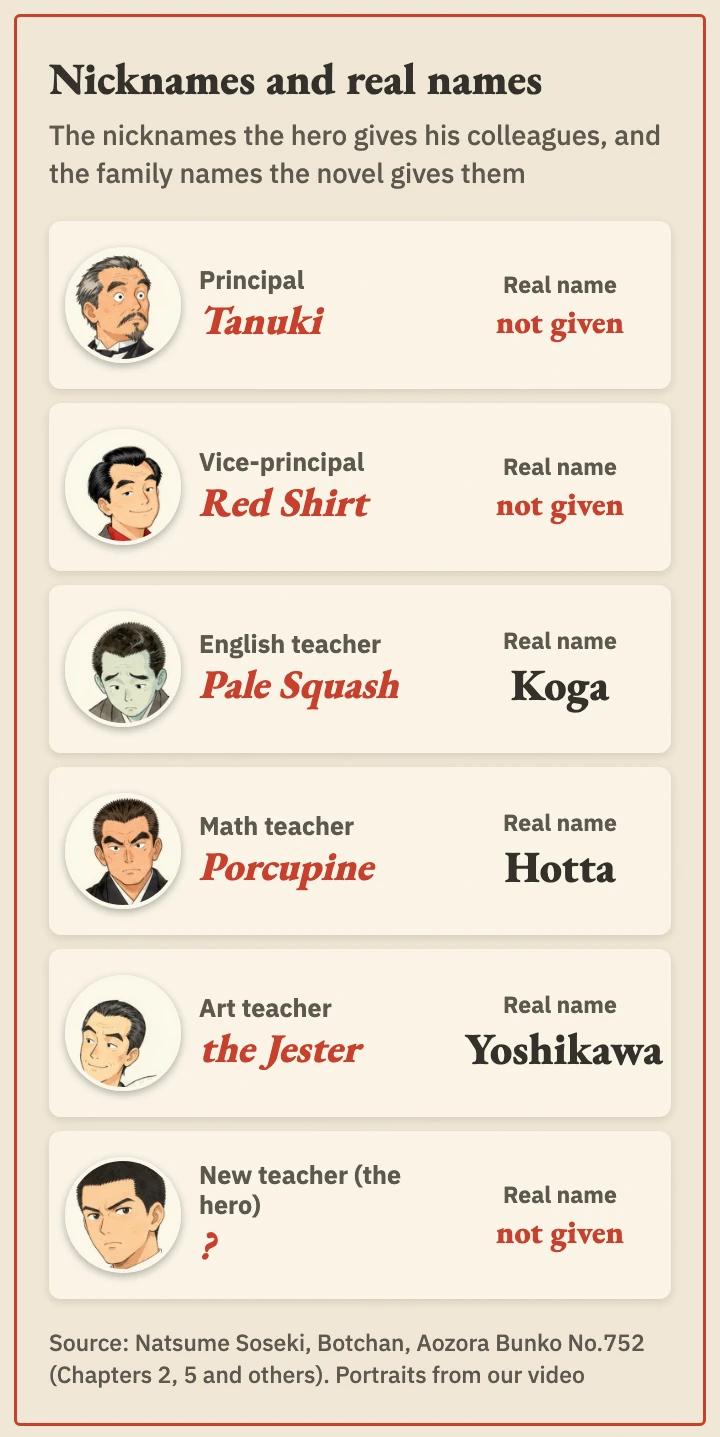
- The hero ("me"): a new math teacher from Tokyo, quick-tempered and blunt. He says he is "twenty-three years and four months" old (Chapter 5). The novel never tells us his name.
- Kiyo: the elderly maid who worked for his family in Tokyo, with salt-and-pepper hair. She adores him more than anyone, and calls him "Botchan."
- Porcupine (Hotta): head of the math department, from Aizu in northeastern Japan. Burly, loud and popular with the students.
- Red Shirt: the vice-principal, a literature graduate. He wears a red flannel shirt even in the summer heat and speaks in "a strangely soft voice, like a woman's" (Chapter 2). His real name is never given.
- The Jester (Nodaiko, or Noda; real name Yoshikawa): the art teacher. He talks like a party entertainer and is always at Red Shirt's side.
- Pale Squash (Koga): the English teacher, pale and puffy-faced, and very mild.
- Madonna (Miss Toyama): the young woman promised in marriage to Pale Squash. She never speaks a single line in the novel.
- Tanuki: the principal, named after the raccoon dog. His real name is never given.
The nicknames carry meanings in Japanese. Uranari ("Pale Squash") is the small, poor fruit that forms late at the tip of the vine, and also a mocking word for someone pale and sickly; as a boy, the hero had learned from Kiyo that pale, puffy people get that way from eating too many late squashes (Chapter 2). Nodaiko ("the Jester") means an amateur taikomochi, a man who flatters guests at parties (both meanings from the Digital Daijisen dictionary). Yamaarashi ("Porcupine") is simply the Japanese word for the animal.
Plot summary, chapter by chapter
Spoilers from here to the end.
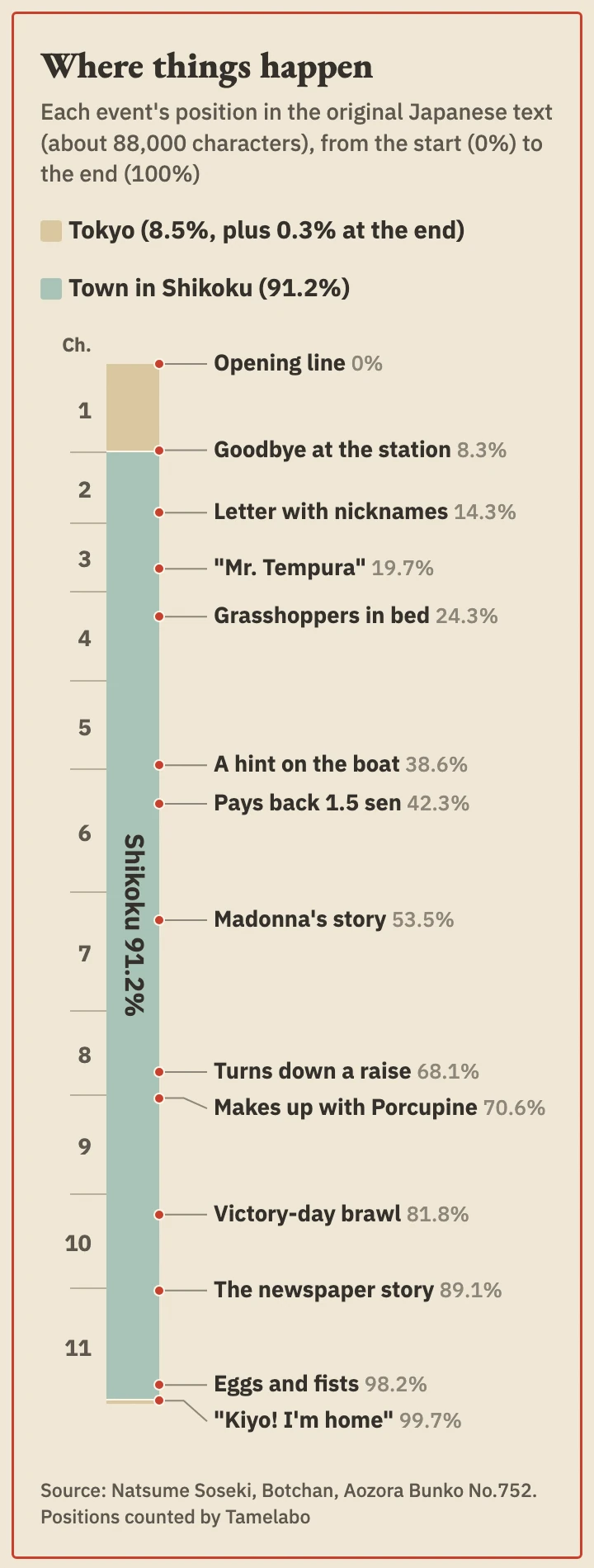
Laid out as one long strip, the novel looks lopsided: Tokyo before he leaves takes up 8.5% of the text, the town in Shikoku 91.2%, and Tokyo after he returns just 0.3%.
Chapter 1: A reckless boy, and Kiyo
His father has little time for him and his mother favors his older brother. Only Kiyo, the elderly maid, treasures him: "You have a fine, honest nature." After his parents die, his brother gives him 600 yen, which he spends on three years at a school of physics. When a post teaching math in Shikoku comes up, at 40 yen a month, he accepts on the spot: "I'll go."
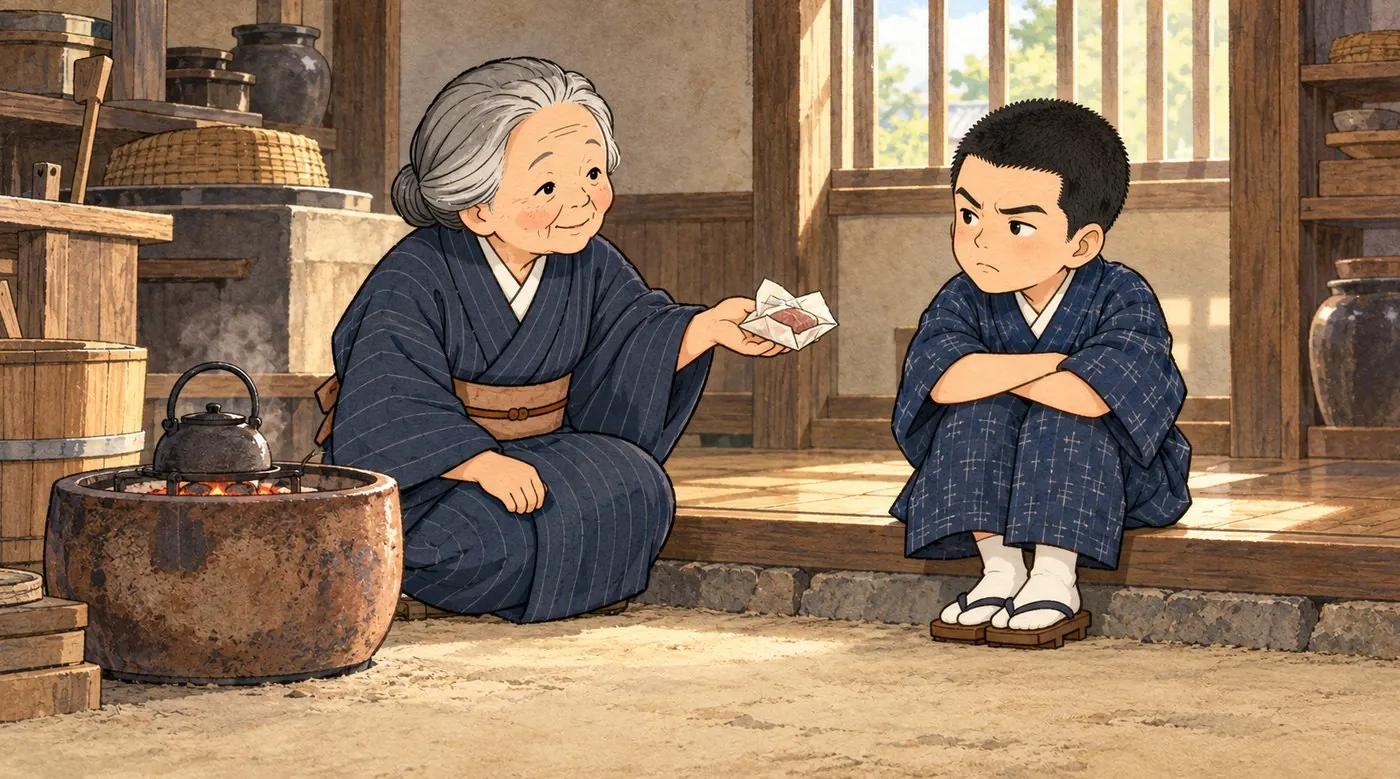
At the station Kiyo says, "This may be our last goodbye. Take good care of yourself." Long after the train pulls out, he looks back. She is still standing there, very small.
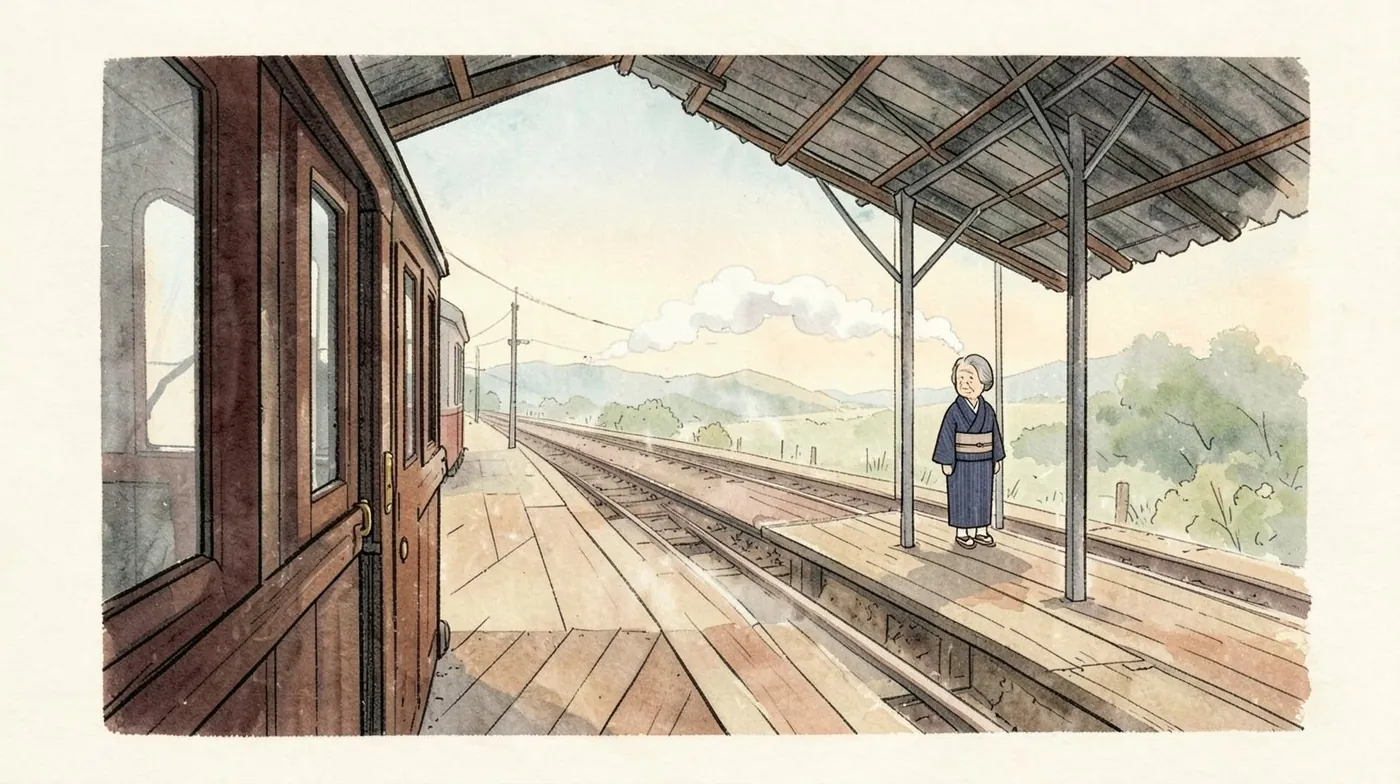
Chapter 2: Arrival, and a nickname for everyone
He comes ashore from the steamer in a small boat and rides a toy-like local train to the school, only to find everyone gone for the day. The next morning he receives his letter of appointment from the principal and meets the staff. That same day he writes to Kiyo: "The principal's Tanuki, the vice-principal's Red Shirt, the English teacher's Pale Squash, math is Porcupine, art is the Jester." Porcupine finds him lodgings and treats him to a shaved ice.
Chapter 3: Mr. Tempura and Red Towel
One night he eats four bowls of tempura noodles; the next morning the blackboard says "Mr. Tempura" in huge letters. When he eats dumplings, the blackboard reports that too. His towel turns red in the hot spring, so the boys call him "Red Towel." After he swims in the big bath, a notice goes up: "No swimming in the bath." The students watch everything he does.
Chapter 4: Grasshoppers on night duty
Teachers take turns staying overnight at the school, though Tanuki and Red Shirt are excused. On his first night on duty the hero slips out to the hot spring, then finds fifty or sixty grasshoppers in his bedding. "Those aren't grasshoppers, sir. They're locusts," a boarder tells him.
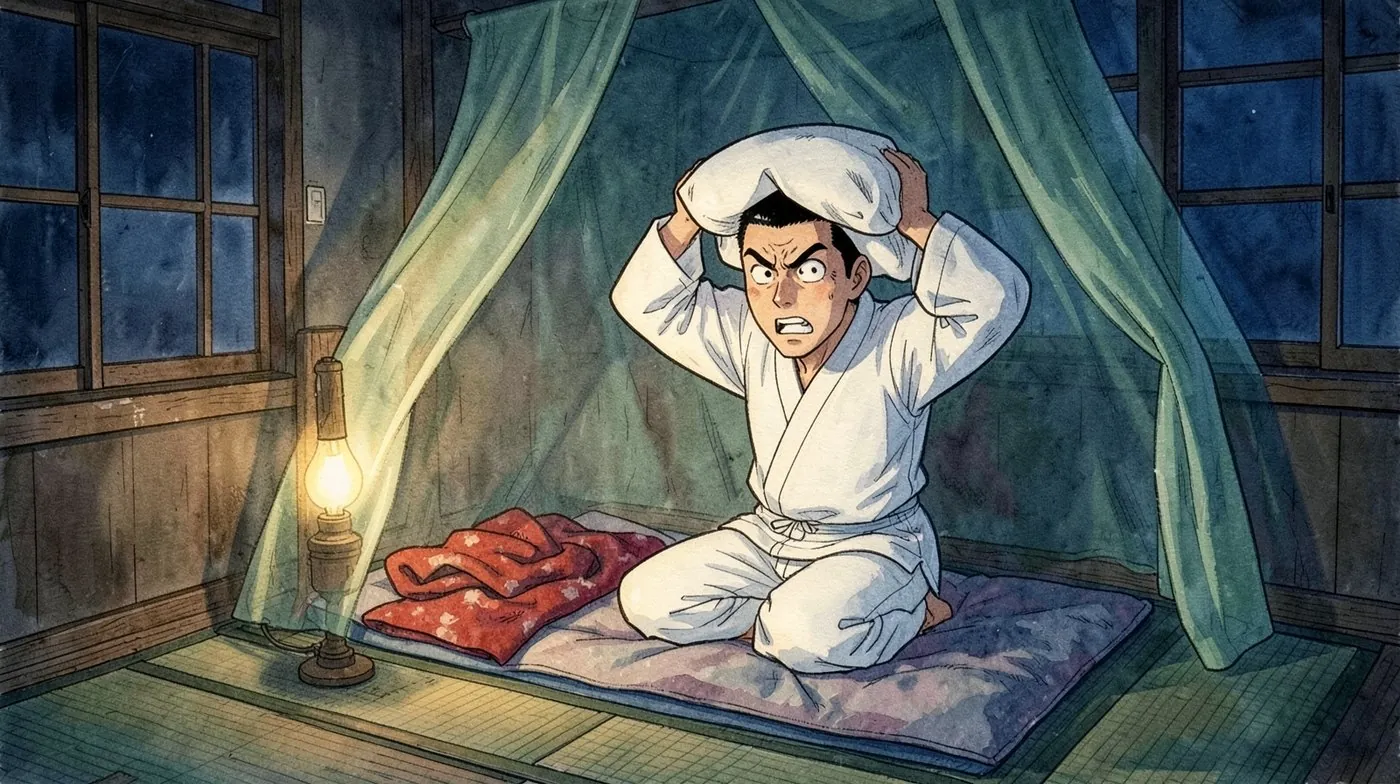
Lying awake, he thinks of Kiyo far away. Then stamping and shouting break out upstairs, and he spends the rest of the night in the corridor waiting for dawn.
Chapter 5: On the fishing boat
Red Shirt takes him fishing with the Jester, and the two whisper about "Hotta" (Porcupine's real name) stirring up trouble. On the way back, Red Shirt warns him without naming anyone: "Some people seem kind. They may even find you lodgings. But you can't let your guard down." It was Porcupine who found him his lodgings.
Chapter 6: One and a half sen
Now suspicious, the hero pays Porcupine back for the shaved ice: one and a half sen (a sen is a hundredth of a yen). They quarrel. Yet at the staff meeting on the boarders' punishment, while Red Shirt and the Jester call for leniency, it is Porcupine who demands a strict penalty for the boys who mocked "a certain new teacher, Mr. So-and-so." When Red Shirt lectures on teachers' "spiritual pleasures," the hero asks, "Is meeting Madonna a spiritual pleasure too?"
Chapter 7: Madonna, and Kiyo's letter
Pale Squash finds the hero new lodgings with an elderly couple. According to his new landlady, Madonna was promised in marriage to Pale Squash, but Red Shirt has won her over, and it was Porcupine who went to confront Red Shirt on Pale Squash's behalf. A long letter arrives from Kiyo. That evening, on a riverbank, the hero runs into Red Shirt walking with Madonna.
Chapter 8: The dusty coins
The coins sit on Porcupine's desk "covered in dust," and the two men don't speak. The hero starts to see Red Shirt as "a man whose front and back don't match." Red Shirt offers him a raise: Pale Squash is being transferred to distant Nobeoka, and his replacement will come for a little less. Then the hero hears that Pale Squash had begged to stay, even at his old pay, and that night he goes to turn the raise down.
Chapter 9: Making up, and the farewell party
On the morning of Pale Squash's farewell party, Porcupine learns that the hero's old landlord had lied about him, and apologizes. Without a word, the hero drops the dusty coins into his own purse, and they are friends again. At the party, Tanuki and Red Shirt speak as if Pale Squash wanted to leave, and Porcupine takes a swipe at Red Shirt in his speech. When the Jester, dancing half-naked, blocks Pale Squash's way out, the hero thumps him on the head.
Chapter 10: The victory celebration brawl
On a day of victory celebrations, Porcupine tells the hero that Red Shirt is said to meet a geisha at an inn called Kadoya, and they plan to watch it from an inn across the street. Later, at the celebration grounds, a brawl breaks out between the middle school and the normal school (a school that trains teachers). The two teachers try to stop it and are dragged in: "the only ones caught were Porcupine and me." The novel never says which war is being celebrated.
Chapter 11: Morning among the cedars
A newspaper blames "the teacher Hotta So-and-so" and "a certain insolent somebody recently arrived from Tokyo." Porcupine is pushed into resigning, but instead of leaving town he hides in the upstairs room of an inn across from Kadoya, and the two keep watch. On the eighth night Red Shirt and the Jester go in, the Jester laughing, "That loudmouth? He's just a hot-headed little Botchan. Rather sweet, really." The two wait until five in the morning, follow them out, and catch them on a road lined with cedars. The hero pelts the Jester with the eight eggs he has been carrying in his sleeve, and Porcupine punches Red Shirt. The hero mails in his resignation too, and that night the two of them sail away.
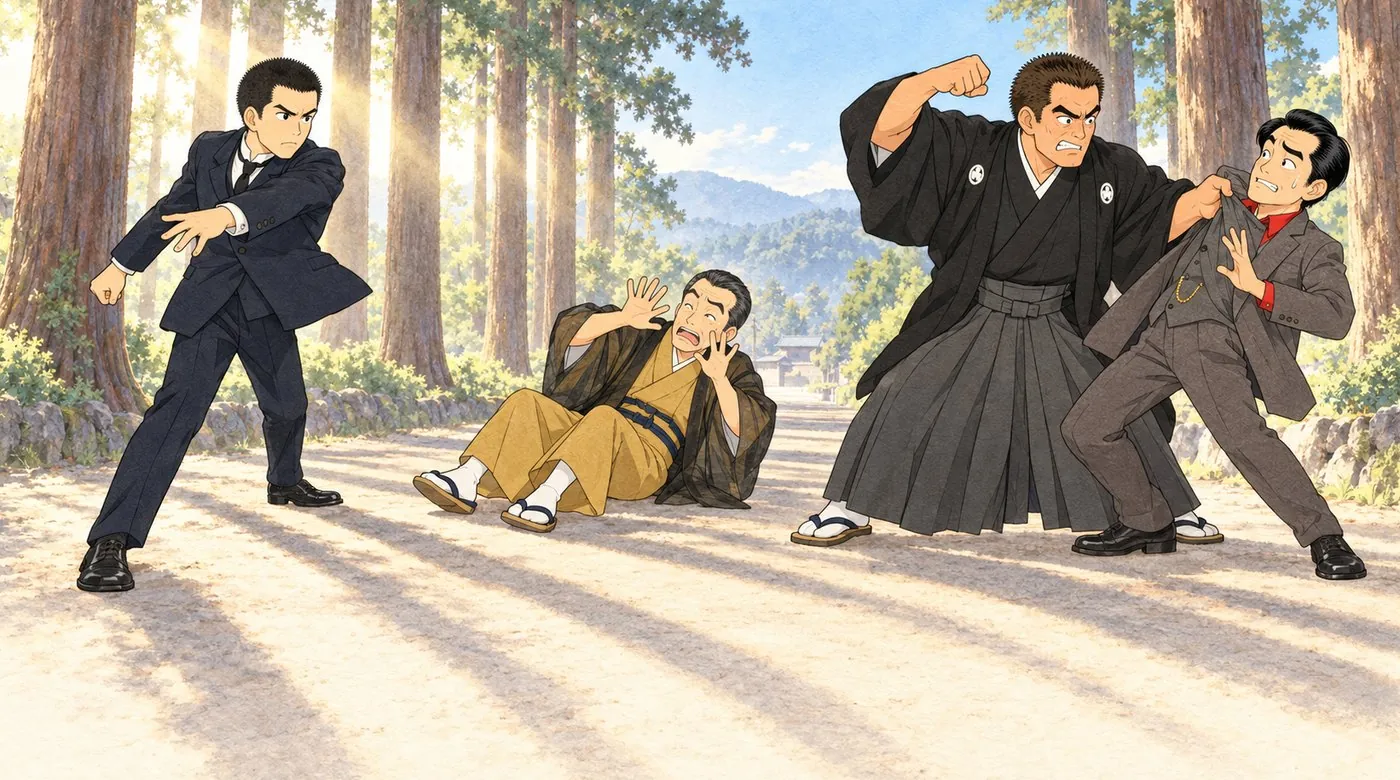
The ending: why Kiyo's grave is in Kohinata
Back in Tokyo, bag still in hand, he goes straight to Kiyo: "Kiyo! I'm home." She cries: "Oh, Botchan! You've come home so soon!" He becomes a technician at the Tokyo streetcar company, and they make a home together.
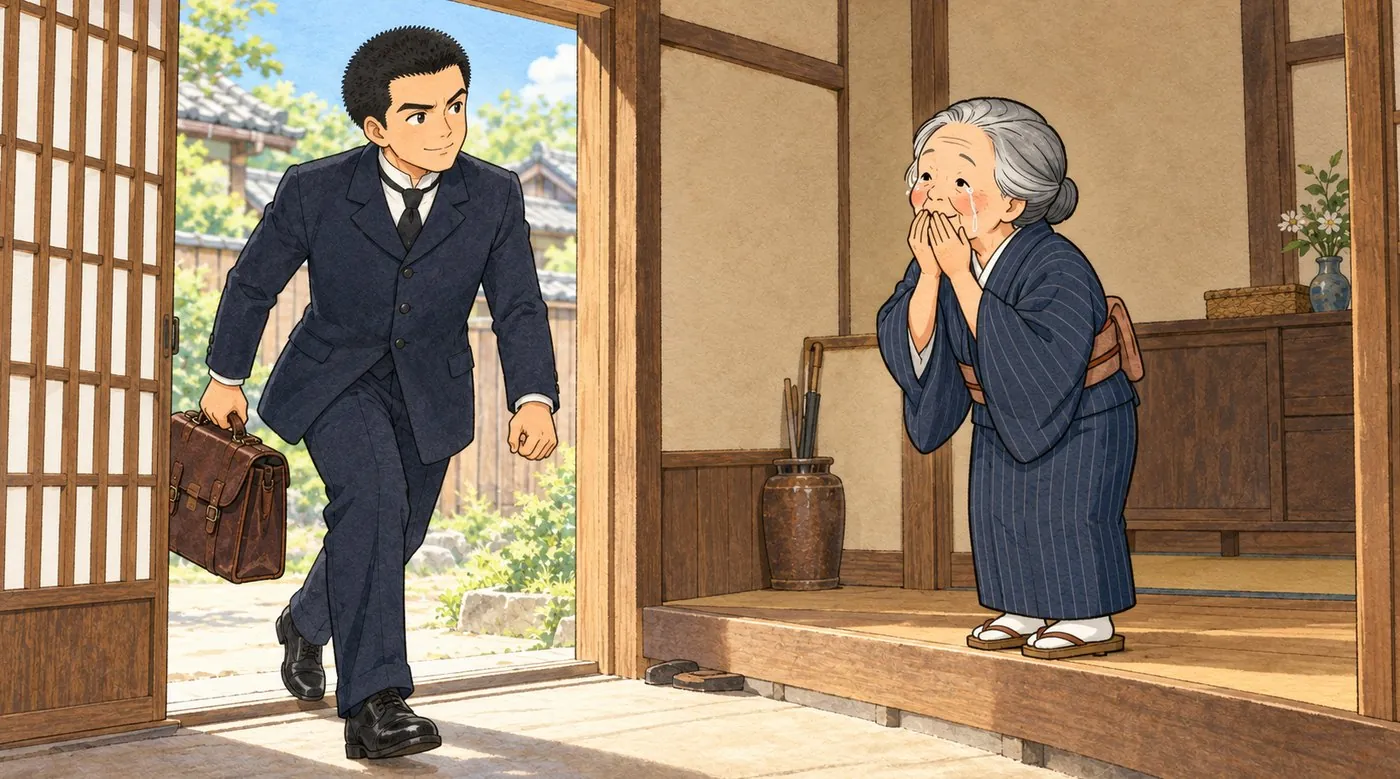
Kiyo, who once believed he would build a house "with a grand front entrance," seems perfectly content with a house that has none. But in February she dies of pneumonia. The day before, she asks him: "Botchan, I beg you. When I die, bury me at Botchan's family temple. I'll be waiting in my grave, looking forward to Botchan's visits."
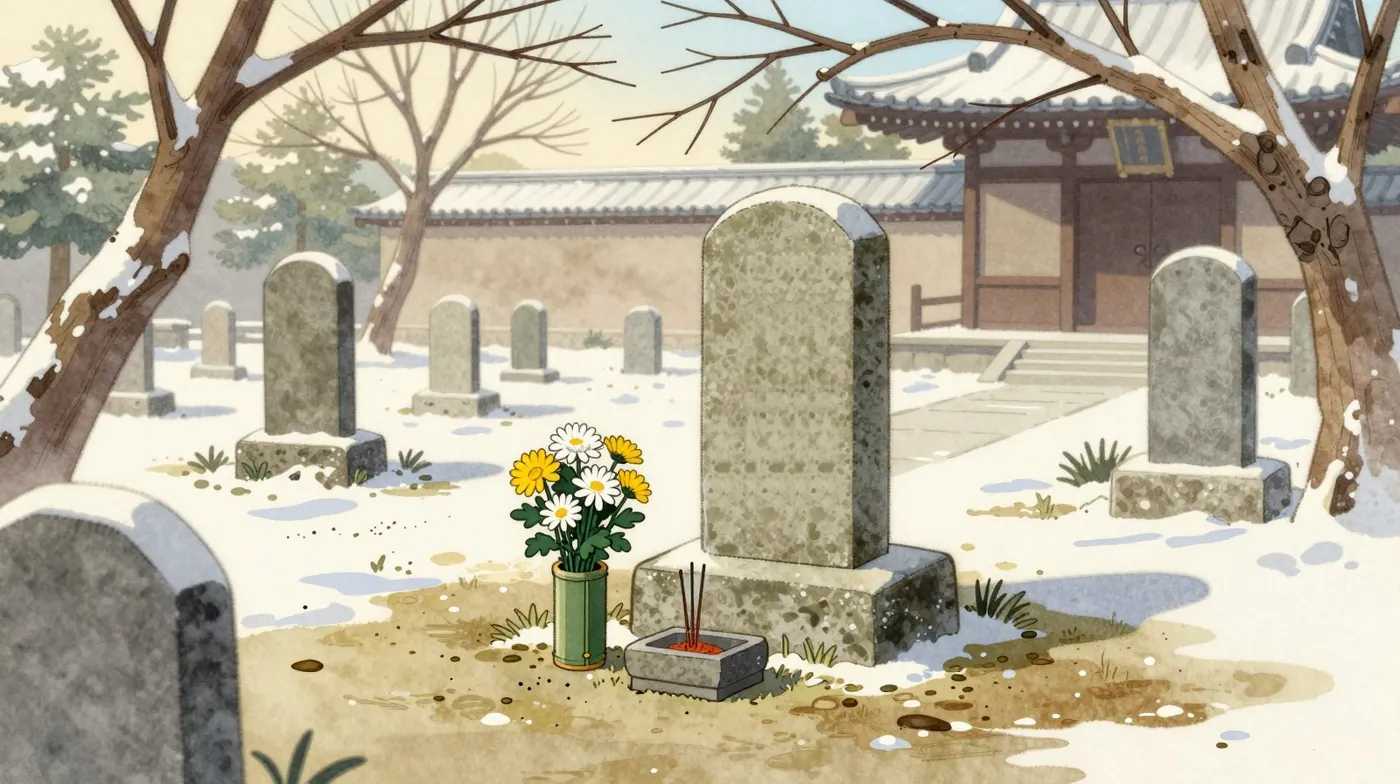
The novel ends: "And that is why Kiyo's grave is at Yogenji Temple, in Kohinata."
What is the hero's name?
It never appears in the novel. Not once.
How we checked: in the original Japanese, we listed every word with an honorific or name marker attached (-kun, -san, -sensei, -shi, -bō "so-and-so," -sama). The family names that turn up (Koga, Hotta, Yoshikawa, Kawamura, Toyama, Hagino and a few others) all belong to other people. Then we read the whole text, start to finish.
The hero calls himself ore. Other people call him:
- "Mr. Tempura": the students, on the blackboard (Chapter 3)
- "Red Towel": the students (Chapter 3)
- "a certain new teacher, Mr. So-and-so": Porcupine, at the staff meeting, without naming him (Chapter 6)
- "a certain insolent somebody": the newspaper (Chapter 11)
- "that loudmouth" and "a hot-headed little Botchan": the Jester (Chapter 11)
- "Botchan": Kiyo, eleven times (Chapters 1, 7 and 11)
The newspaper's word is bō (某), used for a person whose name is unknown or deliberately left out. The hero is furious:
"Is there anyone under heaven whose name is 'Somebody'? Think about it. I've got a perfectly respectable family name, and a given name too." (Chapter 11)
Yet the novel never writes either. Even the letter of appointment, which would have carried his name, is disposed of in advance, in the Chapter 2 scene where he receives it:
"When I went back to Tokyo, I crumpled this letter of appointment into a ball and tossed it into the sea." (Chapter 2)
All we learn is his age: "twenty-three years and four months" (Chapter 5), "still only twenty-four" (Chapter 7). The town has no name either. The word "Matsuyama" appears 0 times in the original, and "Shikoku" just twice.
"Botchan" appears 16 times, and 11 of them are Kiyo's
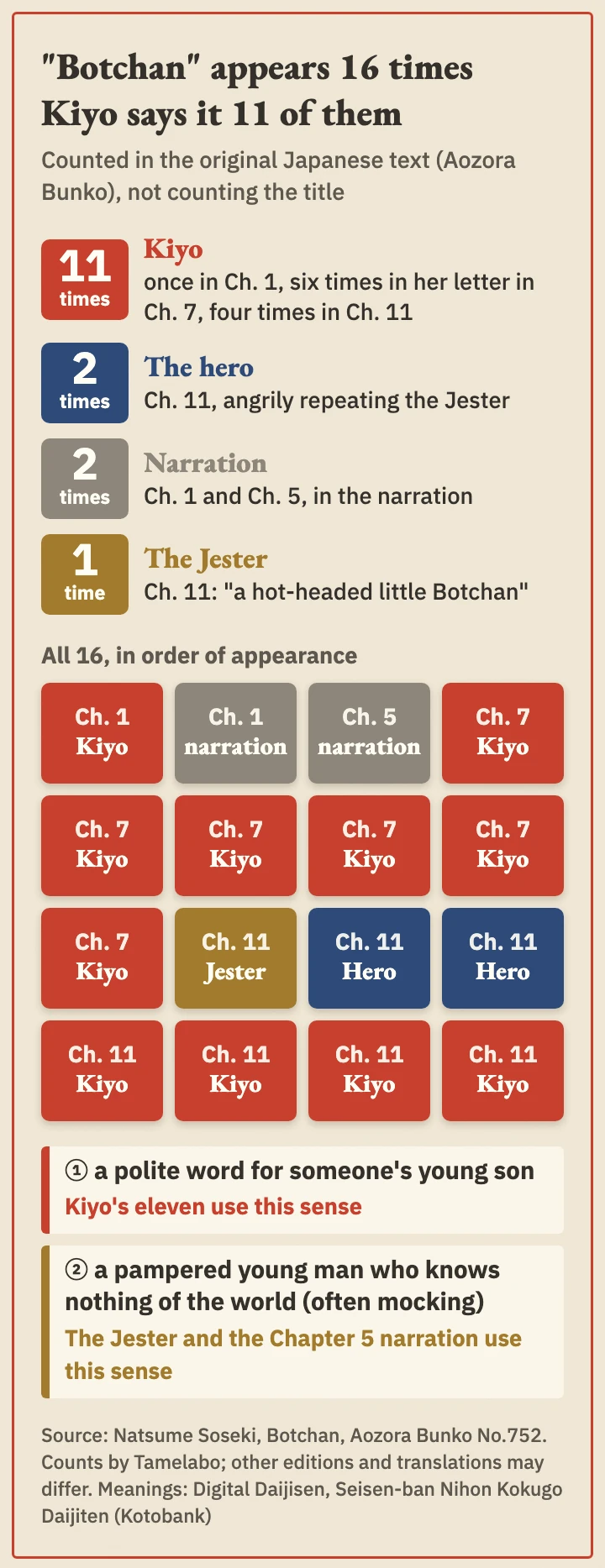
In the original Japanese, the word 坊っちゃん, "Botchan," appears 16 times, not counting the title. Other Japanese editions may spell it differently, and English translations will give different counts.
| Who says it | Times | Chapters | Example (our translation) |
|---|---|---|---|
| Kiyo | 11 | 1, 7 (her letter), 11 | "Oh, Botchan! You've come home so soon!" |
| The hero | 2 | 11 | "What's this 'loudmouth Botchan' business?" |
| Narration | 2 | 1, 5 | "...they sneer at him as 'Botchan' or 'brat.'" |
| The Jester | 1 | 11 | "a hot-headed little Botchan" |
The hero's two are both about the Jester: once repeating the insult in anger, once shouting it back. In a novel that never names its hero, the one who called him "Botchan" most was Kiyo.
Japanese dictionaries give the word two meanings: (1) a polite word for someone else's young son; (2) a man raised with too much care, who knows nothing of the world, a sense one dictionary calls "mostly mocking" (Digital Daijisen and Seisen-ban Nihon Kokugo Daijiten). The Jester and the Chapter 5 narration use the second, mocking sense. Kiyo's eleven use the first.
Kiyo never sets foot in Shikoku, but she is everywhere in it
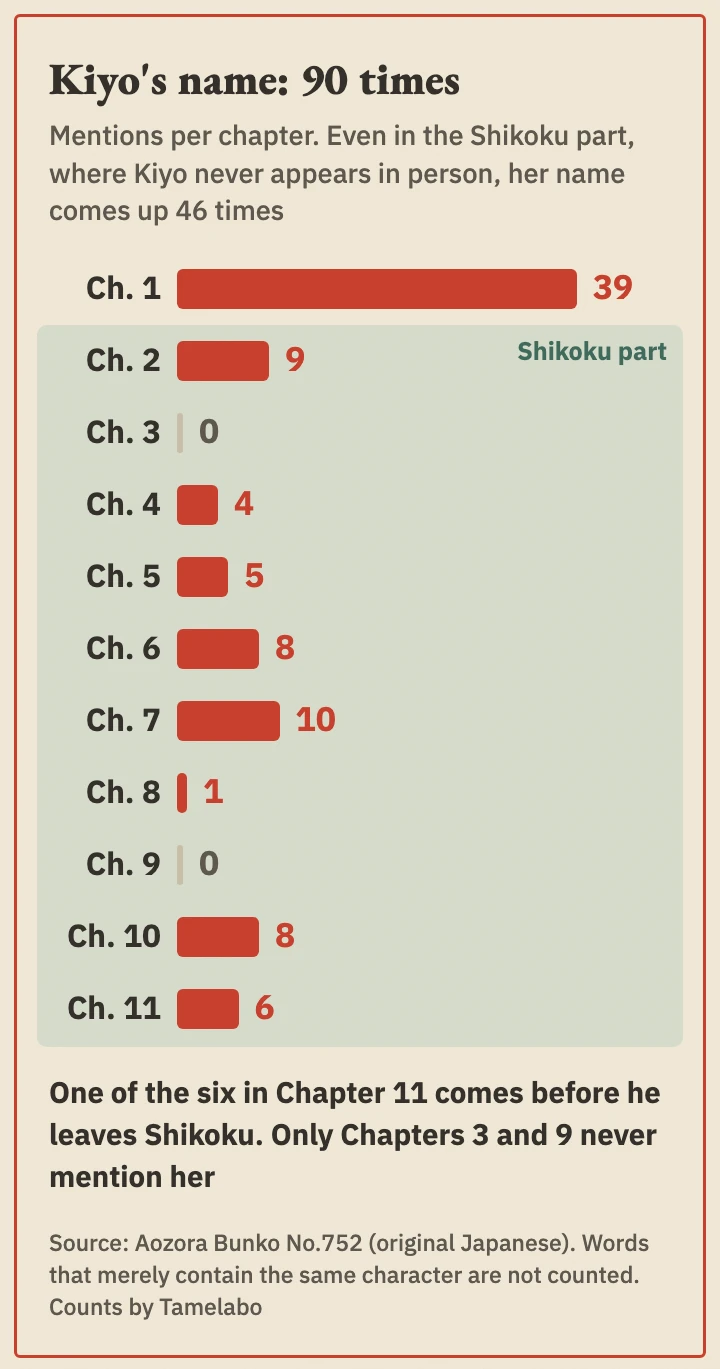
Kiyo stays in Tokyo the whole time. Yet her name appears 90 times in the original Japanese, and 46 times in the Shikoku part alone (from the start of Chapter 2 until "Kiyo! I'm home"). Only Chapters 3 and 9 never mention her.
It is in Shikoku, without her, that he finally sees what she means to him. On his night on duty (Chapter 4), he thinks:
"She took such care of me, and I never felt especially grateful. Only now, alone in a far-off province, do I understand her kindness for the first time." (Chapter 4)
And in Chapter 7: "Now that I'm out here in the country, I can see Kiyo really is a good soul."
He was in Shikoku for just over a month
The Shikoku chapters fill 91.2% of the novel. How long was the hero actually there? The text drops clues (our translations):
- "not yet twenty days since he first faced the students": Porcupine, about the night duty (Chapter 6)
- "barely a month since I came here, if that": after hearing about Madonna (Chapter 7)
- "not even a month, and I already want to go home": the day of the raise offer (Chapter 8)
- "to resign when you've been here barely a month": the principal, to the hero (Chapter 11)
- "On the eighth day, I left my lodgings around seven": the stakeout (Chapter 11)
After the principal's "barely a month," the stakeout still runs to its eighth night before the hero leaves. Going by these lines, the 91.2% of the novel set in Shikoku covers only a month or so.
Botchan by the money
We don't convert the novel's sums into today's money, because the answer swings widely depending on which prices you compare. Everything below is in yen of the story's time (1 yen = 100 sen; 1 sen = 10 rin), and the only comparison is within the story.
| What | Amount | Chapter |
|---|---|---|
| Money from his brother | 600 yen | 1 |
| From his brother for Kiyo (passed on by the hero) | 50 yen | 1 |
| Monthly salary at the school in Shikoku | 40 yen | 1 |
| Tip ("tea money") to the inn | 5 yen | 2 |
| The shaved ice Porcupine bought him | 1.5 sen | 6 |
| Money Kiyo once lent him (never repaid) | 3 yen | 6 |
| Money Kiyo sends with her letter | 10 yen | 7 |
| Pale Squash's extra monthly pay in Nobeoka | 5 yen | 8 |
| Eight nights at the lookout inn (paid by Porcupine) | 5 yen 60 sen | 11 |
| Monthly salary in Tokyo (streetcar technician) | 25 yen | 11 |
| Monthly rent in Tokyo | 6 yen | 11 |
His salary goes from 40 yen a month in Shikoku to 25 yen in Tokyo, and he takes the cut.
And notice the two debts. The moment he suspects Porcupine, he pays back the 1.5 sen. Kiyo's three yen, he never returns:
"I still haven't paid back those three yen, five years on. It's not that I can't. It's that I won't." (Chapter 6)
His reason:
"Not paying her back isn't trampling on Kiyo. It's because I think of Kiyo as the other half of me." (Chapter 6)
The model town: Matsuyama and Soseki
After graduating from Tokyo Imperial University, Soseki went in April 1895 to teach English at Matsuyama Middle School (the forerunner of today's Matsuyama Higashi High School, in Ehime Prefecture). In April 1896 he became a lecturer at the Fifth High School in Kumamoto: about a year in Matsuyama.
Botchan is said to be modeled on that year (Matsuyama City's public relations bulletin, April 1, 2017). But the name "Matsuyama" never appears in the novel, and while the hero teaches math, Soseki taught English. The town in the story stays nameless to the very end.
Questions to think about
The novel doesn't answer these directly. Here are the clues in the text.
Why does the novel never give the hero's name?
He insists he has "a perfectly respectable family name, and a given name too," yet the novel withholds both, and the one document bearing his name ends up in the sea. All we ever see are names other people give him: Mr. Tempura, Red Towel, So-and-so, Botchan. He starts the story as the one handing out nicknames and ends it known only by them. What does that do to how you see him?
Why does he repay the 1.5 sen at once, but never Kiyo's three yen?
He gives his own answer: Kiyo is "the other half of me" (Chapter 6). So what makes Porcupine different? A clue: when the two men make up in Chapter 9, the hero quietly takes the dusty coins back.
Whose voice do you hear in the title?
The same word, botchan, is an insult from the Jester and an endearment from Kiyo. That is our reading, not the only one: from the Jester, it means a spoiled boy who knows nothing of the world; from Kiyo, it is what you call someone you cherish. Eleven of the sixteen are hers. When you read the title, whose voice do you hear?
Frequently asked questions (FAQ)
What is the hero's name in Botchan?
It is never given. The hero calls himself ore ("I"), and other people call him "Mr. Tempura," "Red Towel," "So-and-so" and "Botchan." When a newspaper calls him "a certain insolent somebody," he protests that he has a perfectly good family name and given name, but the novel never reveals them.
Who is "Botchan"?
It is what people call the hero. The word appears 16 times in the original Japanese, and 11 of them are spoken or written by Kiyo, the elderly maid who raised him with love. The Jester uses it once, as an insult; the hero twice, both times about the Jester's insult; and the narration twice.
Where is Botchan set? Is it Matsuyama?
The town is never named in the novel: "Matsuyama" appears 0 times, and "Shikoku" only twice. The story is said to draw on Soseki's year teaching English at a middle school in Matsuyama, starting in April 1895, but within the novel it is simply a town on Shikoku.
What are Red Shirt's and Tanuki's real names?
They are never given. The hero, Red Shirt and Tanuki are the three main characters without real names. Pale Squash is Koga, Porcupine is Hotta, the Jester is Yoshikawa, and Madonna is Miss Toyama.
Does Madonna ever speak?
No. Not a single line of hers appears in the novel. When the hero sees her at a station, she is too far away for him to hear what she is saying.
What happens to Kiyo at the end?
When the hero returns to Tokyo, they make a home together. In February she dies of pneumonia, asking the day before to be buried at his family temple. The novel's last line: "And that is why Kiyo's grave is at Yogenji Temple, in Kohinata."
Which war is the victory celebration for?
The novel doesn't say. The words "Russo-Japanese War" (Chapter 3) and the name of the Russian general Kuropatkin (Chapter 10) appear only in passing comparisons.
How long is the hero in Shikoku?
Just over a month, going by the text. The principal tells him he has been there "barely a month" when he resigns, and the stakeout that follows runs another eight nights before he leaves.
Where to read it
- Botchan, card No. 752 — Aozora Bunko: the original Japanese, free, in modern spelling, in 11 chapters you can read one at a time. A good way in is to read Chapters 1 and 11 first.
- The full text — Aozora Bunko: Kiyo calls him "Botchan" in Chapter 1 (three days before he leaves), Chapter 7 (her letter) and Chapter 11 (the last pages).
- Botchan (Master Darling), translated by Yasotaro Mori — Project Gutenberg: an older English translation, free to read.
- Botchan, translated by J. Cohn — Penguin Classics: a modern English translation.
The count of 16 applies to the original Japanese only; English translations render the word in different ways.
Shorts
Sources
Where the facts and numbers in the video and on this page come from.
- Natsume Soseki, Botchan — Aozora Bunko, card No. 752 (modern kana orthography; source text Chikuma Nihon Bungaku Zenshu Natsume Soseki (Chikuma Shobo, 1992); author's dates and real name)aozora.gr.jp/cards/000148/card752.html
- Botchan, full text — Aozora Bunko (the text we quoted and counted)aozora.gr.jp/cards/000148/files/752_14964.html
- Matsuyama City, Koho Matsuyama, April 1, 2017 (special issue for the 150th anniversary of the births of Masaoka Shiki and Natsume Soseki; on the novel's model)city.matsuyama.ehime.jp/shisei/machizukuri/kotoba/shikisoseki15…
- Kumamoto City, Soseki in Kumamoto (Soseki's timeline (Matsuyama Middle School, then the Fifth High School in Kumamoto))city.kumamoto.jp/nishi/kiji0038055/5_8055_52912_up_0K8M5…
- Tokyo Metropolitan Government, From horse-drawn railways to streetcars (on the Tokyo City Street Railway (Gaitetsu))toshiseibi.metro.tokyo.lg.jp/keikaku_chousa_singikai/pdf/tokyotoshiz…
- Kotobank, botchan (坊ちゃん)(Digital Daijisen and Seisen-ban Nihon Kokugo Daijiten; the two meanings)kotobank.jp/word/坊ちゃん-3218754
- Kotobank, bō (某)(,)kotobank.jp/word/某-486627
- uranari (末生り)(,)kotobank.jp/word/末生り-441874
- nodaiko (野太鼓)(,)kotobank.jp/word/野太鼓-596939
- taikomochi (幇間)(word meanings)kotobank.jp/word/幇間-168200
- Kotobank, sen (銭)(,)kotobank.jp/word/銭-87495
- rin (厘)(,)kotobank.jp/word/厘-150228
- shihan gakkō (師範学校, normal school)(word meanings)kotobank.jp/word/師範学校-74790
- Project Gutenberg eBook #8868 (and)gutenberg.org/ebooks/8868
- Penguin Classics (the English translations mentioned above)penguin.co.uk/books/186692/botchan-by-soseki-natsume/…