Rashomon by Akutagawa: Where Did the Servant's Heart Turn? | Classics in 5 Minutes #02
The story in brief
- A servant with nowhere to go sits under a ruined gate in the rain, torn between starving and stealing.
- His heart turns at the moment he hears the old woman's logic on the upper floor.
- What stays with the reader: which would you choose — starve, or steal?
Video

Pressing play loads the YouTube player on this page. Watch on YouTube
Explained
In the video
- 0:00One man, one needle — which way will it point?
- 0:29Was the gate in the story real?
- 0:51Act 1: Under the gate — starve or steal?
- 1:34Act 2: The upper floor — who is up there?
- 2:21Act 3: The sword — what does it change?
- 3:01Act 4: The old woman's logic — steal to live?
- 3:38What lies at the bottom of the night?
- 4:23What did the two actually say?
- 4:51Where did the tale come from — and did the last line change?
- 5:41What if the old woman had just begged for mercy?
This is a guide to Ryunosuke Akutagawa's short story Rashomon (1915), from the opening scene to the last line. It gives away the ending, so decide for yourself whether you want to know it before you read. Every detail of the story here comes from the Japanese text on Aozora Bunko, a free online library of Japanese books, and all quotations are our own translations. The story has no chapters; the section headings below are ours.
If you know the name Rashomon from Akira Kurosawa's 1950 film: the film takes its plot and characters from a different Akutagawa story, "In a Grove." It borrows only its title and the ruined gate from this one.
The story in 30 seconds
On a rainy evening in Kyoto, a servant who has just lost his job shelters under Rashomon, the city's great southern gate. He knows he must either starve or become a thief, but he can't bring himself to choose stealing. Looking for a place to sleep, he climbs to the gate's upper floor and finds an old woman pulling hair from a corpse. Disgusted, he seizes her. But as he listens to her excuse — that wrongs done to survive can be forgiven — he finds the courage to steal. He strips off her robe and vanishes into the night.
Who's who
- The servant (genin): a low-ranking household servant. A few days earlier, the master he had served for years let him go. He wears a faded dark-blue jacket over a yellow undershirt, carries a sword at his hip, and has straw sandals on his feet. A big, angry pimple sits on his right cheek, and he keeps touching it. The story never gives his name or his age.
- The old woman: she crouches among the dead on the gate's upper floor, pulling out their hair. Akutagawa describes her as short, thin, white-haired, "like a monkey," in a robe the color of cypress bark (a dark reddish brown). She has no name.
- The dead woman: the long-haired corpse the old woman is working on. According to the old woman, she used to cut snakes into pieces about 5 inches (12 cm) long, dry them, and sell them as dried fish to the palace guards. She died of an epidemic.
The narrator also steps into the story now and then as "the author." At one point he corrects his own opening line: instead of saying the servant was "waiting for the rain to stop," it would be truer to say he was "trapped by the rain, with nowhere to go, at a loss."
The plot, scene by scene
Under the gate: nowhere to go
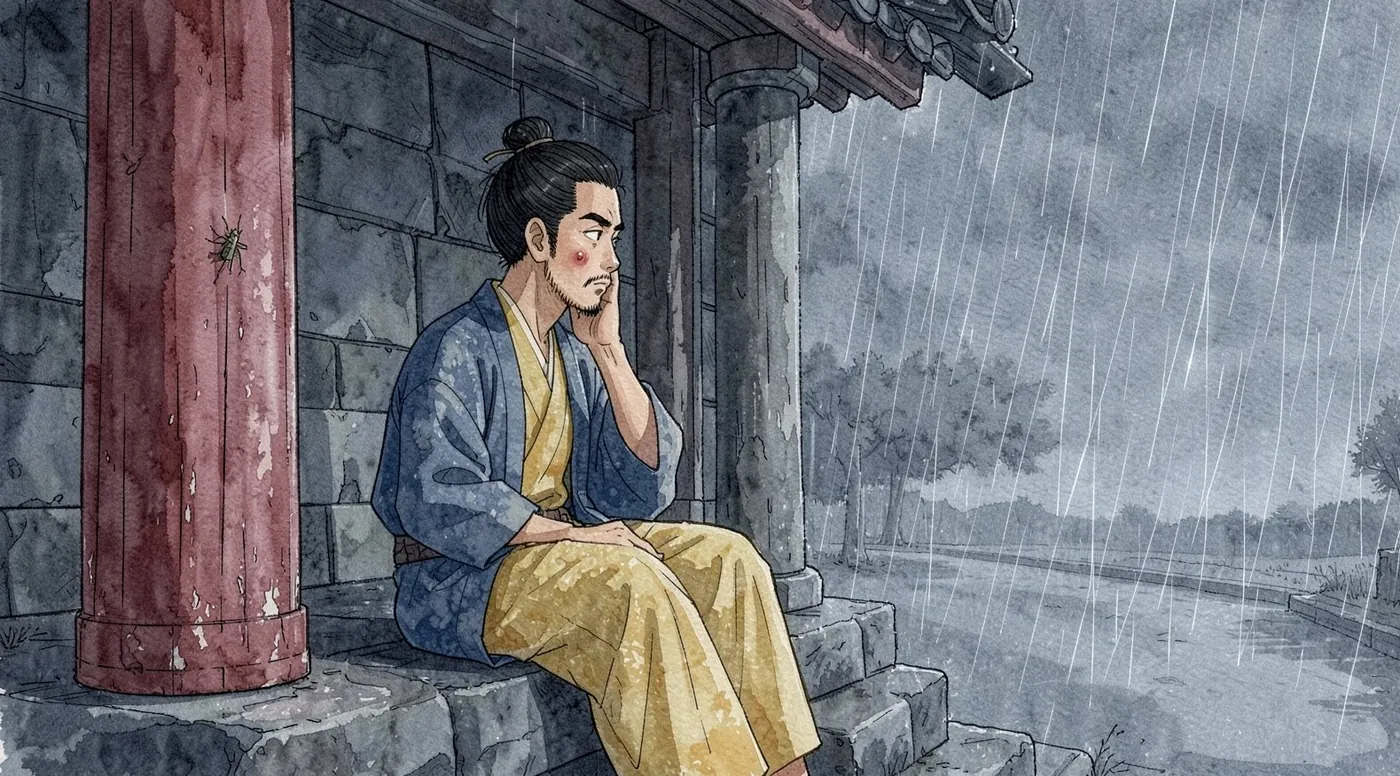
The servant on the top step, fingering the pimple on his right cheek
One evening, a servant sits on the top step of Rashomon waiting for the rain to stop. The story is set in the Heian era, when Kyoto was the capital. For the past two or three years, the city has suffered earthquake, whirlwind, fire, and famine. Kyoto has fallen into ruin. Foxes, badgers, and thieves now live in the neglected gate, and people have even started leaving unclaimed bodies there.
The servant has nowhere to go even if the rain stops. If he is choosy about how he survives, he will starve by the side of the road. If he isn't, the only way left is to steal. He accepts that much, but he lacks the courage to admit, plainly, that he has "no choice but to become a thief." At last, looking for somewhere to spend the night, he sets his foot on the ladder to the upper floor.
The upper floor: the old woman
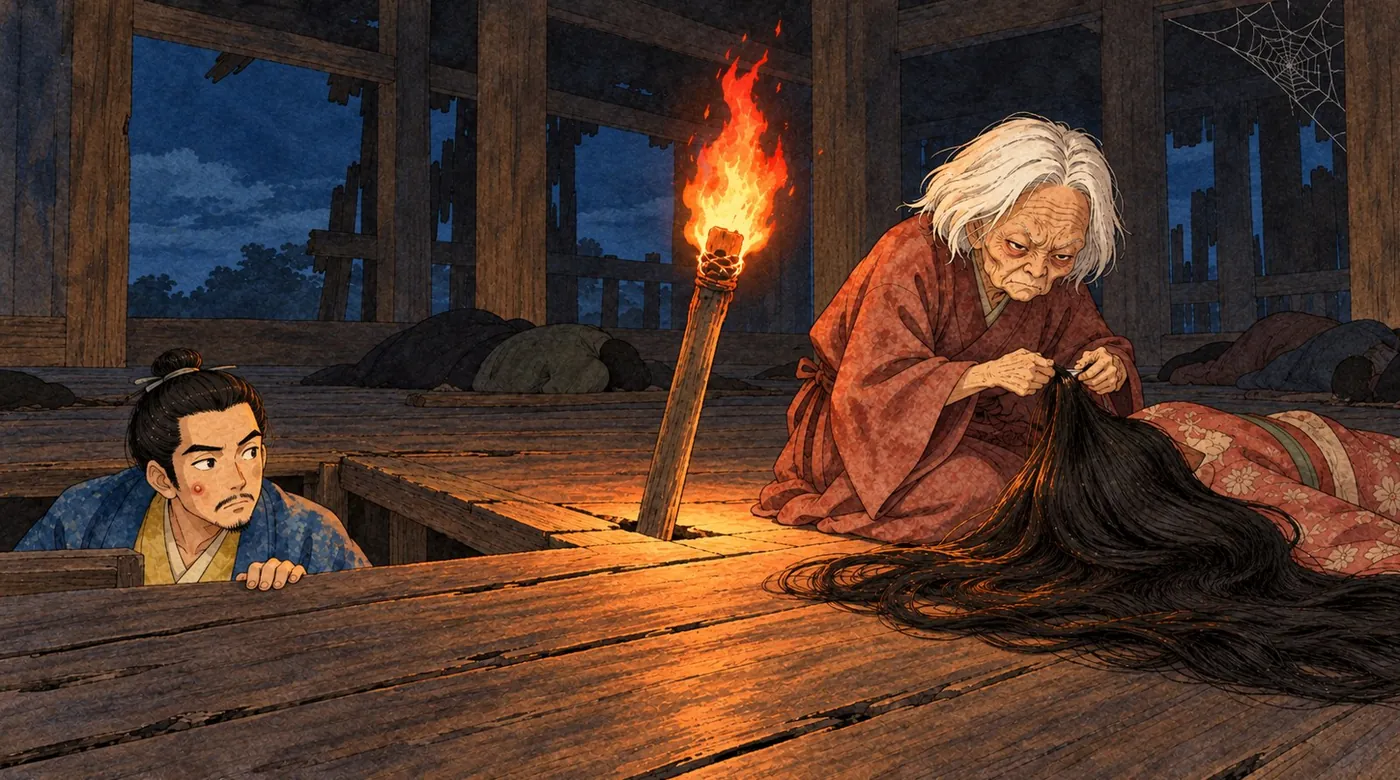
The old woman pulls hair beside the torch while the servant watches from the ladder
Halfway up the ladder, he sees firelight above. He creeps to the top and looks in. Bodies lie scattered across the floor, and among them crouches a white-haired old woman. She wedges her burning stick of pine into a gap in the floorboards, lays both hands on a dead woman's neck, and starts pulling out her long hair, one strand at a time.
With each strand, the servant's fear drains away, and a hatred of every kind of evil rises in its place. The story says that if someone had asked him at that moment whether to starve or to steal, he would "probably" have chosen to starve without a second thought. It is a "what if," not a choice he actually makes. And he has completely forgotten that, only a little while ago, he was ready to become a thief himself.
The sword: a cold kind of satisfaction
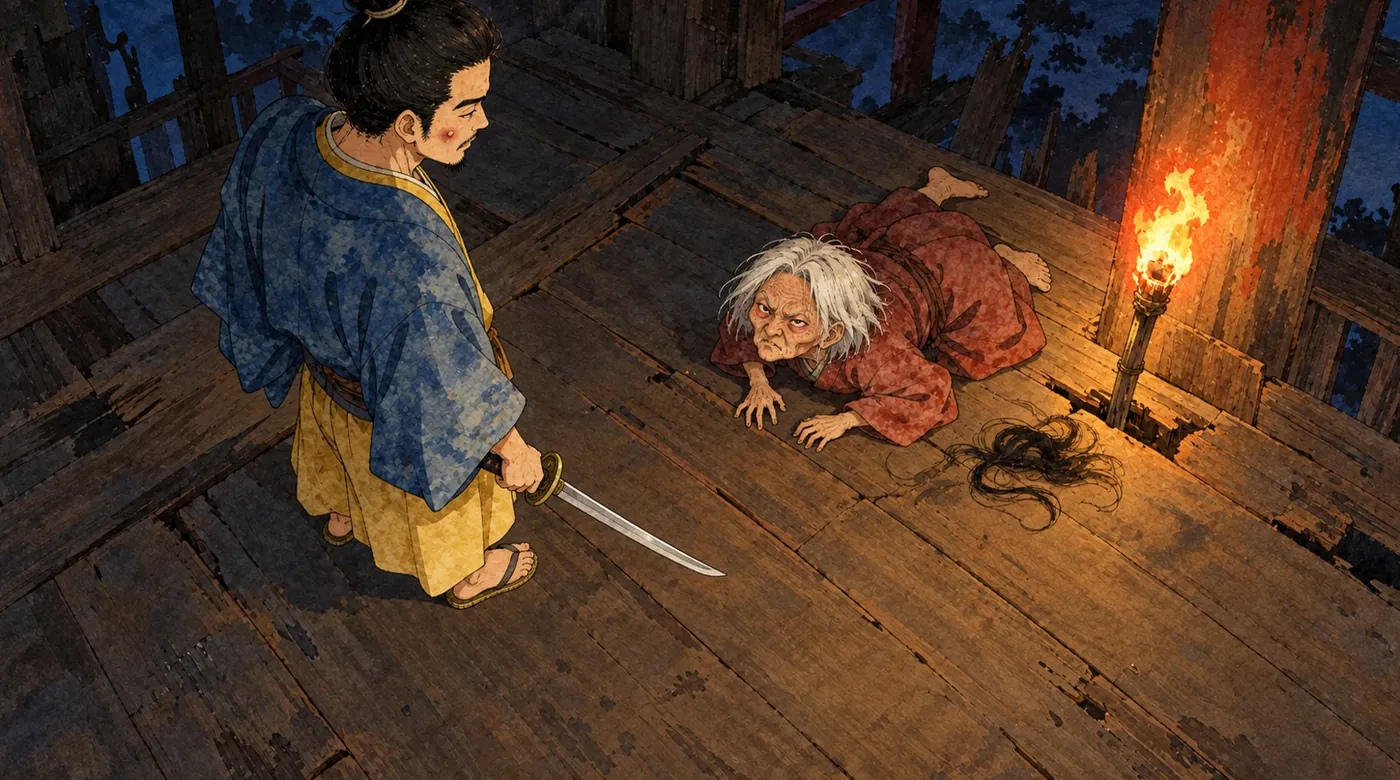
The servant stands over the old woman he has thrown to the floor
He leaps up from the ladder, blocks the old woman as she tries to flee, and wrestles her to the floor. He draws his sword and holds the white blade before her eyes. She says nothing. Realizing that her life is entirely in his hands, he feels his hatred cool. All that's left is "a calm pride and satisfaction," like the feeling of a job well done.
He tells her he is not an officer of the kebiishi, Kyoto's police and court, just a traveler passing by, and asks what she was doing. She answers in a voice like a crow's caw: she was pulling out the hair to make a wig. The answer is so ordinary that he is disappointed, and his hatred returns, now mixed with cold contempt.
The old woman's logic: "I have no choice"
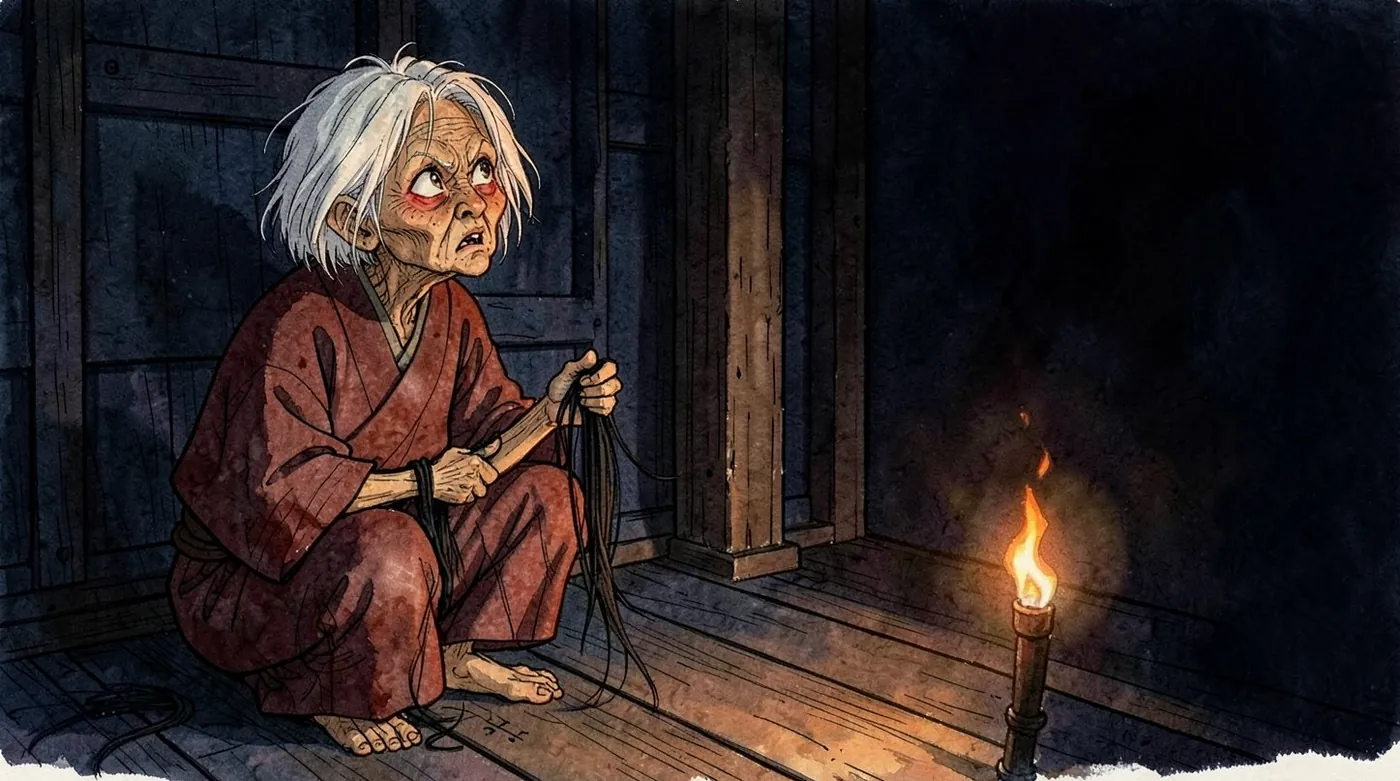
Still clutching the hair, the old woman mutters her excuse
Still clutching the hair, she mutters on. Pulling hair from the dead may well be wicked. But everyone lying here deserves no better. The woman whose hair she was pulling sold dried snake as dried fish. The old woman doesn't call that wicked: the woman would have starved otherwise. By the same token, what she herself is doing now isn't wicked either; if she doesn't do it, she'll starve. So the dead woman, who knew all about having no choice, would surely forgive her.
The servant has put his sword back in its sheath and listens coldly, one hand on his pimple. But as he listens, a certain courage is born in him. It is the courage he lacked down at the gate — and, the story adds, a courage that pushes in "exactly the opposite direction" from the courage he showed when he seized her.
How it ends (spoilers)
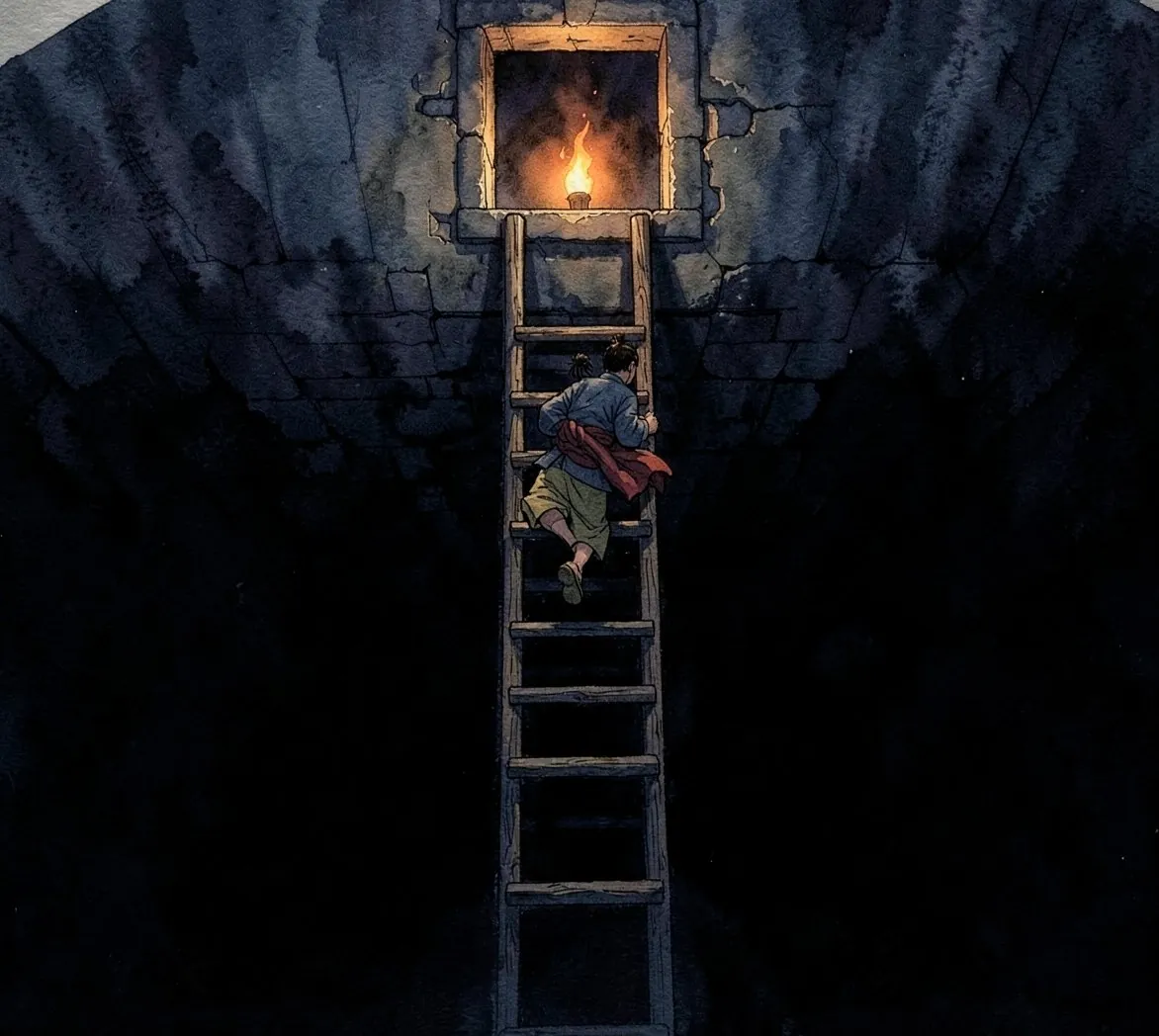
The servant races down the ladder into the dark with the stolen robe
When the old woman finishes, the servant presses her mockingly: "You're sure of that?" Then he takes his hand from his pimple, grabs her by the collar, and says:
"Then you won't hold it against me if I rob you. I, too, will starve if I don't." (the final scene)
He strips off her robe, kicks her down onto the corpses as she tries to cling to his legs, and races down the steep ladder "into the bottom of the night."
After a while, the old woman, now naked, pulls herself up and crawls by the light of the still-burning torch to the top of the ladder. With her short white hair hanging upside down, she peers below. Outside, there is nothing but pitch-black night. The story ends with a single line:
No one knows where the servant went.
What happens to him afterward is never told.
Where does his mind change? Five turns
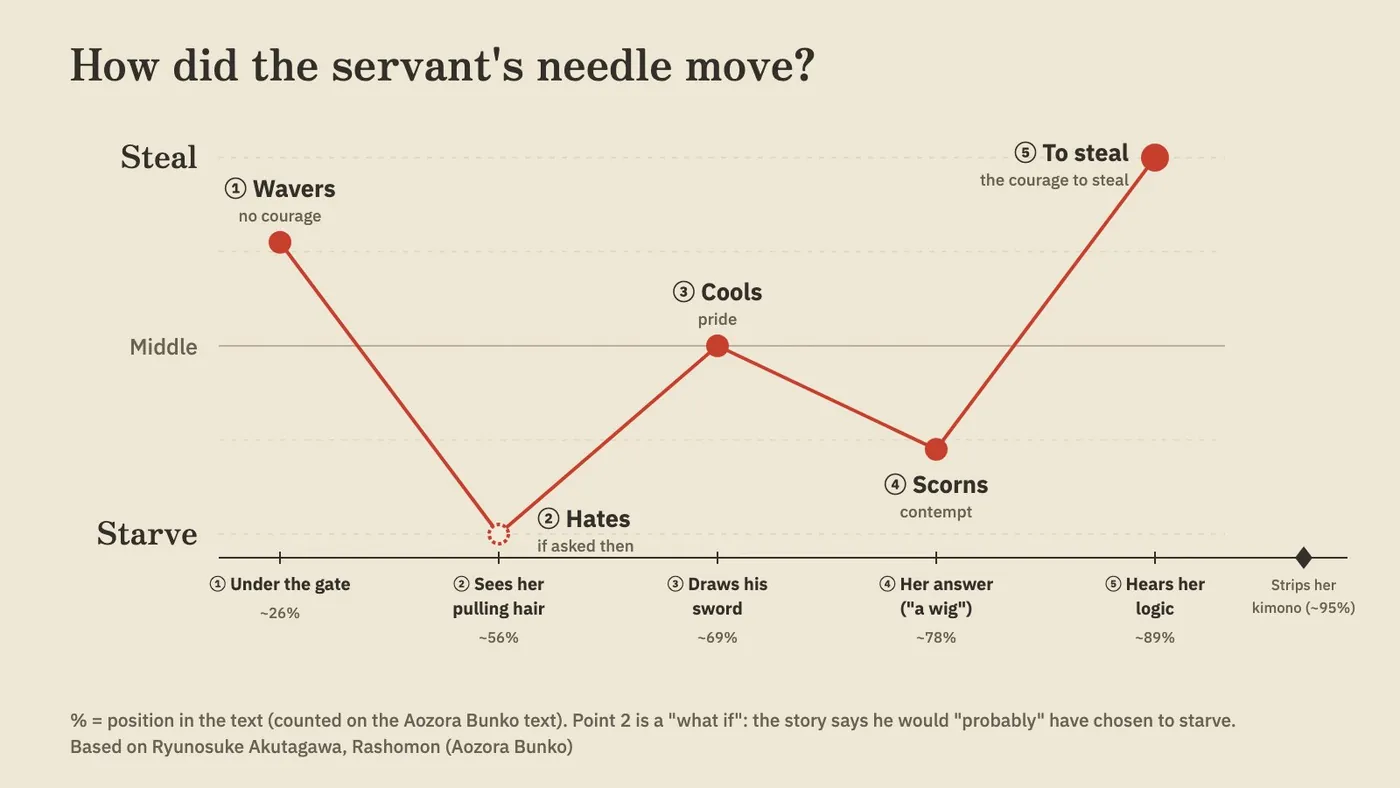
A diagram of the servant's mind as a needle between "Starve" and "Steal," showing its five turns in story order
Picture the servant's mind as a needle, with "Starve" on the left and "Steal" on the right. (The needle is our way of picturing it, not Akutagawa's.) It swings five times. The percentages show roughly how far into the text each moment comes.
- He wavers (under the gate, ~26%): he can't find the courage to accept that he has "no choice but to become a thief."
- He hates (watching her pull hair, ~56%): asked then, he would "probably" have chosen to starve — the story's own hedge.
- He cools (sword drawn, ~69%): holding her life in his hands, he feels only "calm pride and satisfaction." This is before she explains herself.
- He scorns (her answer, "a wig," ~78%): disappointed, he feels his old hatred return "with a cold contempt."
- He steals (hearing her logic, ~89%): "as he listened," the missing courage is born, and starving is pushed out of his mind.
Four of the five turns come after he finds the old woman, between about 56% and 89% of the way through. The theft itself, stripping her robe, happens near the very end, at about 95%. Most of the story is spent on the movements of his mind before he steals.
Their words, side by side
The old woman: "This, too, I do because I have no choice: if I don't, I'll starve." (her excuse)
The servant: "I, too, will starve if I don't." (the final scene)
The logic the old woman uses to excuse herself — if I don't, I'll starve — is handed straight back to her. One way to read the ending is that her own words are what finally push him to steal.
In the Japanese text, her speech runs to 367 characters inside the quotation marks. The old woman in the original tale (next section) says only 69 characters, in classical Japanese, so the comparison is rough. Akutagawa gives her a long argument.
The 900-year-old tale behind it
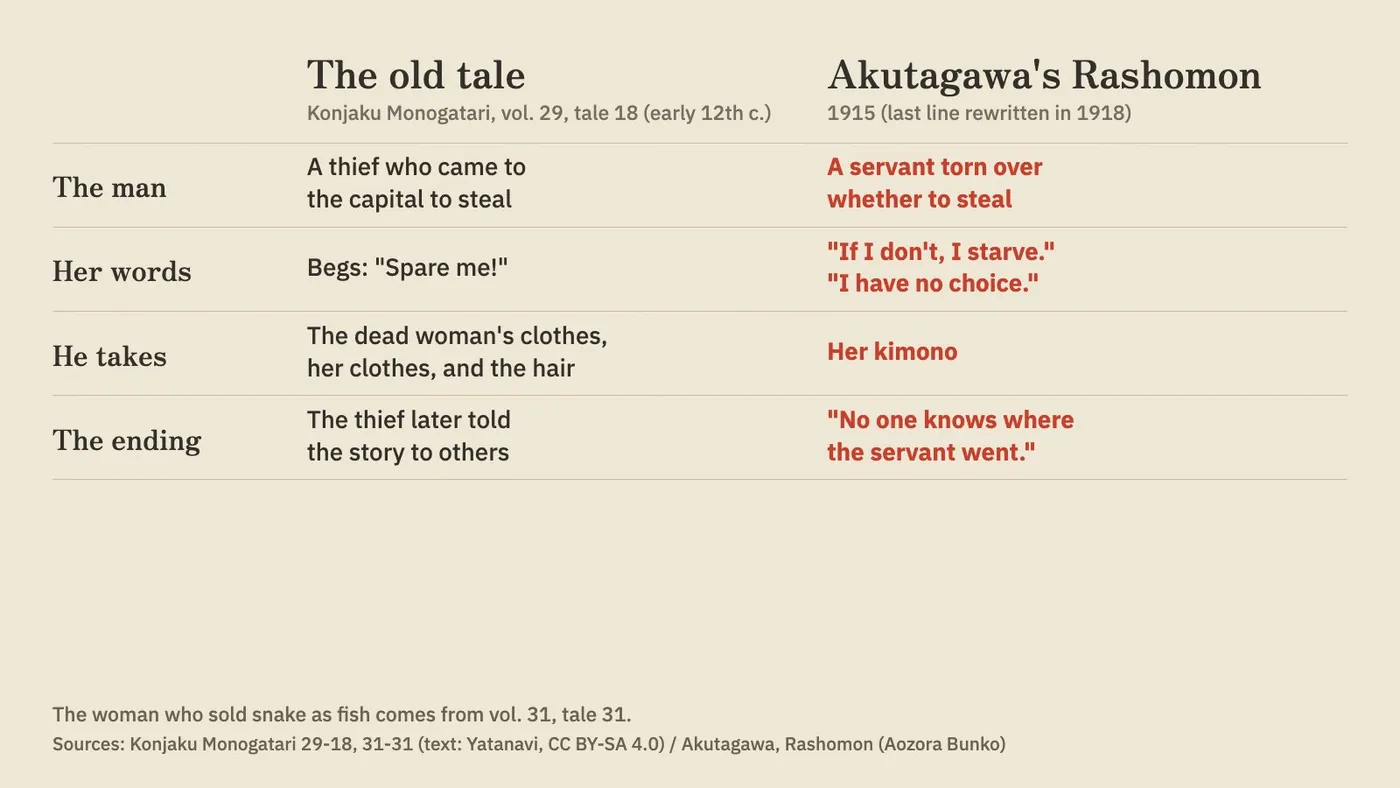
The old tale and Akutagawa's story compared: the man, her words, what he takes, and the ending
Rashomon is based on a tale in the Konjaku Monogatari, a collection of stories compiled in Japan in the early 12th century, about 900 years ago (volume 29, tale 18).
In the old tale, a man comes up to the capital from the provinces "in order to steal" — he is a thief from the start. Avoiding people, he climbs to the upper floor of the gate and finds a white-haired old woman pulling hair from a young woman's body. He draws his sword and rushes at her. Rubbing her hands together, she explains that the dead woman was her mistress, that no one was left to bury her, and that her hair was so long she was making a wig of it — and begs him to spare her. He takes the dead woman's clothes, the old woman's clothes, and the hair, and runs. The tale ends by saying it was heard from the thief himself.
The woman who sold snake as fish comes from another tale in the same collection (volume 31, tale 31), about a woman whose tasty "dried fish" for the palace guards turns out to be snake.
What Akutagawa changed:
- A thief from the start → a servant who has lost his job and is torn over stealing.
- An old woman who begs for mercy → an old woman who argues "if I don't, I'll starve."
- The body of her mistress → the body of the woman who sold snake as fish.
- He takes the clothes and the hair → he takes only the old woman's robe.
- A story the thief told others → "No one knows where the servant went."
- The ruined city and the servant's changing mind are not in either old tale.
Some readers take Rashomon as the story of a good man falling into evil. But the text also says he "was ready to become a thief himself" before he climbed the ladder. What we can say is that Akutagawa turned a born thief into a man torn over stealing, and filled the story with what goes on in his mind.
The last line was rewritten
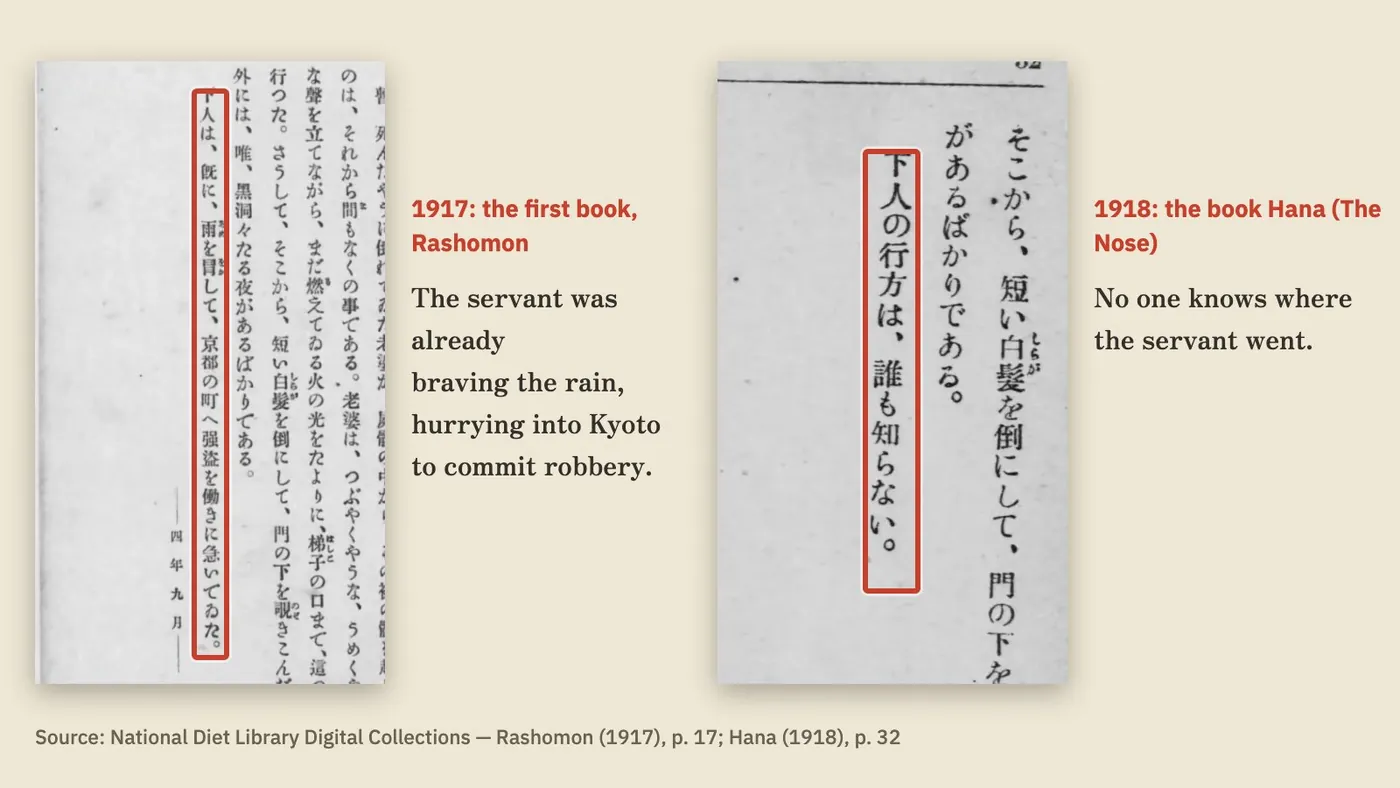
The last lines in the 1917 and 1918 books (National Diet Library Digital Collections)
Today, Rashomon ends with "No one knows where the servant went." It didn't always.
- November 1915: when the story first appeared, in the magazine Teikoku Bungaku, it ended with a sentence saying the servant was hurrying off to commit robbery (Ikegami 2004).
- May 1917: in Akutagawa's first book, Rashomon, the last line still read, "The servant was already braving the rain, hurrying into Kyoto to commit robbery." (page 17)
- July 1918: when the story was reprinted in the book Hana ("The Nose"), the last line became "No one knows where the servant went." (page 32)
The books don't say why he changed it. What we can check is that the ending differs from one edition to the next.
What is the old woman compared to?
The old woman is compared to animals again and again, both in how she looks and in how she sounds. One possible reading: this makes her seem less human, so the servant's hatred and contempt land on her more easily.
| Who | The comparison | Scene |
|---|---|---|
| Old woman | like a monkey | first sight of her |
| Old woman | like a mother monkey picking lice from her young | pulling hair |
| Old woman | arms of skin and bone, like a chicken's legs | thrown to the floor |
| Old woman | eyes as sharp as a bird of prey's | staring at him |
| Old woman | a voice like a crow's caw | her answer |
| Old woman | a voice like a muttering toad | her excuse |
| Servant | curled up like a cat | on the ladder |
| Servant | creeping silently like a gecko | reaching the top |
| His thoughts | thrown away like a dog | under the gate |
How we counted: "like a …" comparisons to living creatures. The old woman gets six, the servant two, and the dog in his thoughts one. Animals that are not comparisons (the cricket on the pillar, the foxes and badgers, the crows that come for the dead, the spider's web, the snakes in her story) are not counted.
The real gate, and the story's history
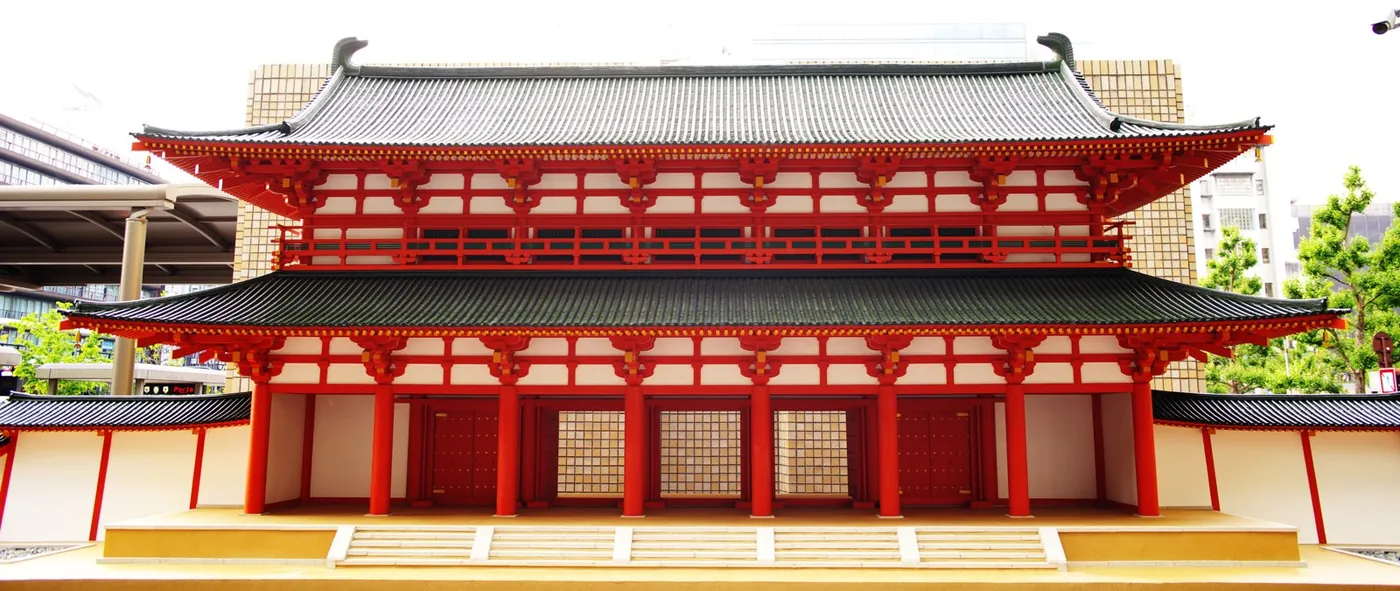
A model of Rajomon at Kyoto Station. Records are scarce, so its exact shape is a reconstruction. Photo: 名古屋太郎 (CC0), Wikimedia Commons
The story's Rashomon is a real gate: Rajomon, the main southern entrance to Heian-kyo, the old capital that is now Kyoto. "Rashomon" is a later way of writing its name. An old record describes it as a two-story gate seven bays wide.
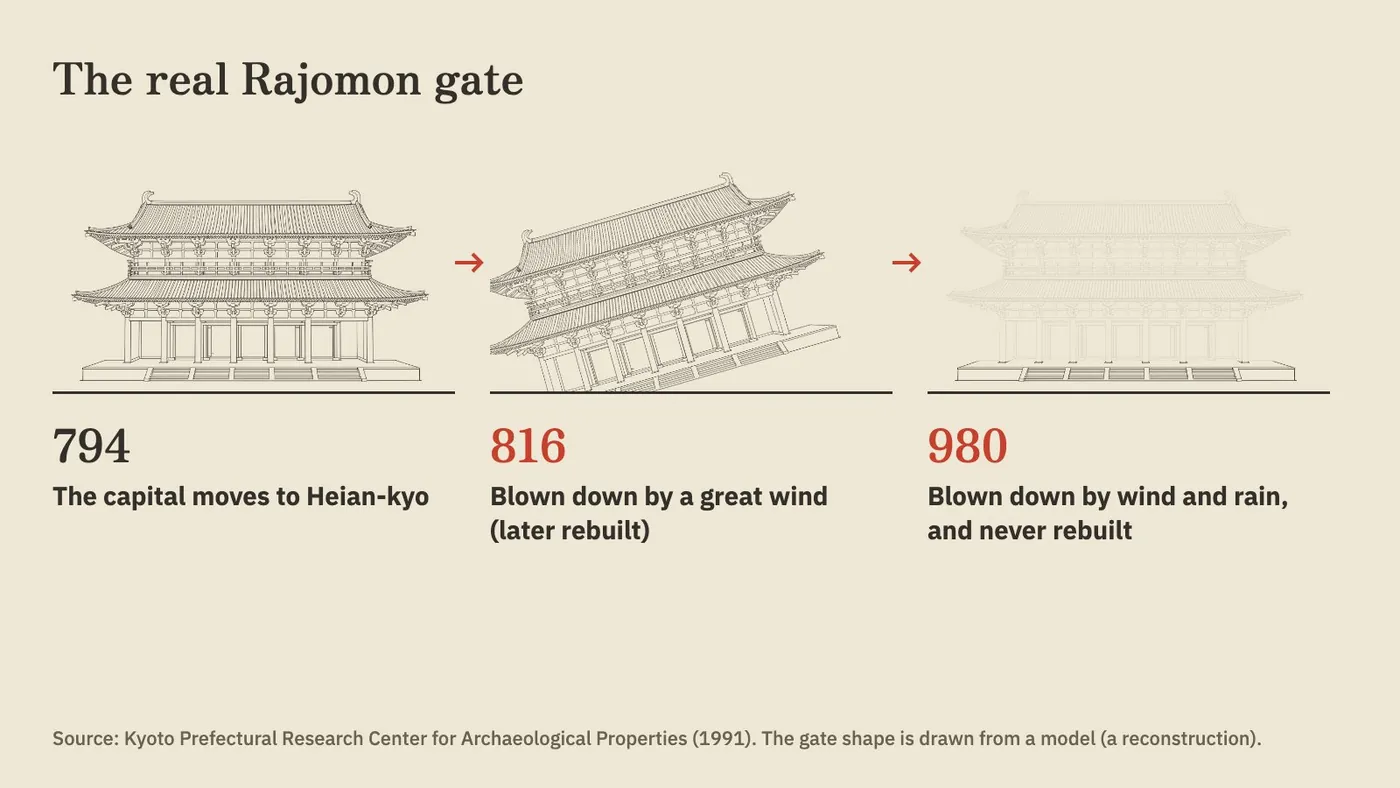
Rajomon was blown down in 816 and 980, and was never rebuilt after that
The capital moved to Heian-kyo in 794. Rajomon was blown down by a great wind in 816; the rebuilt gate fell in a storm in 980 and, despite plans, was never rebuilt. The Konjaku tale is said to show the gate as it was before 980, but the tale itself is a legend, not a record of real events.
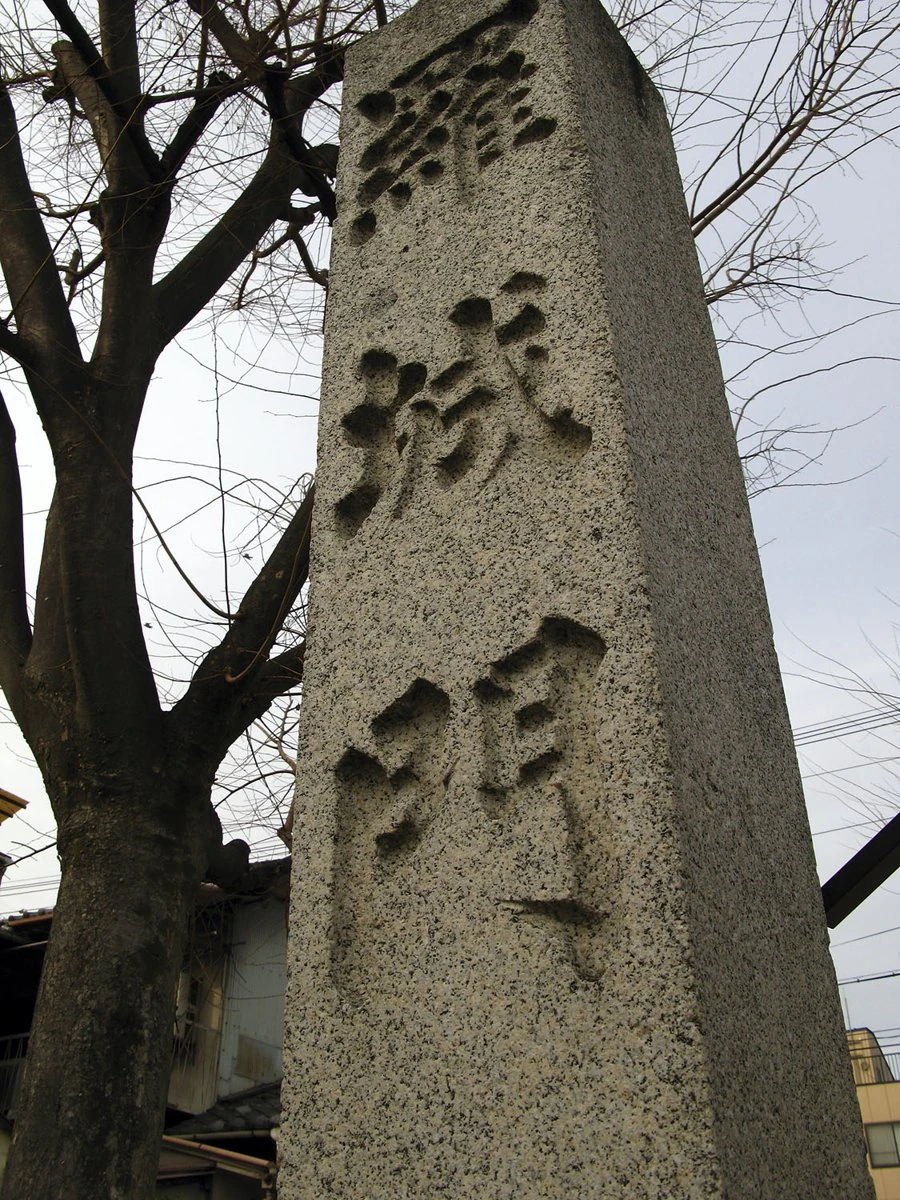
The stone marker at the site of Rajomon in Kyoto today. No clear remains of the gate have been found. Photo: Fg2 (public domain), Wikimedia Commons
About the story:
- Author: Ryunosuke Akutagawa (1892–1927).
- First published: Teikoku Bungaku magazine, November 1915. The text is dated September 1915, when he was 23 and studying English literature at Tokyo Imperial University.
- First book: Rashomon (Oranda Shobo), May 1917.
Questions to think about
There is no single right answer to these. Each can be checked against the text.
- If the old woman had simply begged for mercy, with no argument, which way would his mind have turned? In the old tale, she only begs. Look at exactly what the servant was listening to when his courage was born.
- How are his two kinds of courage different? The story says the courage to steal pushes in the opposite direction from the courage he showed when he leapt up and seized her. What was that first courage aimed at?
- What if the story still ended with him rushing off to rob? Compare an ending where we know where he is going with one where no one knows.
Frequently asked questions (FAQ)
Is Rashomon the story of the Kurosawa film?
No. Kurosawa's Rashomon (1950) takes its plot and characters from Akutagawa's story "In a Grove." It takes only its title and the gate setting from this story.
What happens to the servant at the end?
The story doesn't say. It ends, "No one knows where the servant went." Earlier versions ended with him hurrying into Kyoto to commit robbery.
Why is the old woman pulling out the dead woman's hair?
To make a wig. That is her answer when the servant asks.
What makes the servant decide to steal?
Courage is born in him "as he listened" to the old woman's excuse. The story doesn't say a single word changed him. In the end, he turns her own reasoning — "I'll starve if I don't" — back on her.
Was the servant a good man before this night?
The story doesn't say so. Under the gate he was already thinking that stealing was his only way out, and the text later says he had forgotten that he "was ready to become a thief himself."
What does "genin" mean?
A genin is a low-ranking servant. This one has just been let go by the master he served for years. The story never names him.
Read it yourself
- In Japanese (free): the modern-spelling text on Aozora Bunko, card 127. There is also an old-spelling edition based on the 1917 book, which still has the earlier last line: card 128.
- In English (free): Tales Grotesque and Curious, translated by Glenn W. Shaw (Hokuseido, 1930), includes "Rashōmon." It is public domain in the United States and free on Project Gutenberg. Its wording differs from the quotations above, which are our own translations.
- In English (modern translation): Rashōmon and Seventeen Other Stories, translated by Jay Rubin (Penguin Books, 2006).
Shorts
Sources
Where the facts and numbers in the video and on this page come from.
References
- Text: Aozora Bunko (card127, card128). Quotes are our own translations.
- Photo: Rajomon model by 名古屋太郎 (CC0), Wikimedia Commons
- Illustrations: made with image generators (Z-Image-Turbo, FLUX.2-klein, ChatGPT) and finished by Tamelabo. Diagrams by Tamelabo, based on the text of Rashomon.
Links
- Ryunosuke Akutagawa, Rashomon (Aozora Bunko, modern spelling) (and)aozora.gr.jp/cards/000879/files/127_15260.html
- old spelling ((in Japanese). All quotations are our own translations)aozora.gr.jp/cards/000879/files/128_15261.html
- Konjaku Monogatari, vol. 29, tale 18 (Yatanavi, CC BY-SA 4.0) (and)yatanavi.org/text/k_konjaku/k_konjaku29-18
- vol. 31, tale 31 ((in Japanese))yatanavi.org/text/k_konjaku/k_konjaku31-31
- Date of the Konjaku Monogatari: Kotobank ((in Japanese))kotobank.jp/word/%E4%BB%8A%E6%98%94%E7%89%A9%E8%AA%…
- Takako Ikegami, an essay on the rewritten ending of Rashomon, Nihon Bungaku Kenkyu 39 (2004) ((in Japanese))ypir.lib.yamaguchi-u.ac.jp/bg/1315
- National Diet Library Digital Collections: Rashomon (Oranda Shobo, 1917) (and)dl.ndl.go.jp/pid/1088339
- Hana (Shunyodo, 1918)dl.ndl.go.jp/pid/932985
- Kyoto Prefectural Research Center for Archaeological Properties, on the Rajomon site (1991) ((in Japanese))kyotofu-maibun.or.jp/data/kankou/kankou-pdf/jyouhou/kyoutofu…
- Wikipedia: Rashomon (film)en.wikipedia.org/wiki/Rashomon
- Project Gutenberg: Tales Grotesque and Curious, translated by Glenn W. Shawgutenberg.org/ebooks/78105
- Rajomon model by 名古屋太郎 (CC0)(and)commons.wikimedia.org/wiki/File:180427_Model_of_Raj%C5%8Dmon_…
- Rajomon site marker by Fg2 (public domain) (, Wikimedia Commons)commons.wikimedia.org/wiki/File:Kyoto_Rajomon_C1021.jpg
- Text: Aozora Bunko card127 (current text)aozora.gr.jp/cards/000879/card127.html
- card128 (the 1917 first book, earlier last line, old spelling)aozora.gr.jp/cards/000879/card128.html