Sangetsuki Summary: What Does the Tiger Ask His Friend? | Classics in 5 Minutes #06
The story in brief
- Li Zheng, who has become a tiger, meets his old friend Yuan Can.
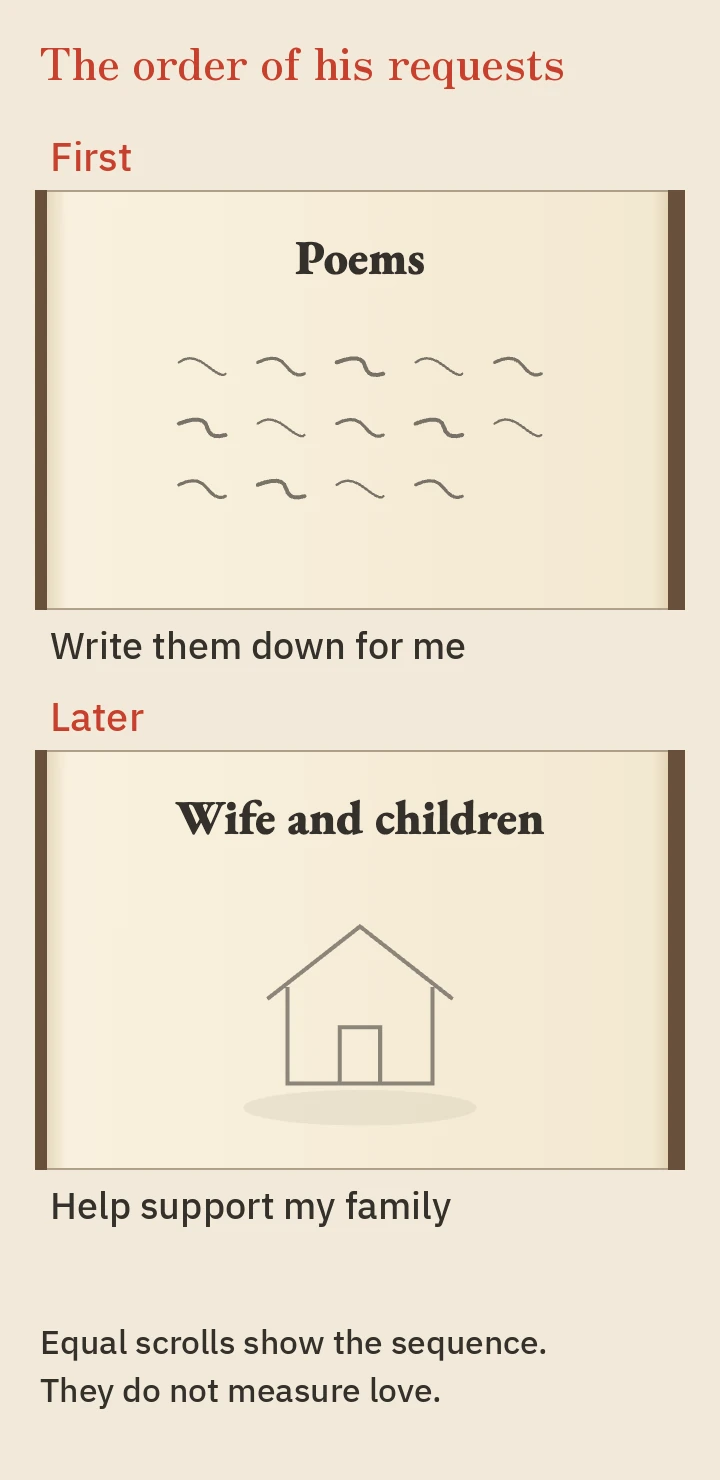
- He first asks Yuan Can to keep his poems, and only later asks him to care for his wife and children.
- Why does he want his friend to look at him only at the very end?
Video

Pressing play loads the YouTube player on this page. Watch on YouTube
Explained
In the video
- 0:00What does the tiger ask?
- 0:22Why return to office?
- 0:58Who recognizes the voice?
- 1:23What is in the stream?
- 1:45What does he fear losing?
- 2:13What should be written down?
- 2:37What does the listener hear?
- 2:59How does Li Zheng see himself?
- 3:27Who is listening now?
- 3:44Why ask about his family later?
- 4:19Why ask for one last look?
- 4:39What do they see from the hill?
- 5:08What does the original say?
Spoilers throughout, including the ending. A tiger speaks with an old friend’s voice. What does Li Zheng ask his friend to do, and why does the order trouble him? This guide follows the encounter and distinguishes what happens from what Li Zheng says about himself.
The story in 30 seconds
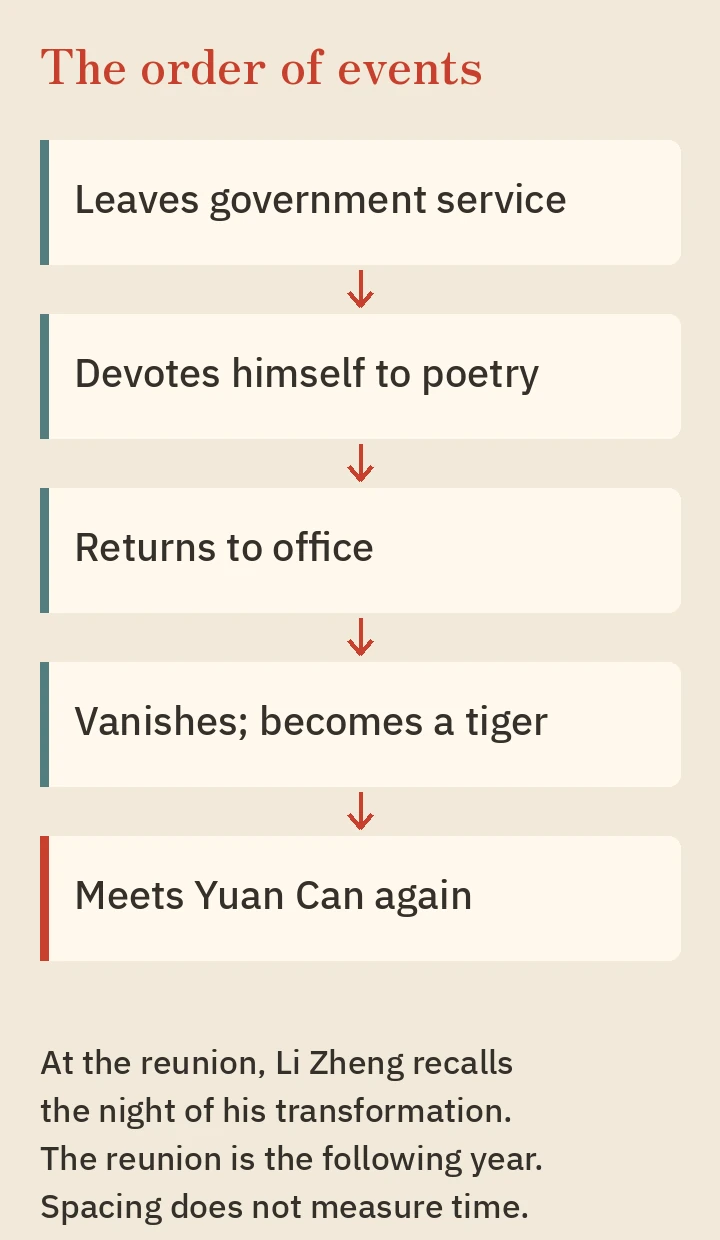
Li Zheng leaves government service to pursue fame as a poet, but poverty forces him back. He later vanishes while traveling. The following year, his friend Yuan Can encounters a tiger with Li Zheng’s voice. Still able to speak, Li Zheng fears losing his human mind. He asks for his poems to be recorded and reflects on the pride and shame that kept him from others. He then requests help supporting his family, reproaching himself for putting the poems first. At parting, he reveals his tiger’s body, roars toward the moon, and disappears into the grass.
Characters
- Li Zheng: a government official who hopes to make his name as a poet. After becoming a tiger, he can still speak and reflect on his past during periods when his human mind returns.
- Yuan Can: his close friend, who encounters him while traveling and listens to the voice hidden in the grass.
- Yuan Can’s attendant: the man who writes down Li Zheng’s poems. He is a separate person from Yuan Can.
- Li Zheng’s wife and children: the family whose future support he entrusts to his friend before they part.
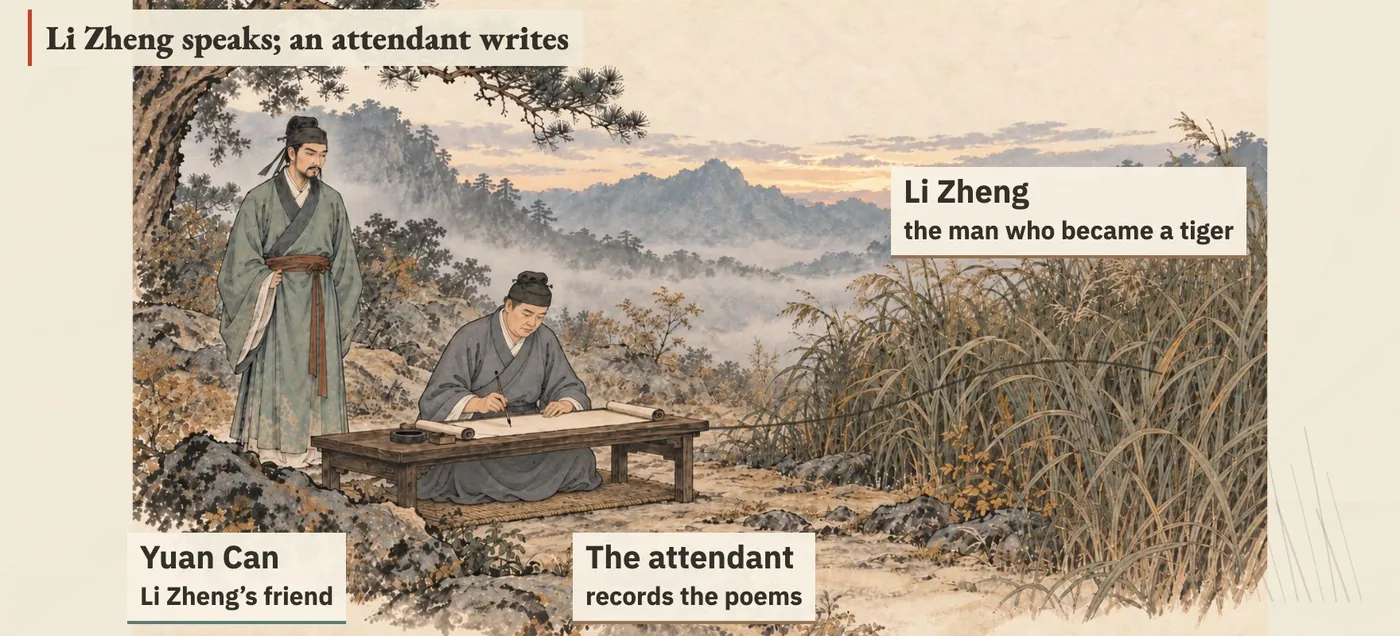
In our illustrations, the human Li Zheng wears gray-brown robes, Yuan Can wears pale teal, and the attendant wears gray with a black cap. These visual distinctions are artistic choices, rather than details specified in the story.
The story in detail: disappearance and reunion
Leaving office to pursue poetry
The story takes place in ancient China. The tiger was once a man named Li Zheng, a gifted official who leaves government work to pursue poetry. Recognition does not come, and poverty drives him back to office to support his wife and children. Former peers he looked down on are now his superiors. Taking their orders wounds his pride. One night, he runs into the darkness and vanishes.
A familiar voice the following year
The following year, his close friend Yuan Can meets a tiger on the road. It retreats into the grass, and Yuan Can recognizes the human voice that follows. He gets off his horse and listens. Li Zheng recounts following a voice into the night and discovering that he has become a tiger. Even after becoming a tiger, he says there are periods when his human mind returns: he can speak and recall his past. Those periods are growing shorter.
Japanese original: read this passage. Search term: 翌年.
Preserve the poems. But what does the listener hear?
Li Zheng first asks to have his remembered poems written down. One of Yuan Can's men does the writing. Yuan Can recognizes exceptional talent, yet feels that something is missing before the poems can become works of the highest order. This is his impression, and the text does not specify the missing quality.
Li Zheng still dreams of his collection lying on the desks of cultured people in Chang'an. He even composes a new poem during the encounter. Treating him simply as a failed writer with no talent would miss the difficulty of this scene. The illustration's ink marks represent a voice being recorded; they do not reproduce an actual poem.
Japanese original: read this passage. Search term: 他でもない.
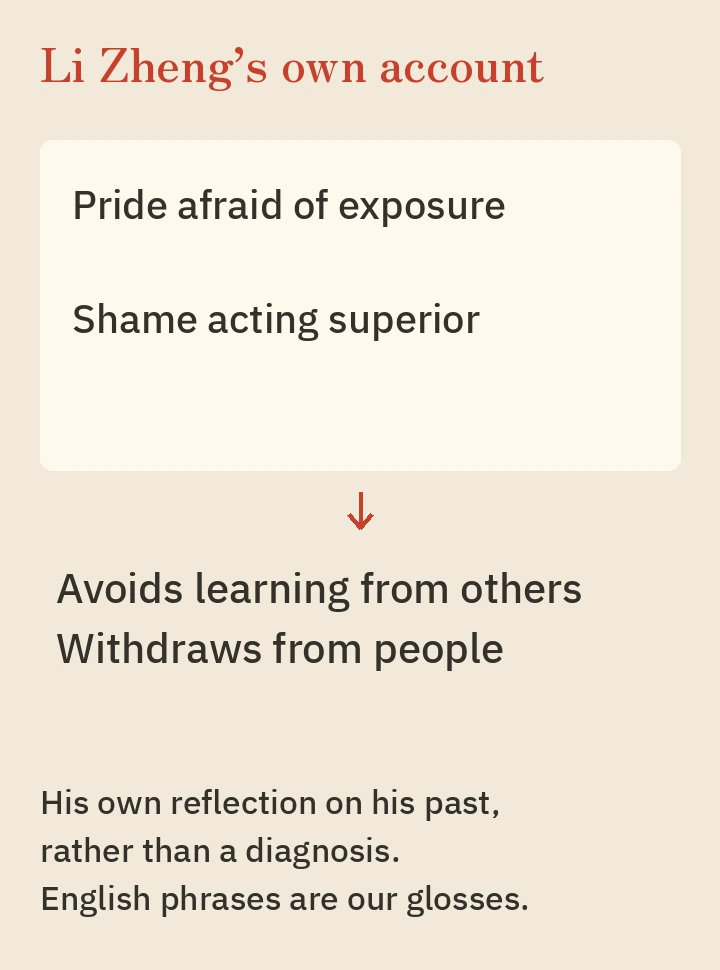
Pride afraid of exposure, shame acting superior
The Japanese phrases are 「臆病な自尊心」 and 「尊大な羞恥心」. Our explanatory gloss is “pride afraid of exposure” and “shame acting superior.” These are Li Zheng's own reflections, not a diagnosis supplied from outside the story.
He wants to believe he is exceptional, but fears discovering otherwise. He says he avoided learning from teachers and improving alongside other poets. He also blames his fear of exposing his limits and his reluctance to work hard. Protecting himself has kept him apart from people.
Earlier, he said he did not know why he had become a tiger. His later account does not establish a general law that pride causes physical transformation.
Japanese original: read this passage. Search term: 臆病.
Why does the family request come later?
As farewell approaches, Li Zheng asks Yuan Can to support his wife and children. He wants them told that he has died, without disclosing his transformation. Yuan Can agrees. Then Li Zheng reproaches himself for not asking about his family first.
Passage location: near the end, after Yuan Can agrees to support the family. The Japanese sentence is:
本当は、先ず、この事の方を先にお願いすべきだったのだ、己が人間だったなら。
In context, he is saying that the request about his family should have come first. It is Li Zheng himself who calls attention to the order. We do not have to conclude that he feels nothing for his family. He cares about them, yet has already asked about the poems. His awareness of that conflict gives the moment its force.
Japanese original: read this passage. Search term: 妻子のことだ.
The ending: why does he finally show himself? (Spoilers)
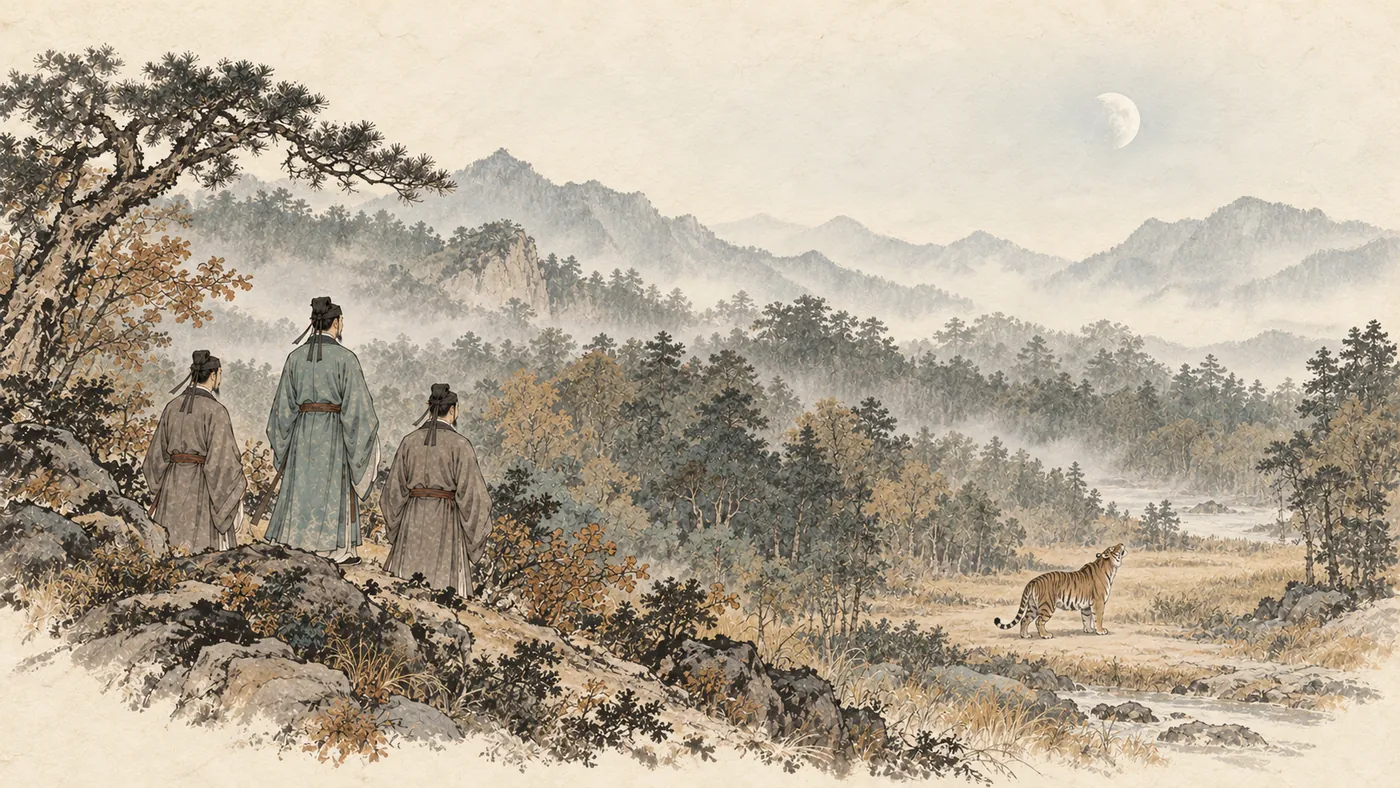
Li Zheng asks his friend not to return by the same road, fearing he may attack without recognizing him. Then he asks the travelers to look back from the hill ahead. He explains that seeing his appearance should discourage Yuan Can from coming to meet him again.
From the hill, they see a tiger emerge from the grass onto the path. He roars toward the fading moon, then retreats. The tiger is in the woodland clearing, not on a mountain summit.
We can read the decision to drive his friend away as an attempt to protect him. The story ends with the farewell, without telling us what happens to Li Zheng afterward. It leaves us with words heard across a hiding place, and a final glimpse of the body that had been hidden. The illustration imagines the composition; it is not a reconstruction of an identifiable location.
Japanese original: read this passage. Search term: 今別れてから.
Frequently asked questions
Why does Li Zheng become a tiger?
At first he says he cannot explain the transformation. Later, he reflects on his own pride and shame and says that his outward form came to match his inner nature. This is Li Zheng’s account of himself; it should not be presented as an independently established cause. Compare his recollection of the transformation with his later confession.
Does Yuan Can write down the poems?
An attendant writes them down at Yuan Can’s command. Li Zheng speaks from the grass, the attendant records his words, and Yuan Can listens. This happens immediately after Li Zheng asks for his poems to be preserved.
What should Li Zheng have asked for first?
Support for his wife and children. His self-reproach refers to the request he has just made about them, after already asking for the poems to be recorded. The order matters, but it does not prove that he feels nothing for his family. This passage follows Yuan Can’s agreement to help.
Does Li Zheng become human again at the end?
The final paragraph shows a tiger. Looking back from the hill, Yuan Can and his men see him emerge onto the path, roar toward the moon, and return to the grass. The story does not describe Li Zheng’s life after this farewell.
Finding your way into the original
Read Sangetsuki at Aozora Bunko (in Japanese). The text has no numbered chapters. Our links open the complete story, rather than jumping to a particular paragraph. To find one passage, use your browser’s “Find in page” command with the short Japanese term beside that section.
- The reunion:
翌年. - The request to preserve the poems:
他でもない. - Li Zheng’s reflection on himself:
臆病. - The family request:
妻子のことだ. - The request for a final look back:
今別れてから.
No knowledge of Japanese is needed to follow the English summary and commentary above. The original-language phrases are included as search aids. The English explanations are Tamelabo’s own wording, not quotations from a published English translation.
About the text
Sangetsuki was first published in the February 1942 issue of 文學界, paired with 文字禍 under the heading 古譚. Bibliographic source. This commentary checks the modern Japanese spelling edition. Edition details.
Original work: Atsushi Nakajima, Sangetsuki. Source: Aozora Bunko. Base edition: Riryo / Sangetsuki, Shincho Bunko, Shinchosha. Text entered by 平松大樹; proofread by 林めぐみ. Released November 12, 1998; corrected November 2, 2010. The digital text was created by Aozora Bunko volunteers. The English commentary is Tamelabo's own writing, not an excerpt from a published translation.
Sources
Where the facts and numbers in the video and on this page come from.
- Music (OpenTracks): “茶屋にて” by MATSU; “縁側” by siroimu; “百花繚乱” and “藁の記憶” (no artist listed).opentracks.com
- Japanese original: read this passageaozora.gr.jp/cards/000119/files/624_14544.html
- Edition detailsaozora.gr.jp/cards/000119/card624.html
- Bibliographic sourceaozora.gr.jp/cards/000119/card623.html
Voice, music, art
- Voices: Irodori-TTS (Japanese) and Kokoro (English), the selected series narrator.
- Music (OpenTracks): “茶屋にて” by MATSU; “縁側” by siroimu; “百花繚乱” and “藁の記憶” (no artist listed). https://opentracks.com/
- Fonts: Zen Old Mincho, IBM Plex Sans JP, EB Garamond, M PLUS Rounded 1c (SIL Open Font License).