Where Does the Thread Snap in The Spider’s Thread? | Classics in 5 Minutes #05
The story in brief
- From Paradise, the Buddha looks down on Kandata in Hell and lowers a spider’s thread.
- Kandata climbs up the thread toward Paradise, but the thread snaps and he falls back into Hell.
- So what does the text actually say about Kandata’s fear in that moment — and where does the thread snap?
Video

Pressing play loads the YouTube player on this page. Watch on YouTube
Explained
In the video
A silver thread descends into Hell. Kandata fears it will break in the middle. Do you remember where it actually snaps? We follow the story’s three parts, compare it with the older tale it is thought to draw on, and look closely at Paradise at the beginning and the end.
The story in 30 seconds
Includes the ending.
The Buddha remembers that Kandata, a robber suffering in Hell, once spared a small spider. Hoping to save him, the Buddha lowers a silver spider’s thread from Paradise. Kandata climbs, but sees other sinners following him and fears their weight will break the thread. He shouts that the thread is his. At that moment, it snaps right where he is hanging, and he falls back into Hell. The Buddha walks on with a sad face. The lotuses pay no attention and keep blooming. In Paradise, morning has become nearly noon.
▶ Watch the full video · 日本語
What kind of story is this?
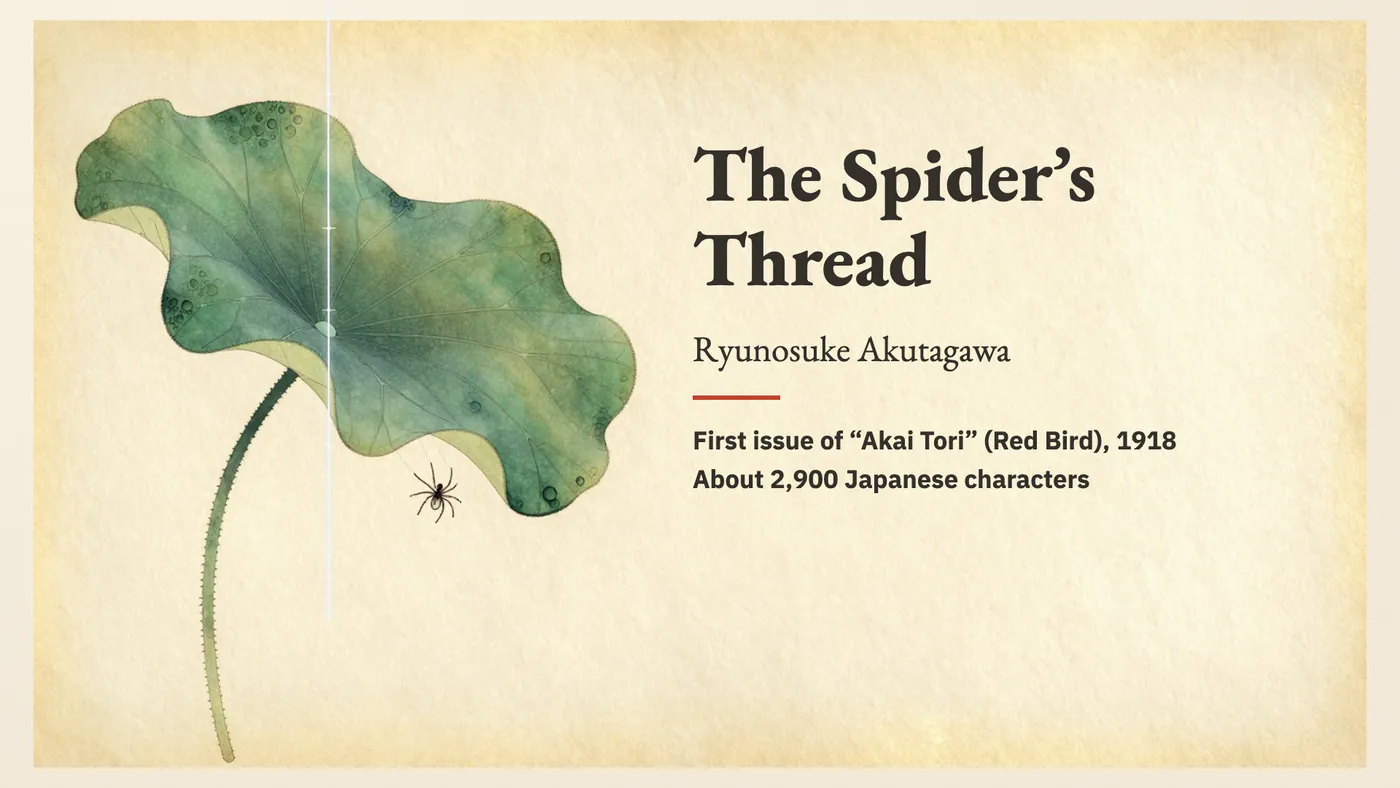
Ryunosuke Akutagawa (1892–1927) wrote this as his first story for children. It appeared in July 1918, in the first issue of Akai Tori (Red Bird), the children’s literary magazine founded by Miekichi Suzuki. The Japanese text ends with the date April 16, 1918, when Akutagawa was 26. See Aozora Bunko’s book card (in Japanese) and Rieko Chiko’s study (in Japanese).
The story is short: about 2,900 Japanese characters, arranged in three numbered parts. Our count of Aozora Bunko’s text is 2,854, including punctuation and quotation marks but excluding spaces, line breaks, part numbers and the final date.
What happens in the three parts?
Spoilers follow, including the ending.
Part 1: Morning in Paradise
The Buddha strolls alone beside a lotus pond in Paradise. Through its clear water he can see Hell directly beneath it, and notices Kandata, a great robber. Kandata has killed people and set houses on fire, but once spared a small spider he was about to crush. Remembering this one good deed, the Buddha lowers a beautiful silver thread from a spider in Paradise to the depths of Hell.
Part 2: The bottom of Hell
Kandata grasps the thread and climbs out of the Pool of Blood. Paradise is tens of thousands of ri away; exhausted, he rests and laughs, “I’ve done it!” when he sees the Mountain of Needles beneath his feet. Then he notices hundreds, thousands of sinners climbing after him like a line of ants. Afraid the thread will break in the middle, he shouts that it is his and orders them off. At that moment it snaps right where he is hanging, and he falls into the darkness; only a short, glittering thread remains.
Part 3: Nearly Noon in Paradise
The Buddha has watched it all. With a sad face, he walks on. The lotuses pay no attention: fragrance still flows from their golden centers, and it is nearly noon in Paradise.
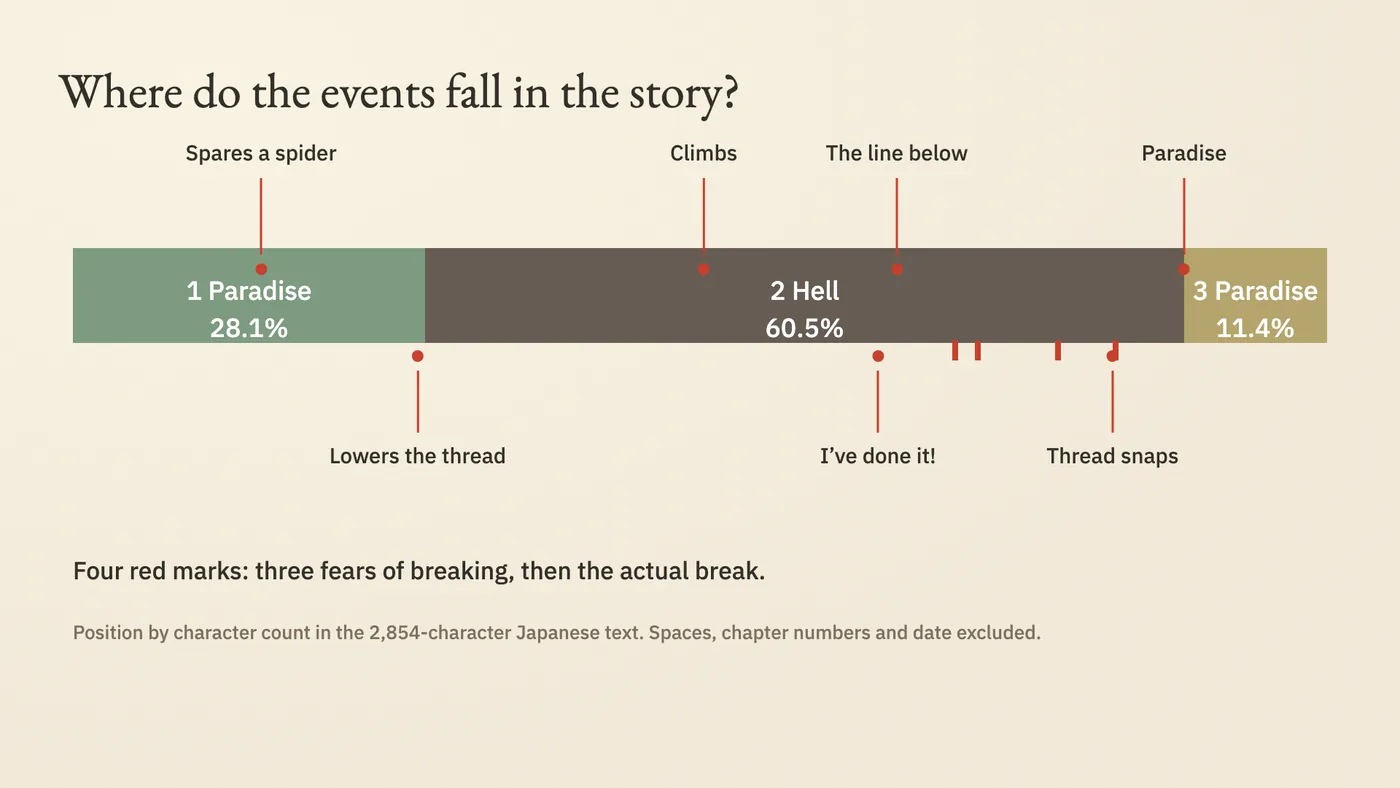
Part 1 has 803 characters (28.1%), Part 2 has 1,726 (60.5%), and Part 3 has 325 (11.4%). Positions on the band follow the text, not the video timeline. The four small red marks locate the Japanese word for breaking used in the next comparison.
Who and what are in the story?
| Person or thing | Role |
|---|---|
| The Buddha | Looks down from Paradise and lowers the thread. He has no dialogue. |
| Kandata | A great robber whose one good deed was sparing a spider. The original has three quoted speeches by him. |
| The spider of Paradise | Spins a beautiful silver thread on a lotus leaf. |
| The other sinners | Climb after Kandata, in their hundreds and thousands. |
Kandata’s name is written 犍陀多, read kandata. Counting exact character strings in the original gives 17 for his name, 14 for “thread” (including 10 for “spider’s thread”), 13 for “Hell,” 10 for “Paradise,” 7 for “the Buddha,” 7 for “Pool of Blood,” and 25 for the sequence ございま, part of the polite narration. These are literal text counts, not counts classified by meaning or speaker.
Where does the thread snap?
The answer is in this sentence:
The spider’s thread, which had held fine until then, suddenly snapped with a sharp little sound, right where Kandata was hanging. — Akutagawa, The Spider’s Thread, Part 2, our translation
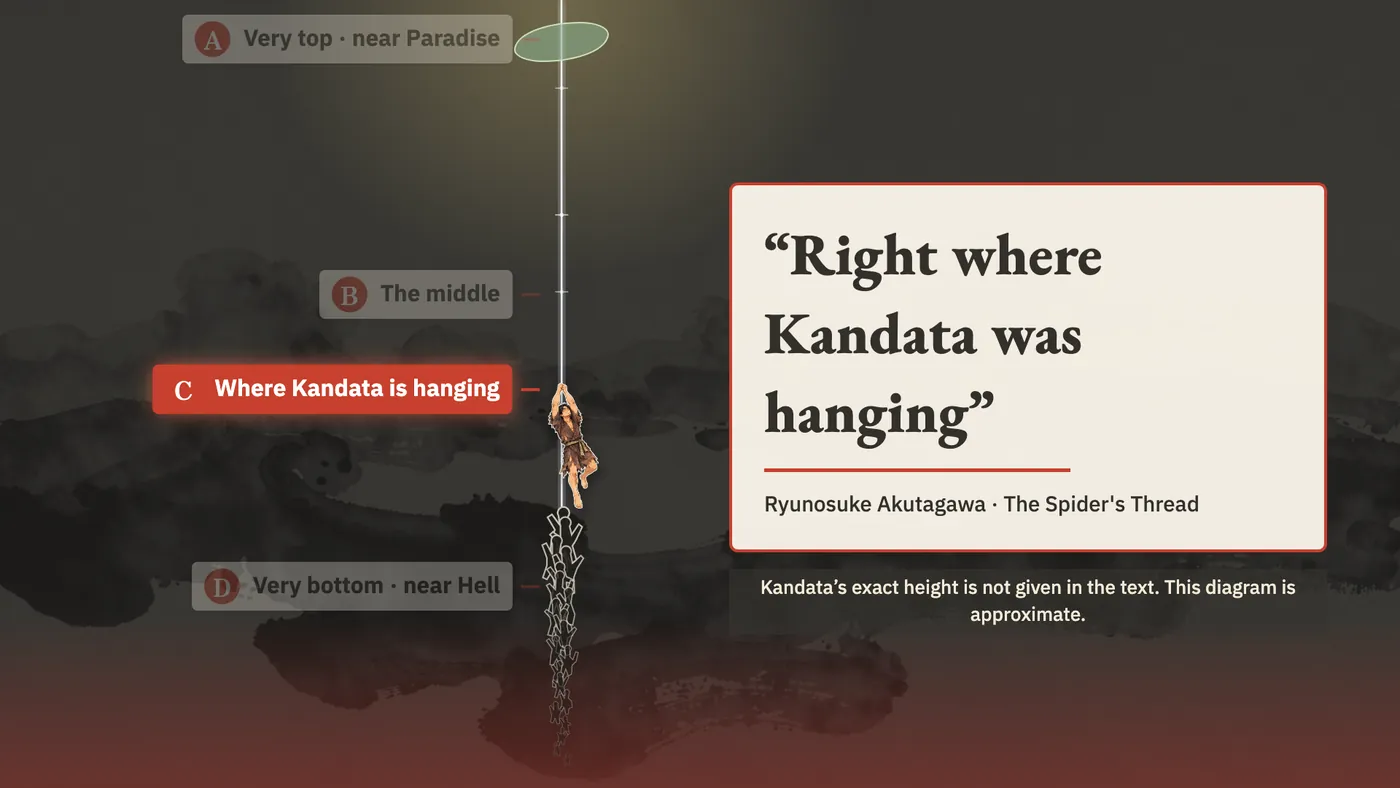
The thread had held fine while hundreds, even thousands of sinners climbed it. It broke at the very moment he shouted. In the video, the thread snaps as this sentence is spoken.
The text does not give Kandata’s exact height on the thread. It only says he is hanging partway up. In our approximate diagram we put him below the midpoint, interpreting his fear that a break in the middle would make him fall too. We cannot state as a textual fact that the actual spot was not the middle.
Part 3 describes his merciless wish to escape alone and his falling back into Hell as a punishment fitting that heart. Reading significance into the location of the break is one possible interpretation. The text does not explain a physical mechanism by which his heart could cut a thread.
Why does Kandata fear a break three times?
| Wording in the original, translated here | Position in text | What is happening? |
|---|---|---|
| “Likely to break even with him alone” | 70.1% | Fear of his own weight |
| “If, by some chance, it broke along the way” | 71.9% | Fear of falling back |
| “The thread would break in two at the middle” | 78.3% | Fear as more sinners climb |
| “Snapped … right where Kandata was hanging” | 82.9% | The actual break |
The Japanese string 断れ occurs four times: three fears concerning the load, followed by the event itself. Put the fear’s wording, “at the middle,” beside the event’s wording, “where Kandata was hanging.” Whether those heights coincide is not specified.
What is the older tale?
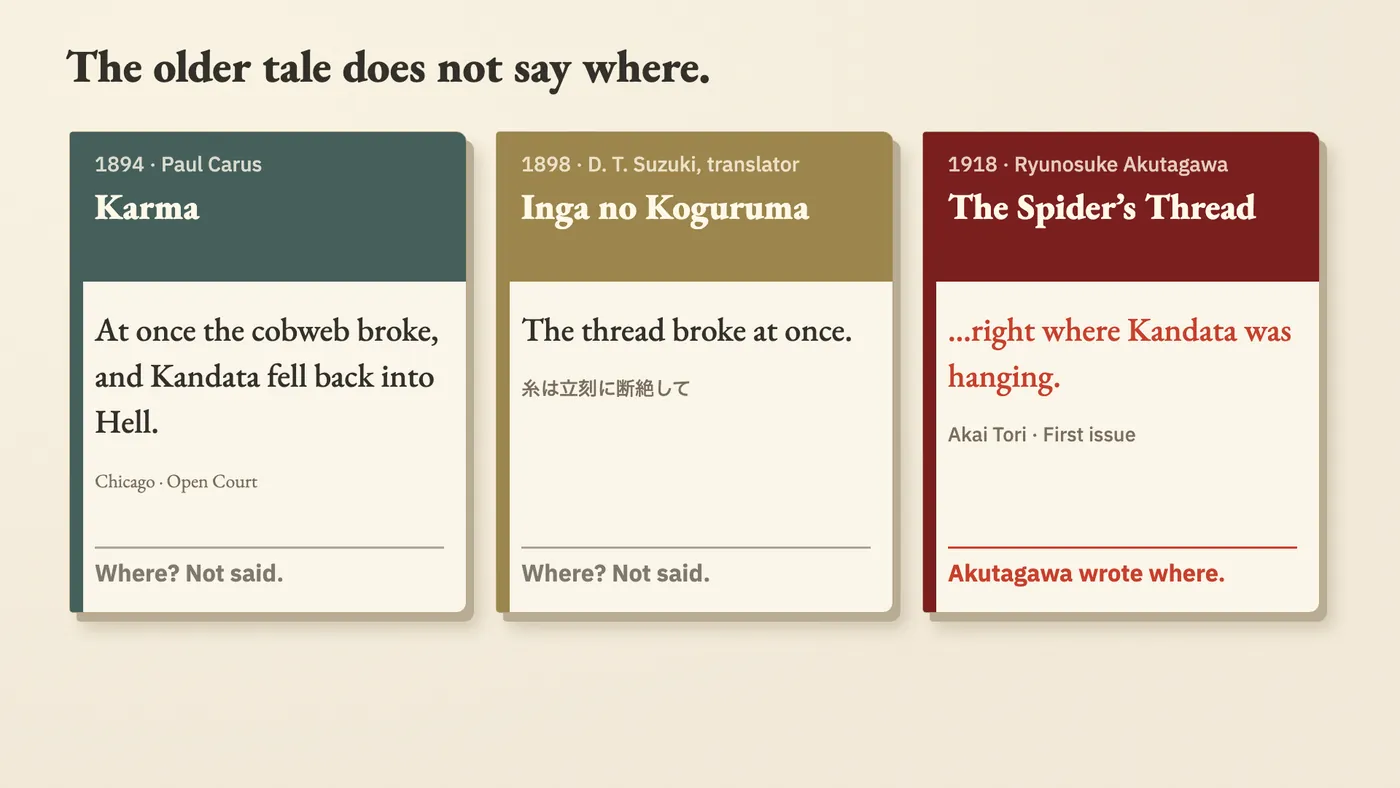
Paul Carus’s Karma: A Story of Buddhist Ethics, published by Open Court in Chicago in 1894, includes “The Spider-Web.” Teitaro Suzuki, better known as D. T. Suzuki, translated it as Inga no Koguruma, published by Hasegawa in 1898. Researchers regard this translation as the source Akutagawa adapted. Another proposed connection is the “little onion” story in Dostoevsky’s The Brothers Karamazov. See studies by Kinzo Ikuno, Nobuhiko Kobayashi and Kayoko Nagao (in Japanese; Nagao includes an English abstract).
| Scene | Carus, Karma (1894) | Suzuki’s Japanese translation (1898) | Akutagawa (1918) |
|---|---|---|---|
| Who tells it? | A monk tells a dying robber chief | The same framing | A polite narrator |
| Plea for help | The man asks the Buddha for mercy | The man asks for mercy | No plea; the thread descends silently |
| Sparing the spider | The spider is harmless | Killing the harmless creature would be cruel | Small as it is, it is alive |
| Invitation to climb | The spider says, “Take hold of the web and climb up.” | The spider gives the invitation | No invitation |
| Fear | “How can this thin thread bear the weight of all?” | The thin, weak thread might break partway | It will break in two at the middle |
| Shout | “Let go the cobweb. It is mine!” | Go away; this thread is mine | This spider’s thread is mine |
| Break | “At once the cobweb broke, and Kandata fell back into Hell.” No location | It breaks at once and he falls back. No location | Right where Kandata is hanging |
| Afterward | A monk’s lesson: more climbers make the effort easier for everyone | The same lesson | The quiet lotuses of Paradise, nearly noon |
Carus’s quoted English is from the 1894 edition. For Suzuki we checked pages 18–19 of the 1898 edition; English renderings and unquoted entries in the table are our translations or summaries. The Japanese phrase 糸は立刻に断絶して means “the thread broke at once.” It does not say where.
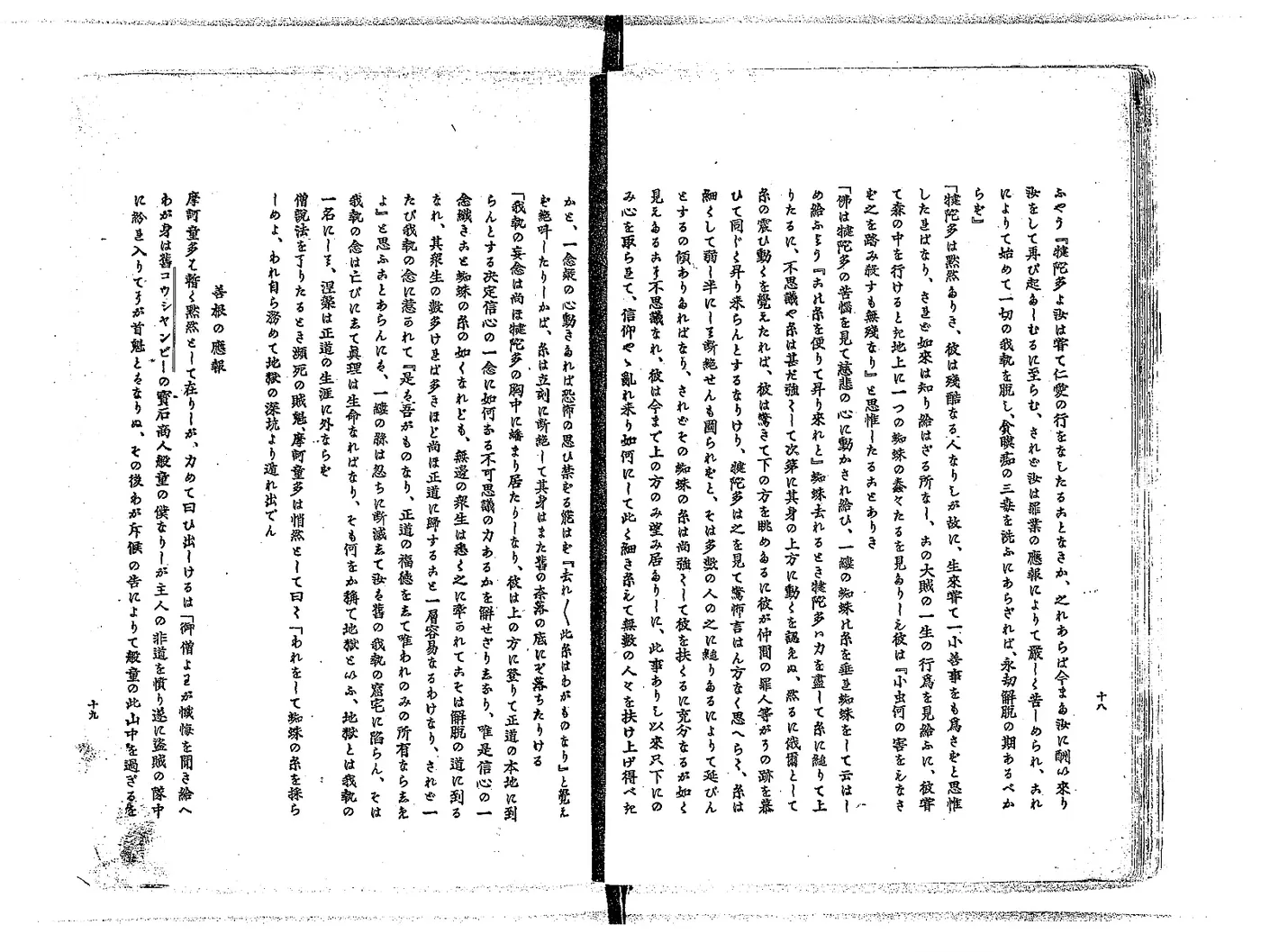
Source: National Diet Library Digital Collections, Inga no Koguruma (1898), marked PDM (public domain). The image has not been cropped, recolored or overprinted. Two relevant lines, transcribed in modern Japanese characters, are 糸は細くして弱し半にして断絶せんも図られぬ and 糸は立刻に断絶して.
What stays the same in Paradise?
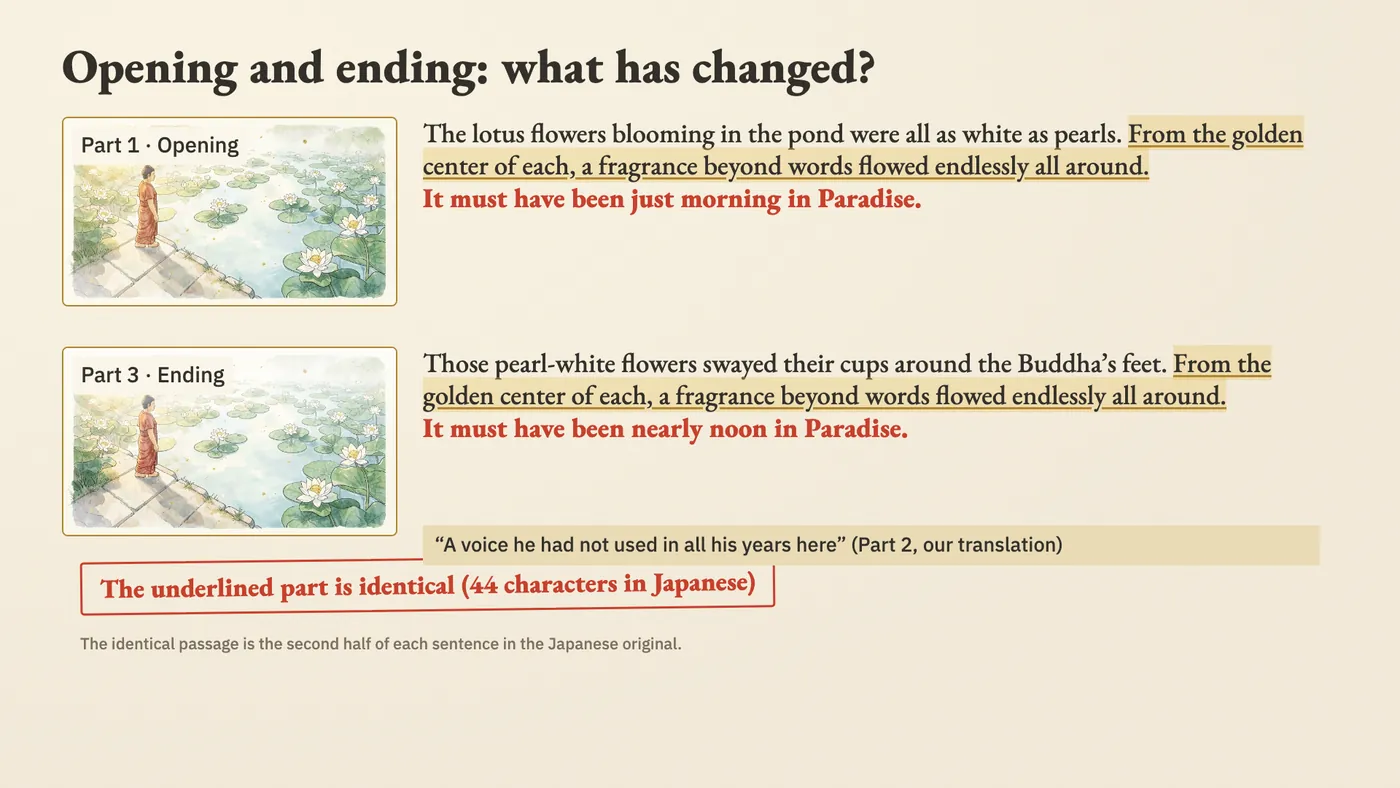
In the original Japanese, the opening sentence has 71 characters and the closing sentence 80. Their first halves differ. But the passage after a comma is identical:
From the golden center of each, a fragrance beyond words flowed endlessly all around.
That is our translation of a 44-character Japanese passage, including punctuation. It is the second half of each sentence, not the whole sentence. We use the same English wording for the identical Japanese. In the very next sentence, “just morning” becomes “nearly noon.” Chiko’s study (in Japanese) also discusses the close similarity of the opening and closing descriptions.
Kandata laughs in a voice he has not used in all his years in Hell. Yet, in Paradise, the events from the lowering of the thread to its breaking take place between morning and just before noon. The text does not tell us whether time flows at the same rate in the two places. All the while, the lotuses keep blooming.
How far is “tens of thousands of ri”?
Using the Japanese ri of the time, one ri was 36 cho, about 3.927 km. Even at the low end, 10,000 ri is about 39,000 km: 98% of the Earth’s roughly 40,000-km equatorial circumference. See Daijisen’s entry for ri (in Japanese) and NASA’s Earth Fact Sheet.
The calculation is 10,000 × 3.92727 km ≈ 39,273 km. NASA’s equatorial radius of 6,378.137 km gives 2 × π × 6,378.137 km ≈ 40,075 km around the equator. The story’s phrase conveys an immense distance; it is not a measured distance.
Can real spider silk hold a person?
In 2006, Professor Shigeyoshi Osaki of Nara Medical University succeeded in an experiment with a person hanging from a rope made of spider silk. The university reports a rope 3 mm in diameter holding a person weighing 66 kg. See JSPS KAKENHI News, 2010 Vol. 3, p. 13 (in Japanese) and Nara Medical University’s report (in Japanese).
The university also reports a spider’s lifeline as having twice the strength needed for the spider’s weight and consisting of two filaments; one can support it if the other breaks. These numbers belong to those reported conditions. We do not extrapolate them into a count of people. The story uses a spider’s thread from Paradise: a real experiment cannot decide whether the fictional thread is right or wrong.
How can you read the original?
Aozora Bunko No. 92 (in Japanese) is free. About 2,900 characters makes it a short read: under ten minutes aloud at the pace used for our estimate (about 8.8 minutes). Find the breaking sentence near the end of Part 2, roughly 83% of the way through the text, then read around it.
A free English translation by Glenn W. Shaw is in Standard Ebooks’ Akutagawa collection. Carus’s older English tale is in Karma at the Internet Archive. The English narration and quotations in our video and article are our own translations, rather than Shaw’s.
Shorts
Sources
Where the facts and numbers in the video and on this page come from.
References
- Akutagawa, The Spider’s Thread (1918), Aozora Bunko No.92 (in Japanese)
- Paul Carus, Karma (1894), “The Spider-Web”
- D. T. Suzuki’s Japanese translation, Inga no Koguruma (1898), National Diet Library (in Japanese)
Links
- Aozora Bunko No. 92 (in Japanese) (, based on Chikuma Bunko’s Akutagawa Ryunosuke Zenshu 2. Older works:)aozora.gr.jp/cards/000879/card92.html
- Carus, Karma (1894) (and)archive.org/details/karmaastorybudd00carugoog
- Suzuki, Inga no Koguruma (1898, in Japanese) (. Research:)dl.ndl.go.jp/pid/896667
- Ikuno (,)tsukuba.repo.nii.ac.jp/record/23884/files/4.pdf
- Kobayashi (,)stars.repo.nii.ac.jp/record/8031/files/KJ00000184538.pdf
- Nagao (and)ouhs.repo.nii.ac.jp/record/1247/files/OUHS-kiyo%E4%BD%93-37…
- Chiko ((in Japanese). Unit, Earth and experiment sources are linked in their sections)kbu.repo.nii.ac.jp/record/3371/files/02_%E5%8D%83%E5%8F%A4…
- Standard Ebooks’ Akutagawa collectionstandardebooks.org/ebooks/akutagawa-ryunosuke/short-fictio…
- Daijisen’s entry for ri (in Japanese)kotobank.jp/word/里
- NASA’s Earth Fact Sheetnssdc.gsfc.nasa.gov/planetary/factsheet/earthfact.html
- JSPS KAKENHI News, 2010 Vol. 3, p. 13 (in Japanese)jsps.go.jp/j-grantsinaid/22_letter/data/news_2010_…
- Nara Medical University’s report (in Japanese)naramed-u.ac.jp/university/oshirase/hese25nendoizen/doc…
Voice, music, art
- Voices: Irodori-TTS (Japanese), Kokoro-82M (English).
- Music (OpenTracks): “神秘的な和の夜” by ゆうり; “百花繚乱”; “茶屋にて” by MATSU; “藁の記憶”. https://opentracks.com/
- Sound effects: Freesound (CC0), Kenney Impact Sounds (CC0), and Tamelabo synthesis.
- Original illustrations: ChatGPT, Z-Image-Turbo, FLUX.2-klein. Diagrams, animation and light: Tamelabo code.
- Fonts: Zen Old Mincho, IBM Plex Sans JP, Shippori Mincho, EB Garamond, M PLUS Rounded 1c (SIL OFL).