What Is Night on the Galactic Railroad About? A 5-Minute Summary | Classics in 5 Minutes #07
The story in brief
- On the night of the star festival, a boy named Giovanni rides a train across the Milky Way with his friend Campanella.
- The journey ends by a river, where Giovanni learns something that changes how the story's first words sound.
- How does Campanella's question — “Will my mother forgive me?” — sound once you know how the journey ends?
Video

Pressing play loads the YouTube player on this page. Watch on YouTube
Explained
In the video
- 0:00What is this story about?
- 0:27Why is Giovanni so alone?
- 1:12Where does Giovanni find himself?
- 1:45What does Campanella ask about his mother?
- 2:21What is the ticket that goes anywhere?
- 2:47Who are the passengers bound for heaven?
- 3:20What does the scorpion's fire light up?
- 4:01Can the two friends stay together?
- 4:58What does Giovanni learn by the river?
- 5:53How do the first words sound now?
- 6:39Where should you start reading the original?
- 6:47What is Classics in 5 Minutes?
Giovanni and Campanella travel on a train across fields of stars. If a ticket can take you anywhere, can it also keep you together with a friend? This article follows the story, then returns to the words exchanged across their seats. It discusses the ending.
The story in 30 seconds
Giovanni is a boy who works while attending school and cares for his sick mother. On the night of a festival, he lies down on a hill and finds himself traveling through fields of stars with his friend Campanella. They meet strange passengers and hear a story about a scorpion that becomes a light for others. Their conversations turn to happiness. Then Campanella disappears. After waking, Giovanni learns that his friend jumped into a river to help a classmate and has not returned. Carrying milk for his mother, Giovanni runs toward home, while the question of happiness remains open.
Characters
- Giovanni attends school and works in a print shop. He sets out to collect milk for his sick mother and finds himself traveling by train with his friend.
- Campanella is Giovanni's friend, sitting in the opposite seat. He speaks about his mother's forgiveness and happiness.
- Giovanni's parents: his mother is ill and his father is away. Giovanni insists that his father cannot have done anything bad enough to go to prison.
- Zanelli and Marso are classmates. Zanelli teases Giovanni during the festival; Marso explains events beside the river near the end.
- The bird catcher, a young man, and two siblings are fellow travelers. The bird catcher comments on Giovanni's pass. The young man describes a shipwreck, and the girl tells the scorpion's story.
- Campanella's father watches his clock beside the river near the end.
Source: Aozora Bunko, Night on the Galactic Railroad, sections one through four and six through nine. The events at the river are discussed under “The ending” below.
Plot summary by section
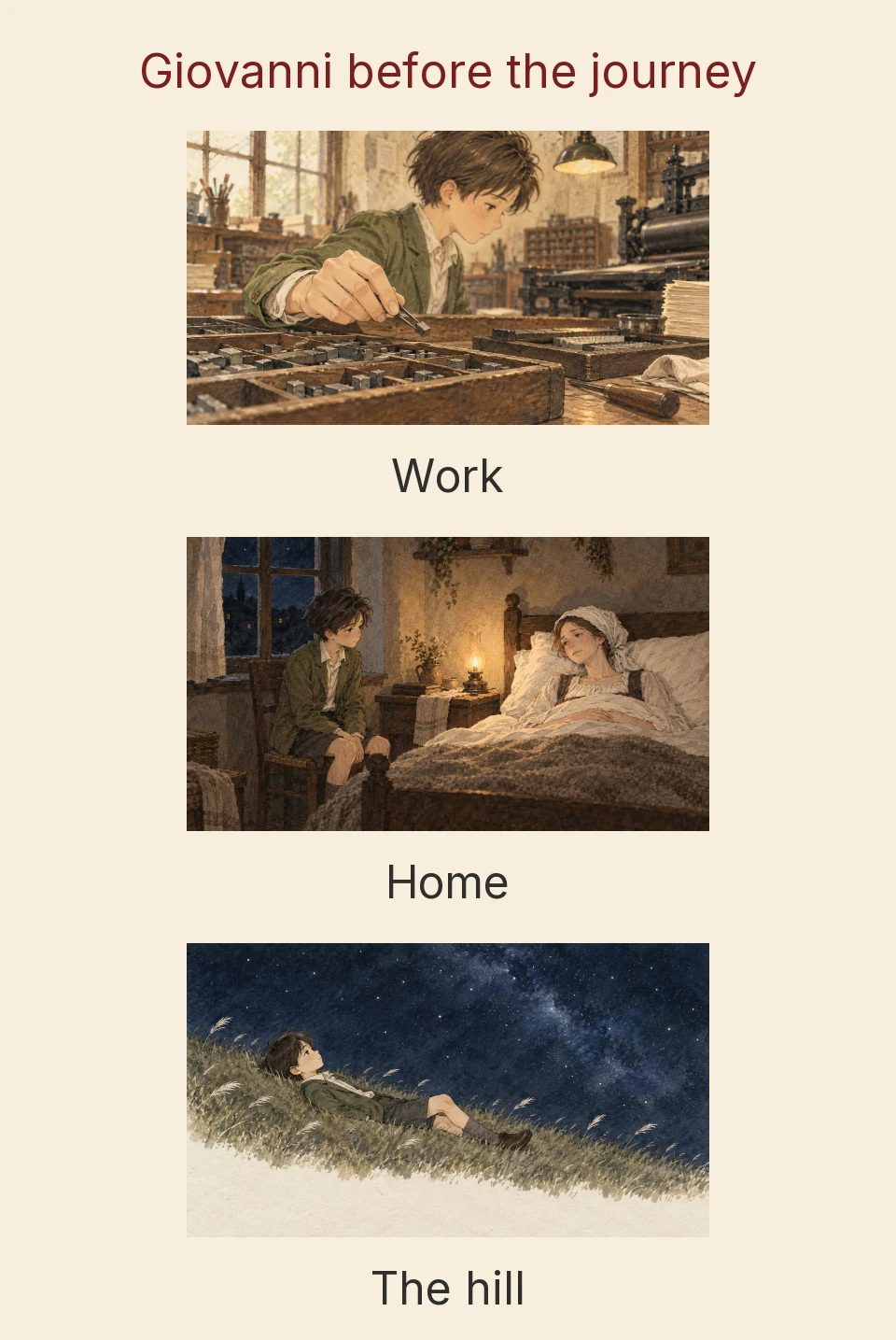
Sections one to five: Giovanni before the journey
Giovanni works while attending school. He is sleepy in class and cannot answer a question even though he knows the answer. After school, he picks out small pieces of type in a print shop. His mother is ill, and his father is away. In conversation with his mother, Giovanni insists that his father cannot have done anything bad enough to go to prison. The story does not establish that his father has committed a crime.
On the night of the star festival, he goes to fetch milk for his mother. A classmate, Zanelli, teases him about his father. At the dairy, he is told to return later. Afterward, a group of classmates teases him again at a crossroads. Campanella looks at him with sympathy rather than joining the teasing. Giovanni leaves the town and lies in the grass on a hill. The presence of a friend does not automatically make Giovanni feel less alone.
Source: Aozora Bunko, Night on the Galactic Railroad, sections one through five.
Sections six to nine: people in the fields of stars
Giovanni finds himself on a small train, with his friend Campanella in the seat across from him. Campanella says that Zanelli has gone home and that his father came to fetch him. As he speaks, he looks a little pale and troubled. Outside are glowing triangular markers, silver reeds, and purple gentians. The Milky Way has become a transparent river. The boys get off at the Swan station and explore crystal sand and an excavation at the Pliocene Coast. Earlier in their conversation, Campanella also wonders whether his mother will forgive him. He wants her to be happy, and says that doing something truly good brings happiness. The text describes him as seeming to have made up his mind.
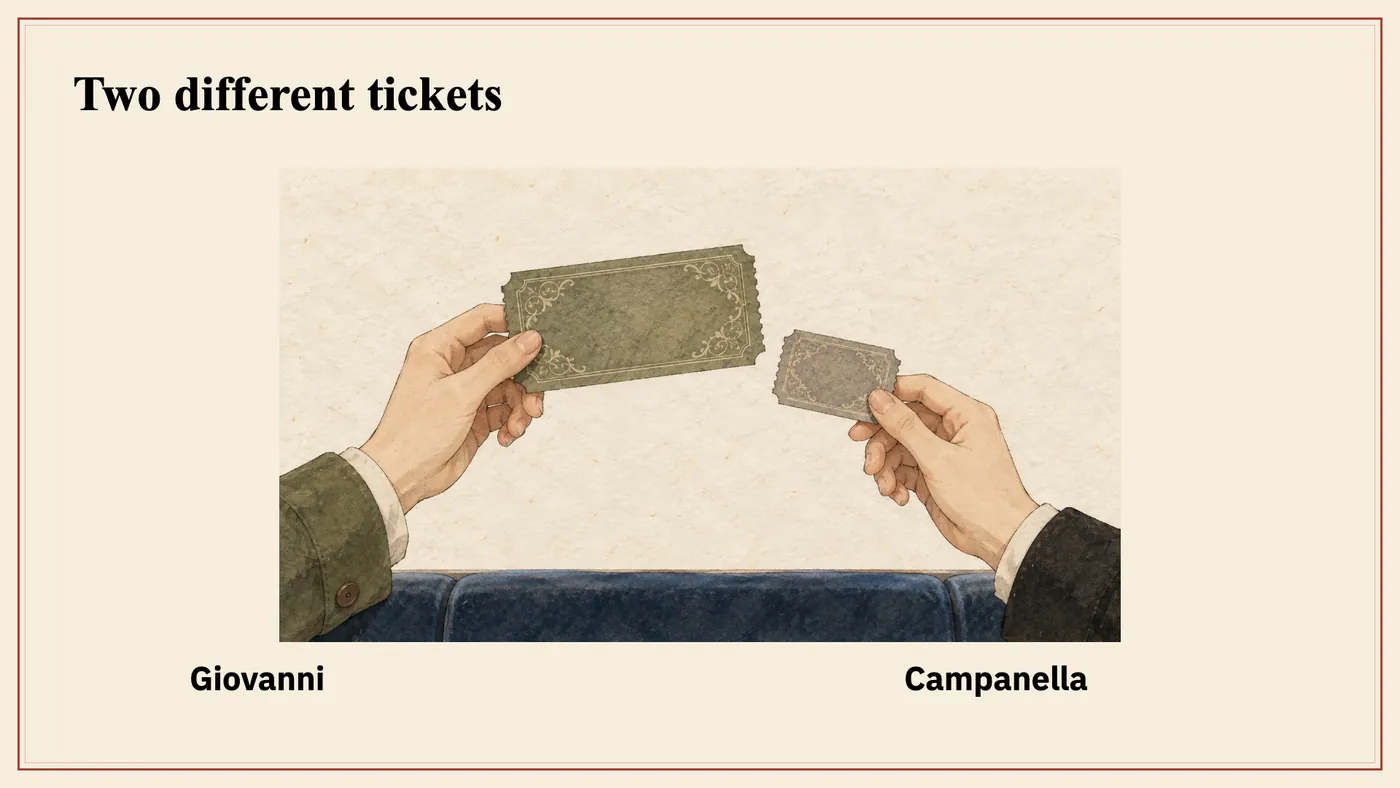
A bird catcher joins them with birds that can be eaten and taste like sweets. During the ticket inspection, Campanella produces a small gray ticket. Giovanni finds a larger green paper in his pocket. The bird catcher describes it as a pass that lets its holder go anywhere. The text does not explain what the difference between the tickets means.
After the bird catcher disappears, Giovanni regrets having thought of him as a nuisance. A young man and two children then arrive and tell of a shipwreck. Giovanni thinks about other people's happiness, yet feels lonely when Campanella talks with the girl. Compassion and jealousy occupy the same heart.
Source: Aozora Bunko, Night on the Galactic Railroad, sections six through nine.
Section nine: the scorpion and the Southern Cross
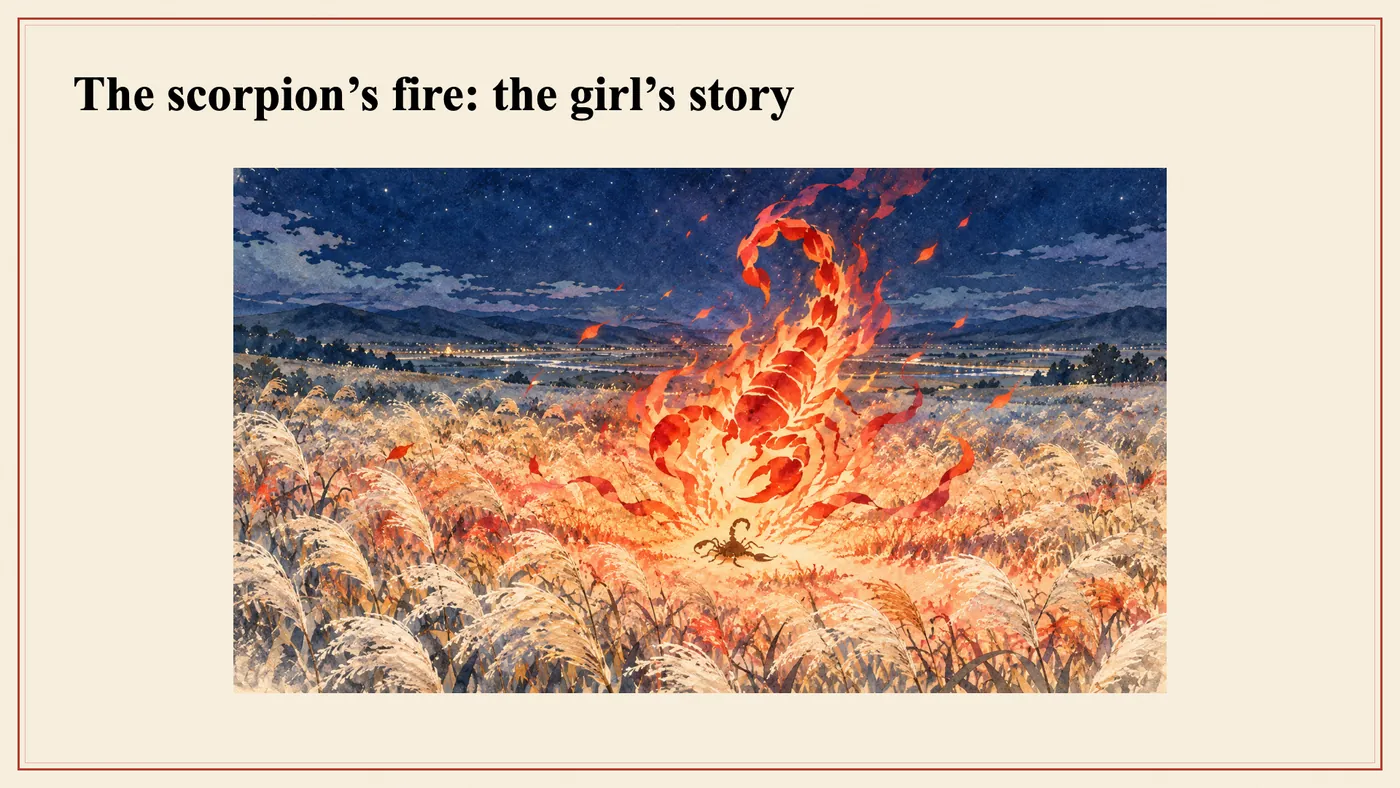
The girl tells a story she heard from her father. A scorpion, pursued by a weasel, falls into a well. It prays that its life might serve everyone's happiness and becomes a red fire that lights the night. This is a story told by a passenger.
After the young man and the children leave at the Southern Cross, Giovanni says that he would let his body burn a hundred times, like the scorpion, for everyone's happiness. Campanella says he would too. Immediately after expressing such resolve, they ask what happiness itself means.
Source: Aozora Bunko, Night on the Galactic Railroad, section nine, the scorpion story and the conversation after the Southern Cross.
The ending: an empty seat and the river back home
The following section discusses the friends’ parting and what Giovanni learns at the river in detail.
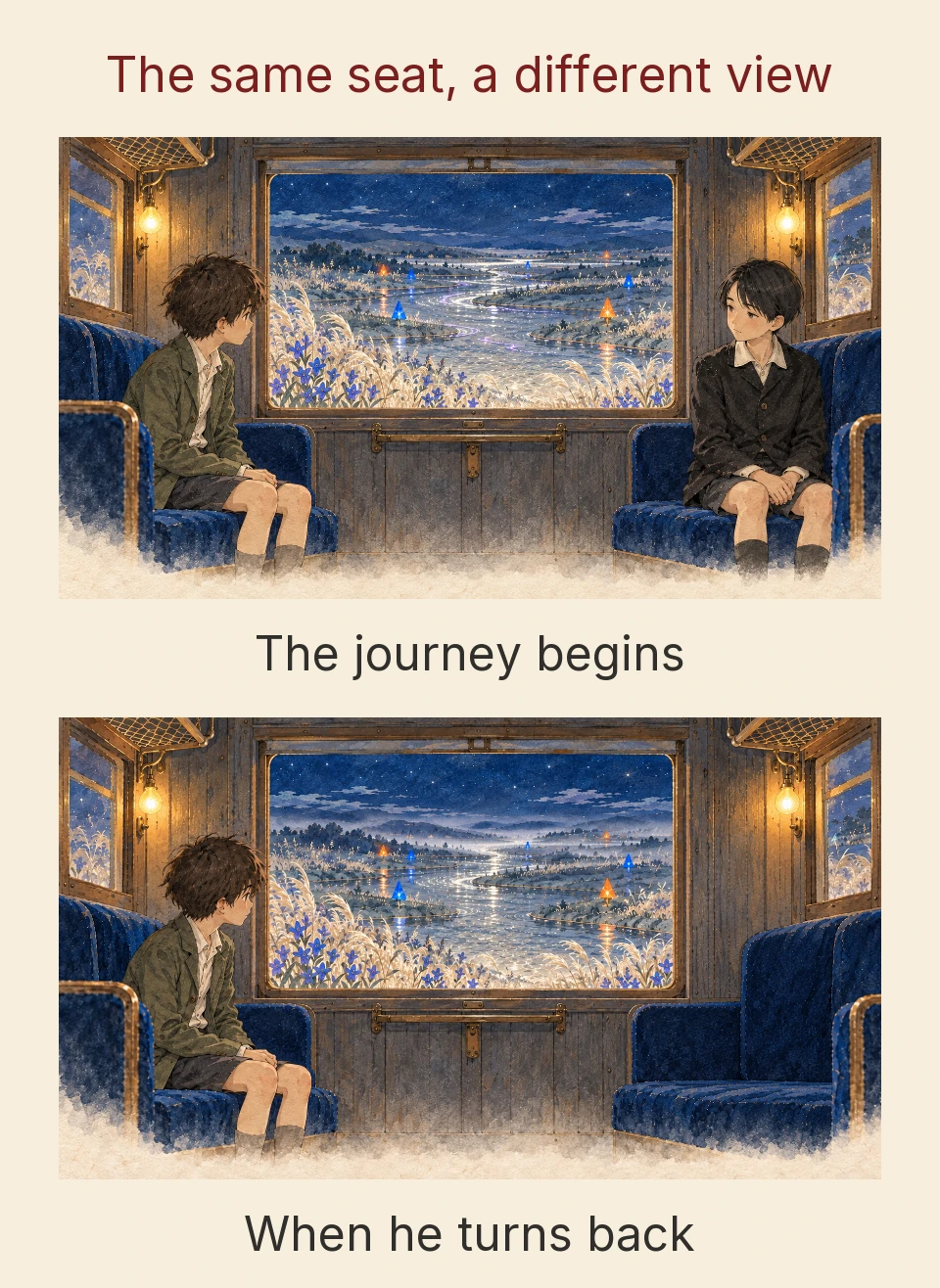
Campanella says that his mother is in a distant field. Giovanni sees only a pale, misty landscape. When he turns back, his friend's seat is empty.
Giovanni wakes on the hill and receives a warm bottle of milk at the dairy. Later, he finds people gathered beside the river. His classmate Marso explains that Campanella jumped in to help Zanelli, another classmate, who had fallen from a boat. Zanelli was saved, but Campanella cannot be found. Watching his clock, Campanella's father says that there is no hope left.
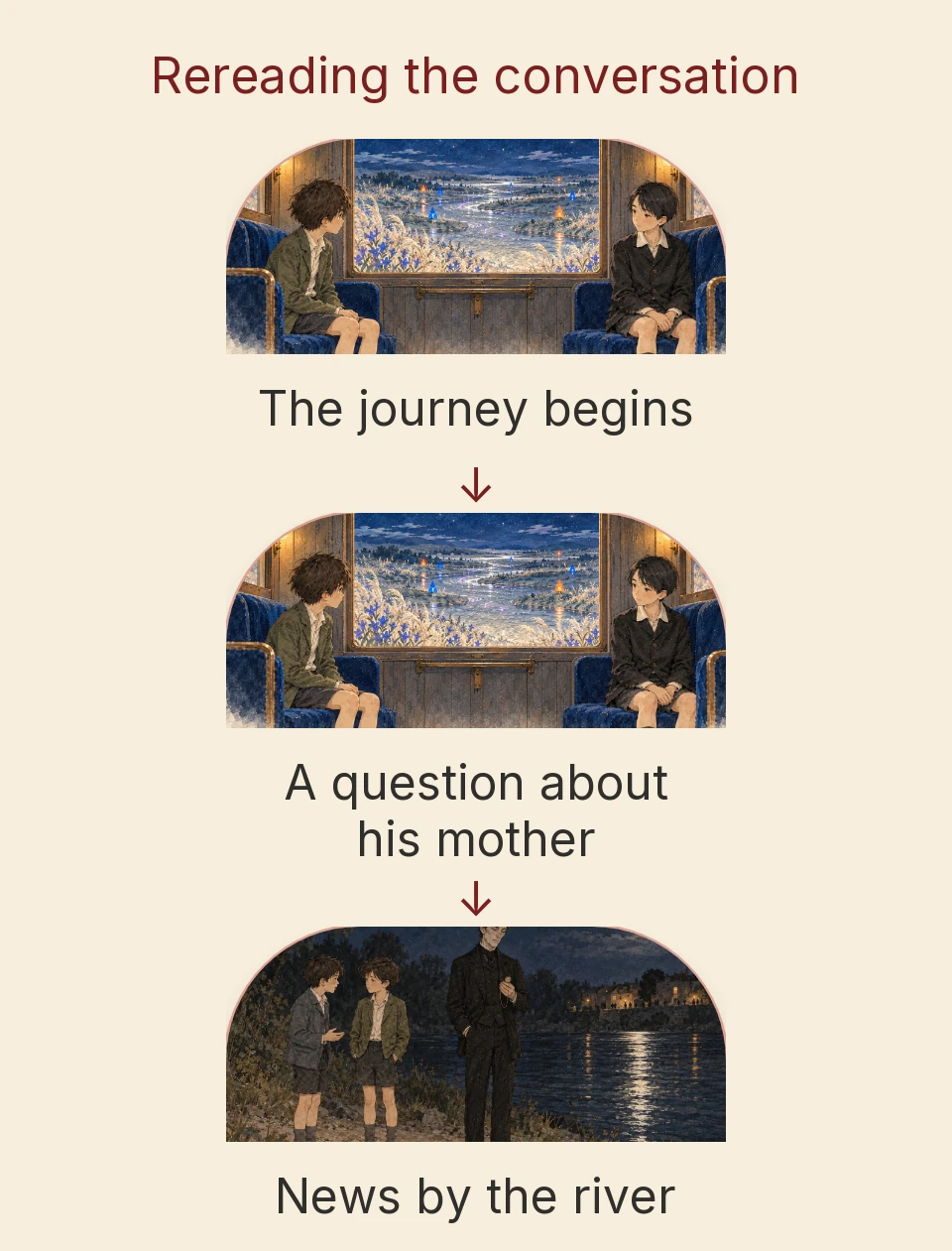
The illustration below compares matching carriage views to show the change when a friend is no longer there. The text does not show a body being found or a funeral. The empty seat and the river reflecting the Milky Way both give shape to the absence of a friend who does not return.
Source: Aozora Bunko, Night on the Galactic Railroad, the closing part of section nine.
Questions to read with
Does the scorpion’s story answer the question?
“But what is true happiness, really?” “I don't know.”
Giovanni asks the question; Campanella gives the reply. At the beginning of section seven, Campanella says that doing something truly good brings happiness and that his mother will forgive him. He seems to have made up his mind. In section nine, both friends express a willingness to sacrifice themselves. Yet that resolve does not settle the question of what true happiness means. They have convictions, and still have questions.
Source: Aozora Bunko, Night on the Galactic Railroad, section nine, the scorpion story and the conversation after the Southern Cross. Short quotations translated by Tamelabo.
Return to the opening of section seven
Early in the journey, Campanella says that Zanelli went home with his father. At the start of section seven, he asks:
“Will my mother forgive me?”
Giovanni does not yet know what happened at the river. A reader who knows the ending may hear these words differently. They still do not establish a single explanation for Campanella's thoughts or his wish for forgiveness.
At the end, Giovanni runs to take his mother the milk and tell her that his father is coming home. The story does not yet show him reaching the house. Rather than announcing a definition of true happiness, it closes with movement toward someone nearby. What do you take from that ending?
Source: Aozora Bunko, Night on the Galactic Railroad, section six, the opening of section seven, and the end of section nine. Short quotations translated by Tamelabo.
Frequently asked questions
Why does Campanella not return?
Marso explains that Campanella jumped into the river to help Zanelli, who had fallen from a boat. Zanelli was saved, but Campanella cannot be found. His father says there is no hope left. The text does not show a body being found or a funeral. (End of section nine.)
What does the difference between the tickets mean?
Campanella has a small gray ticket; Giovanni has a larger green paper. The bird catcher describes Giovanni's paper as a pass that lets its holder go anywhere. The text does not explain the difference as a simple division between the living and the dead. Readers can notice the contrast without treating a single interpretation as an established fact. (Section nine.)
Does the story give an answer to “true happiness”?
Even after expressing a willingness to sacrifice themselves, the boys still ask what happiness means. Campanella says he does not know. Our reading considers that unanswered question alongside Giovanni's final movement toward his mother. It does not present “happiness means self-sacrifice” as the author's settled conclusion. (Section nine.)
Where should a first-time reader begin?
Begin with section one to follow the whole story. To reread the conversation after learning the ending, return to the start of section seven, where Campanella speaks about his mother's forgiveness and happiness. The linked Aozora Bunko edition is the Japanese original; this page provides an English summary and commentary.
Source: Aozora Bunko, Night on the Galactic Railroad, section one, the start of section seven, and section nine. The final two answers also include Tamelabo's reading suggestions.
A guide to the Japanese original
Open the Japanese text at Aozora Bunko, a free library of Japanese texts. Find the heading “七、北十字とプリオシン海岸” for the conversation about Campanella's mother. To read from the beginning, start at “一、午后の授業”.
This commentary uses Aozora Bunko's text based on the Shincho Bunko edition. It does not combine passages from other editions or earlier versions. The characters and scenery are newly illustrated from details in the text. Our interpretations are invitations to read, rather than claims to the author's single intended answer.
Source details: Kenji Miyazawa, Night on the Galactic Railroad, Aozora Bunko, work No.456. Base edition: 『新編 銀河鉄道の夜』, Shincho Bunko, Shinchosha, published June 15, 1989; transcription used the thirteenth printing, June 5, 1994. Parent edition: 『新修宮沢賢治全集 第十二巻』, Chikuma Shobo, January 1980. Transcription: 中村隆生 and 野口英司. Proofreading: 野口英司. Aozora text released October 28, 1997, revised November 1, 2010; rechecked October 28, 2026. Work card / Aozora usage guidelines, in Japanese.
Commentary, short quotation translations, and illustrations: Tamelabo. The video uses synthetic narration. Music credits appear in the video description.
Sources
Where the facts and numbers in the video and on this page come from.
- Aozora Bunko, Night on the Galactic Railroadaozora.gr.jp/cards/000081/files/456_15050.html
- Work cardaozora.gr.jp/cards/000081/card456.html
- Aozora usage guidelines, in Japaneseaozora.gr.jp/guide/kijyunn.html
Voice, music, art
- Voice: Kokoro (synthetic narration)
- Music (OpenTracks): “茶屋にて” by MATSU; “縁側” by siroimu; “百花繚乱”; “藁の記憶”