Big Numbers: How Many Zeros in 12,500 thousand? (Grade 4, Core) | Math Aha! Theater #04
Short answer
- Yes: 12 million 500 thousand and 12,500 thousand are the same number, 12,500,000 (8 digits).
- In a chart with houses of three places, the 1 and the 2 of 12,500 thousand move into the millions house, so every place matches.
- To compare different numbers, put them in the same chart and compare from the left: 12,500 thousand is bigger than 12 million 50 thousand.
Also calledplace value chart grade 4millions and thousandswrite big numbers in standard formcompare large numbersnumbers in thousands
Video

Pressing play loads the YouTube player on this page. Watch on YouTube
Try it
Explained
In the video
- 0:00Two numbers, one question
- 0:32Can we tell by looking?
- 1:27Building the number houses (place value chart)
- 2:28Putting in the first number
- 2:49Putting in the second number
- 3:49Seeing both on a number line
- 4:45Which one is bigger?
- 5:43How to write big numbers in digits
- 6:21Practice 1
- 7:08Practice 2
- 8:17Try it on your own
- 9:05Checking the answer
- 9:39Today's aha: line up the places
Math Aha! Theater (算数ひらめき劇場) | Grade 4 · Core | Numbers & calculation | For parents and teachers
Is "12,500 thousand" the same number as "12 million 500 thousand"? This page collects the problems from the video and the thinking behind them: a place-value chart split into groups of three places (ones, thousands, millions), the same groups that give us the comma every three digits. The video works through these problems in order.
This page includes the answers. If you are working with a child, show only "The problems" first, and give them time to think before you open the sections marked as containing answers. Everything can be followed on paper with the pictures and text alone.
The problems
The main problem
Are 12 million 500 thousand and 12,500 thousand the same number? Or is one of them bigger?
A: 12 million 500 thousand is bigger / B: 12,500 thousand is bigger / C: they are the same
Practice problems
Practice 1: Write 3 million 60 thousand as a number.
Practice 2: 24,500 cards that each say "1 thousand" make 24,500 thousand. Write it using millions and thousands.
On your own
Write 1 billion 230 million 500 thousand as a number.
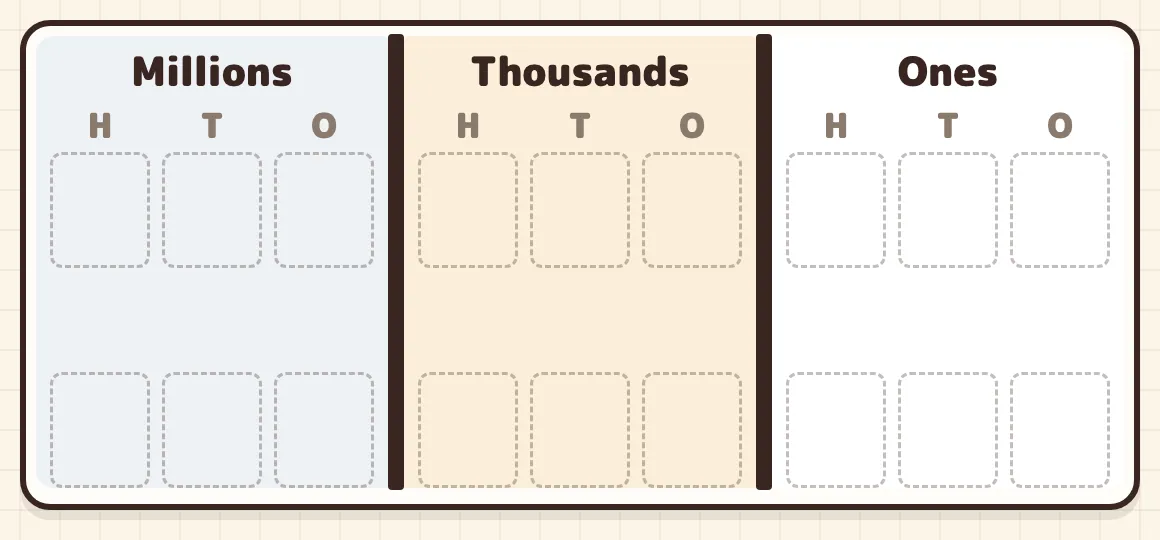
Pause and think before you open the answers.
What children usually try first
Comparing by looks
Most children first decide by appearance. "12,500 is bigger than 12," so 12,500 thousand must be bigger. Or "million is bigger than thousand," so 12 million 500 thousand must be bigger. Both are noticing something real, but the two clues point in opposite directions, so looks alone cannot decide.
Writing zeros
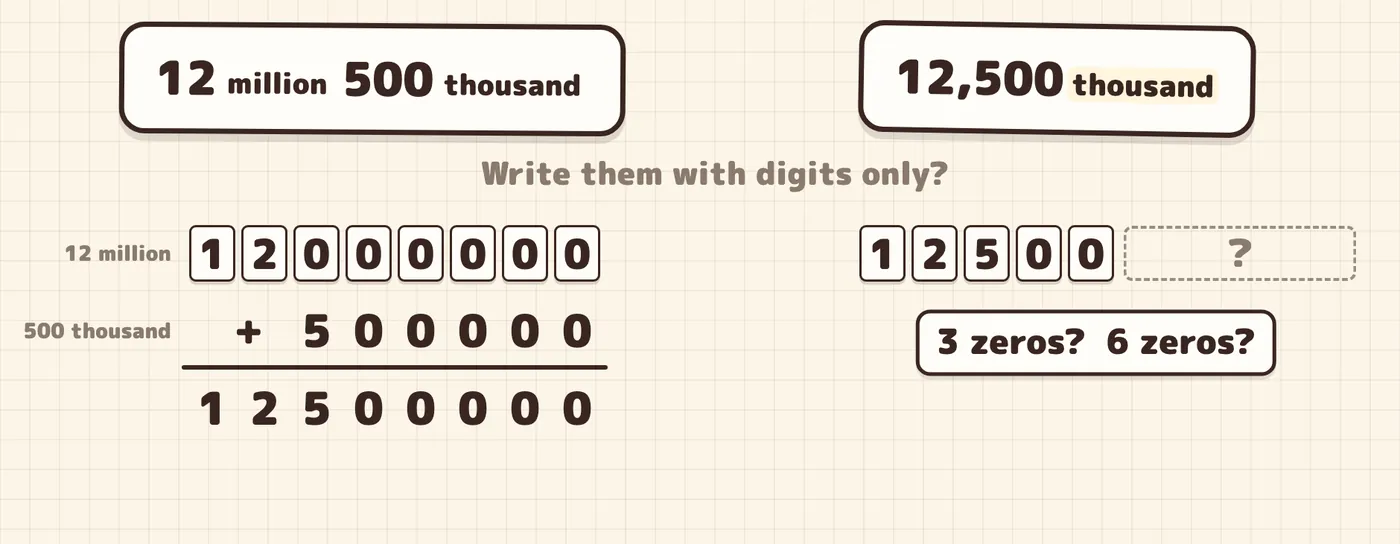
The next idea is usually to write both numbers with digits. That is a correct method, and the video does it first. 12 million is 12 followed by six zeros, 500 thousand is 500,000, and lining up the right ends and adding gives 12,500,000.
The second number is where children get stuck. When you say "12,500 thousand" out loud, you hear the word thousand twice: "twelve thousand five hundred thousand". Do you add three zeros after 12500, or six? Counting zeros is slow, and it is easy to drop or add one. The first move this episode teaches is different: put both numbers into the same chart before comparing them.
How to use the place-value chart
Drawing the chart
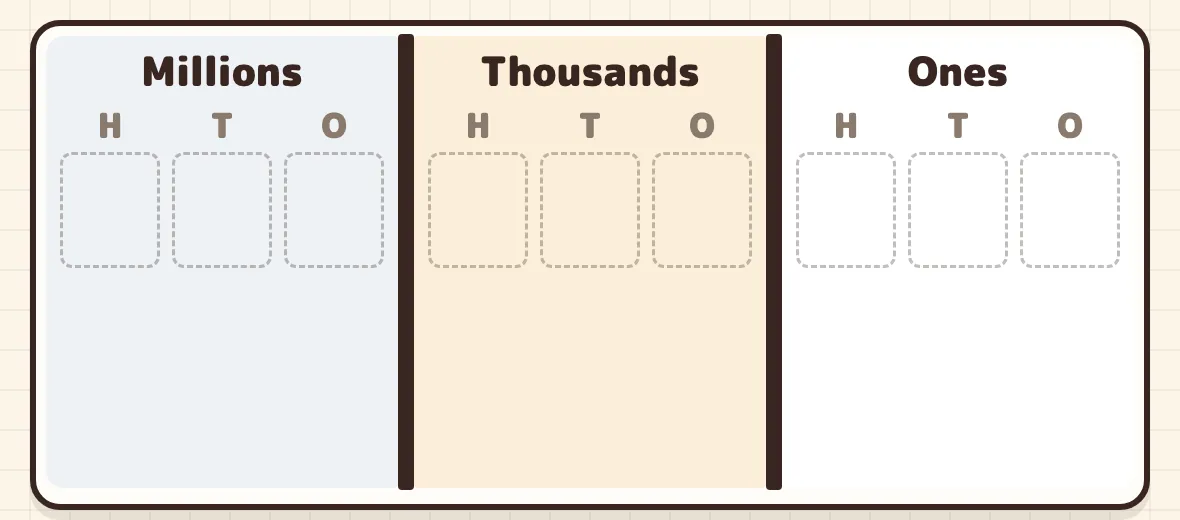
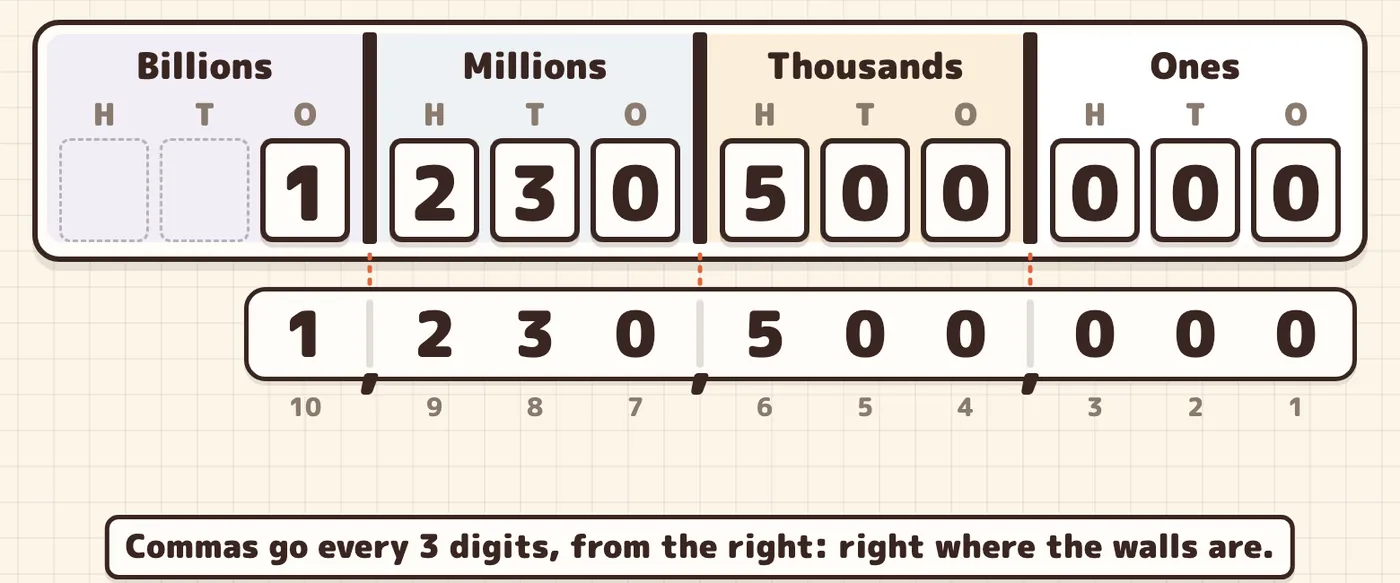
Draw places from right to left: ones, tens, hundreds. These three places make the ones house. Then a new house starts: thousands, ten thousands, hundred thousands make the thousands house. Ten hundred thousands make one million, so the next house is the millions house. Every house has the same three places, hundreds, tens, and ones (H, T, O). The name changes every three places, and that is exactly why big numbers get a comma every three digits.
In many U.S. classrooms, each house of three places is called a period. The video calls them houses, because it lets children say "it doesn't fit" and "it moves next door."
Putting a number in
Look at the word after each number: it tells you where the right end goes.
- The number before "million" goes in with its right end in the millions place.
- The number before "thousand" goes in with its right end in the thousands place.
For 12 million 500 thousand: the 2 of 12 goes in the millions place and the 1 next to it; the last 0 of 500 goes in the thousands place.
Filling zeros and reading
Every empty place to the right of the first digit gets a 0. Then read from the left: 12 million 500 thousand becomes 12500000. The chart decides how many zeros there are, so nobody has to count them.
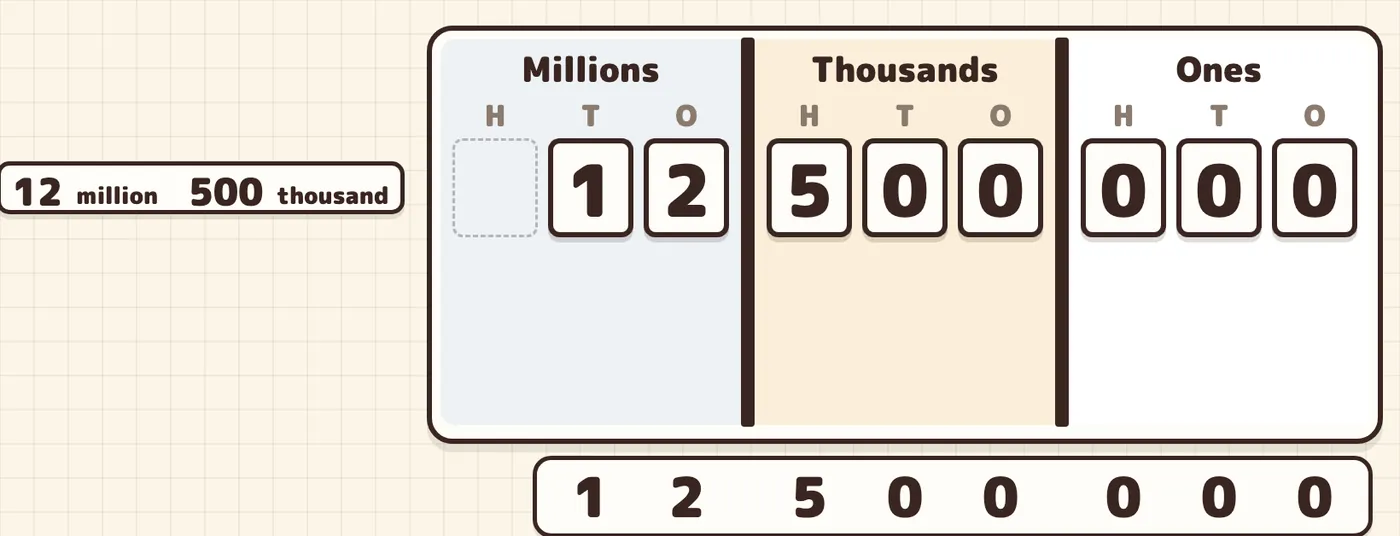
Comparing two numbers
Put both numbers in the same chart, one per row. Then compare from the left, one place at a time. An empty place counts as 0. Where the digits first differ, the bigger digit wins. If every place is the same, the numbers are the same. This is the reasoning behind Common Core 4.NBT.A.2 ("compare two multi-digit numbers based on meanings of the digits in each place").
For example, 12 million 500 thousand and 12 million 50 thousand match in the ten-millions and millions places, and the hundred-thousands place (5 against 0) decides: 12 million 500 thousand is bigger.
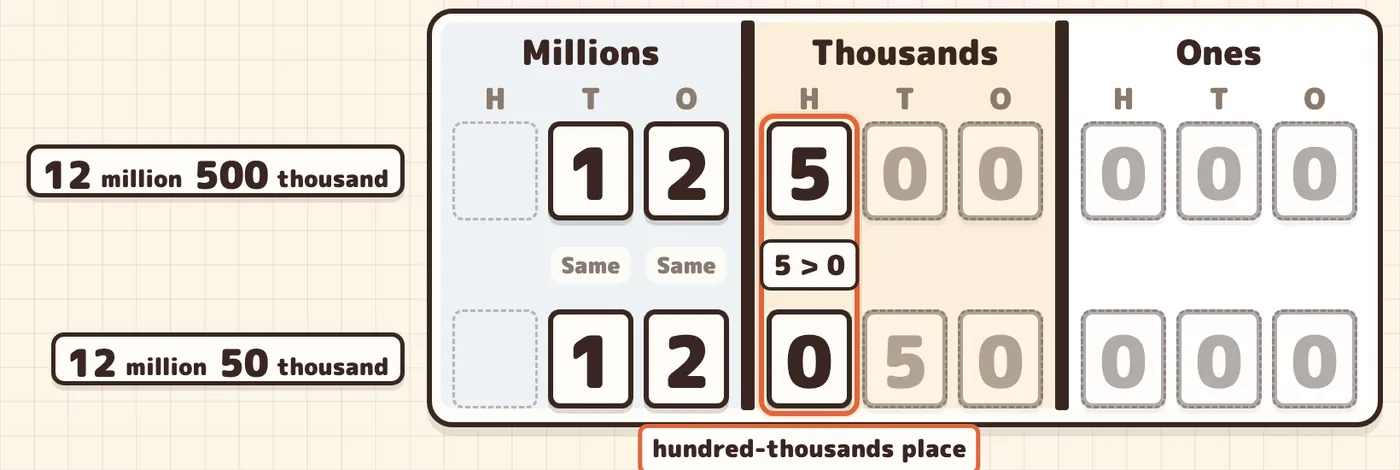
Watch it move: the frame steps from the left, one place at a time
Answers and checks (contains answers)
The main problem
C: they are the same. Both are 12,500,000. When 12,500 thousand goes into the chart, its right end goes in the thousands place. That is five digits, but the thousands house has only three places, so the 1 and the 2 don't fit. They move next door into the millions house: the 2 in the millions place and the 1 in the ten-millions place. Each step to the left is worth ten times as much, so this is not a trick; 12,000 thousand really is 12 million. After that, all eight places match the row for 12 million 500 thousand. Children who looked at "how big 12,500 is" and children who looked at "the word million" were both noticing something important; the chart brings the two views together.
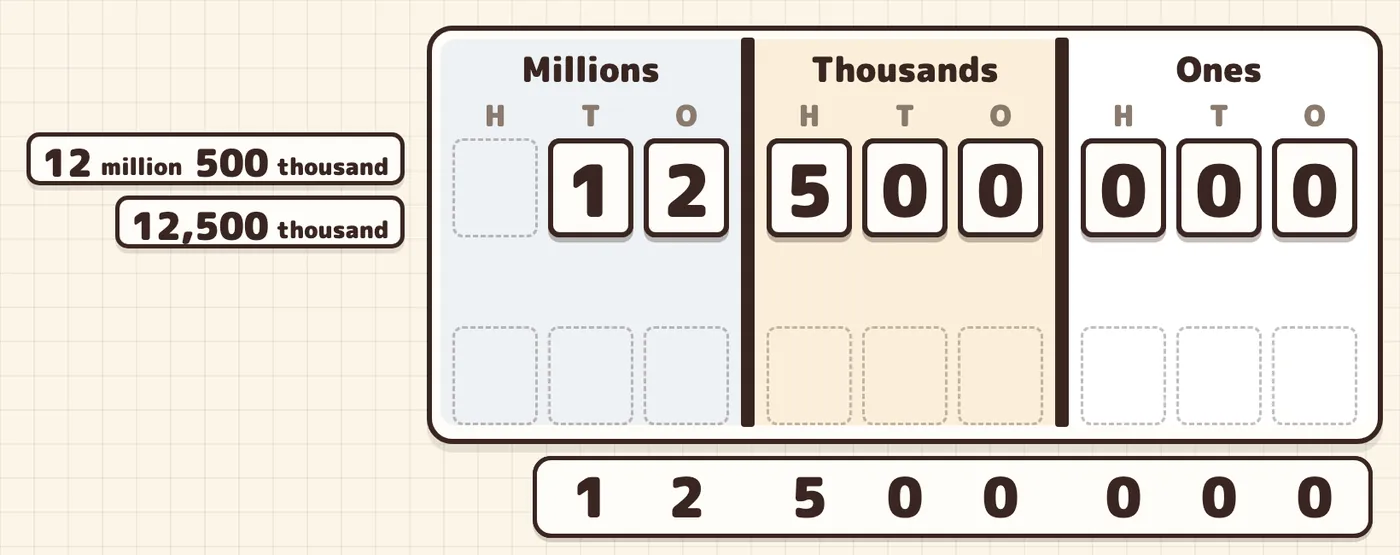
Watch it move: the 1 and the 2 pile up at the wall, move next door, and the rows overlap
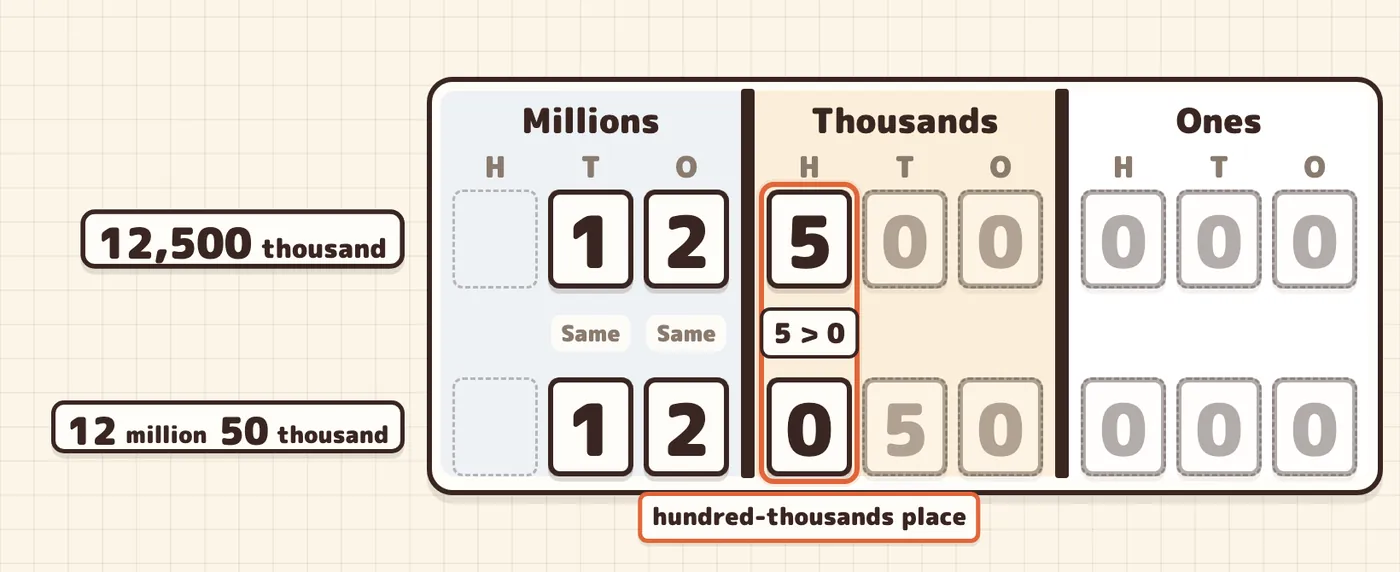
The question asked midway through the video, "12,500 thousand or 12 million 50 thousand: which is bigger?", has the answer 12,500 thousand. The ten-millions and millions places match, and the hundred-thousands place (5 against 0) decides. Having "million" in it doesn't always make a number bigger.
Practice 1 and Practice 2
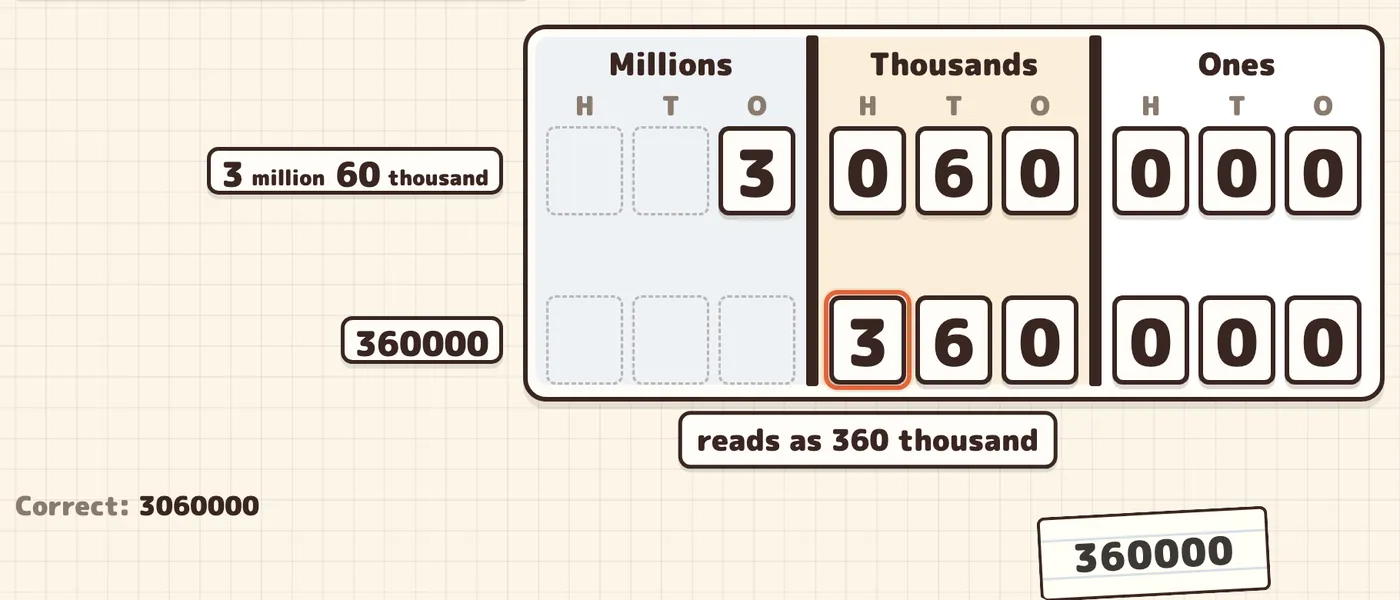
- Practice 1: 3 million 60 thousand = 3,060,000. The 3 goes in the millions place. The right end of 60 goes in the thousands place, so the 6 lands in the ten-thousands place and the hundred-thousands place is left empty. It gets a 0 (3 | 060 | 000).
- Practice 2: 24,500 thousand = 24 million 500 thousand. With the right end of 24,500 in the thousands place, the 2 and the 4 don't fit, so they move into the millions house. Reading house by house: 24 in the millions house, 500 in the thousands house, and only zeros in the ones house.
On your own
1 billion 230 million 500 thousand = 1,230,500,000. The chart needs one more house on the left, the billions house, because the names keep changing every three places. The 1 goes in the billions place; 230 fills the millions house; 500 fills the thousands house; the ones house gets three zeros. It has ten digits.
How to check
- Put a comma at each wall, counting from the right, and read the number house by house: 1 | 230 | 500 | 000 → 1 billion 230 million 500 thousand. If you get the original number back, it's right.
- Count the digits: a number that reaches the millions place has 7 digits; ten-millions, 8; hundred-millions, 9; billions, 10.
- Another route: 12,500 thousand means 12,500 × 1,000 = 12,500,000. Or use 1,000 thousand = 1 million: 12,500 thousand is 12,000 thousand and 500 thousand, which is 12 million and 500 thousand.
Common slips and how to fix them
All of these slips can be found by the child, not just by the adult: put the written number into the chart, read it back, and see whether it comes back to the original number.
Squeezing out an empty place
3 million 60 thousand written as 360000. The child wrote the 3, then 60, then three zeros, and the empty hundred-thousands place disappeared. In the chart, the 3 lands in the hundred-thousands place and the number reads back as 360 thousand. Fix: write a 0 in every empty place.
Lining up the left end instead of the right end
3 million 60 thousand written as 3,600,000. The child filled the thousands house from the left ("60" became "600"). It reads back as 3 million 600 thousand. Fix: the word "thousand" tells you where the right end goes.
Starting the commas from the left
24,500 thousand written as "245 million." The child wrote all the digits, 24500000, and then put in commas from the left: 245,000,00. Fix: houses and commas are counted from the right, so 24500000 is 24,500,000.
Dropping one zero
12,500,000 written with one zero too few: 1250000. Every digit slides one place to the right, and each place is worth one tenth as much, so the number is only one tenth as big (1 million 250 thousand). This is the "ten times the place to its right" idea from Common Core 4.NBT.A.1, seen from the other side.
Another view: the number line and "thousands of thousands"
On a number line from 0 to 15 million with a tick every million, twelve jumps of 1 million reach 12 million, which is also 12,000 thousand. Half a tick more (500 thousand) lands on one point, and both 12,500 thousand and 12 million 500 thousand point to it. The number with a dropped zero, 1,250,000, sits far to the left, between 1 million and 1.5 million.
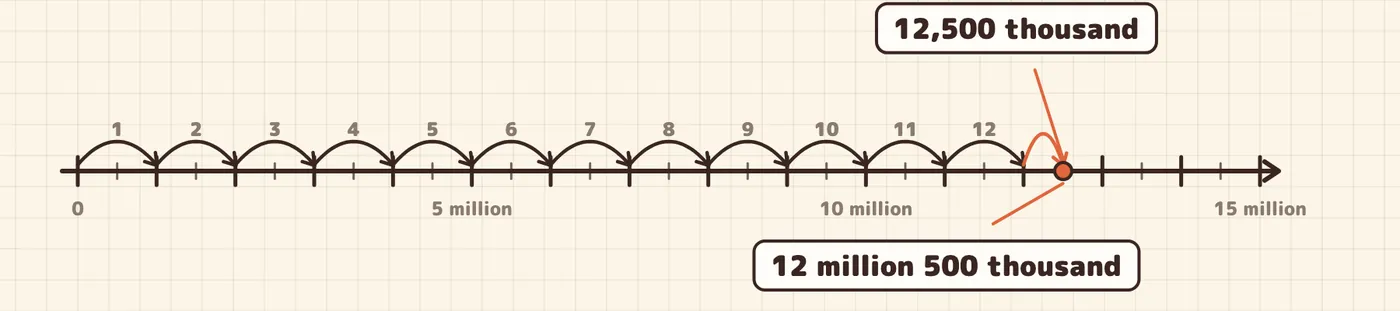
Watch it move: twelve jumps of 1 million, then 500 thousand more
Where "thousands" like this show up
Numbers like 12,500 thousand are not just puzzle numbers. Many data tables, reports, and budgets print large numbers "in thousands" to save space: a column that says "(in thousands)" and shows 12,500 means 12,500 thousand, which is 12,500,000. Reading such a table is exactly the skill in this episode.
More to try
- Put these in order from largest to smallest: 3 million 60 thousand, 3,060 thousand, 360 thousand.
- Write 2 trillion 450 billion as a number. (A trillion is a thousand billion. Add a trillions house to the left of the billions house.)
- There are 24,500 boxes with 1,000 beads in each. How many beads? Write it using millions and thousands.
- Read 306,000,000 using house names.
- A table says "(in thousands)" and shows 12,500. What is the number, written in full?
Answers to More to try (contains answers)
- 3 million 60 thousand = 3,060 thousand > 360 thousand. Squeezing out the zero in 3 million 60 thousand gives 360000, the same digits as 360 thousand, which is why it is a trap.
- 2,450,000,000,000 (13 digits).
- 24 million 500 thousand beads (24,500,000).
- 306 million (306 | 000 | 000).
- 12,500,000, which is 12 million 500 thousand.
For parents and teachers
- Let the chart do the counting. Rather than telling a child "thousand means three zeros," let them put the number into the chart and discover that the ones house has three places. Children remember what they found themselves.
- Ask for a read-back, even when the answer is right. "Put commas at the walls and read it to me" is a habit that catches squeezed zeros and left-end mistakes on its own.
- Treat slips as numbers to read, not as errors. If a child writes 360000, ask them to put it in the chart and read it. When it comes out as "360 thousand," they usually see the problem immediately.
- Use real "in thousands" numbers. Sports attendance, city populations, or a table that says "(in thousands)" all make good material for saying the same number in two ways.
- About the grade level. Common Core grade 4 works with whole numbers up to 1,000,000 (4.NBT). This episode uses the same two ideas, that each place is worth ten times the place to its right and that we compare from the left, and stretches them to millions and billions. "Grade 4 · Core" is this series' own guide, not an official level.
Frequently asked questions
Is "12,500 thousand" a wrong way to write a number?
No. It means 12,500 groups of a thousand, and as a number it is perfectly correct. In everyday writing we would usually say 12 million 500 thousand, but "in thousands" numbers appear all the time in tables and reports, so children benefit from being able to switch between the two.
Why do number names change every three digits?
English names big numbers in groups of three: ones, thousands, millions, billions. Inside each group the places repeat as hundreds, tens, and ones. That is why commas come every three digits and why the chart is built from houses of three places.
My child's class only goes up to 1,000,000. Is this too hard?
The ideas are the same ones taught with numbers up to a million: each place is worth ten times the place to its right, and you compare from the left. If millions feel too big, try the same moves with smaller numbers first, for example 12 thousand 500 and 12,500.
Why does the chart have "houses"?
Each house is one group of three places, which many textbooks call a period. Calling them houses gives children words for what they see: a digit "doesn't fit" and "moves next door."
How do you draw the chart on paper?
Draw a long box, divide it with thick lines into groups of three columns from the right, and write Ones, Thousands, and Millions above the groups. Inside each group write H, T, O. Add a Billions house on the left when you need it.
Try it in the "Number Houses" activity
In "Number Houses," children tap digit cards into a place-value chart and work through six tasks: the main problem, Practice 1, Practice 2, a solo challenge with the billions house, explaining why the two numbers are the same, and fixing another child's notebook slips by reading numbers back from the chart. After that there are fresh practice problems every time (easy, normal, challenge), a "make a puzzle" mode for family members, and a learning map. Time and scores are never recorded.
Sources
Where the facts and numbers in the video and on this page come from.
References
- Problems: all problems on this page are original problems by Tamelabo. Pictures and animations by Tamelabo (font: M PLUS Rounded 1c, SIL OFL 1.1).
Links
Voice, music, art
- Voice: Kokoro (synthetic voice) / Music (OpenTracks): “のんびり行こうよ” by zmino, “パステルハウス” by かずち / Sound effects: Tamelabo (made with code) / Font: M PLUS Rounded 1c (SIL OFL 1.1) / Art, problems, and animation: Tamelabo