How Many Animals in All? Count with a 10-Seat Bus | Math Aha! Theater #01
Short answer
- Seven dogs, eight cats, two rabbits, and three pandas make 20 animals in all.
- Counting one by one is easy to lose track of, so the trick is to make groups of ten first.
- A ten-seat bus shows how filling exactly ten turns a long count into easy addition.
Video

Pressing play loads the YouTube player on this page. Watch on YouTube
Try it
Explained
In the video
Seven dogs, eight cats, two rabbits, and three pandas. How many animals are there in all?
Math Aha! Theater(算数ひらめき劇場) | Grade 2 · Starter | Numbers and calculation
This guide is for parents and teachers helping a child move from counting every animal to adding groups of ten. Sections marked “answers included” contain worked solutions. You can share the problem sections separately.
The problem: count the animals in the park
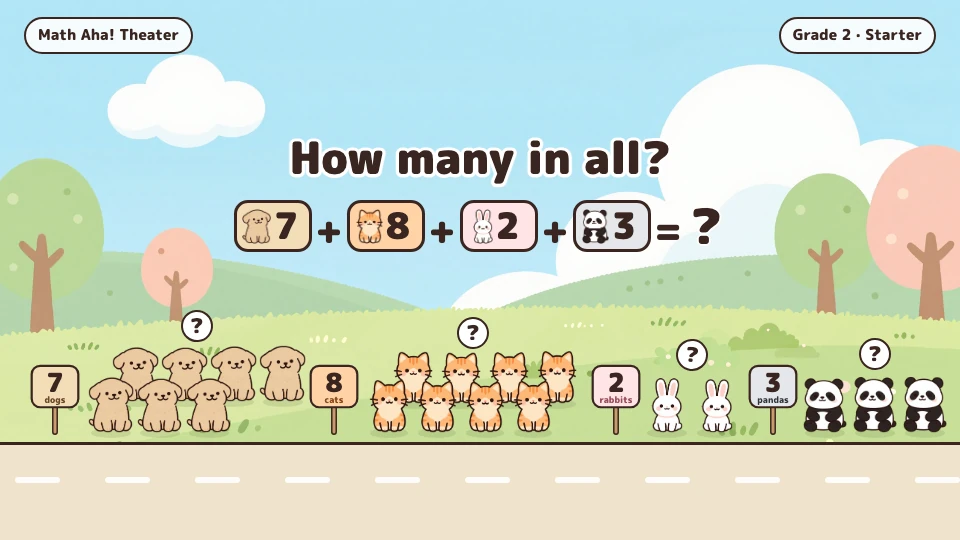
There are 7 dogs, 8 cats, 2 rabbits, and 3 pandas. How many animals are there altogether? The addition is 7 + 8 + 2 + 3 = ?
Let the child choose a starting point. They might point to each animal, draw circles, or add from left to right. Give them a chance to try before suggesting which groups to put together.
The first move in the make-ten strategy: look at the gaps
Counting each animal is a valid approach. If the child loses their place, ask, “Could we arrange them so we know how many there are without counting every one again?” The bus gives that question a concrete meaning.
Establish what a full bus tells us
The bus has two rows of five seats: ten seats altogether. With one animal in each seat, a full bus holds ten animals. On paper, draw two rows of five boxes. This is a ten-frame: a space for seeing a group of ten.
Fill the gaps, rather than starting the count again
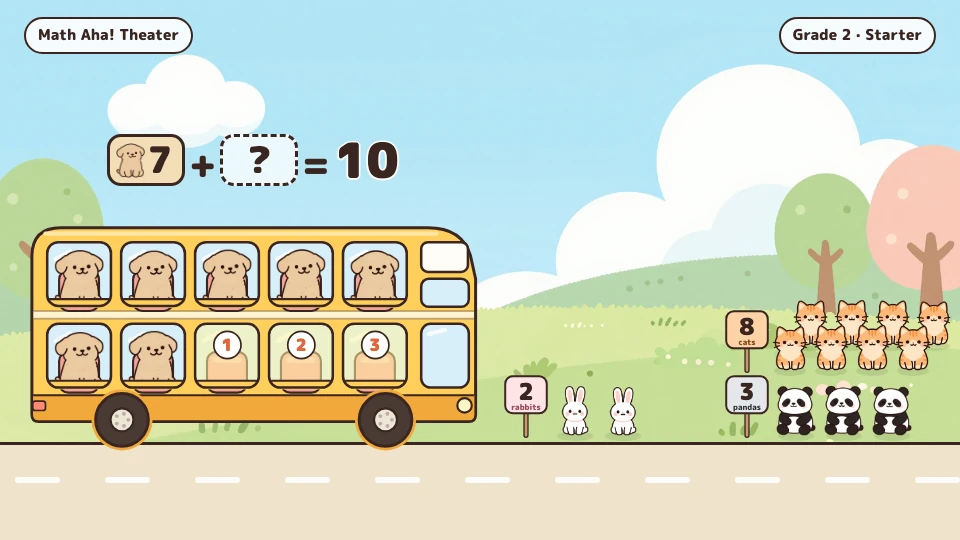
Put the seven dogs on the bus. Ask, “How many more will fit?” Then ask, “Which waiting group could all get on together?” For this first problem, keep each animal group together.
There are three empty seats. Let the child compare the cats, rabbits, and pandas with that space. They can find a matching group by counting the gaps, even if they have not memorized the pairs that make ten.
Work through the solution and check it (answers included)
Match the waiting groups to the gaps
- Seven dogs leave three empty seats. The three pandas fit exactly, making one full bus: 7 + 3 = 10.
- Put the eight cats on the next bus. Two seats are empty, so the two rabbits fit exactly: 8 + 2 = 10.
- Count the full buses. Each represents a group of ten, so we can add those groups instead of counting each animal.
Find the total and account for every animal
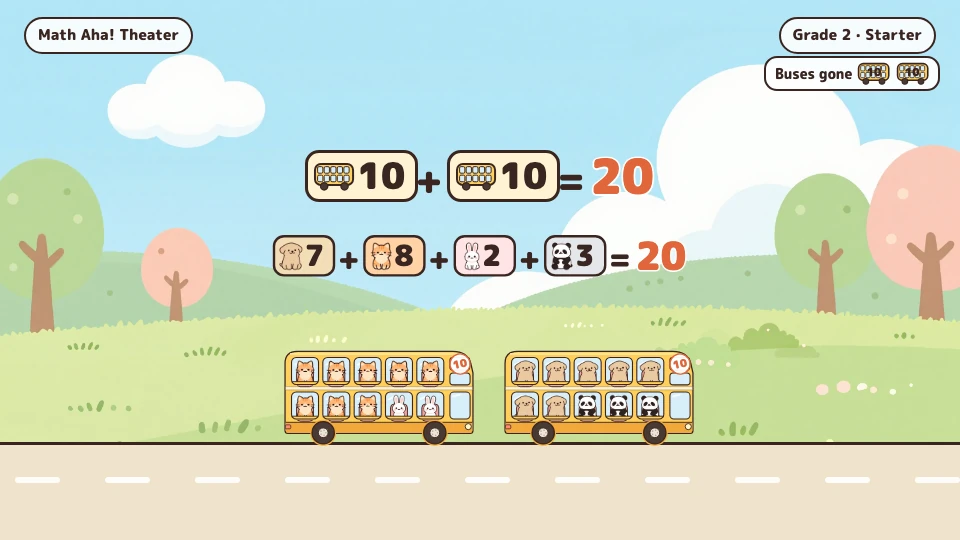
Two full buses give 10 + 10 = 20. There are 20 animals in all.
Check that all four groups are on board and that no animal has been counted twice. We changed the arrangement of 7 + 8 + 2 + 3 to put 7 with 3 and 8 with 2. We used exactly the same animals, so changing the order and grouping did not change the total. Adding from left to right works too.
If combining full buses still feels unfamiliar, return to one full bus and seven animals outside it. That is ten and seven more, or 17. The idea is to recognize the full group before counting what is left.
Keep a record of other ways to make ten
Using two numbers from 1 to 9, and counting a reversed pair as the same pair, these are the five possibilities:
| Starting group | Group that fills the gaps | Total |
|---|---|---|
| 9 | 1 | 10 |
| 8 | 2 | 10 |
| 7 | 3 | 10 |
| 6 | 4 | 10 |
| 5 | 5 | 10 |
The last row uses two separate groups of five. It does not mean counting the same five animals again. Use the table to record and revisit what the child has checked with the seats.
A full bus can also hold more than two groups. Both 5 + 3 + 2 and 1 + 2 + 3 + 4 make ten. The useful question remains, “What will fill the empty seats?”
Make ten by splitting a group (answers included)
When no whole group fits
Now try eight pigs and five bears: 8 + 5. After the pigs get on, two seats are empty, but there is no separate group of two. Pause and ask, “Could some of the bears get on first?” This time, a group may split up.
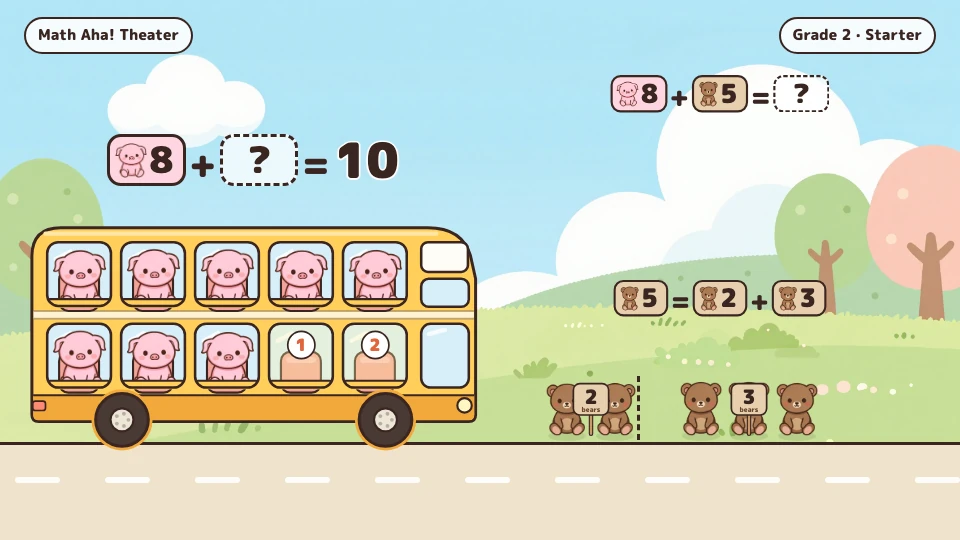
- Choose two of the five bears to fill the empty seats.
- Move those two onto the bus. Eight pigs and two bears make ten.
- Keep the other three bears visible. They still belong in the total.
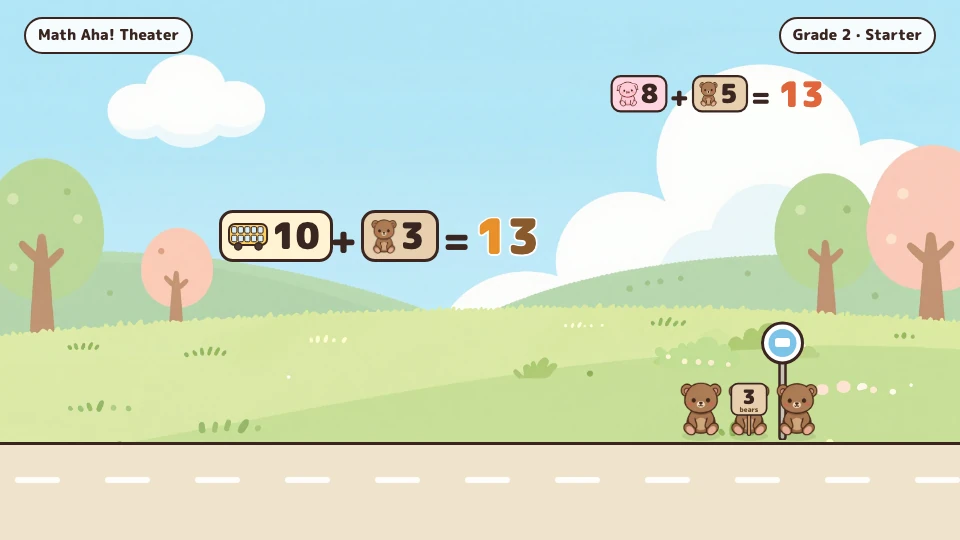
Splitting five into two and three changes 8 + 5 into 10 + 3. The total is 13 animals. Making ten is a step toward the answer; we still need to include the three outside the bus. Count the bears either as the original five or as two and three, rather than adding both descriptions together.
Start with the other group
The five bears could get on first. Five seats would then be empty. Split the eight pigs into five and three, and move five pigs onto the bus. There is a full group of ten and three pigs outside: still 13 animals.
If the child chooses this route, follow it. Both methods account for every original animal. Comparing the two arrangements also gives you a way to check the answer.
Problems to share with your child
Before calculating, ask the child to connect the numbers they would combine first, or show where they would split a group. The last problem needs a split to make ten.
- Nine monkeys, six frogs, and one hamster. How many in all? (9 + 6 + 1)
- 6 + 9 + 4 + 1 = ?
- 8 + 4 + 2 = ?
- 7 + 6 = ?
For a printed activity, keep this problem block separate from the answer key below. Circles and two rows of five boxes are enough to try the ideas on paper.
Practice answer key (answers included)
| Problem | First move | Answer and check |
|---|---|---|
| 9 + 6 + 1 | Put the nine monkeys with the one hamster | Ten plus the six frogs gives 16 animals |
| 6 + 9 + 4 + 1 | Pair 6 with 4, and 9 with 1 | 10 + 10 = 20; all four numbers are used |
| 8 + 4 + 2 | Combine 8 and 2 first | 10 + 4 = 14; include the remaining 4 |
| 7 + 6 | Split 6 into 3 and 3; combine one group of 3 with 7 | 10 + 3 = 13; include the remaining 3 |
For 7 + 6, starting with six also works. Split seven into four and three, then combine six and four. The result is again ten and three, or 13. Check both the full group and what remains outside it.
Helping without giving away the next move
Learners need to count objects up to about twenty, connect a written number with a quantity, and understand “how many altogether.” They can begin without knowing the make-ten pairs by heart.
When a child is stuck, point them toward the empty seats rather than naming the matching group. If a group does not fit, leave the gaps or extra animals visible and ask what the arrangement tells them to try next.
When splitting a group, ask two separate questions: “How many did you move?” and “How many stayed?” Once they have an answer, ask, “Where did you look first?” or “Why is the total still the same?” Listen for their explanation and any change of plan, rather than focusing on speed.
“Grade 2” refers to Japan's school grades. “Starter” is this series' guide to difficulty, not a formal assessment level or a promise of learning results. Use the activity wherever it suits the learner's current understanding.
Frequently asked questions (FAQ)
Does my child need to memorize the pairs that make ten first?
No. They can count the empty seats and look for a group that fits. Use the table as a record of pairs they have explored, rather than a prerequisite for starting.
Should I correct a child who adds from left to right?
Adding from left to right is correct. Acknowledge their answer, then invite them to try the bus as another way of arranging the same animals. They can compare the two approaches.
What if my child makes ten but forgets the animals left over?
Keep the full bus and the waiting animals visible together. Ask them to include both the passengers and the animals outside. Leave the remaining group in place while they work out the total.
Are children allowed to split the groups?
In the first problem, keep each group together and find matching groups. In the pigs-and-bears problem, split a group to fill the gaps. In both cases, check that every original animal is counted exactly once.
See it move: the Make-Ten Bus activity
Open “Make-Ten Bus” in this page's “Try it” section. You can also choose “Open full screen.” Begin with “Easy / Two groups” and press “Play.” Tap a balloon of animals to put them on the bus. Before tapping, look at the empty seats and choose a group that could fit.
For more groups, choose “Medium / Three groups OK.” To explore what happens when a group goes beyond ten, choose “Challenge / Going over OK.” The extra animals carry over to the next bus. The game uses changing groups, so it will not necessarily offer the exact problems in this article.
For an offline version, follow the pictures in order: animals waiting, a group split to fill the gaps, then a full bus and the remaining animals. Move the circles you already have and leave the rest visible.
Shorts
Sources
Where the facts and numbers in the video and on this page come from.
- Japan's Ministry of Education, Culture, Sports, Science and Technology (Commentary on the Elementary School Course of Study, Mathematics (2017 notification), Grade 1 A(1), printed pp. 80–82, and Grade 2 A(2), pp. 111–113. Used to check the curriculum content on combining and separating quantities and changing addition order and grouping. Tamelabo created the problems, bus setting, and diagrams independently around these ideas; they are not copied or adapted problem statements from this document. Its text and diagrams have not been reproduced)mext.go.jp/component/a_menu/education/micro_detail…
- Tongyi-MAI (Z-Image-Turbo was used to create animals and backgrounds in the existing illustrations. Model license: Apache-2.0)huggingface.co/Tongyi-MAI/Z-Image-Turbo
- Black Forest Labs (FLUX.2-klein-4B was used to create animals in the existing illustrations. Model license: Apache-2.0)huggingface.co/black-forest-labs/FLUX.2-klein-4B
- Google Fonts (M PLUS Rounded 1c, the typeface in the diagrams. SIL Open Font License 1.1. Copyright 2016 The Rounded M+ Project Authors)github.com/google/fonts
Voice, music, art
- Voice: Kokoro / Music: “のんびり行こうよ” by zmino, “パステルハウス” by かずち (OpenTracks) / Sound effects: Freesound (CC0) and Tamelabo / Font: M PLUS Rounded 1c (SIL OFL 1.1) / Art, problems, and animation: Tamelabo