35 Heads, 94 Legs. How Many Rabbits? | Math Aha! Theater #02
Short answer
- With 35 heads and 94 legs in the cage, there are 12 rabbits.
- This heads-and-legs puzzle comes from the Sunzi Suanjing, a Chinese math book written more than 1,500 years ago.
- Lining the animals and legs up in a picture lets the answer come into view without guess and check.
Video

Pressing play loads the YouTube player on this page. Watch on YouTube
Try it
Explained
In the video
- 0:00What is this 1,500-year-old puzzle?
- 0:24Can you solve it?
- 0:43Will guess and check work?
- 1:23What if the cage is small?
- 2:27How do we picture all 35?
- 3:44Where is the answer in the picture?
- 4:39Does the old book agree?
- 4:52Your turn: how many apples and mandarins?
- 7:08What did the blocks show us?
Math Aha! Theater | A guide for parents and teachers
When a child starts guessing how many animals are in a cage, there is something useful to build on: each guess can be checked. The next move is to make the difference visible. An area diagram, built from columns of blocks, shows a part shared by every animal and an extra part belonging to just one kind.
This guide takes you from a first attempt to a worked solution, then applies the idea to shopping and a game. Answers are included in the sections marked below. When sharing with a child, stop before those sections and allow time to try. The still pictures and explanations also work on paper.
The puzzle: count the heads and legs
A cage holds pheasants and rabbits. A pheasant is a bird with 2 legs; a rabbit has 4 legs. There are 35 heads and 94 legs altogether. How many rabbits are there?
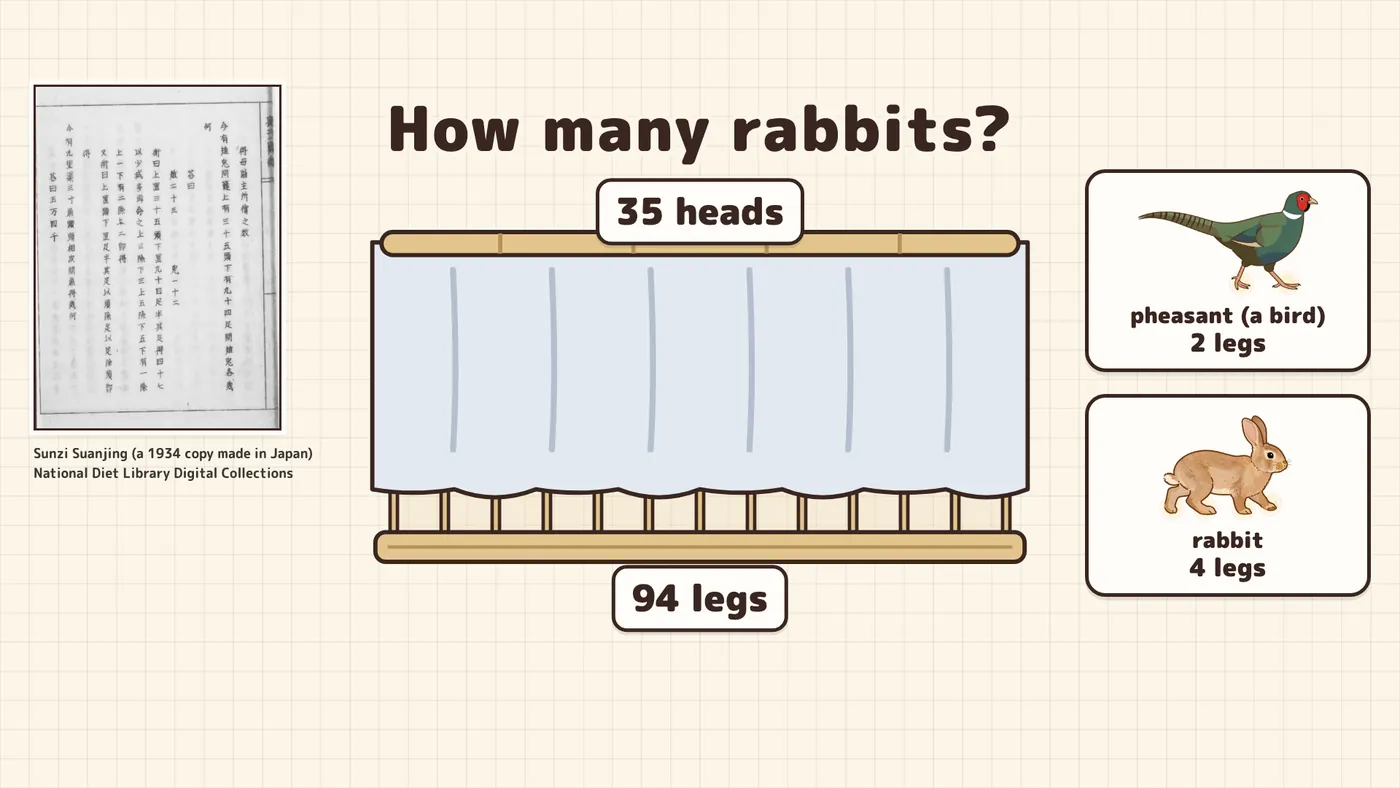
Each animal has one head, so there are 35 animals. Invite your child to draw, make a table, or try a guess before offering a method.
The puzzle comes from the Sunzi Suanjing, or The Mathematical Classic of Master Sun, a Chinese mathematics book written more than 1,500 years ago. The original asks for both kinds of animal. This version keeps the animals and numbers and focuses the question on rabbits.
Begin with a guess, then look for a shared part
A child might begin with roughly half of each kind. Here are the two attempts used in this episode:
| Pheasants | Rabbits | Total legs | Compared with 94 |
|---|---|---|---|
| 18 | 17 | 18 × 2 + 17 × 4 = 104 | 10 too many |
| 28 | 7 | 28 × 2 + 7 × 4 = 84 | 10 too few |
Adjusting a guess is a valid method. You can keep track of only the legs that change. To see how much adjustment is needed all at once, ask: “What part could we draw for every animal, even before we know which kind it is?”
Make the picture with a small cage first
Use a cage whose contents are already known: 3 pheasants and 2 rabbits, making 14 legs.
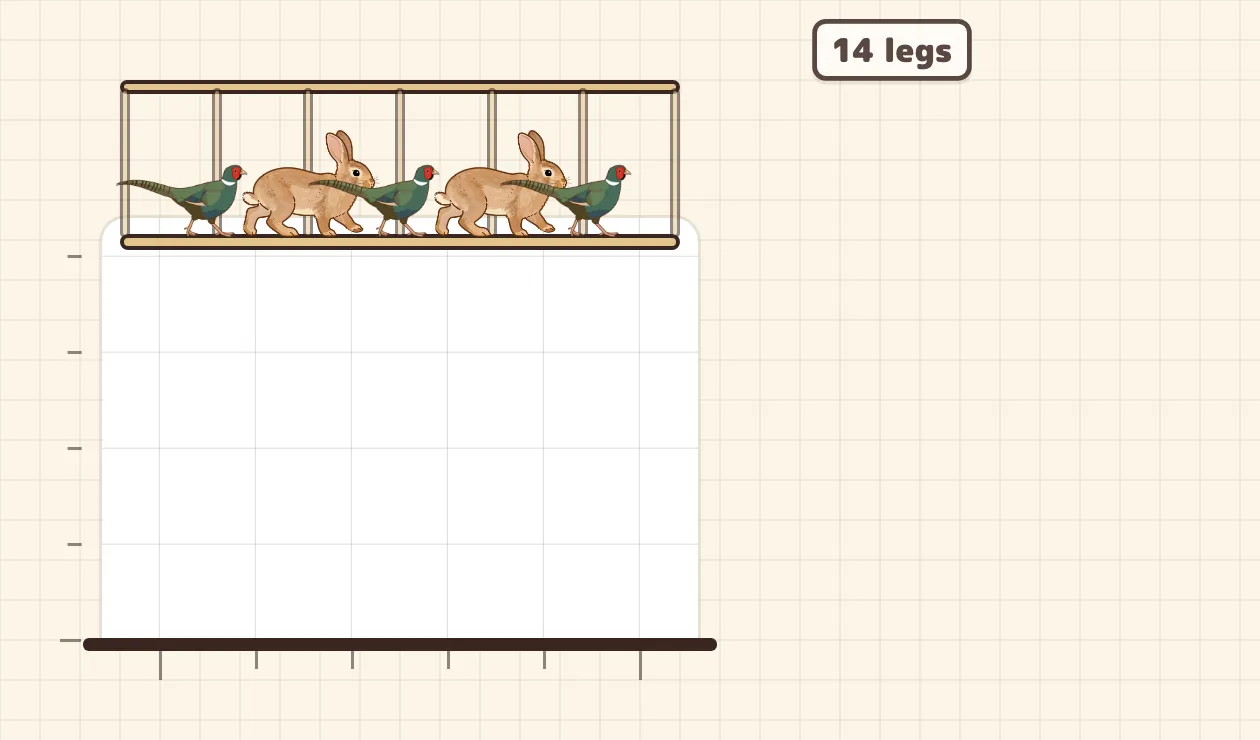
Let one block stand for one leg. Give each animal a column: 2 blocks for a pheasant and 4 for a rabbit. A column counts one animal; its height counts that animal's legs.
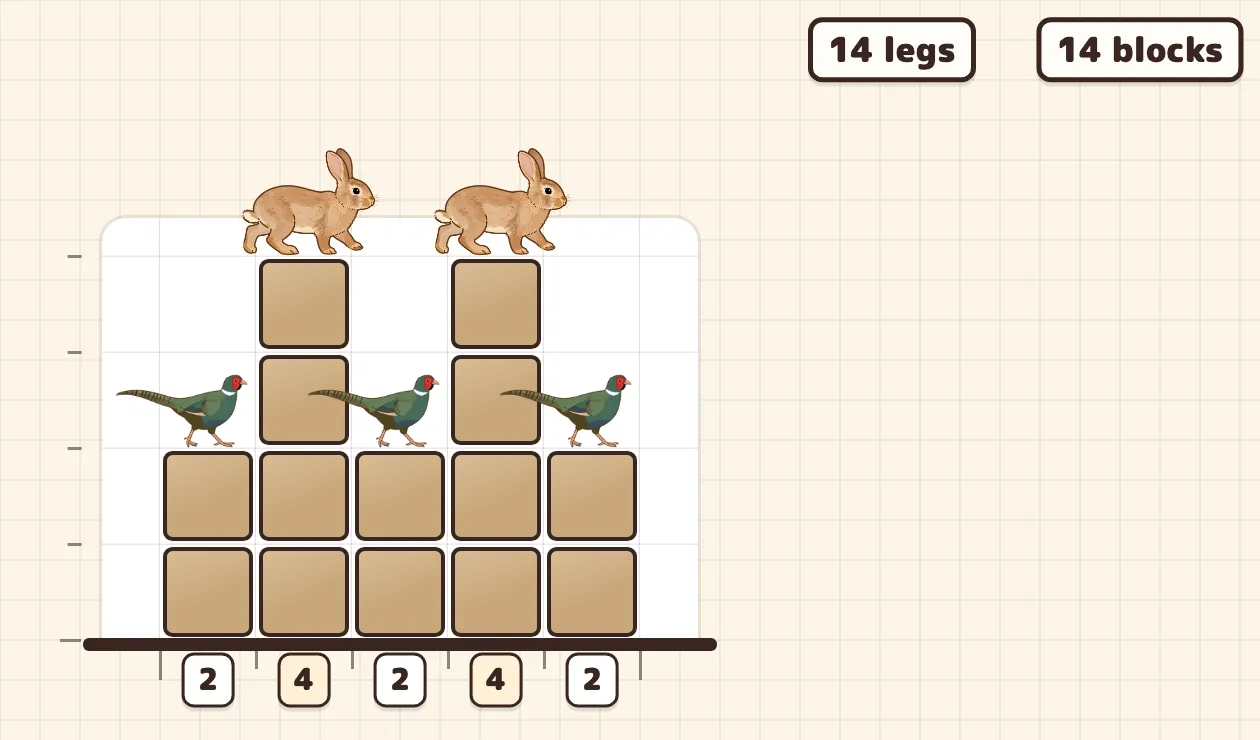
Move the rabbit columns together on the right. Moving whole columns changes neither the animals nor the total number of blocks.
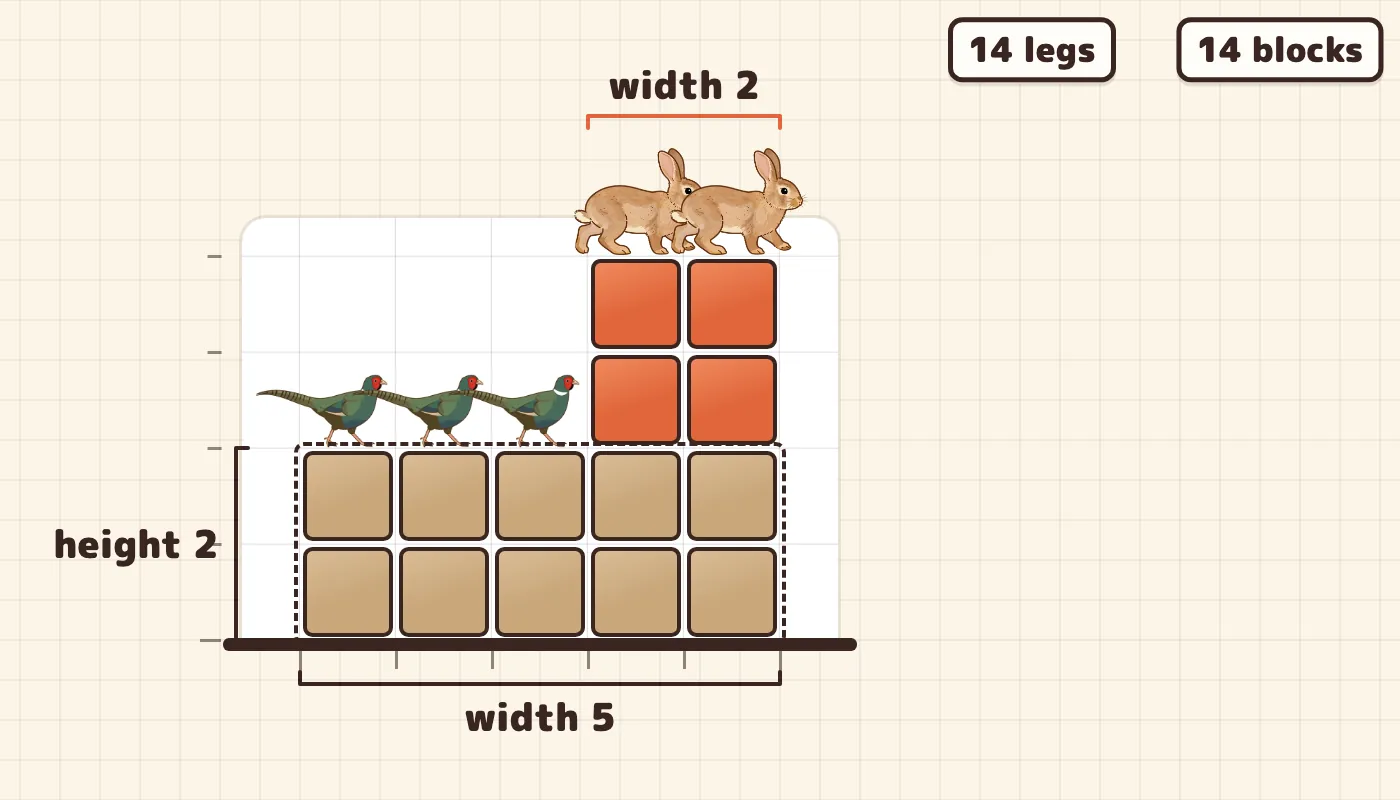
The bottom rectangle contains 2 × 5 = 10 blocks. Every animal contributes to it. The 4 blocks above it belong only to rabbits, with 2 extra blocks in each rabbit column. The width of the extra part counts rabbits. That is the feature to carry back to the larger puzzle.
Play the diagram: turn the small cage's legs into blocks
Build the area diagram for all the animals
Draw what is known before finding what is unknown
We do not know which animals are rabbits, but we do know that all 35 animals have at least 2 legs. Draw 35 columns and put 2 blocks in every column.
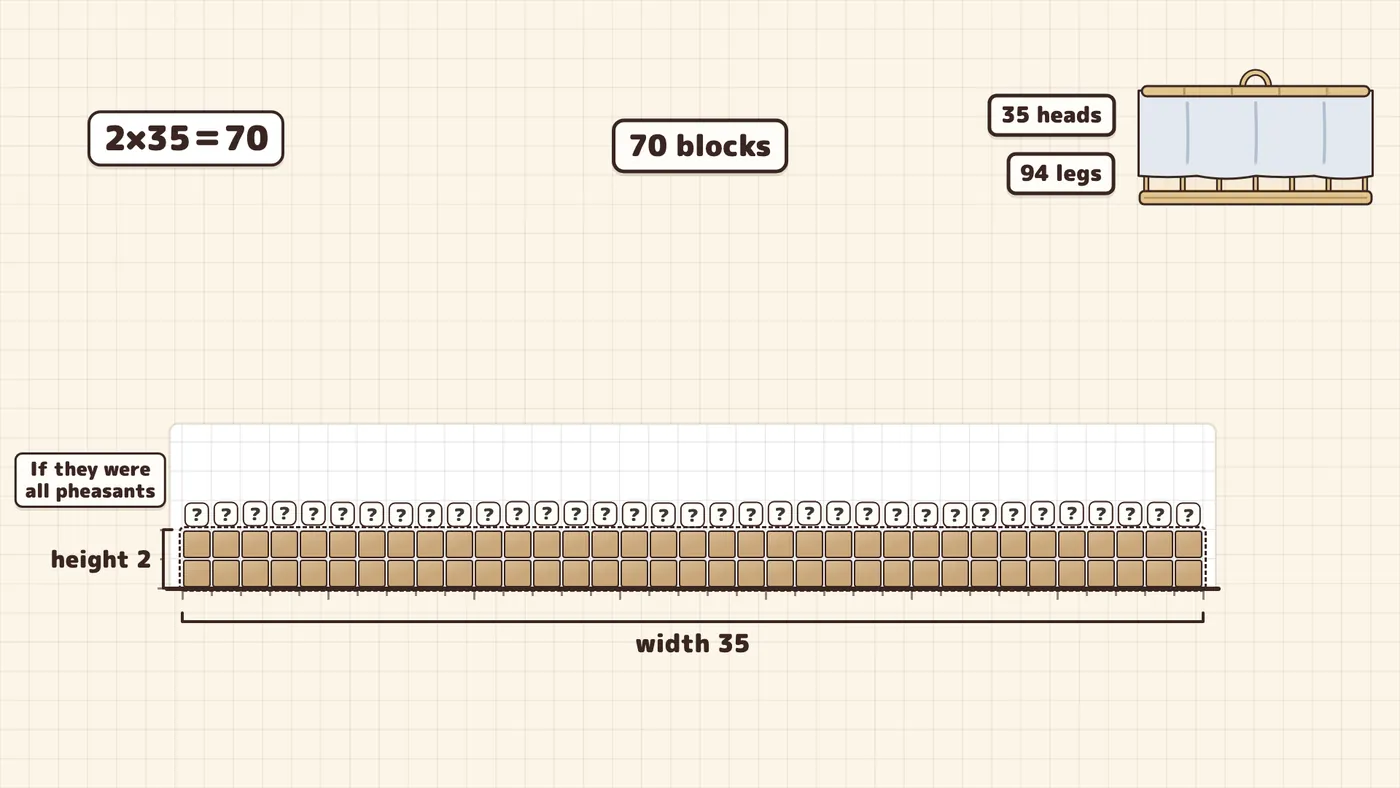
The rectangle contains 2 × 35 = 70 blocks. This is what the leg total would be if every animal were a pheasant. It is also the part of the actual total that every animal shares.
Find the blocks still waiting to be placed
There are 94 legs in the real cage, so 94 − 70 = 24 blocks remain.
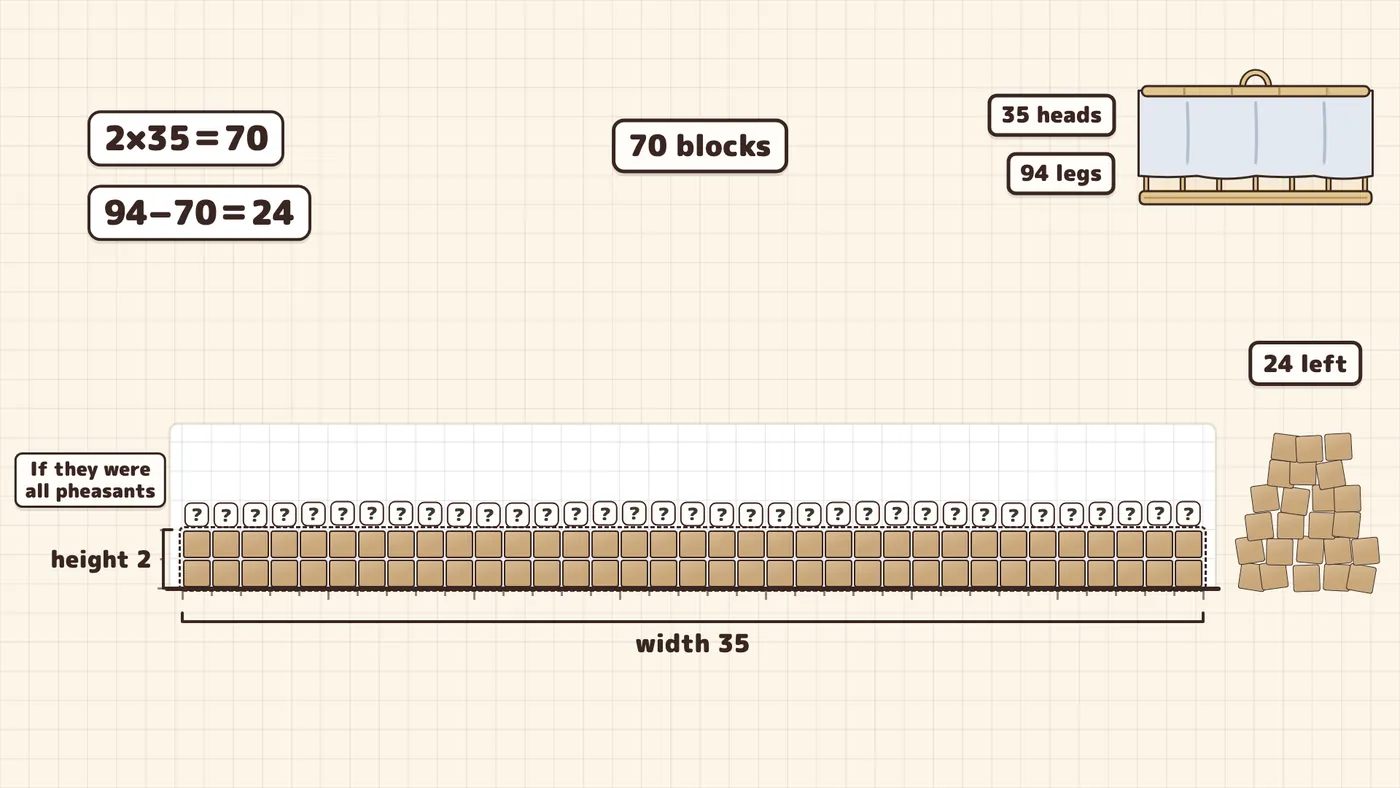
Ask where those blocks can go. A pheasant's column is already complete. Only the rabbits need more blocks.
Work out the extra height of each rabbit column
A rabbit's whole column is 4 blocks tall, but 2 of those blocks are already in the bottom rectangle. Each rabbit needs 4 − 2 = 2 extra blocks. Imagine the rabbits grouped on the right, as in the small cage.
Before reading on, ask your child to split the leftover pile into columns of that height. How many columns will it make, and which animals will stand on them?
Worked answer and checks — answers included
The leftover pile makes 24 ÷ 2 = 12 columns.
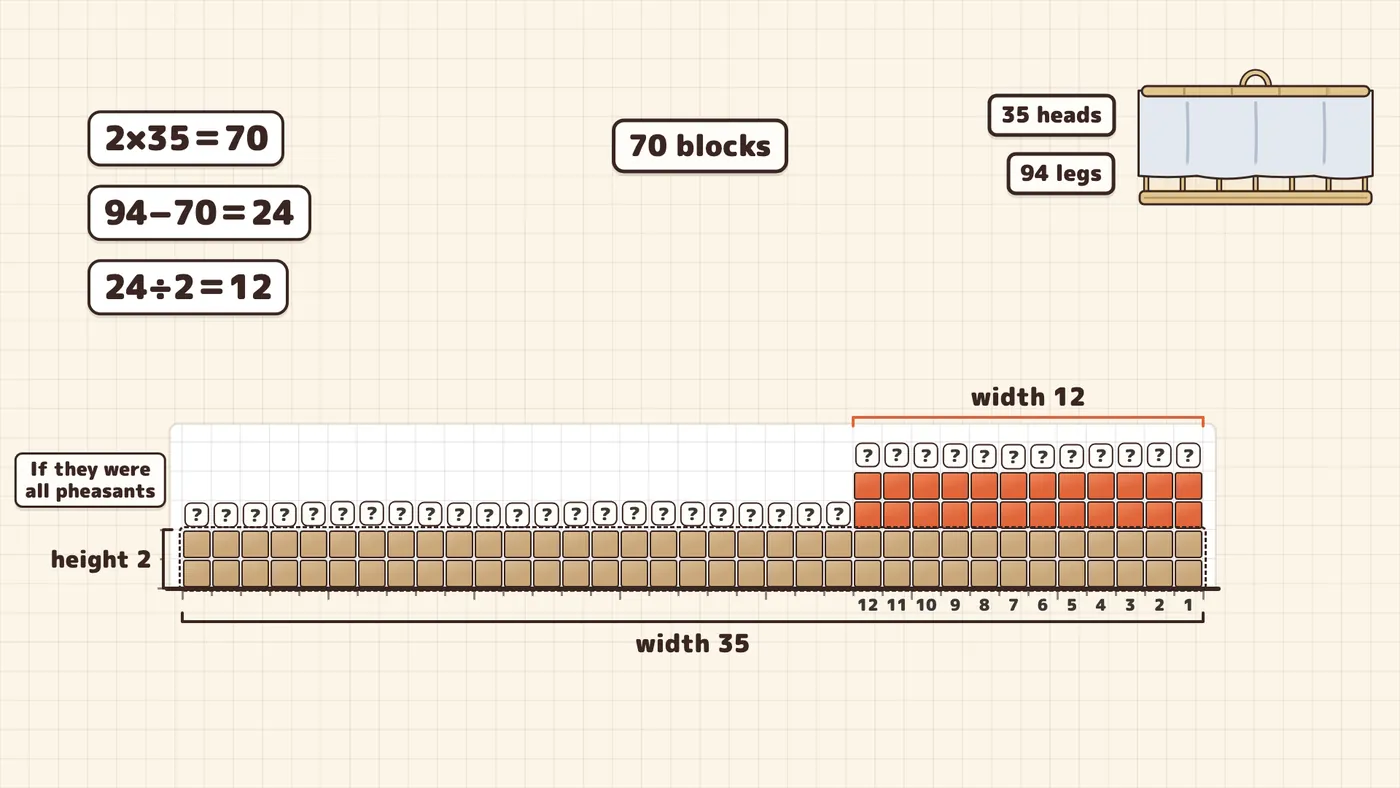
Those are the columns with extra legs, so there are 12 rabbits. The other 35 − 12 = 23 animals are pheasants. Starting with an all-pheasant rectangle does not make the final quotient a count of pheasants: it counts the columns that needed extra blocks.
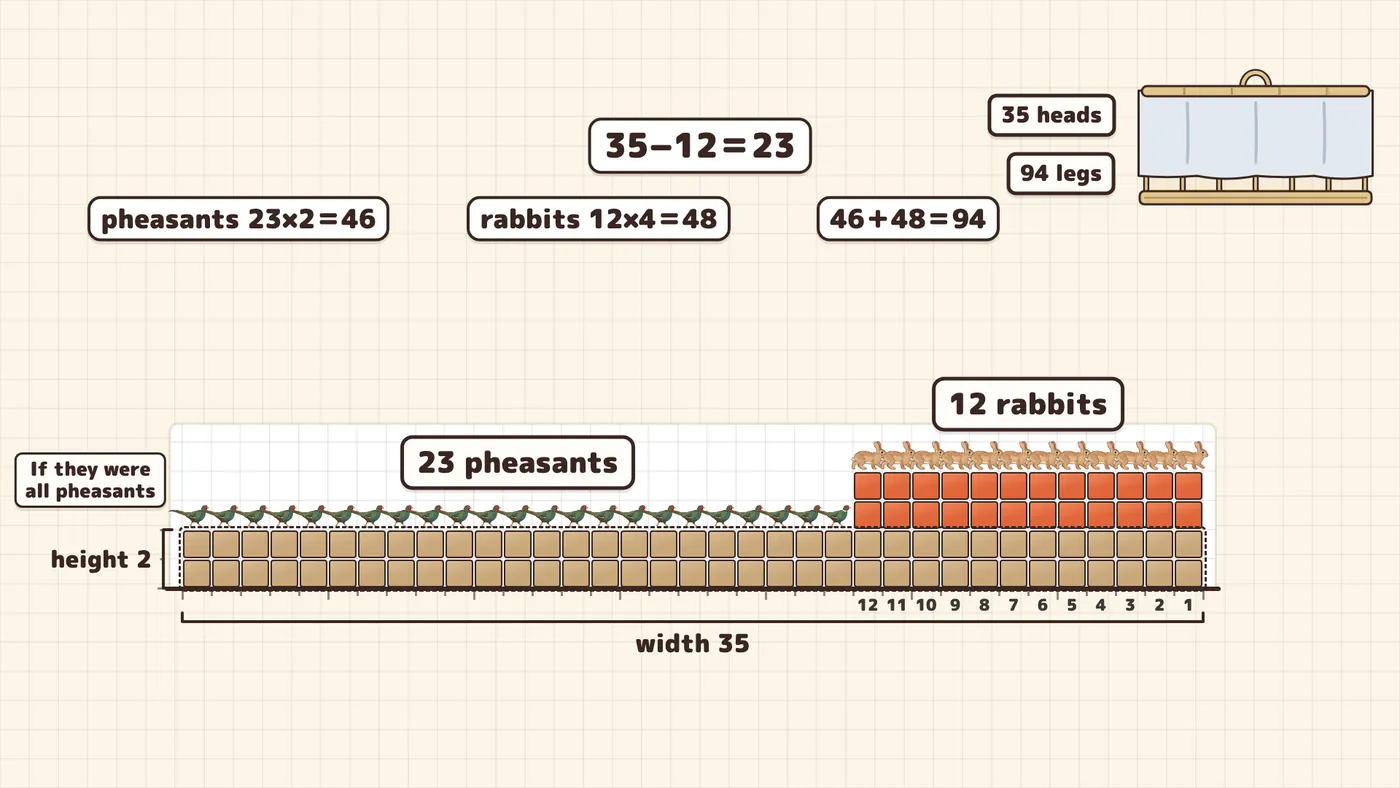
Check both original conditions:
- Heads: 23 + 12 = 35.
- Pheasant legs: 23 × 2 = 46. Rabbit legs: 12 × 4 = 48.
- Total legs: 46 + 48 = 94.
Swapping the two animal counts would give 116 legs, so the labels matter as much as the arithmetic.
Play the diagram: build the shared rectangle and place the leftovers
The old book gives the same answer. The page shown here is a 1934 copy made in Japan, held by the National Diet Library.
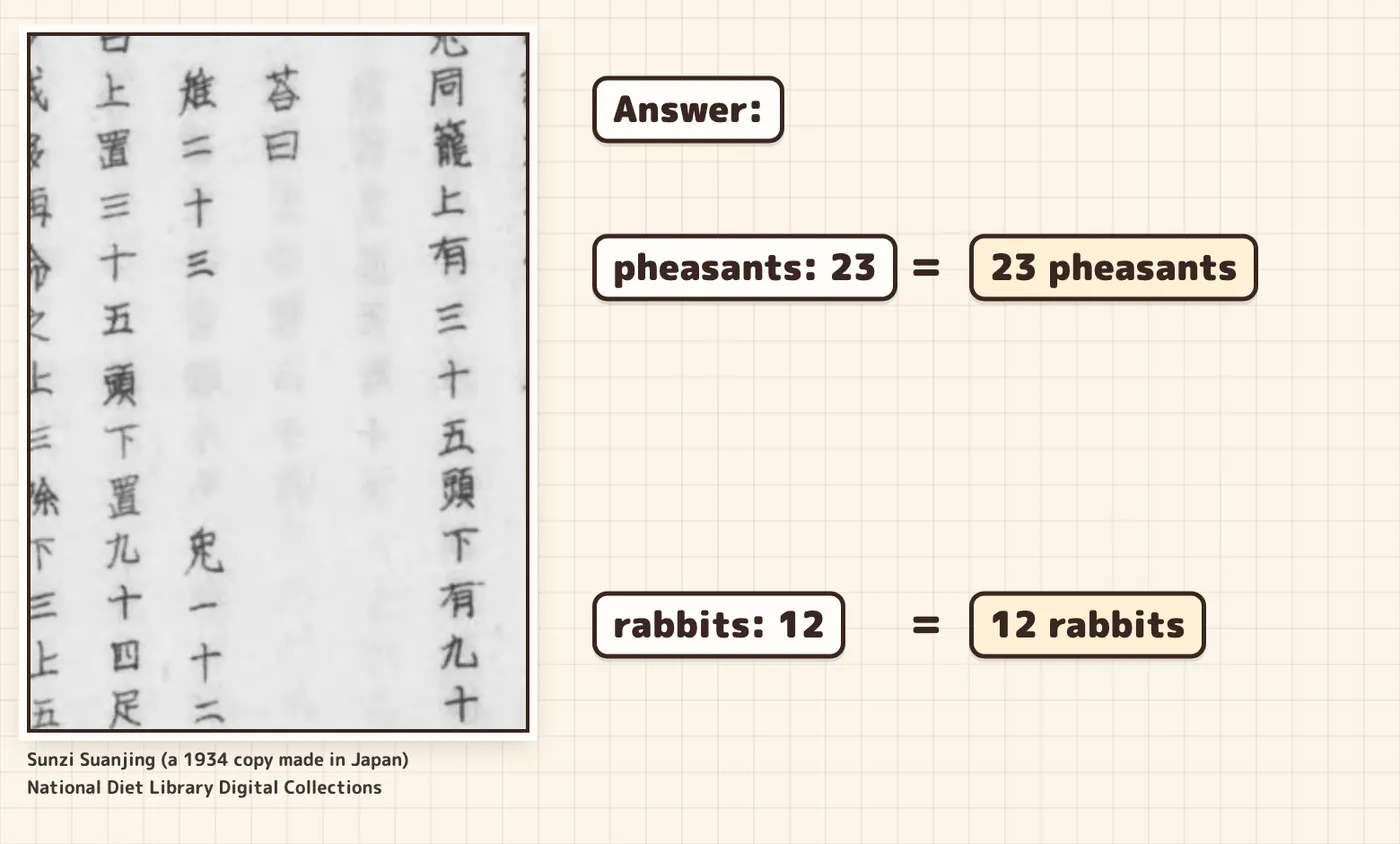
Two other ways to use the difference — answers included
Return to the first guess: 17 rabbits produced 10 legs too many. Replacing a rabbit with a pheasant keeps the head count fixed and removes 2 legs. Make 10 ÷ 2 = 5 replacements, leaving 17 − 5 = 12 rabbits. This is the same difference seen in the block picture.
You can also imagine that every animal is a rabbit. The full rectangle would contain 4 × 35 = 140 blocks. Since the actual total is 94, it has 140 − 94 = 46 blocks missing. Each pheasant column is short by 2 blocks, so 46 ÷ 2 = 23 counts pheasants this time. Always name what the width represents before using it as an answer.
Transfer the idea to a shopping problem
An apple costs 120 yen and a mandarin orange costs 80 yen. You buy 15 pieces of fruit for 1,520 yen. How many apples did you buy? All shopping prices in this guide are invented for practice.
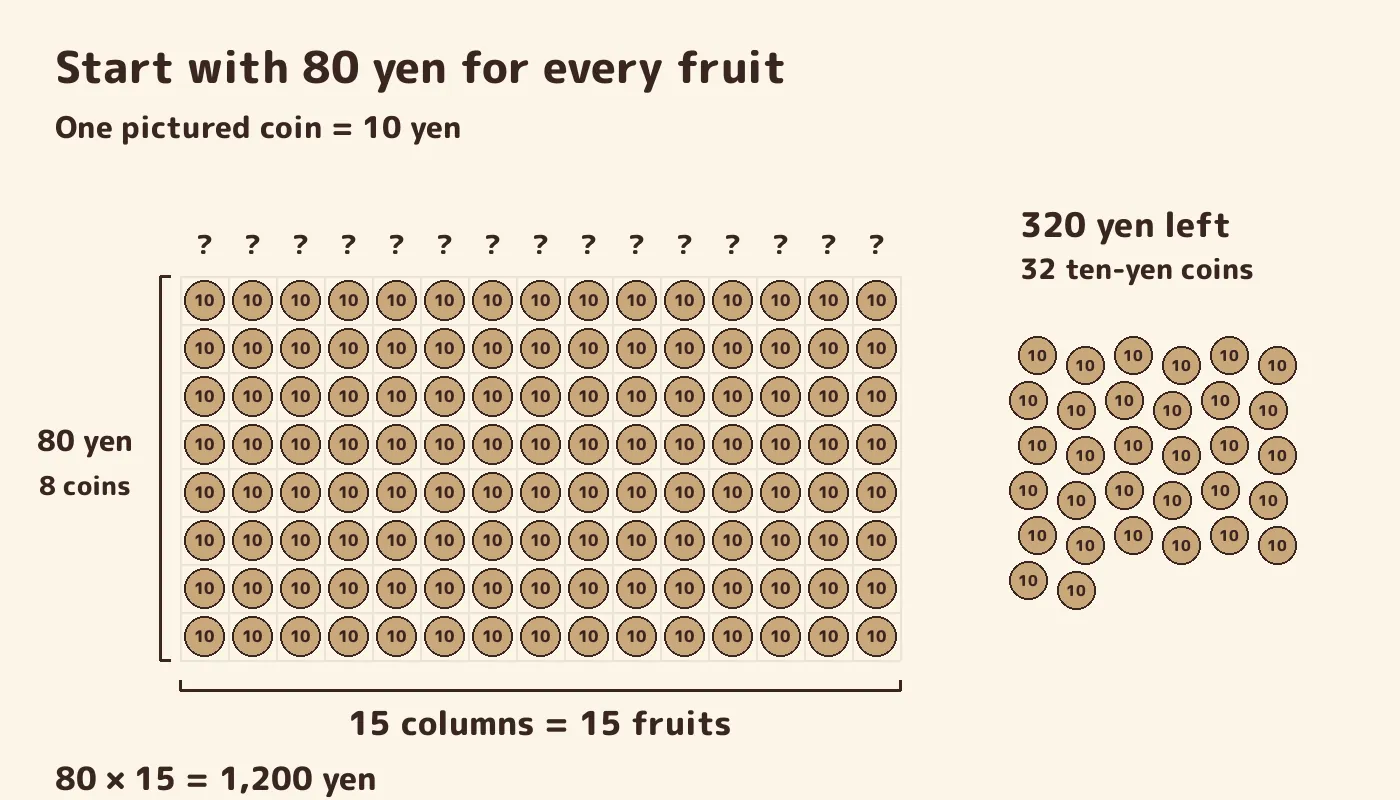
Keep the amounts in yen; no currency conversion is needed. Each pictured ten-yen coin stands for 10 yen. One fruit still takes one column: a mandarin needs 8 coins and an apple needs 12.
Separate the shared cost from the extra cost
If all 15 fruits were mandarins, the cost would be 80 × 15 = 1,200 yen. Draw that shared rectangle first. The actual bill is 1,520 − 1,200 = 320 yen higher, leaving 32 ten-yen coins to place.
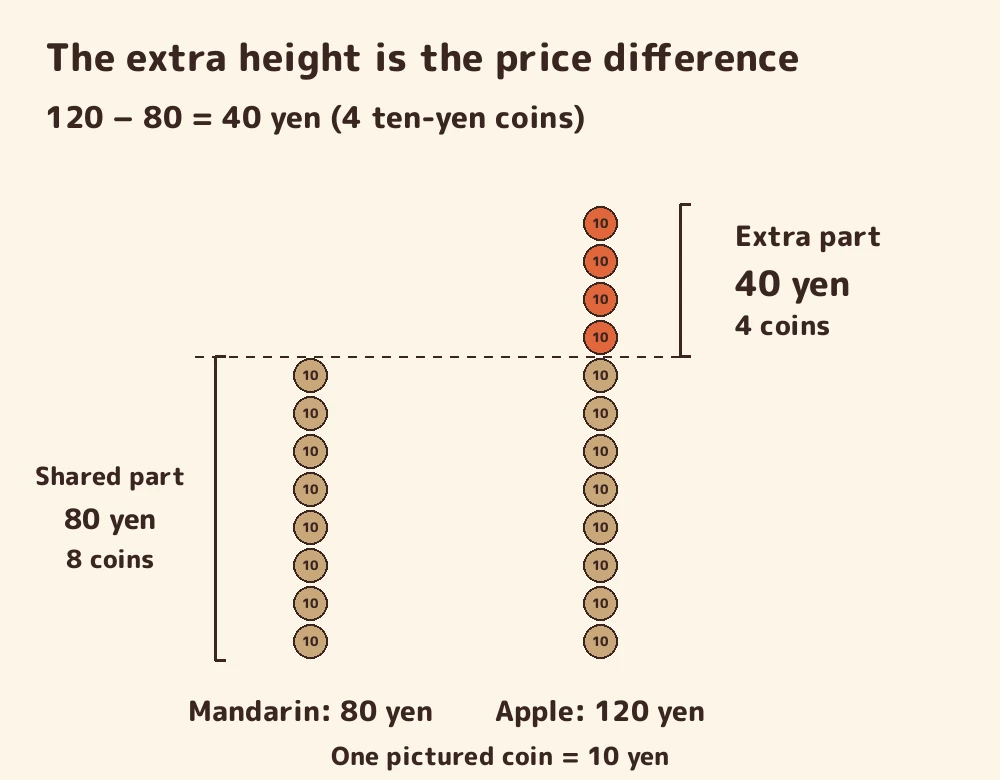
Pause at this question: “How much must be added to one column to make it an apple?” The bottom rectangle already includes 80 yen for that fruit. The extra height is therefore 120 − 80 = 40 yen, or 4 coins.
Shopping answer and checks — answers included
Split the remaining 32 coins into columns of 4: 32 ÷ 4 = 8. In yen, the same calculation is 320 ÷ 40 = 8. Only apple columns need that extra cost, so there are 8 apples and 7 mandarins.
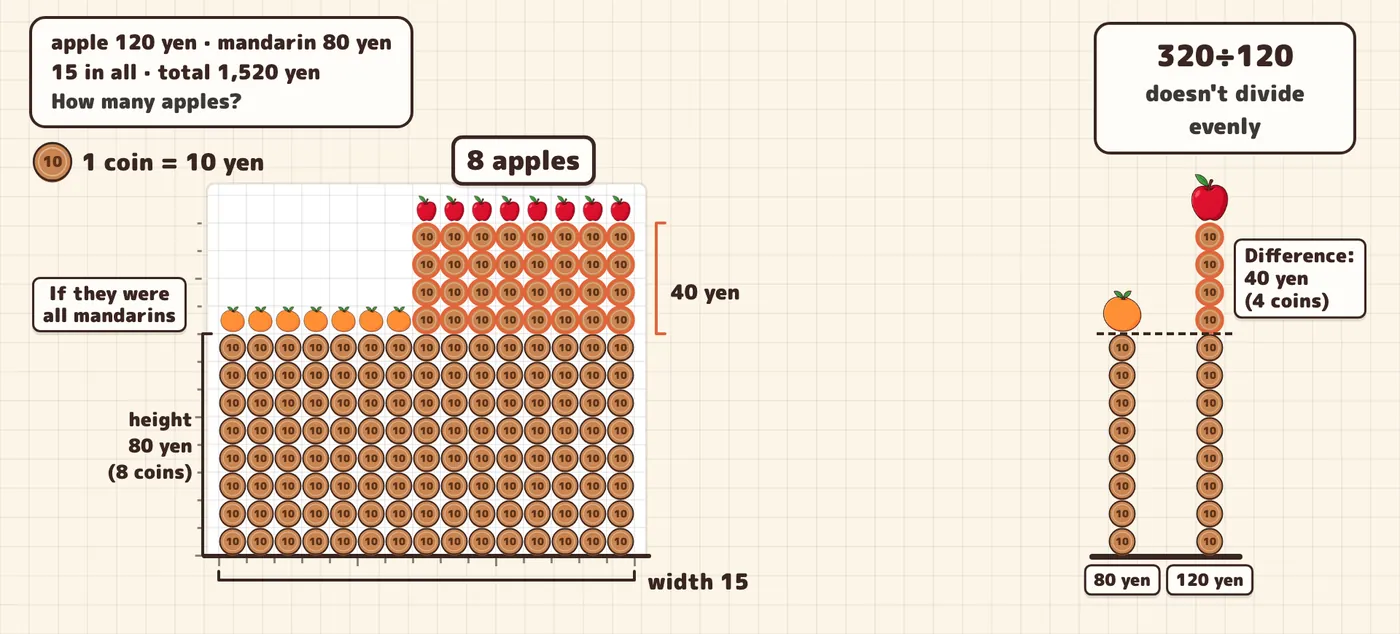
Check the count, 8 + 7 = 15, and the bill: 120 × 8 = 960; 80 × 7 = 560; 960 + 560 = 1,520 yen.
Dividing 320 by the whole apple price, 120, does not give a whole number. Dividing by 80 gives 4, but 4 apples and 11 mandarins cost only 1,360 yen. A whole-number result alone is not enough: check the extra height and put the counts back into the story.
Play the diagram: stack coins to show the shared cost and the difference
Practice, followed by an extension
Ask your child to mark the shared amount, the leftover amount, and the difference per column.
- A pack of gum costs 60 yen and a chocolate bar costs 90 yen. You buy 15 items for 1,110 yen. How many chocolate bars?
- You have 20 coins, some worth 50 yen and some worth 100 yen, with a total value of 1,450 yen. How many 100-yen coins?
- A pudding costs 90 yen and a piece of cake costs 150 yen. You buy 12 items for 1,500 yen. How many puddings?
- Pheasants with 2 legs and rabbits with 4 legs share a cage with 8 heads and 22 legs. How many pheasants? Try starting with an all-rabbit rectangle.
Practice solutions — answers included
- All gum would cost 900 yen. The extra 210 yen, divided by the 30-yen difference, gives 7 chocolate bars, leaving 8 packs of gum. Check: 90 × 7 + 60 × 8 = 1,110.
- All 50-yen coins would be worth 1,000 yen. The extra 450 yen, divided by 50, gives 9 coins worth 100 yen, leaving 11 worth 50 yen. Check: 100 × 9 + 50 × 11 = 1,450.
- All cake would cost 1,800 yen. The missing 300 yen, divided by the 60-yen difference, gives 5 puddings, leaving 7 pieces of cake. Check: 90 × 5 + 150 × 7 = 1,500. Starting with all puddings would find the cake count first; read the question again before answering.
- All rabbits would have 32 legs. The missing 10 legs, divided by the difference of 2, gives 5 pheasants, leaving 3 rabbits. Check: 2 × 5 + 4 × 3 = 22.
Extension: a rock-paper-scissors staircase
For each win, move up 3 steps. For each loss, move down 1 step. Ignore ties. After 20 rounds that count, you are 36 steps above the start. How many rounds did you win?
Extension solution — answer included
If every round were a win, you would climb 3 × 20 = 60 steps, which is 24 too many. Changing a win to a loss removes the 3-step climb and adds a 1-step drop: a difference of 4 steps. Thus 24 ÷ 4 = 6 rounds were losses and 14 were wins. Check: 3 × 14 − 6 = 36.
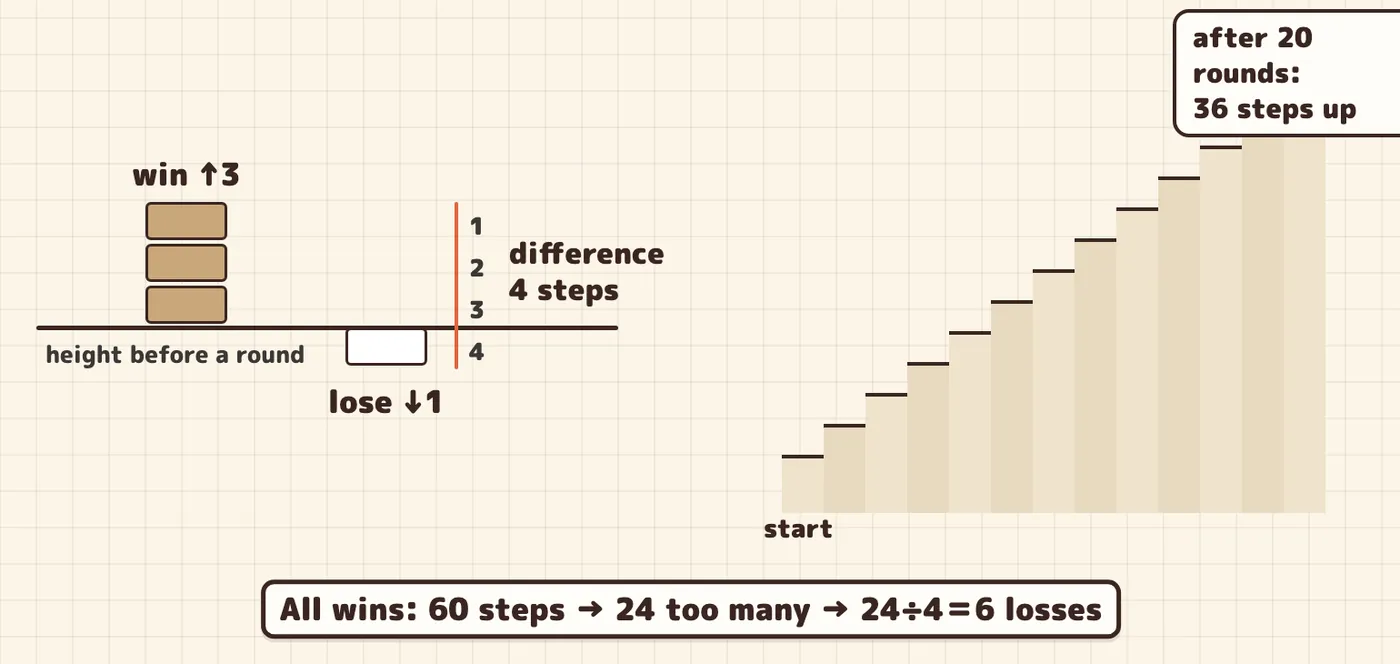
Here the downward move is awkward to draw as an ordinary stack of blocks. Comparing the two possible outcomes of one round still uses the same “imagine they are all alike” idea.
Helping a child take the next step
Offer one prompt at a time: “What can we put in every column?” Then, “Where can the leftovers go?” Then, “How much does each of those columns need?” Let the child point to the picture while explaining.
If a child is adjusting a guess successfully, ask what changes in one replacement. If the diagram makes sense already, ask why the fruit problem uses a price difference. Notice the explanation or the revision of an idea, rather than making speed the goal.
The arithmetic uses counting, multiplication, subtraction, and division. A child who has not learned rectangle area can count the blocks. The episode's “Grade 4 · Advanced” label follows Japanese school grades and the series' own difficulty guide; it is not a placement recommendation for another country's curriculum. In Japan, problems of this kind are sometimes called tsurukame-zan, or crane-and-turtle problems.
Frequently asked questions (FAQ)
What do the height, width, and area represent?
Height represents legs per animal or cost per item. Width counts animals or items. The area counts the total blocks or pictured coins. Label the units and say what one column represents before calculating.
Why divide the leftover legs by the difference rather than by the rabbit's whole leg count?
The shared rectangle has already counted part of each rabbit's legs. The leftovers supply only the extra part of a rabbit column. The same reasoning applies to prices: after subtracting the shared cost, divide by the extra cost per item.
Does the width always give the number the question asks for?
No. Starting with the smaller amount makes the extra width count the kind with the larger amount. Starting with the larger amount makes the missing width count the kind with the smaller amount. Identify that kind, then check whether the question asks for it or for the remaining items.
Try the interactive activity: The Mystery Cage
Open The Mystery Cage. On the episode page, you can also use the activity in the “Try it” section.
Choose “Try a small cage first.” Tap animals to swap them, then select “Put the rabbits on the right” and inspect the shared and extra parts. In the big cage, open the hints as needed and place the extra blocks yourself.
Next, choose “More puzzles.” “Medium” includes shopping problems; “Challenge” asks for the cheaper item, giving a reason to check what the width counts. “Make a puzzle” lets you choose heads and legs and investigate whether those numbers can make a cage.
Shorts
Sources
Where the facts and numbers in the video and on this page come from.
- Project Gutenberg, Sunzi Suanjing, eBook #24038 (Chapter 3, Problem 31, for the original problem and answer. The animals and numbers are unchanged; Tamelabo's English wording focuses the question on rabbits. The text is public domain in the United States)gutenberg.org/ebooks/24038
- National Diet Library Digital Collections, Sunzi Suanjing(Commentary attributed to Li Chunfeng and others; Sawamura Shahondo, 1934. The problem and answer appear on the right-hand side of frame 31. The page image is public domain. This copy has an additional character in 「下有九十四足」 compared with the Gutenberg text; the meaning is unchanged)dl.ndl.go.jp/pid/1147712
- University of Tsukuba, history-of-mathematics lecture material (Dating of the book and identification of Chapter 3, Problem 31 (in Japanese). No slide images reproduced)math-info.criced.tsukuba.ac.jp/museum/wisdom_of_math/copy_of_ppt_Jochi…
- Wikipedia, Sunzi Suanjing (Reference for the date range and English book title. No article text or images reproduced)en.wikipedia.org/wiki/Sunzi_Suanjing
- Japanese Wikipedia, 鶴亀算(Reference for the Japanese name (in Japanese). No article text or images reproduced)ja.wikipedia.org/wiki/鶴亀算
- Japan's Ministry of Education, Commentary on the Elementary School Course of Study, Mathematics, 2017 notification (Grade 3 A(3)(4), Grade 4 A(3) and B(4); rectangle area and shapes composed of rectangles on printed pages 208–211 (in Japanese). This does not mean the named heads-and-legs method is a required curriculum topic)mext.go.jp/component/a_menu/education/micro_detail…
- All About, Tsuyoshi Miyamoto, article on special arithmetic problems (Reference for the term “area diagram” in Japanese entrance-exam arithmetic (in Japanese). No article text or diagrams reproduced)allabout.co.jp/gm/gc/488973
- Z-Image-Turbo model distributor (Model used to make existing illustrations (Apache-2.0). Tamelabo made the problem wording, learning diagrams, animation, practice problems, and invented prices. The main puzzle is attributed to the classical source above, rather than claimed as an original problem)huggingface.co/Tongyi-MAI/Z-Image-Turbo
- FLUX.2-klein-4B model distributor (Model used to make existing illustrations (Apache-2.0). Diagram typeface: M PLUS Rounded 1c (SIL OFL 1.1). Additional diagrams drawn by Tamelabo)huggingface.co/black-forest-labs/FLUX.2-klein-4B
- Kokoro model distributor(English voice in the existing diagram clips (Apache-2.0). Music: “のんびり行こうよ” by zmino, via OpenTracks; the material record permits commercial use and makes credit optional. Sound effects made by Tamelabo)huggingface.co/hexgrad/Kokoro-82M
Voice, music, art
- Voice: Kokoro / Music: “のんびり行こうよ” by zmino, “パステルハウス” by かずち (OpenTracks) / Sound effects: Tamelabo / Font: M PLUS Rounded 1c (SIL OFL 1.1) / Art, problems, and animation: Tamelabo