How Many Thousands Make One Million? (Grade 4, Starter) | Math Aha! Theater #03
Short answer
- One million is 1,000 thousands: 1,000 × 1,000 = 1,000,000.
- Write 1,000,000 in a place-value chart and cover the ones period (the last three digits); 1000 is left.
- Adding 1,000 to 999,000 makes the thousands period carry into the millions place, and 1,000 thousand cubes form one big cube.
Also calledhow many thousands make a million1,000,000 divided by 1,000place value chart periodsreading big numbers with commasthousands and millions place value grade 4
Video

Pressing play loads the YouTube player on this page. Watch on YouTube
Try it
Explained
Math Aha! Theater | Grade 4 · Starter | For parents and teachers
"How many thousands make one million?" sounds like a trivia question, but it sits right at the heart of fourth-grade place value. This page walks through it the way the video does: first count blocks of one thousand, then use a place-value chart, cover the ones period, and read the number back with commas every three digits from the right.
It lines up with the Common Core State Standards for Grade 4: a digit in one place is worth ten times what it is worth in the place to its right (4.NBT.A.1), and children read and write multi-digit numbers with digits, number names, and expanded form (4.NBT.A.2).
The second half contains the answers. If you are working with a child, show only "The four problems" first and give them time to think before you reach the sections marked as containing answers. Everything here works on paper, too.
What this page covers
- A path from "count, then chart, then watch the carry" to a real understanding of how 1,000,000 relates to 1,000.
- The chart method used in the video: write the number in the chart, cover the ones period, and read what is left.
- The most common slips when writing big numbers in digits, and how reading back with commas catches them.
- A printable blank place-value chart.
The four problems (no answers yet)
- Main question: How many thousands make one million?
- Practice 1: How many thousands make two million?
- Practice 2: Write 3,500 thousands as a number.
- On your own: Write 4 million 200 thousand as a number.
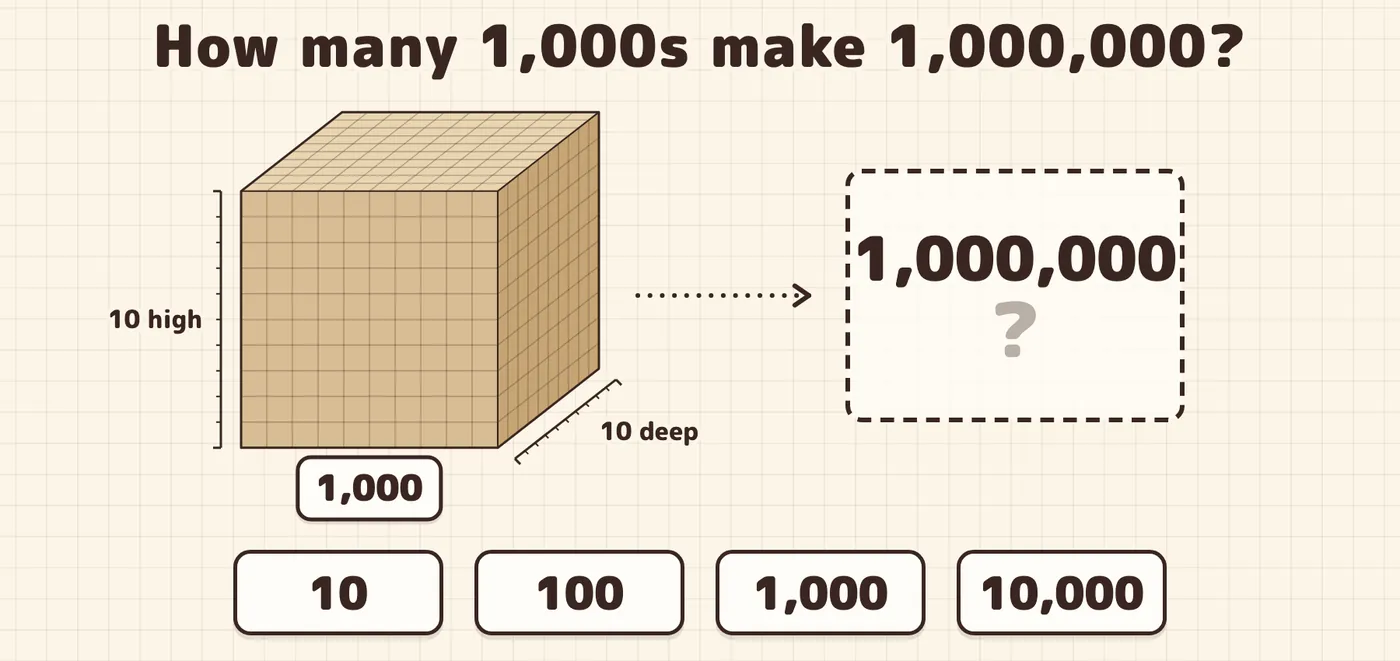
In the video, one thousand appears as a cube: small cubes ten across, ten deep, and ten high. It is the same "thousand cube" many classrooms have in their base-ten blocks. Before going further, ask the child to pick a guess: 10, 100, 1,000, or 10,000 of these cubes?
The first move: count by thousands
Most children start by counting: one thousand, two thousand, three thousand... That is not wrong. It always gets there eventually, and the video shows it honestly.
- Ten thousand cubes in a row make a rod: 10,000.
- Ten rods fill a layer: 100 cubes, which is 100,000.
Here the thing being counted changes, so name it out loud. Put a frame around the layer: that is one layer of one hundred thousand. One million is ten of these layers. After a hundred cubes, we are only one tenth of the way there.
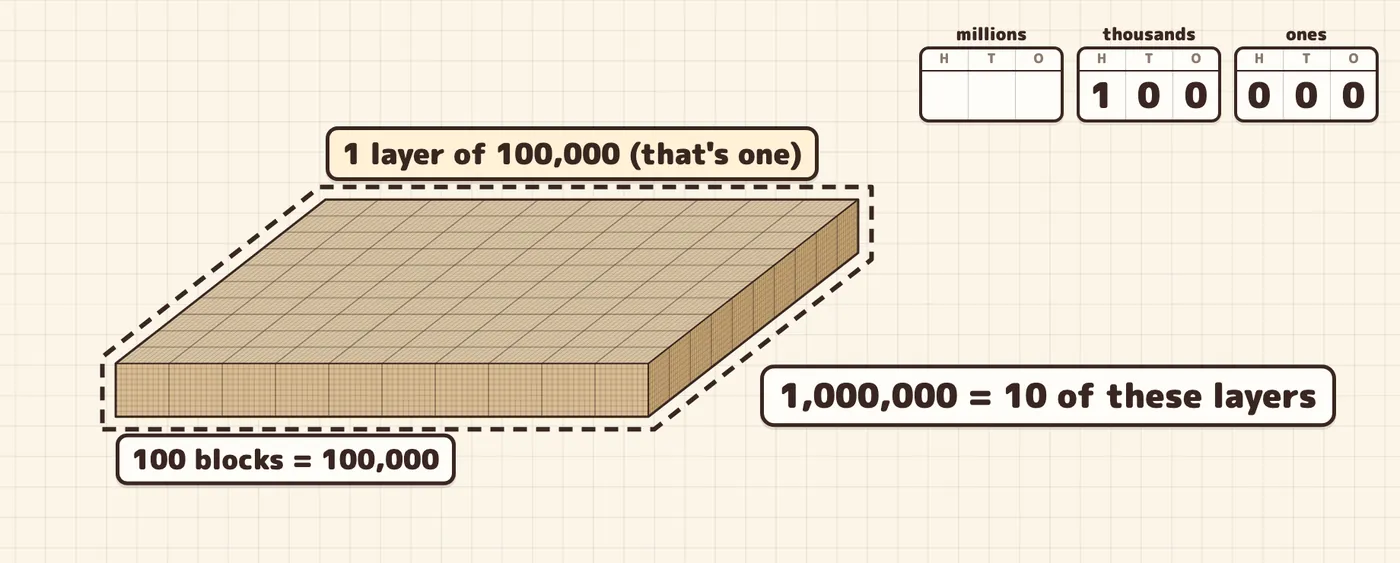
Watch it move: lining up thousand cubes, up to one layer
That moment of "all this, and still only one hundred thousand?" is what makes children want a way that needs no counting.
The place-value chart method
This is the method used in this article and in the video. Schools and textbooks draw place-value charts in slightly different ways; the idea is the same.
Drawing the chart
Draw three groups of three boxes. Each group is a period, and inside every period the places are hundreds, tens, and ones (H T O). From the right, the periods are the ones period, the thousands period, and the millions period. Inside the thousands period are the thousands, ten-thousands, and hundred-thousands places, and just to the left of them is the millions place.
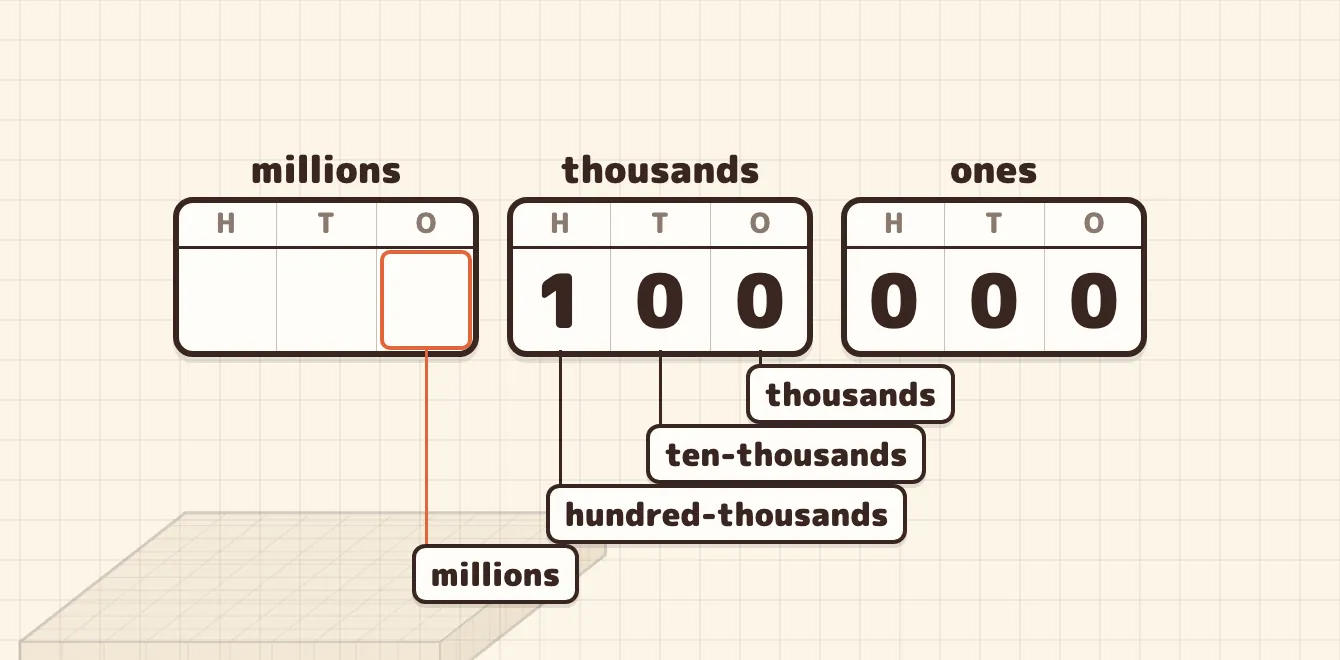
When children draw it by hand, three groups of three boxes are enough; they do not need to write H, T, O. You can also print the blank chart below.
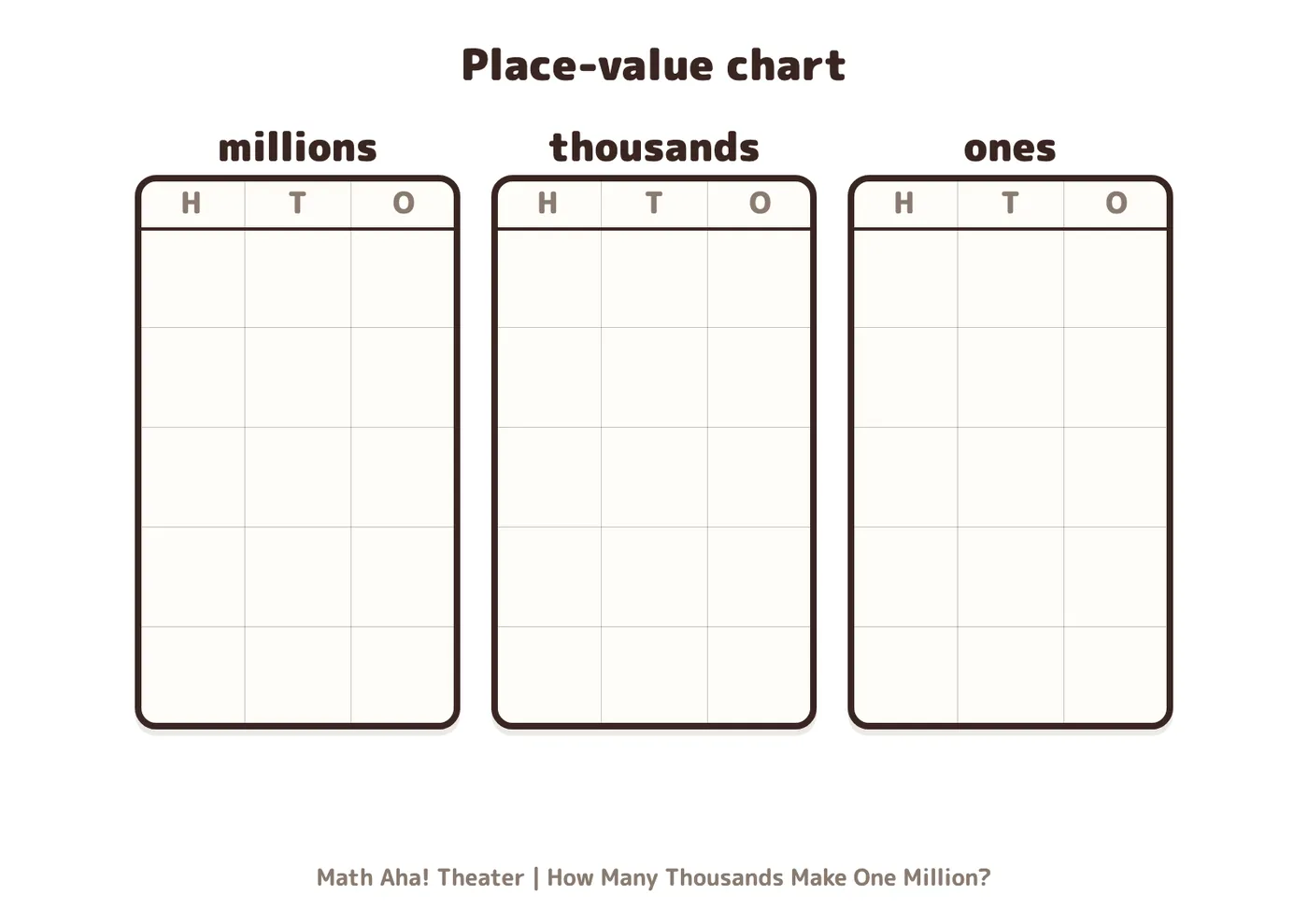
Reading "how many thousands"
- Write the number in the chart, lined up on the right. For 1,000,000: a 1 in the millions place and six zeros.
- Cover the ones period (the last three digits) with a finger or a sticky note.
- Read what is left as an ordinary number.
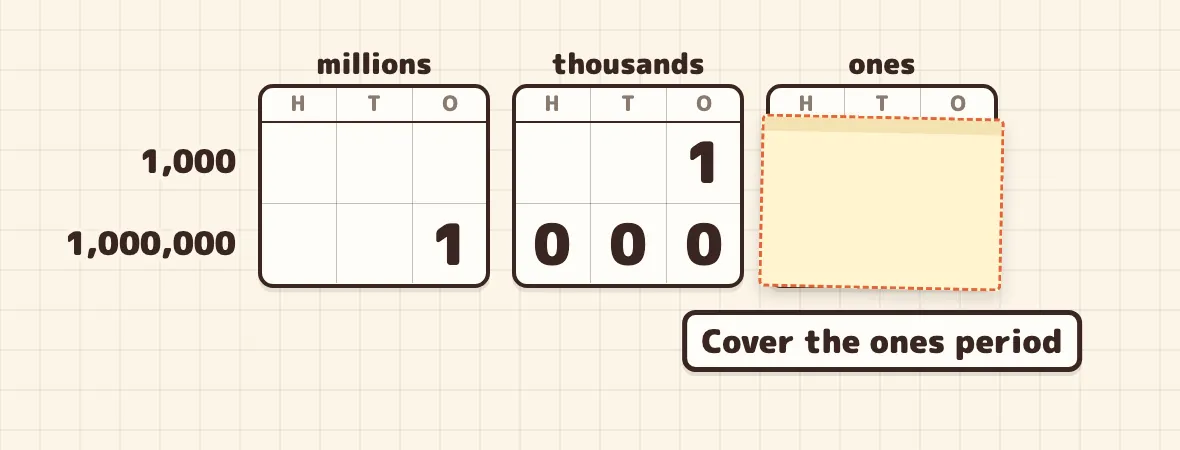
Try it first with 1,000: what is left is 1. One thousand is one thousand cube, so the method checks out on an easy case.
Writing a number in digits
- Put each part in its period, lined up on the right: millions in the millions period, thousands in the thousands period.
- Every empty place to the right of the first digit gets a 0: gaps inside a period, empty periods, and the ones period.
- Write the digits from left to right.
A number given as "3,500 thousands" is a nice twist: the thousands period has only three places, so 3500 cannot fit inside it. Write 3500 so that it ends in the thousands place, and the 3 lands in the millions place. That is why 3,500 thousands is three million, five hundred thousand.
Reading it back: commas from the right
- Starting from the right, put a comma after every three digits.
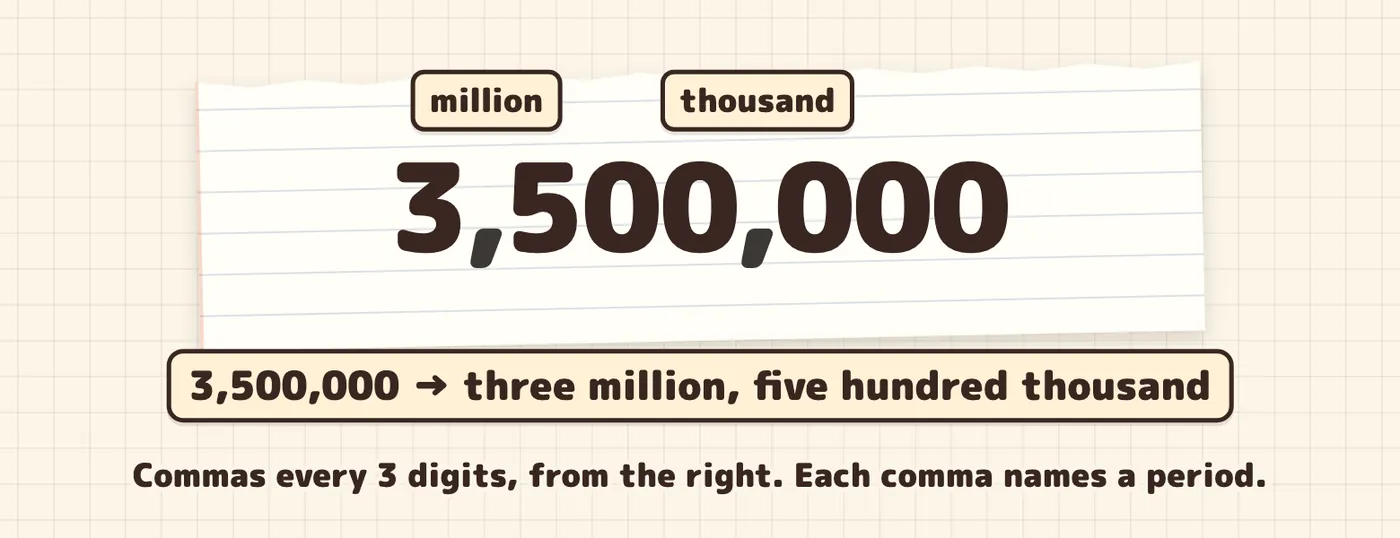
- Name the commas from the right: the first one says "thousand," the next says "million."
- Read each period from the left, then say its name, and check that it matches the question.
Why covering the ones period works
The three places in the thousands period count thousand cubes, exactly like an ordinary number: the thousands place counts single cubes, the ten-thousands place counts rods of 10 cubes, and the hundred-thousands place counts layers of 100 cubes.
At 999 cubes (9 layers, 9 rods, and 9 cubes), there is one gap left at the top front corner, and the chart shows 999 | 000. Add one more cube, and the nines in the thousands period turn to zeros from right to left while a 1 carries three times and lands in the millions place. At the same moment, the cubes complete one big cube that looks just like the thousand cube: 10 by 10 by 10.
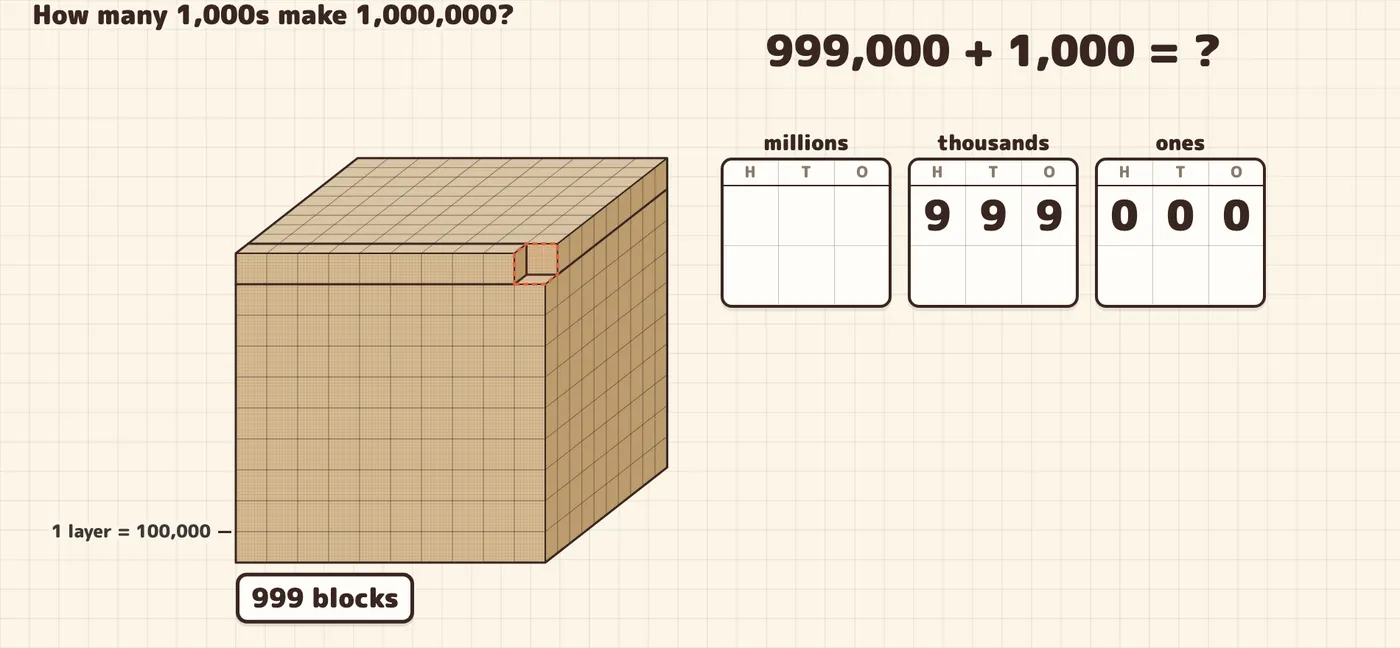
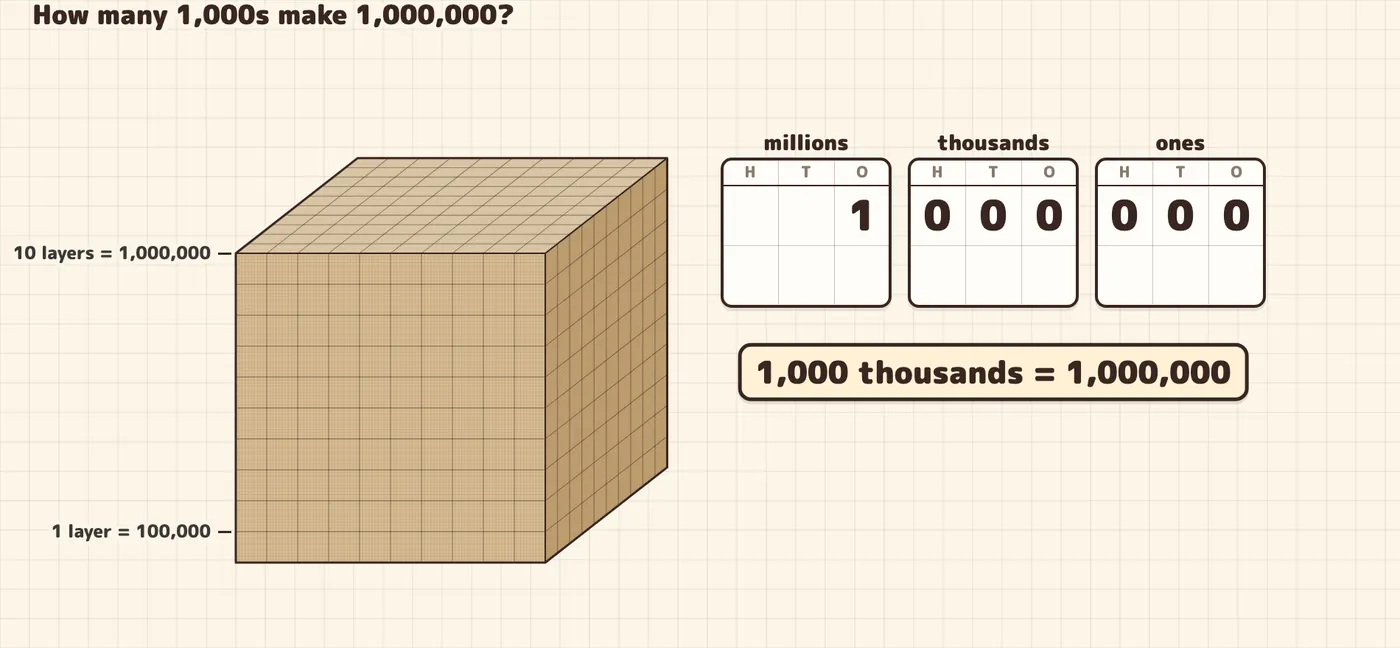
The same thing happens inside one cube: 999 small cubes plus one make 1,000. In the chart, it is the same carry, three places over.
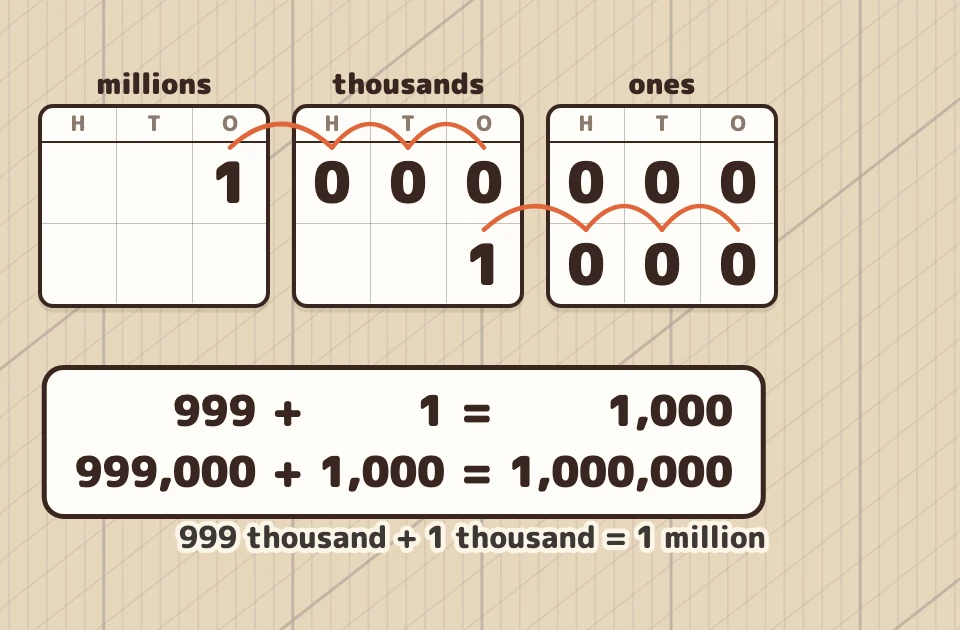
Watch it move: the carry from 999,000 to 1,000,000
Because hundreds, tens, and ones repeat in every period, covering the ones period leaves the number of thousands. Two quick cross-checks:
- Count the zeros: 1,000,000 has six zeros and 1,000 has three. 6 − 3 = 3, so the answer is a 1 followed by three zeros.
- Ten times, three times (4.NBT.A.1): 1,000 → 10,000 → 100,000 → 1,000,000. Each step moves every digit one place to the left.
A picture that sticks: if the small cubes are the common 1-centimeter base-ten cubes, a thousand cube is 10 centimeters on each edge, and a million cube would be 1 meter on each edge.
Common stumbles, and what to say
Instead of saying "that's wrong," try "Let's put it in the chart and read it back." Most children then catch the mistake themselves.
One zero short
3,500 thousands sometimes gets written 350000. In the chart, every digit shifts one place to the right: 350 | 000, which reads three hundred fifty thousand. In the picture, that is three and a half layers instead of three big cubes and five layers: only one tenth. The ones period always has three places, so it needs three zeros.
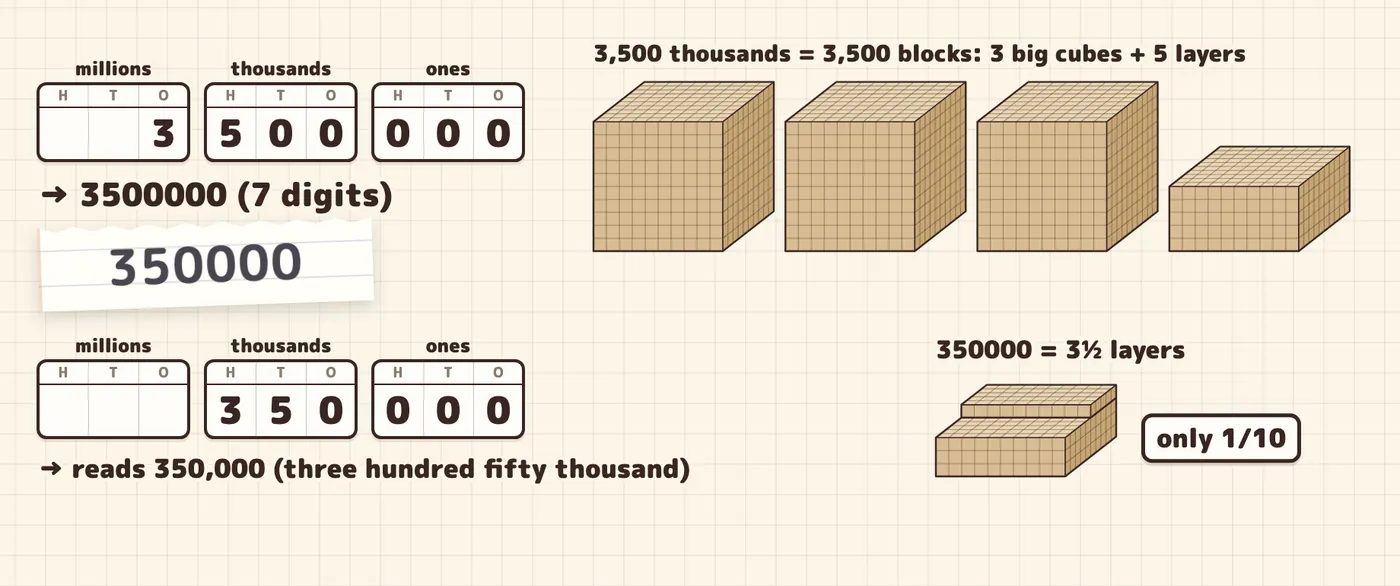
Watch it move: the chart and cubes for the mistaken number
Writing the two parts side by side
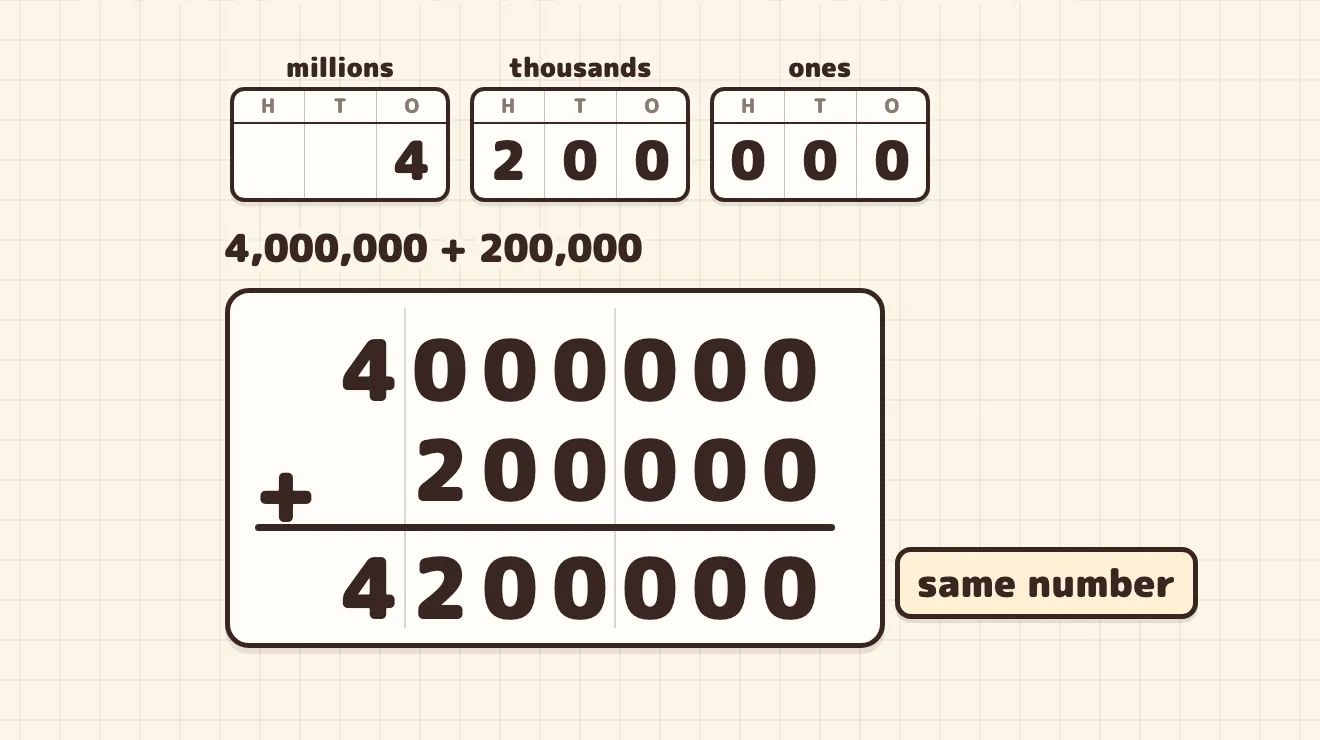
Writing 4,000,000 and 200,000 separately and joining them gives 4000000200000, a 13-digit number. Everything goes into one chart.
Forgetting zeros inside a period
In a number like 5 million 30 thousand, the zero in 030 is easy to forget, and 530000 appears. Every period has three places; empty places get a 0: 5,030,000.
Calling the first comma "thousand"
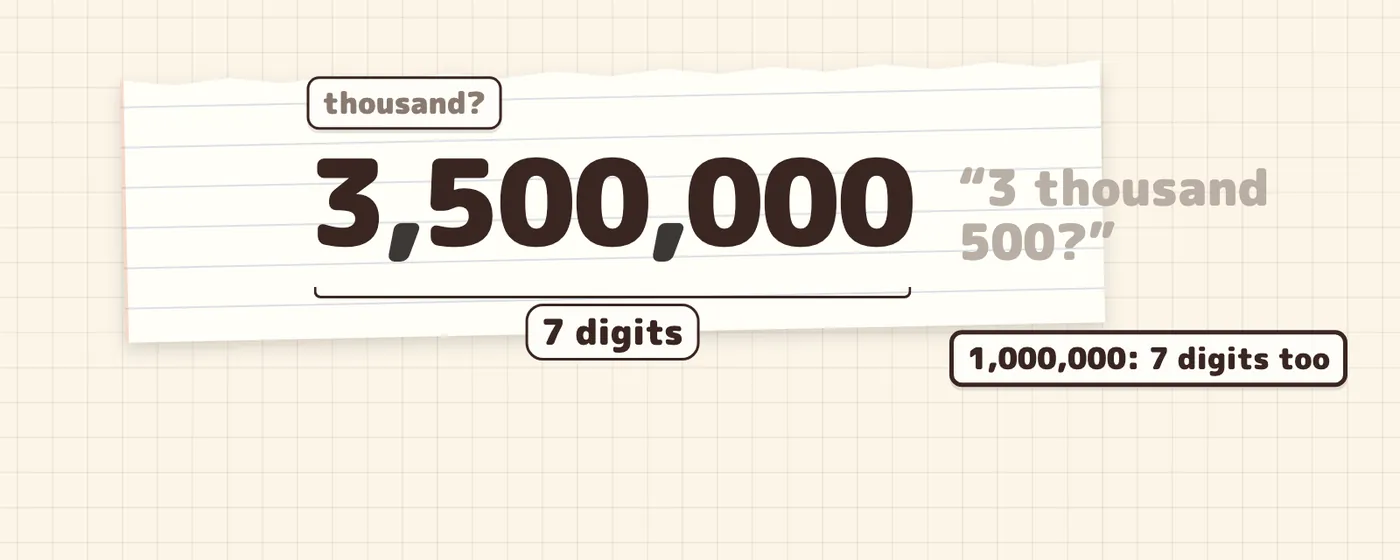
Many children first meet the comma in numbers like 3,500, where it means "thousand." Reading 3,500,000 from the left, some say "three thousand five hundred" at the first comma and stop. But the number has seven digits, and one million also has seven digits, so it must be in the millions. Name the commas from the right instead: thousand, then million. It reads three million, five hundred thousand.
→ Try it with your own hands: Open the "Million Blocks" activity
Answers and checks (this section contains the answers)
| Problem | Answer | Check 1 | Check 2 | ||
|---|---|---|---|---|---|
| How many thousands make one million? | 1,000 | Cover the ones period: 1 \ | 000 \ | 000 → 1000 | Ten times, three times; or zeros 6 − 3 = 3 |
| How many thousands make two million? | 2,000 | Cover and read: 2 \ | 000 \ | 000 → 2000 | 1,000,000 is 1,000 thousands, so twice that |
| Write 3,500 thousands as a number | 3500000 (3,500,000 is also correct) | Commas from the right: 3,500,000 → three million, five hundred thousand | 3,500 × 1,000 = 3,500,000 | ||
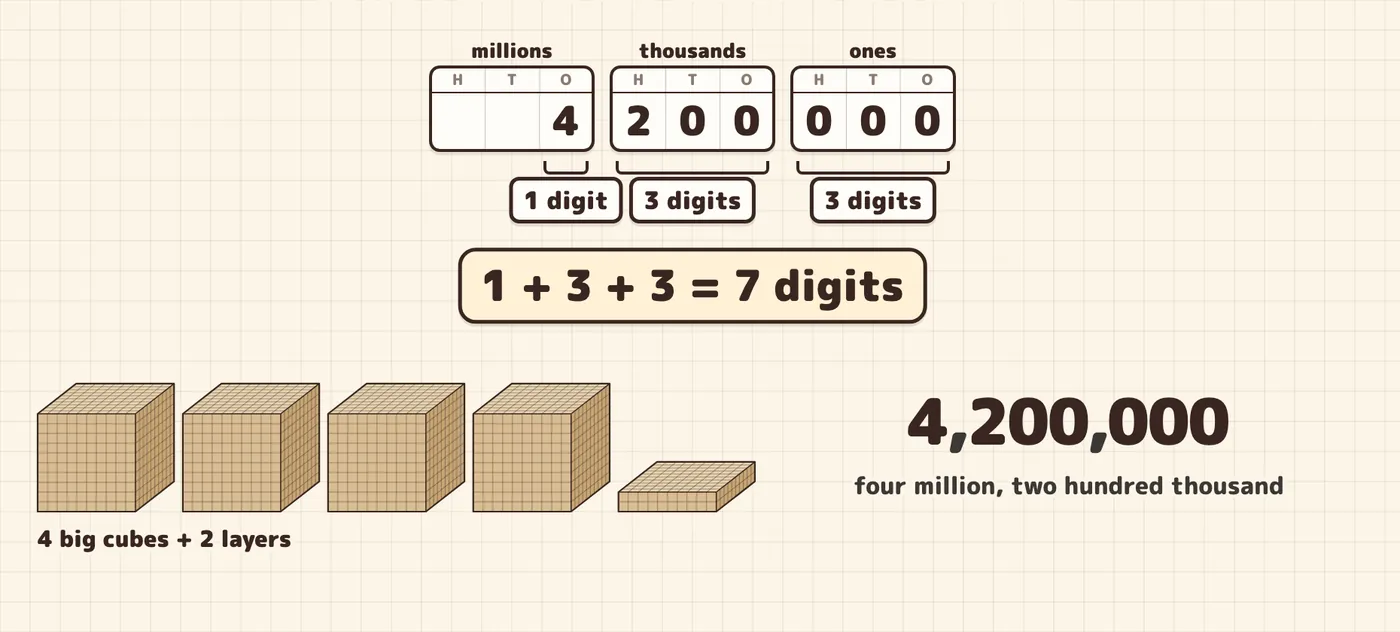
| Write 4 million 200 thousand as a number | 4200000 (4,200,000 is also correct) | Commas from the right: 4,200,000 → four million, two hundred thousand | 4,000,000 + 200,000 = 4,200,000 |
For "how many thousands" answers, 1000 and 1,000 both count as correct. For "write it in digits," the number with or without commas is correct.
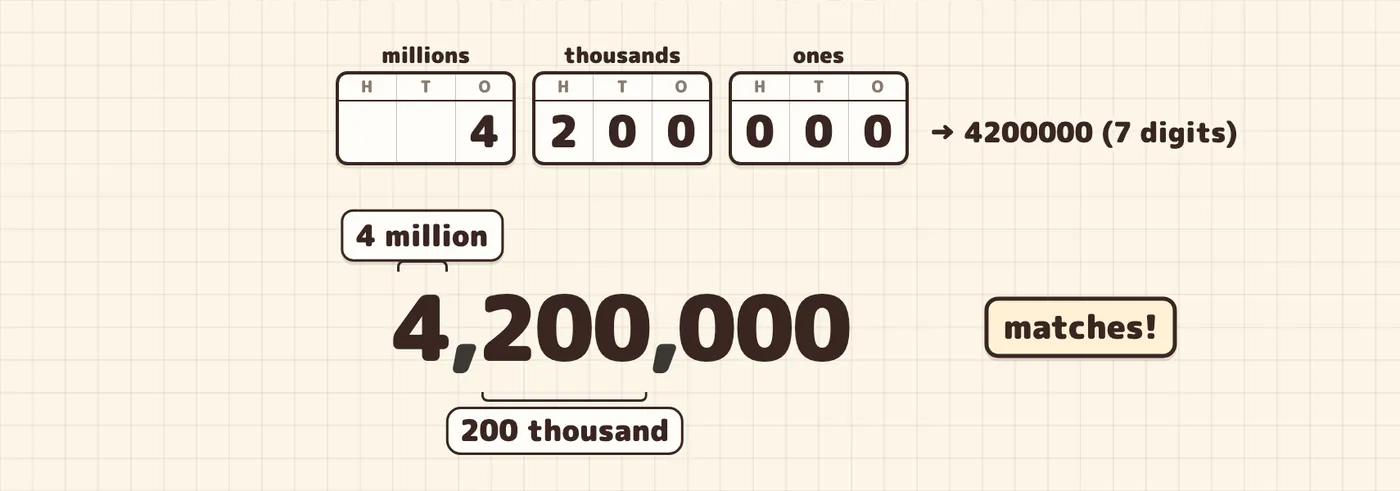
Why seven digits? One digit in the millions period, three in the thousands period, and three in the ones period: 1 + 3 + 3 = 7. Every number from 1,000,000 up to 9,999,999 has seven digits. In cubes, 4,200,000 is four big cubes and two layers.
Big numbers in real life: the U.S. population
The 2020 Census counted the resident population of the United States on April 1, 2020, as 331,449,281 (U.S. Census Bureau). Try reading it period by period.
How to read it (contains the answer)
The commas split it into three periods: 331 | 449 | 281. It reads three hundred thirty-one million, four hundred forty-nine thousand, two hundred eighty-one.
More to try
- How many hundred-thousands make one million?
- How many thousands make 6,400,000?
- Write 5 million 30 thousand as a number.
- Read 20,070,000.
Answers to "More to try" (contains the answers)
- 10 (ten layers make one big cube).
- 6,400 (cover the ones period of 6 | 400 | 000).
- 5030000, or 5,030,000 (5 | 030 | 000).
- Twenty million, seventy thousand (20 | 070 | 000).
For parents and teachers: how to help
- When drawing the chart, three groups of three boxes are enough. The printable chart works too.
- Instead of "How many zeros?", ask "Which period does this part go in?" Children then write the zeros without counting them.
- Build the habit of reading back with commas from the right. Most slips are caught that way, by the child.
- Use the cubes when a number feels abstract: a rod is 10,000, a layer is 100,000, and the big cube is 1,000,000.
- Praise checking and fixing, not speed.
The Common Core Grade 4 standards in this area are limited to whole numbers up to 1,000,000. The main question stays inside that limit. The practice problems (2,000,000; 3,500,000; 4,200,000) peek a little into the millions on purpose, to show the same period pattern repeating. "Starter" is this series' own level guide, not an official level or a promise of learning results.
Frequently asked questions
How should the answer to a "how many thousands" question be written?
As a plain count of thousands: 1000 or 1,000 are both correct. "One million is 1,000 thousands" is the same fact said in unit form, like "35 hundreds is 3,500."
Why do commas come every three digits?
Because English number names change every three digits: thousand, million, billion. Each comma marks the start of a new period, and each period is read as an ordinary three-digit number followed by its name.
Why cover the last three digits and not some other number of digits?
The ones period has three places. Covering it divides by 1,000 in one move, so what is left counts thousands. Covering six digits would count millions instead.
My child already knows base-ten blocks. Is this the same thing?
Yes. The unit cube, rod, flat, and thousand cube are exactly the ones place through the thousands place. This video simply keeps going: ten thousand cubes make a rod of 10,000, ten rods make a layer of 100,000, and ten layers make a big cube of 1,000,000. The shapes repeat every three places, just like the periods.
Try the activity
Open the "Million Blocks" activity. It is also linked from this episode's page.
Tap "Add 1 block" or "Add 100 blocks" to collect thousand cubes, and watch the picture and the chart change together. From 999 cubes, add one more to set off the carry yourself. Then try the same six tasks as the video, extra problems at three levels, and "Make a number" to see your own number as cubes, layers, and rods. No timers, no scores.
Sources
Where the facts and numbers in the video and on this page come from.
References
- Problems: original, made by Tamelabo. Figures and animation: Tamelabo (drawn with code).
- Font: M PLUS Rounded 1c (SIL OFL 1.1). Video voice: Kokoro. Music (OpenTracks): “のんびり行こうよ” by zmino, “パステルハウス” by かずち. Sound effects: made by Tamelabo.
Links
- Common Core State Standards for Mathematics, Grade 4, Number & Operations in Base Ten (4.NBT.A.1 and 4.NBT.A.2, and the note that Grade 4 expectations in this domain are limited to whole numbers less than or equal to 1,000,000. Used to match the level of this lesson)thecorestandards.org/Math/Content/4/NBT
- U.S. Census Bureau, "2020 Census Apportionment Results Delivered to the President" (press release CB21-CN.30, April 26, 2021) (resident population of the United States on April 1, 2020: 331,449,281)census.gov/newsroom/press-releases/2021/2020-censu…
Voice, music, art
- Voice: Kokoro / Music (OpenTracks): “のんびり行こうよ” by zmino, “パステルハウス” by かずち / Sound effects: Tamelabo / Font: M PLUS Rounded 1c (SIL OFL 1.1) / Art, problems, and animation: Tamelabo