How Many Millions Make One Billion? (Grade 4, Starter) | Math Aha! Theater #07
Short answer
- One billion is one thousand millions (1 billion = 1,000 million), so the answer is C.
- Ten times one hundred million is one billion. Bundle sticks of one million by tens: on the third bundling, the 1 crosses into the Billions.
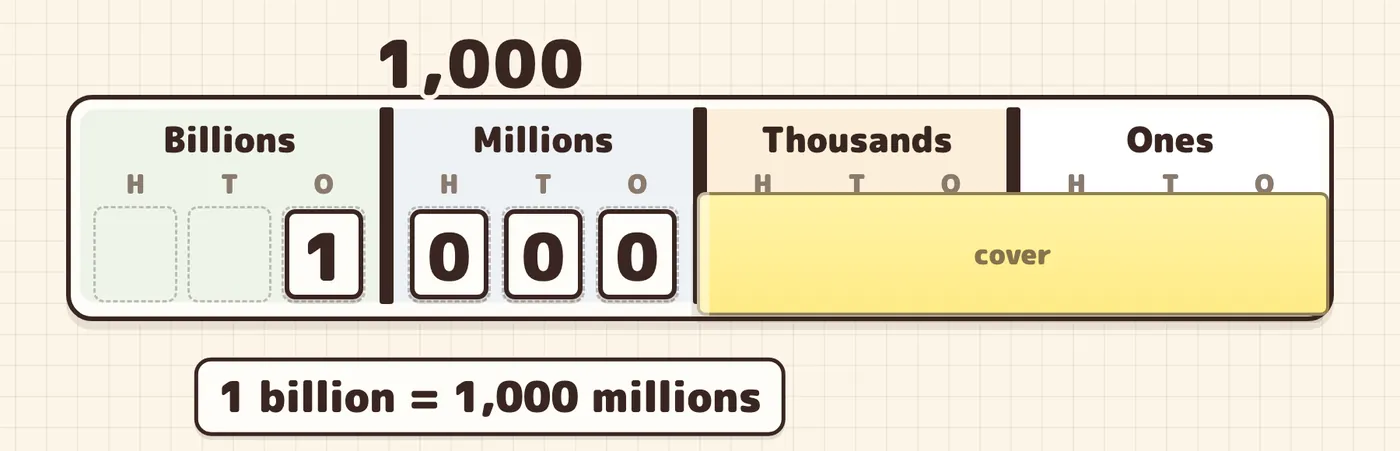
- Write 1 billion on the chart and cover the places to the right of the millions place. You can see 1,000.
Also calledhow many millions in a billionbillion vs million1 billion in millionscomparing large numbers grade 4place value chart billions
Video

Pressing play loads the YouTube player on this page. Watch on YouTube
Try it
Explained
In the video
Math Aha! Theater | Grade 4 · Starter | Numbers & calculation | For parents and teachers
"Million, ten million, hundred million, and then billion. So how many millions is a billion?" Nobody can count that high to check, so children have only the place names to go on. This page collects the problems from the video and a way to work them out on a place-value chart, written for parents and teachers. The video for this episode works through the problems on this page in order.
This page includes the answers. If you are working with a child, show only "The problems" first, and give them time to think before you open the sections marked "contains answers."
The problems (printable)
The main problem
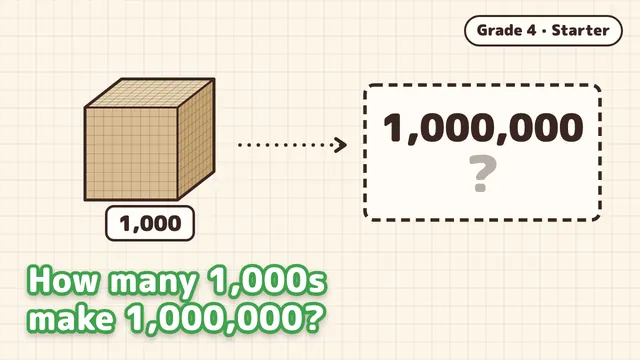
How many millions make one billion?
A 10 / B 100 / C 1,000
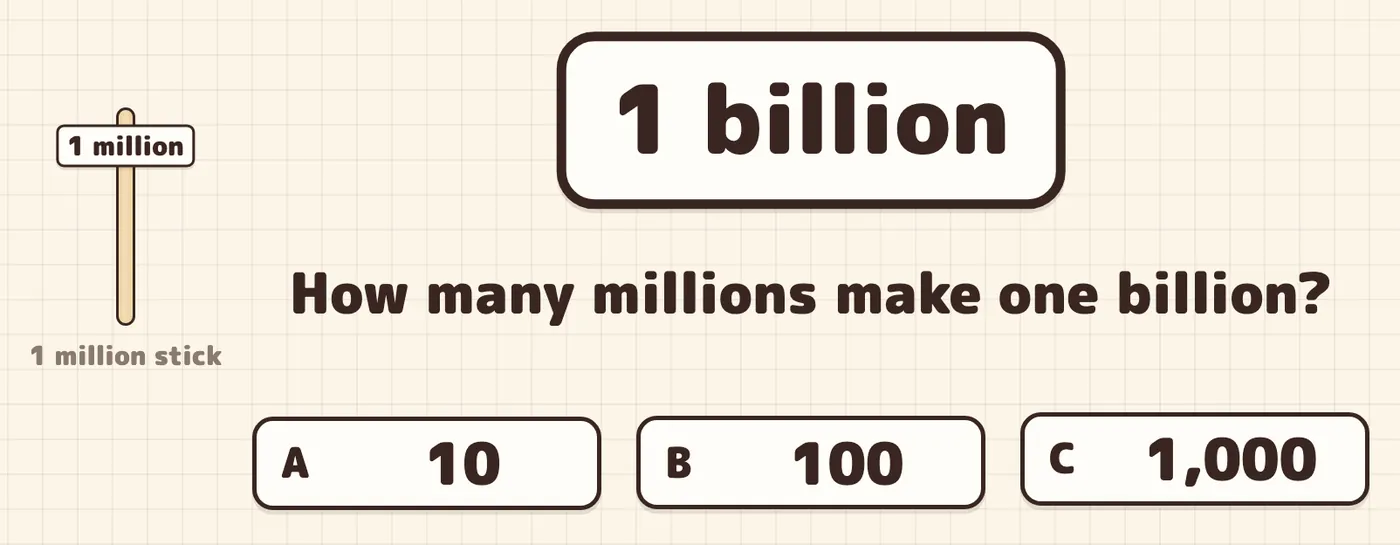
Practice problems
Practice 1: 3 billion is how many millions?
Practice 2: Which is greater: 900 million or 1 billion 20 million?
On your own
Which is greater: 1 billion 5 million or 999 million?
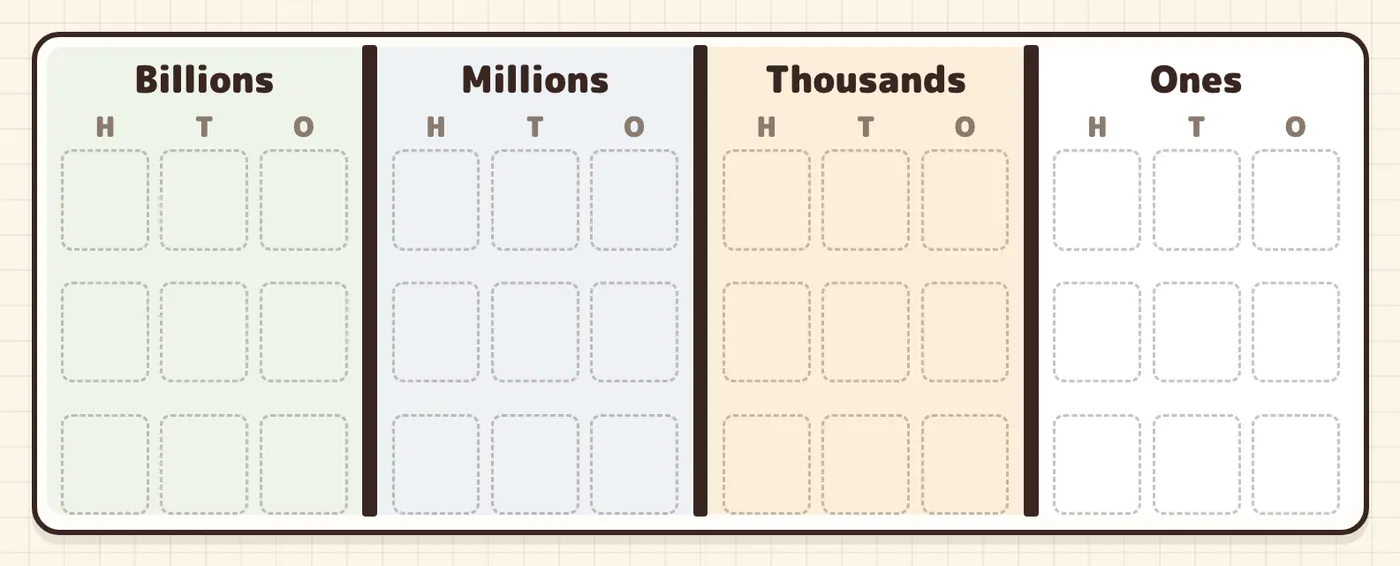
Pause the video and think it through before you open the answer section.
What children might try first
Counting the places and stopping at hundred millions
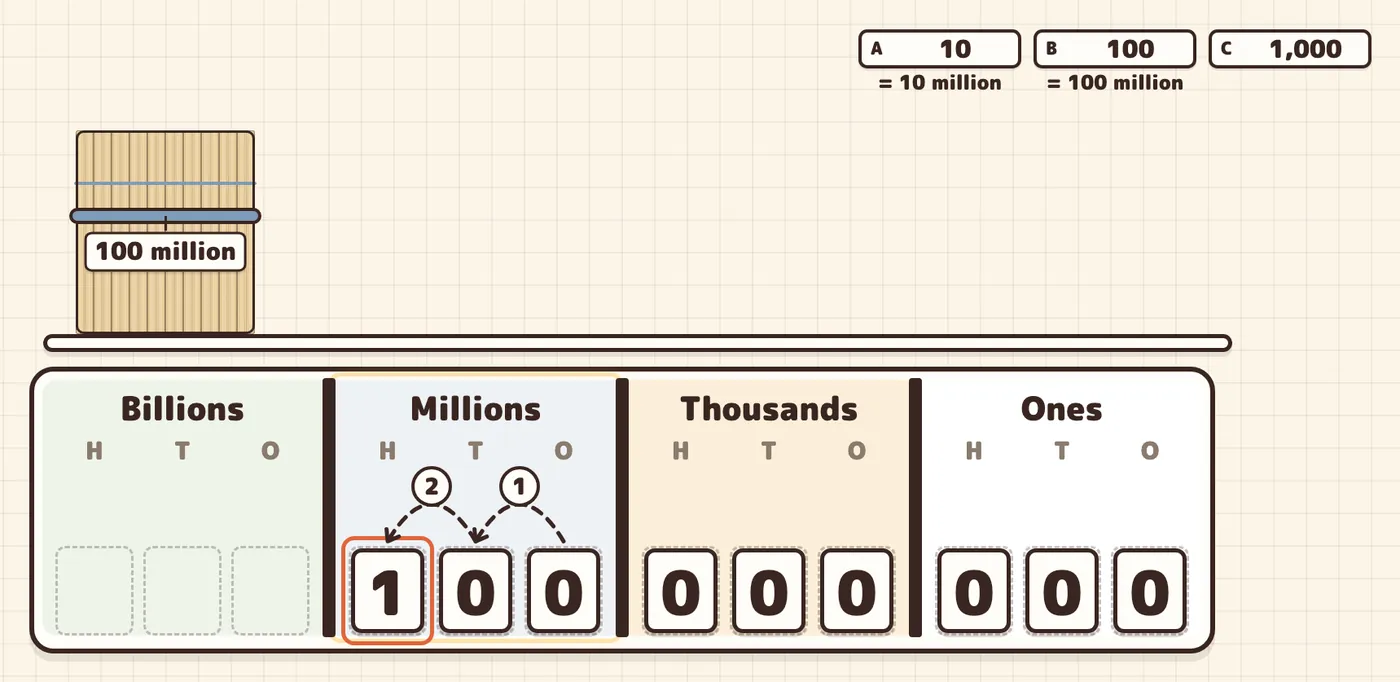
A child who knows the place names might count "million, ten million, hundred million," expect a billion to come next, and decide that a billion is 100 million (guess B). But 100 millions make only 100 million. On the chart, the digit 1 is in the hundred millions place, still inside the Millions period.
Counting by millions
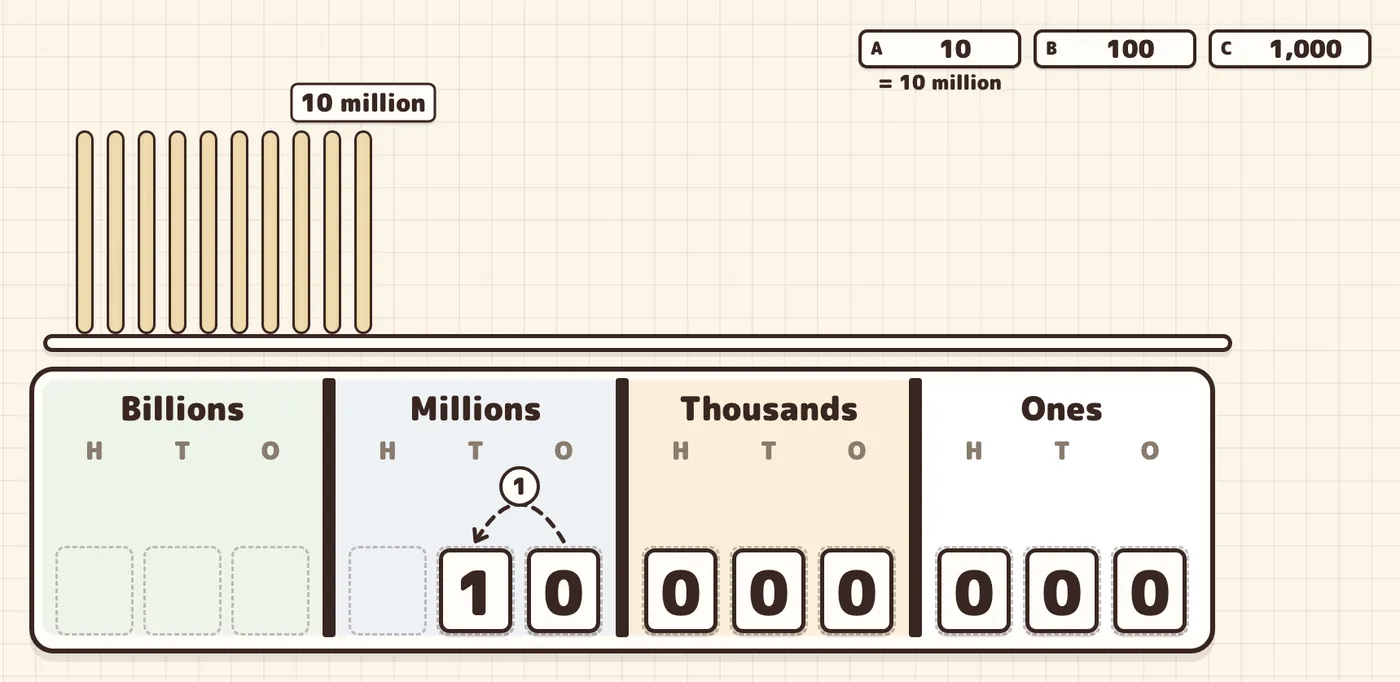
Counting one stick at a time, "1 million, 2 million, 3 million," is correct, but ten sticks make only 10 million (guess A, 10, gives 10 million). A billion is still a long way off.
Lining up the left ends to compare
If the two numbers in Practice 2 are written as plain digits and lined up at the left, the child ends up comparing the first digits, 9 and 1. The numbers have different numbers of digits, so lining up the left ends does not line up the places.
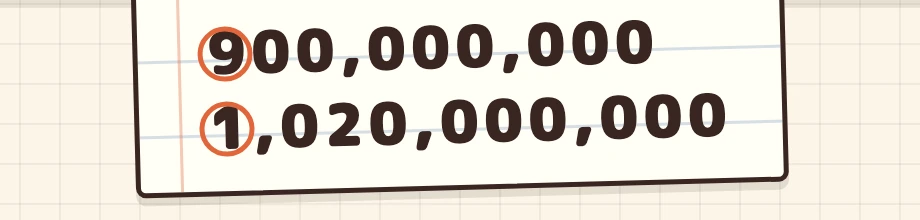
The first move that helps with all of these: think of 1 million as one stick, and bundle by tens. Each bundling moves the digit 1 on a place-value chart one place to the left, so you can count the moves. To compare, put the numbers on the chart with the places lined up, not as strings of digits.
Working it out on a place-value chart (starting from the first move)
The chart has 12 places. From the right, they form four periods (Ones, Thousands, Millions, and Billions), each with hundreds, tens, and ones, and a thick line (a wall) separates the periods. The commas in a written number fall exactly where the walls are.
Think of 1 million as one stick, and bundle by tens
Treat 1 million as a single unit: one stick. Ten sticks tied together make a 10 million bundle, and ten of those bundles make 100 million. It is the same "make a ten, then make ten of those" idea children already use with straws or base-ten blocks, with a bigger unit.
The 1 moves left three times, into the Billions period
Each bundling makes the number ten times as large, and the digit 1 on the chart moves one place to the left: from the millions place to ten millions, then to hundred millions. Both moves stay inside the Millions period. The third bundling carries the 1 over the wall into the billions place. This is the Grade 4 idea that "a digit in one place represents ten times what it represents in the place to its right" (Common Core 4.NBT.A.1). How many sticks that makes is in the answer section.
Reading "how many millions": cover the places to the right of the millions place
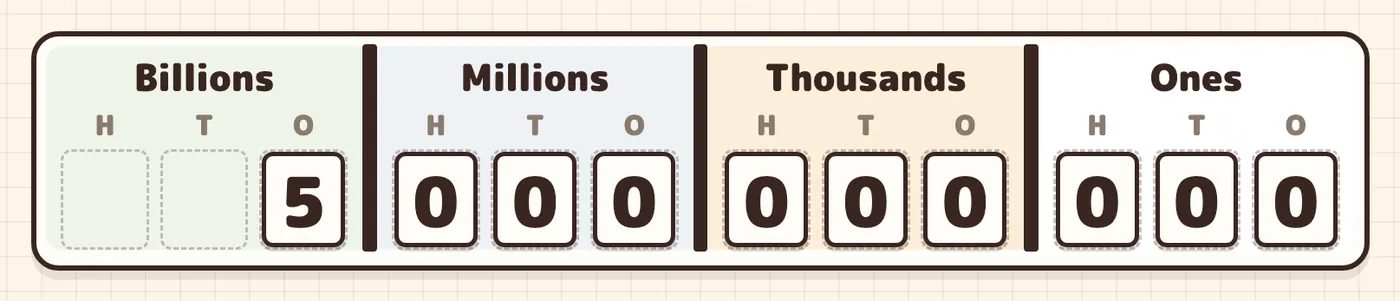
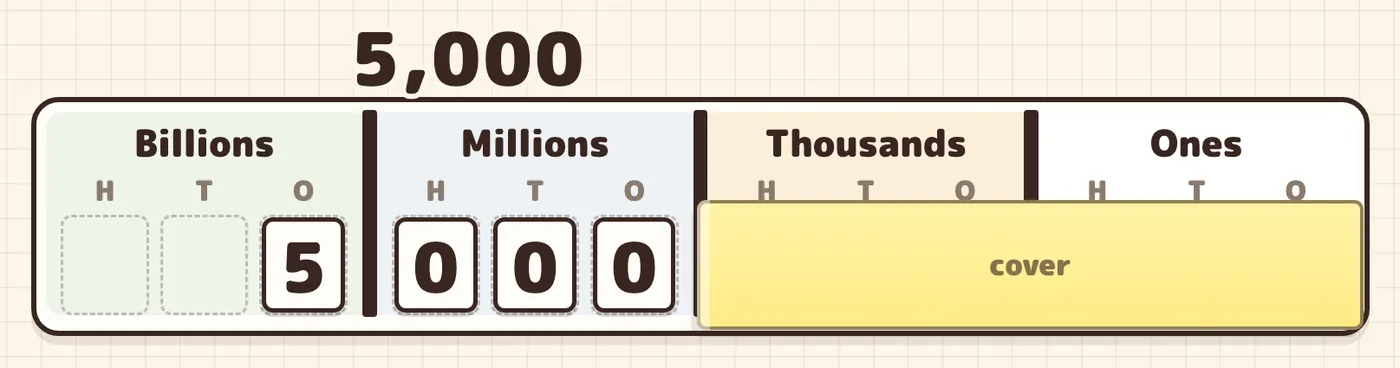
Here is an example that is not one of the four problems: 5 billion. Write it on the chart, then cover the six places to the right of the millions place (the Thousands and Ones periods) with a strip of paper. The digits you can still see read 5,000, so 5 billion is 5,000 million.
Comparing: line up the places and look from the left
Put the two numbers on the chart, one above the other, with the places lined up: the number before "billion" ends in the billions place, and the number before "million" ends in the millions place. Then look at each place from the left. The first place where the digits differ decides it: the number with the greater digit there is greater (an empty place counts as 0).
Answers and checks (contains answers)
Answer to the main problem
The answer is C, 1,000. One billion is one thousand millions (1 billion = 1,000 million). Put another way, ten times one hundred million is one billion. The sticks go 10, 100, 1,000 as you bundle, and three bundlings make 10 × 10 × 10 = 1,000.
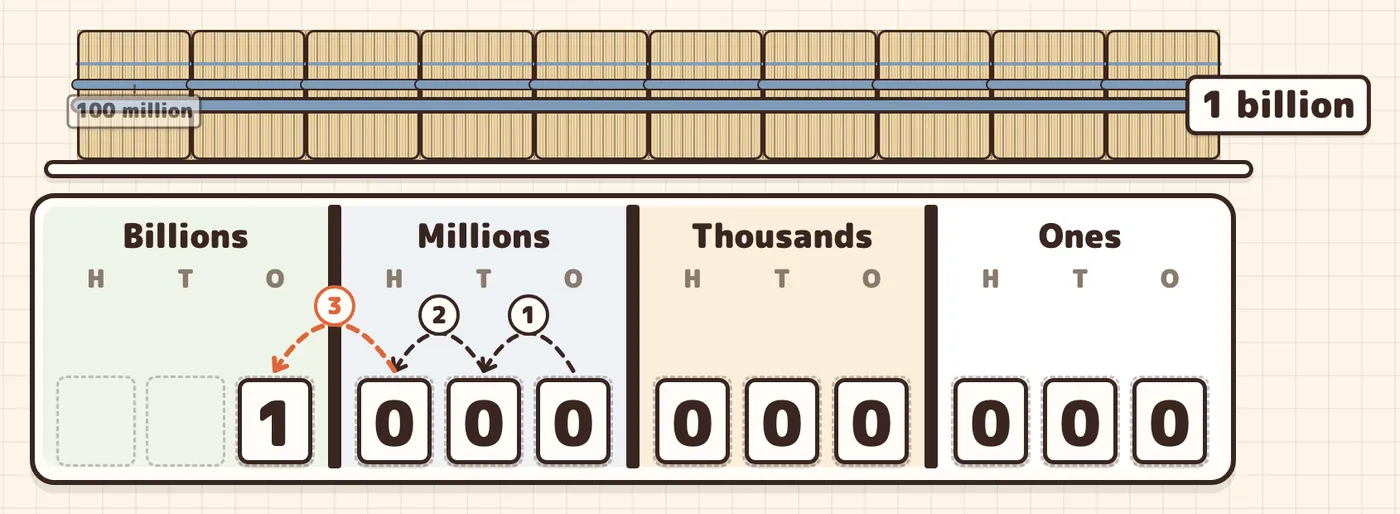
Watch it move: ten 100 million bundles line up, and as they are tied together, the digit 1 jumps over the wall into the Billions period (about 8 seconds)
The chart agrees. Write 1 billion and cover the places to the right of the millions place: the digits you can see read 1,000, the same as the number of sticks.
Answers to Practice 1 and Practice 2
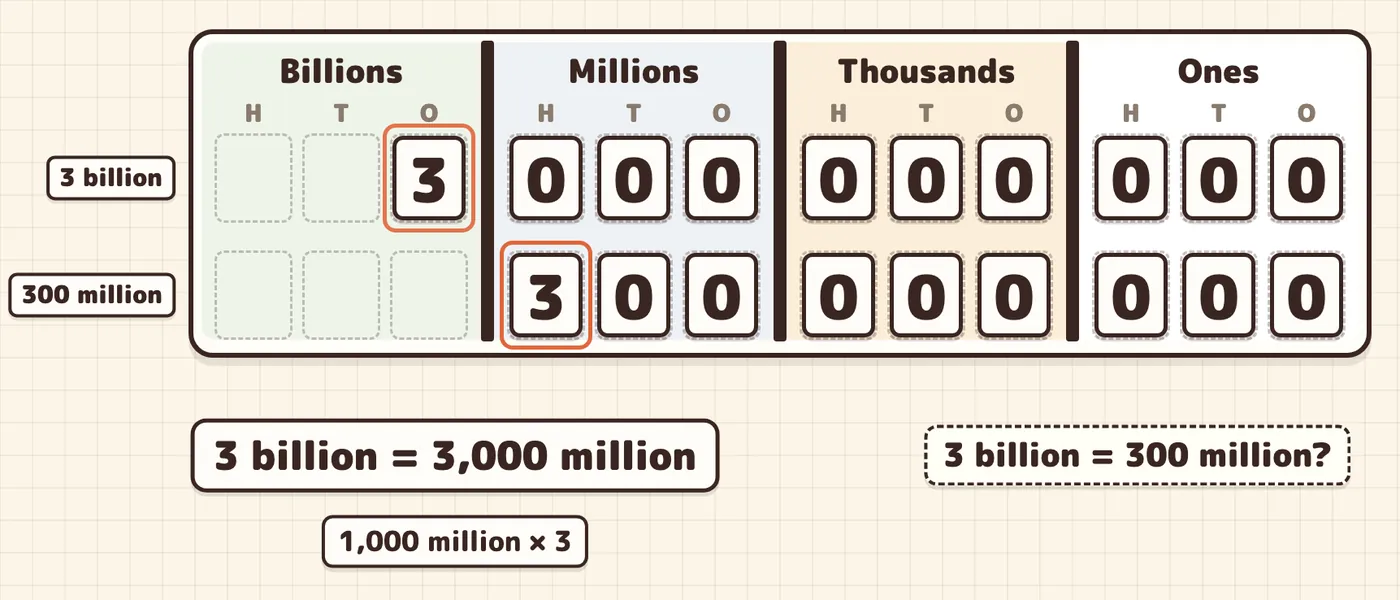
Practice 1: 3 billion is 3,000 million. Cover the places to the right of the millions place and you see 3,000. You can also think of it as three groups of 1,000 million.
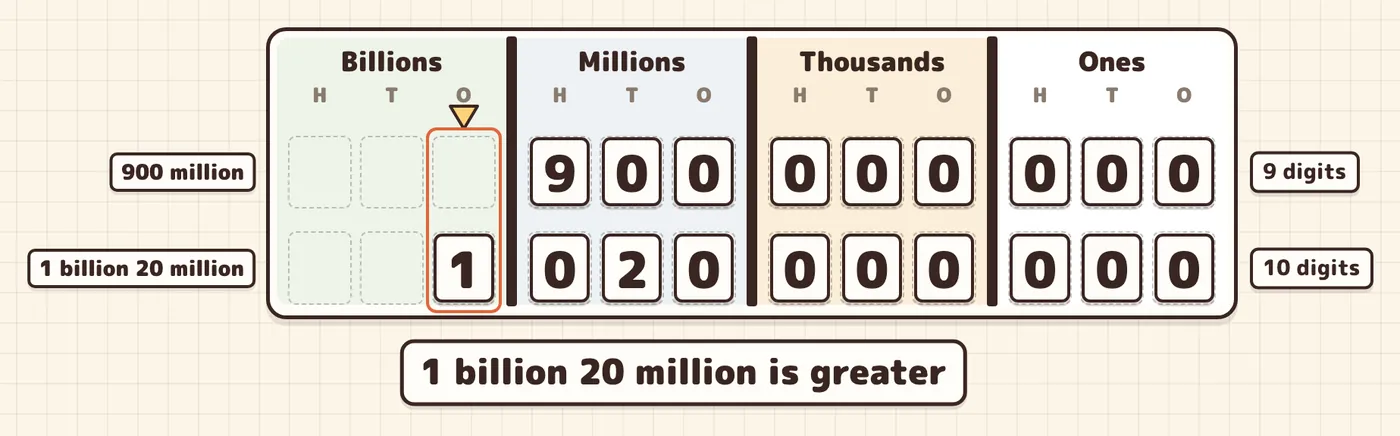
Practice 2: 1 billion 20 million is greater. 900 million has 9 digits and 1 billion 20 million has 10. With the places lined up, the first place that differs is the billions place, and only 1 billion 20 million has a digit there.
Answer to On your own
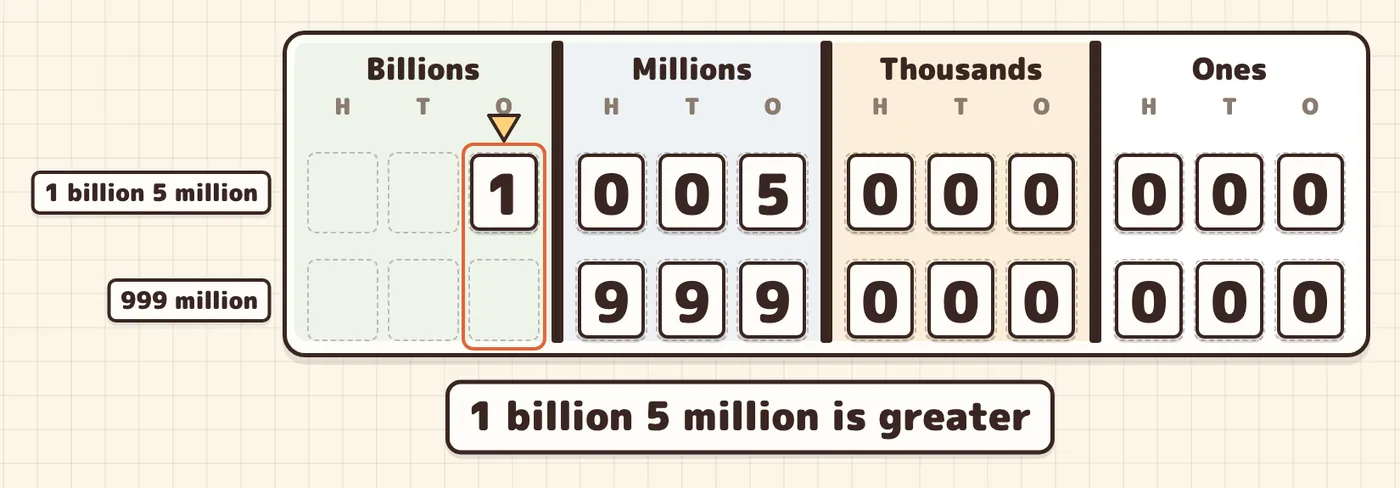
1 billion 5 million is greater. With the places lined up, the first place that differs is the billions place, and only 1 billion 5 million has a digit there. 999 million shows three 9s, but it lives inside the Millions period.
How to check
- Rewrite in millions. 1 billion 5 million = 1,000 million + 5 million = 1,005 million, which is more than 999 million.
- Add 1 million. 999 million + 1 million = 1 billion. So 999 million is 1 million short of a billion, 1 billion 5 million is 5 million past it, and they differ by 6 million.
- Count the digits. 1 billion 5 million has 10 digits; 999 million has 9.
- For the main problem, check that the number of bundlings (3) and the number you read after covering (1,000) agree: 10 × 10 × 10 = 1,000.
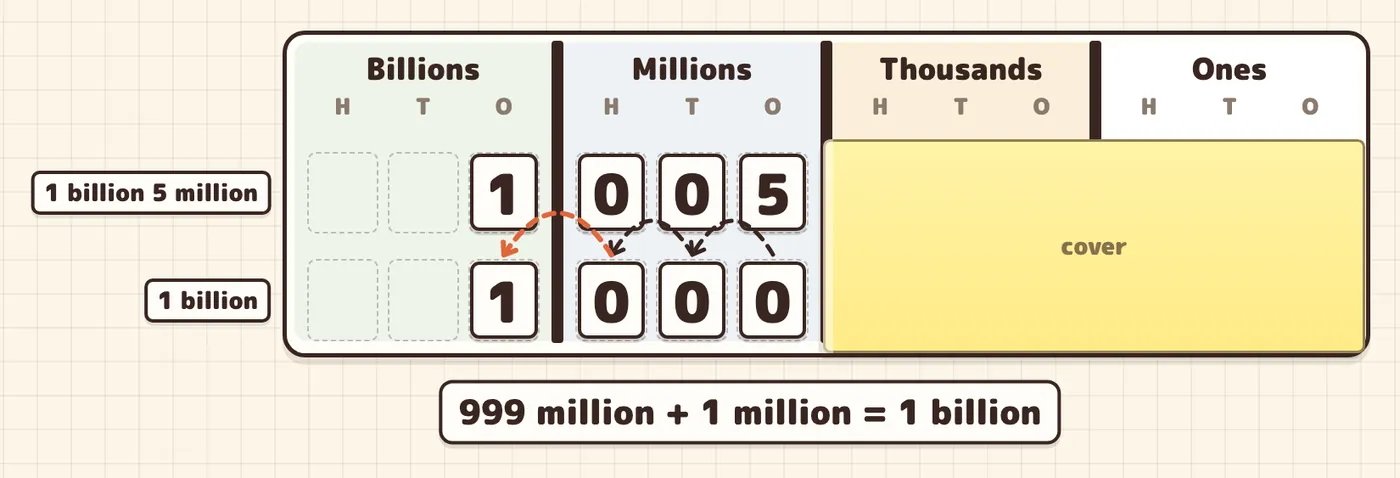
Watch it move: adding 1 million to 999 million, the 9s turning to 0 and the 1 crossing the wall (about 6 seconds)

Slips to look out for, and how to fix them
In each case, putting the numbers on the chart and reading them together lets the child spot the problem without being told "wrong."
Thinking a billion is 100 million
Some children count "million, ten million, hundred million" and conclude that a billion is 100 million. Put 100 million and 1 billion on the chart, one above the other: the 1 in 1 billion is one place further left, and one place to the left means ten times as much. Then ask about small numbers: "What place comes after hundreds?" Ten hundreds make one thousand, and 100 and 1,000 line up the same way.
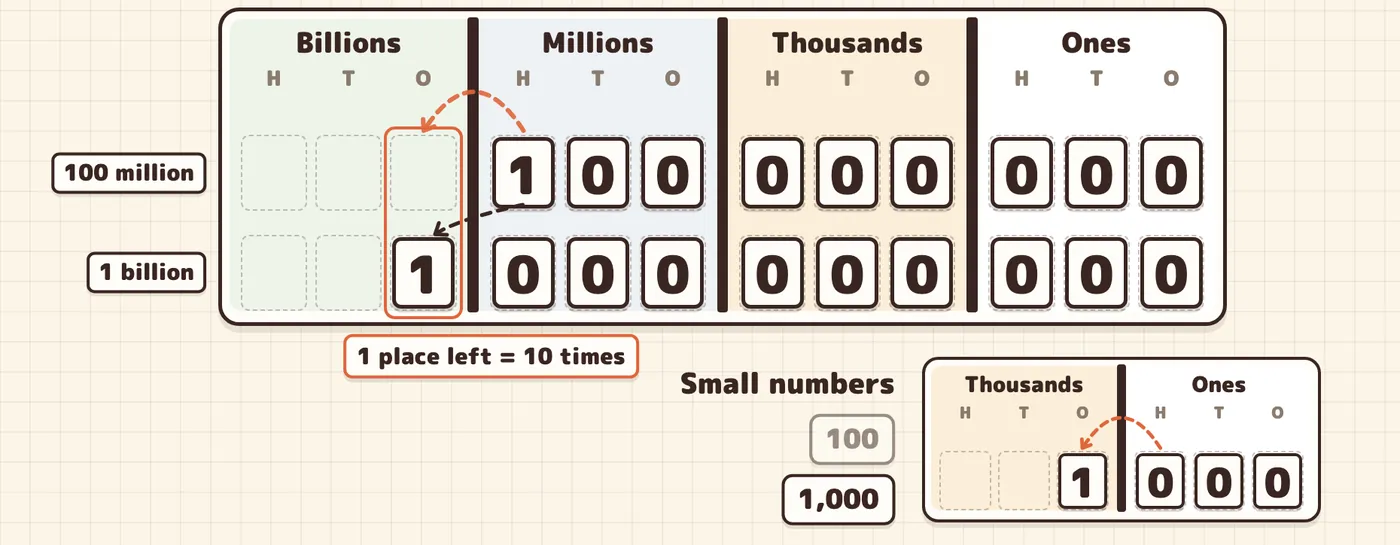
This slip carries over. If a billion were 100 million, 1 billion 5 million would read as 105 million, and 999 million would seem greater, the opposite answer. In Practice 1, 3 billion would become 300 million.
Lining up the left ends
Lined up at the left, Practice 2 compares 9 with 1, and On your own compares 1 with 9. Count the digits first, then put both numbers on the chart so the ones places line up.
Thinking more 9s means bigger
999 million shows three 9s, so it can look bigger than 1 billion 5 million. Look first at the greatest place: does either number reach the Billions period?
Another view: the same pattern as small numbers
Watch only the moments when the 1 crosses a wall, and the same thing happens each time:
- Ones to Thousands: one thousand is one thousand ones.
- Thousands to Millions: one million is one thousand thousands.
- Millions to Billions: one billion is one thousand millions.
Every time you cross a period wall, the new name is 1,000 of the old one: thousand, million, billion. Inside every period the places repeat ones, tens, hundreds, so the step after hundreds always brings a new name. Ten hundreds make one thousand, and in the same way, ten hundred millions make one thousand millions. That's one billion. Question 2 in "More to try" can be worked out with this view, too.
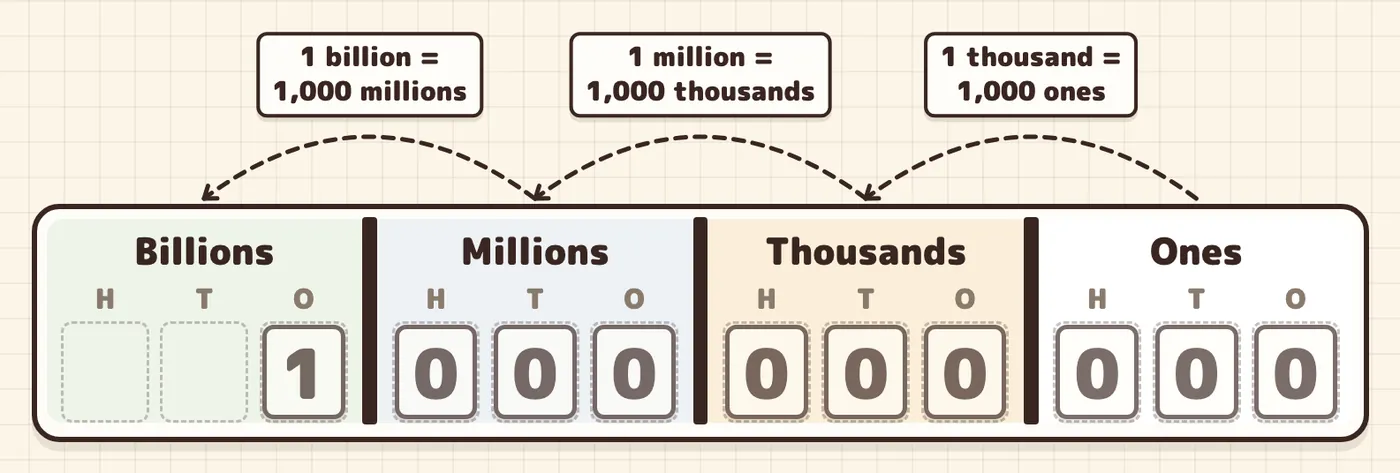
How big is a billion?
One million seconds is about 11 and a half days. One billion seconds is 1,000 times as long: more than 31 years (counting a year as 365 days). If a billion were only 100 million, a billion seconds would be a little over 3 years, ten times too short.
Numbers in the news are good practice. When a story mentions billions, such as a budget or a population, write the number on a place-value chart with your child and read how many millions it is. Use whatever numbers are in that day's news.
More to try
- How many millions make 10 billion?
- How many thousands make 1 billion?
- 4 billion 700 million is how many millions?
- Write 3,800 million in billions and millions.
- Order from least to greatest (two of them are equal): 1 billion 2 million, 999 million 999 thousand, 1 billion, 1,002 million, 99 million
Answers to More to try (contains answers)
- 10,000 millions. 10 billion is ten times 1 billion, and 1 billion is 1,000 millions.
- 1,000,000 (one million) thousands. Write 1 billion on the chart and cover the three places to the right of the thousands place: you see 1000000.
- 4,700 million. Cover the places to the right of the millions place.
- 3 billion 800 million. On the chart, the 3 lands in the billions place and the 8 in the hundred millions place.
- 99 million < 999 million 999 thousand < 1 billion < 1 billion 2 million = 1,002 million
For parents and teachers
- Bundling straws or craft sticks into tens, then bundling the bundles, is a familiar place-value activity. Before asking your child to memorize "1 billion = 1,000 million," bring back that experience and count how many times you bundled.
- Even when the answer is right, encourage the cover-and-read check on the chart.
- When an answer is off, put that number on the chart and read it together. There is no need to call it wrong.
- A phrase to take away: "After the hundreds place comes a new name. One billion is one thousand millions."
- About the grade level: Grade 4 standards ask children to see each place as ten times the place to its right and to compare multi-digit numbers by place value (Texas TEKS 4.2(A)–(C); Common Core 4.NBT.A.1–2). Common Core's Grade 4 numbers go up to 1,000,000, and TEKS goes up to 1,000,000,000. This episode centers on 1 billion and goes a little further, to 3 billion and numbers just over a billion, with the same ideas.
Frequently asked questions (FAQ)
Why do some kids say a billion is 100 million?
Some children count the place names, "million, ten million, hundred million," and expect a billion to be the last of these. In fact the billions place is one more step to the left of the hundred millions place, so a billion is ten times 100 million. It works just like small numbers, where ten hundreds make one thousand. Compare 100 and 1,000 first, then put 100 million and 1 billion on the chart, one above the other.
Is "a thousand millions" a real way to say it?
Yes. In everyday speech we say "one billion," but "one thousand millions," written 1,000 million, names the same number, 1,000,000,000. It is the form that answers "how many millions?" directly, and Practice 1 uses it too: 3 billion = 3,000 million.
How do I explain comparing 999 million and 1 billion 5 million?
Three things can pull a child toward 999 million: the many 9s, lining the digits up at the left (1 against 9), and thinking a billion is 100 million (which turns 1 billion 5 million into 105 million). Two checks settle it: line up the places and look from the greatest place, and rewrite both numbers in millions (1,005 million and 999 million).
How do I draw a place-value chart on paper?
Draw 12 boxes in a row and split them from the right into four periods of three with thick lines. Label the periods Ones, Thousands, Millions, and Billions from the right, and label the boxes in each period H, T, O. A printable blank chart is in "The problems" above.
Try it in "Bundle Up to a Billion"
In this episode's hands-on activity, "Bundle Up to a Billion," children bundle the 1-million sticks themselves and watch the digit 1 cross the wall into the Billions period. There are six tasks: the main problem, Practice 1, Practice 2, On your own, explaining why (fill-in cards and their own words), and fixing the mistakes in a notebook by putting the notebook's numbers on the chart. There are also "One more" problems at three levels, "Make a puzzle," and a learning map. Time and scores are never recorded.
"算数ひらめき劇場" (Sansu Hirameki Gekijo) is our series' original name in Japanese. In English, it is "Math Aha! Theater."
Sources
Where the facts and numbers in the video and on this page come from.
References
- Problems: the four problems, the worked example (5 billion), and More to try are original problems by Tamelabo.
- The days and years for 1 million and 1 billion seconds are Tamelabo's own calculations (a year counted as 365 days).
- Pictures and animations by Tamelabo (font: M PLUS Rounded 1c, SIL OFL 1.1).
Links
- Texas Essential Knowledge and Skills for Mathematics, §111.6 Grade 4 (4.2(A) "interpret the value of each place-value position as 10 times the position to the right and as one-tenth of the value of the place to its left," 4.2(B), and 4.2(C) "compare and order whole numbers to 1,000,000,000 and represent comparisons using the symbols >, <, or =.")tea.texas.gov/sites/default/files/ch111a.pdf
- Common Core State Standards for Mathematics, Grade 4, Number & Operations in Base Ten (4.NBT.A.1 "Recognize that in a multi-digit whole number, a digit in one place represents ten times what it represents in the place to its right." 4.NBT.A.2 "Compare two multi-digit numbers based on meanings of the digits in each place, using >, =, and < symbols to record the results of comparisons." Grade 4 expectations in this domain are limited to whole numbers less than or equal to 1,000,000)thecorestandards.org/Math/Content/4/NBT
Voice, music, art
- Voice: Kokoro (synthetic voice) / Music (OpenTracks): “のんびり行こうよ” by zmino, “パステルハウス” by かずち / Sound effects: Tamelabo (made with code) / Font: M PLUS Rounded 1c (SIL OFL 1.1) / Art, problems, and animation: Tamelabo