"Three Hundred Thousand, Fifty" in Digits? (Grade 4, Starter) | Math Aha! Theater #05
Short answer
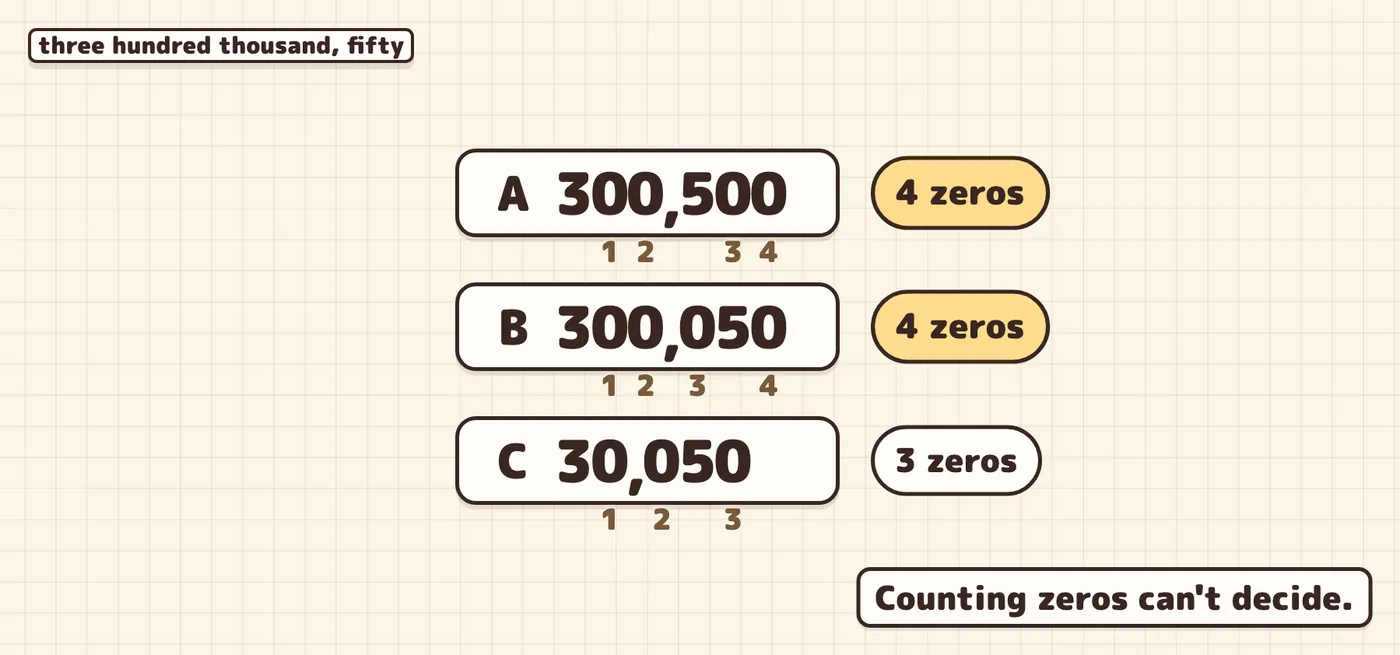
- Three hundred thousand, fifty in digits is 300,050 (6 digits), so the answer is B.
- You never hear any of its 4 zeros: 3 are inside 300 and 50, and 1 fills the empty hundreds place.
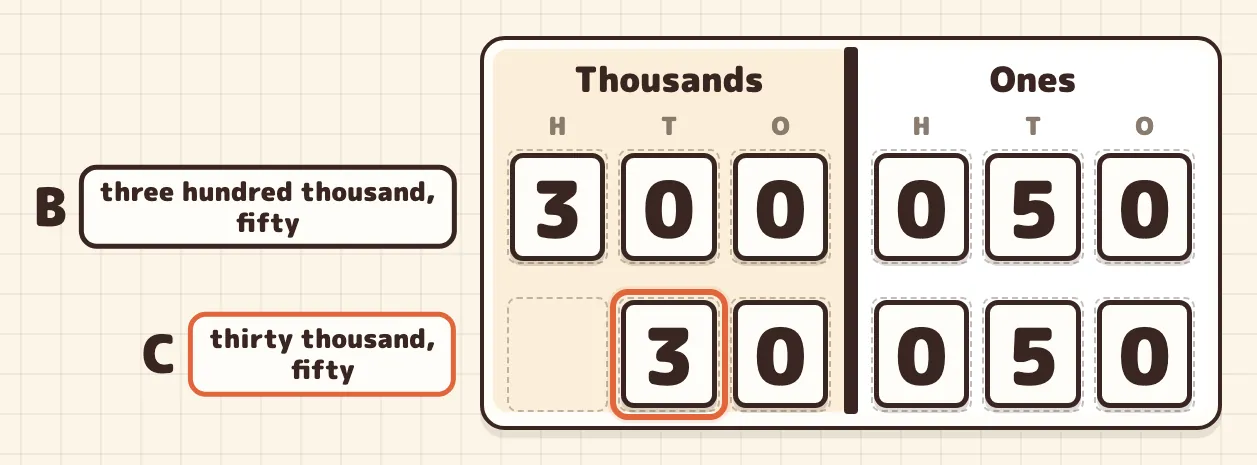
- A, 300,500, reads three hundred thousand, five hundred, and C, 30,050, reads thirty thousand, fifty.
Also calledthree hundred thousand fifty in digitswriting number names with digitsplaceholder zeroplace value chart grade 44.NBT.A.2
Video

Pressing play loads the YouTube player on this page. Watch on YouTube
Try it
Explained
In the video
Math Aha! Theater | Grade 4 · Starter | Numbers & calculation | For parents and teachers
Say "three hundred thousand, fifty" out loud and you never hear the word "zero." Write it with digits, though, and the zeros show up. This page collects the problems from the video and one reliable way to write number names with digits: a place-value chart split into houses of three places. The video works through these problems in order.
This page includes the answers. If you are working with a child, show only "The problems" first, and give them time to think before you open the sections marked as containing answers. Everything can be followed on paper with the pictures and text alone.
The problems
The main problem
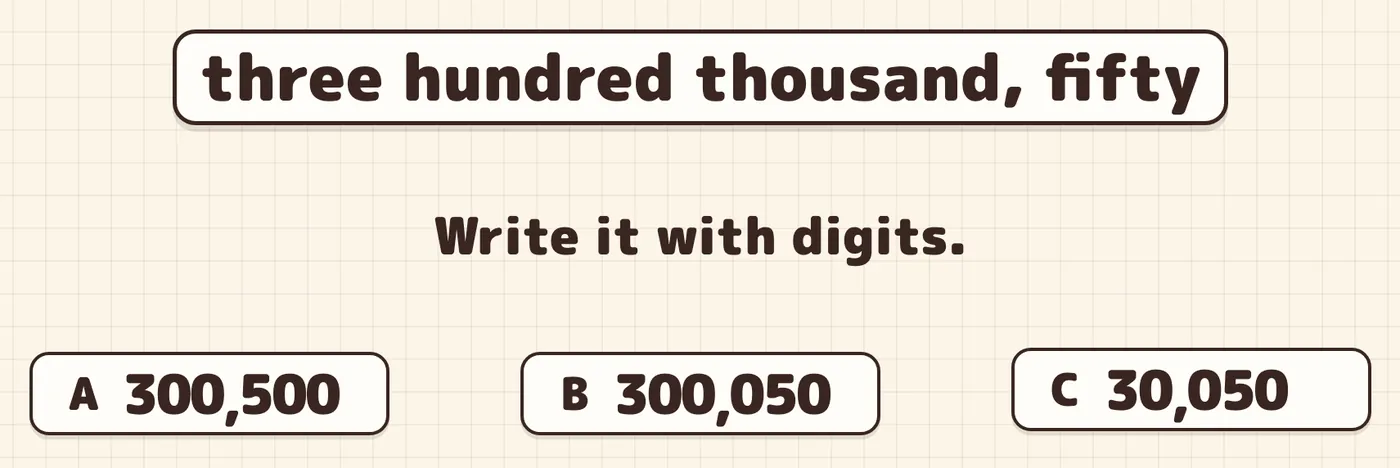
Three hundred thousand, fifty: how do you write it with digits?
A 300,500 / B 300,050 / C 30,050
Practice problems
Practice 1: Write five hundred thousand, three, with digits.
Practice 2: Write seventy thousand, eight, with digits.
On your own
Write one hundred twenty thousand, four hundred six, with digits.
Pause and think before you open the answer sections.
What children usually try first
Counting the zeros
All three guesses are made of a 3, a 5, and zeros. Count the zeros and A has four, B also has four, and C has three. Counting zeros is a sensible clue, but A and B tie, so it can't decide. What differs is where the zeros sit.
Writing what they hear
Some children write each part the way it sounds, side by side: 300000 for "three hundred thousand," then 50 for "fifty," which gives 30,000,050 (thirty million, fifty).
Pushing fifty to the left
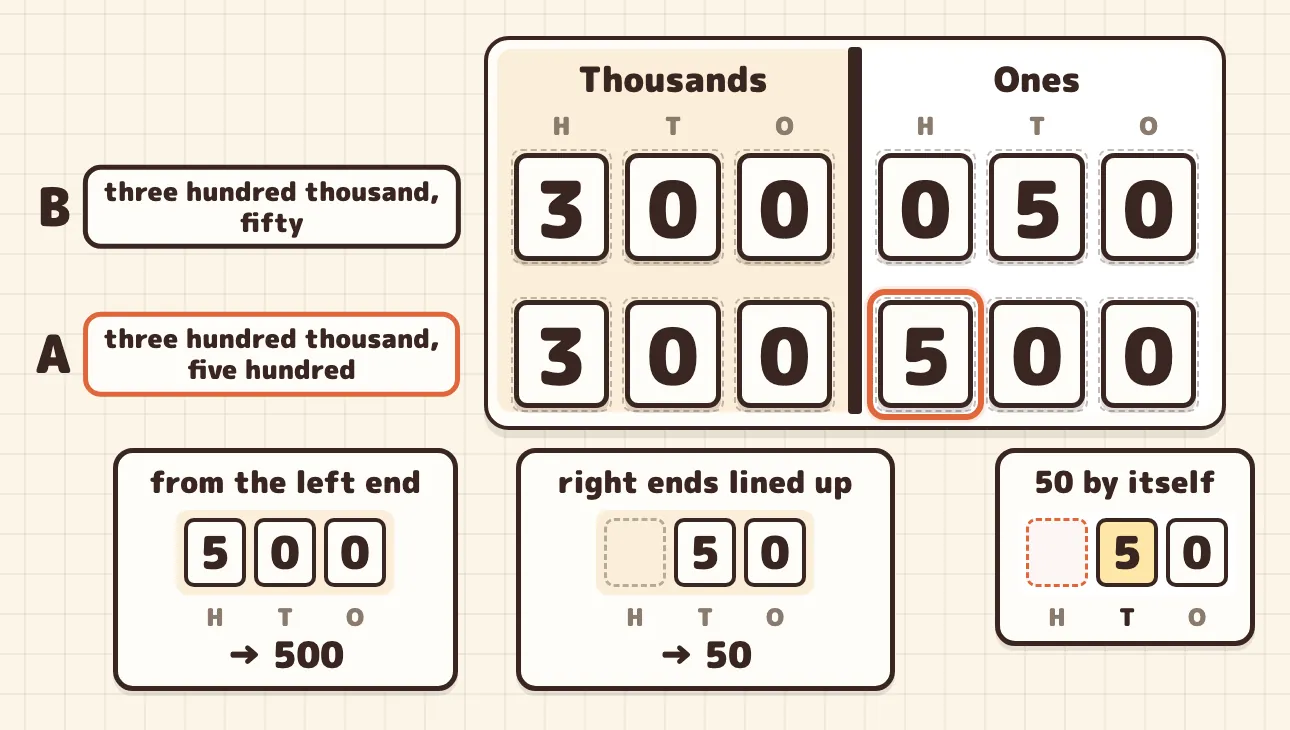
Others know a house has three places, so they start fifty at the left end and fill the rest with a zero: 500 instead of 050. That gives 300,500 (A), which reads three hundred thousand, five hundred.
All of these are connected to one fact: when we read a number, we only say the places that have digits. The first move that fixes this is before writing anything, put each part of the name into a chart of three-place houses, lined up at the right end.
Writing it with a place-value chart (the first move)
We'll use a different number from the four problems: four hundred thousand, sixty.
Drawing the chart
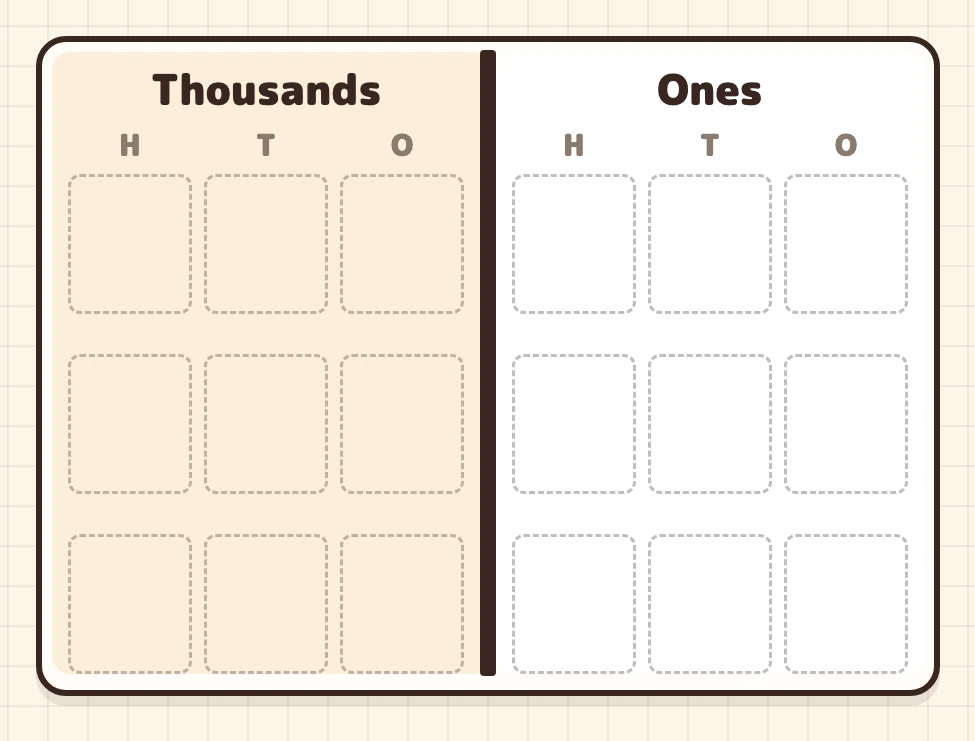
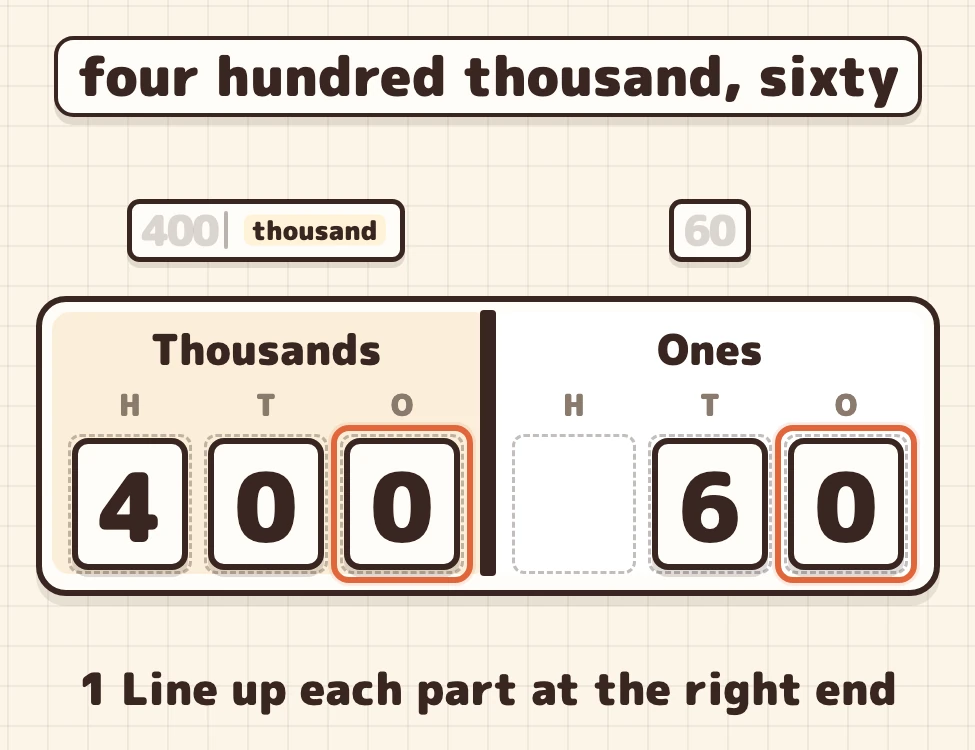
Draw places from the right in houses of three: ones, tens, hundreds. Then the same three again, each with "thousand" after it: thousands, ten thousands, hundred thousands. Separate the houses with a thick line (a wall). The right house is the Ones house, the left one is the Thousands house. Ten hundred thousands make one million, where a new house would begin, but Grade 4 numbers stop at 1,000,000.
Lining up each part at the right end
The part before the word "thousand" goes in the Thousands house, with its right end in the thousands place: the 4 of 400 lands in the hundred thousands place. The rest, sixty, goes in the Ones house with its right end in the ones place, so the 6 lands in the tens place. Never start a part at the left end of a house.
Writing a zero in every empty place
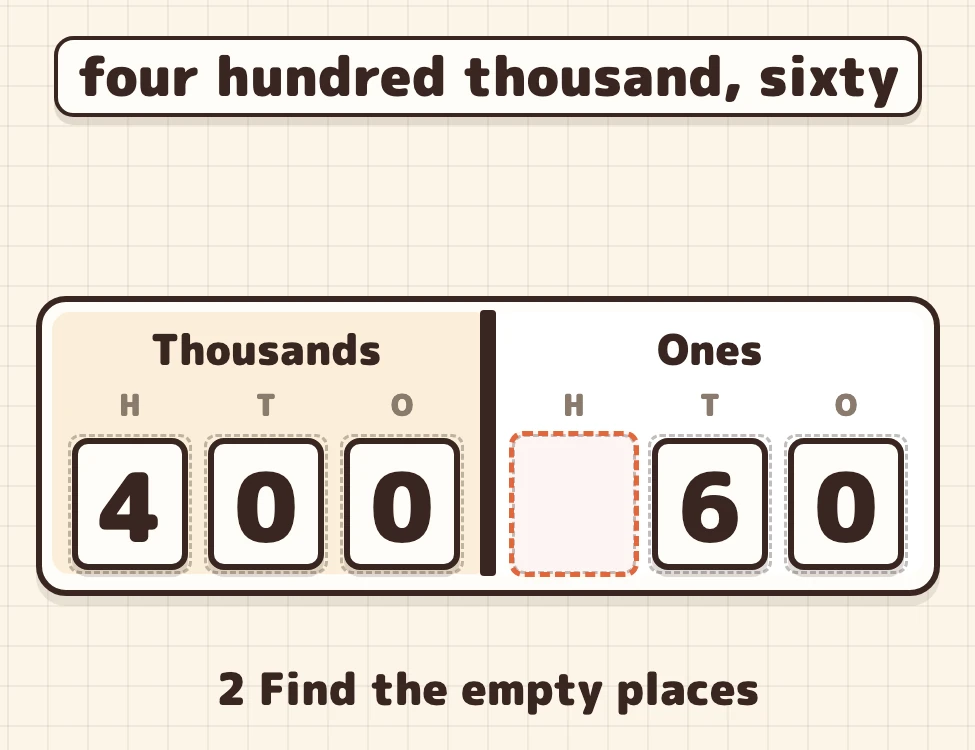
To the right of the first digit (the 4), any place without a digit gets a 0. Here that is the hundreds place. Nothing is written to the left of the first digit.
Reading the digits and reading them back
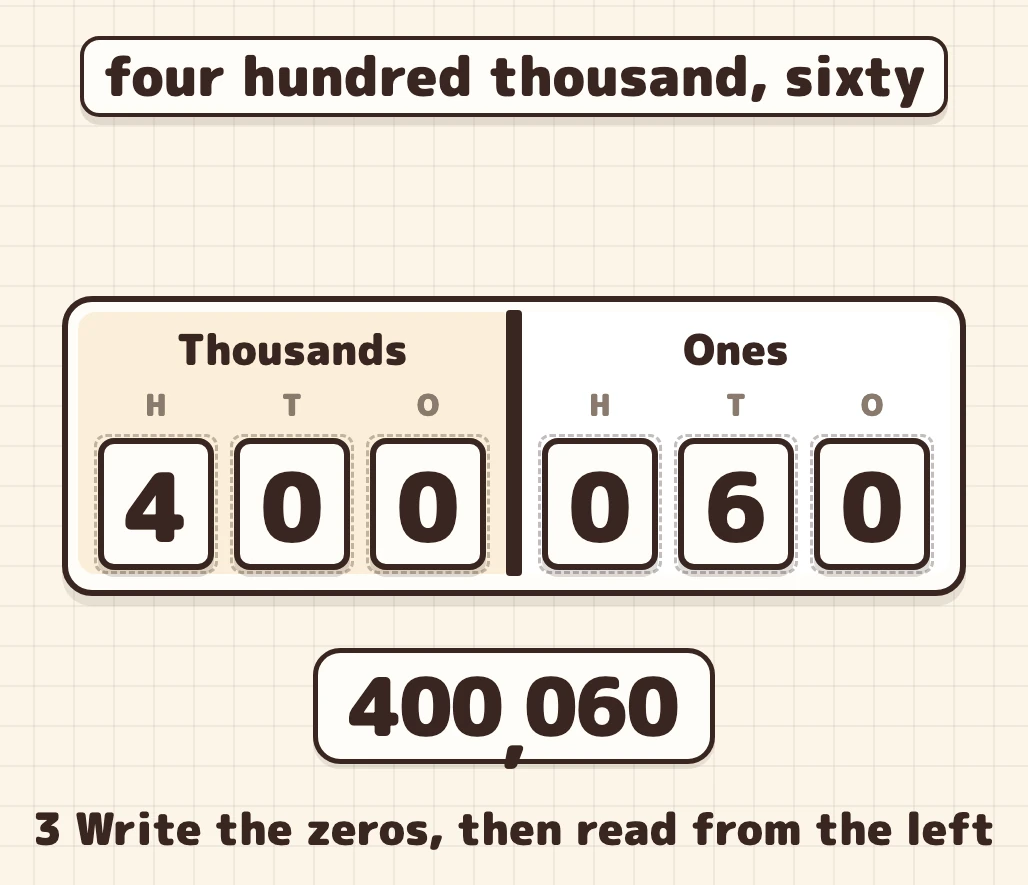
Copy the digits from the left: 400,060. Then read it back one house at a time: "four hundred thousand, sixty." It matches the name, so it's right. In expanded form, 400,000 + 60 = 400,060.
Answers and checks (contains answers)
The main problem
The answer is B: 300,050. Three hundred goes in the Thousands house, so the 3 is in the hundred thousands place. Fifty goes in the Ones house with its right end in the ones place, so the 5 is in the tens place. The hundreds place is empty and gets a 0. That makes four zeros: three were already inside 300 and 50, and we wrote one more. We couldn't hear any of them.
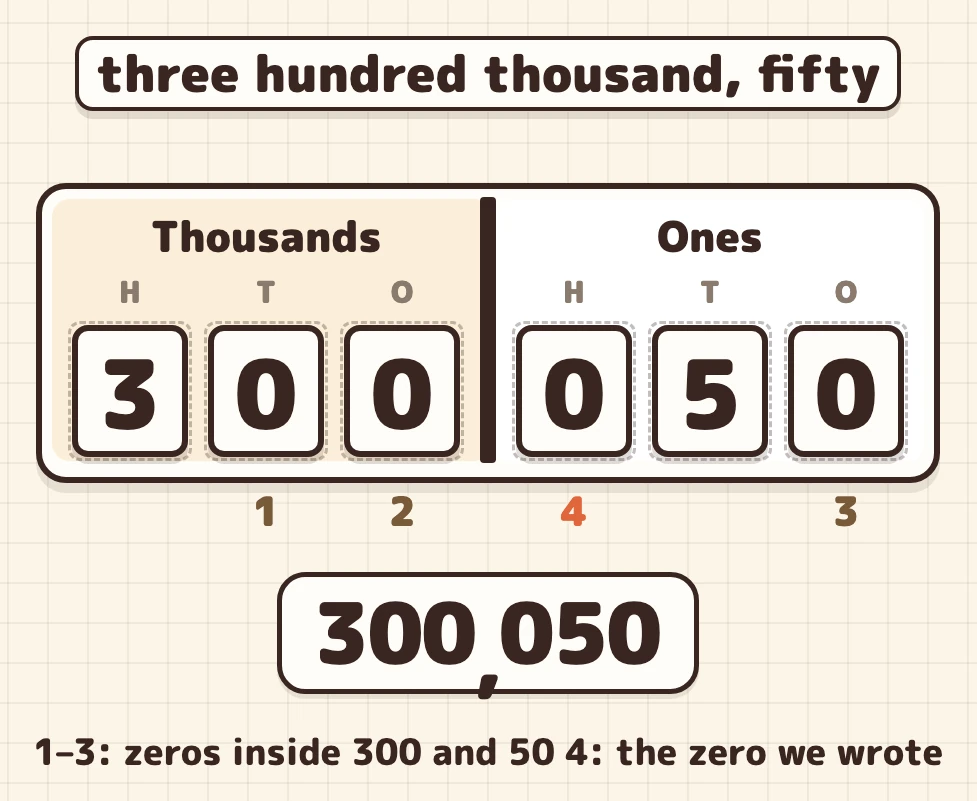
See it move: a zero card drops into the empty place (about 8 seconds)
Practice 1 and Practice 2
| Problem | Answer | Expanded form |
|---|---|---|
| Practice 1: five hundred thousand, three | 500,003 | 500,000 + 3 |
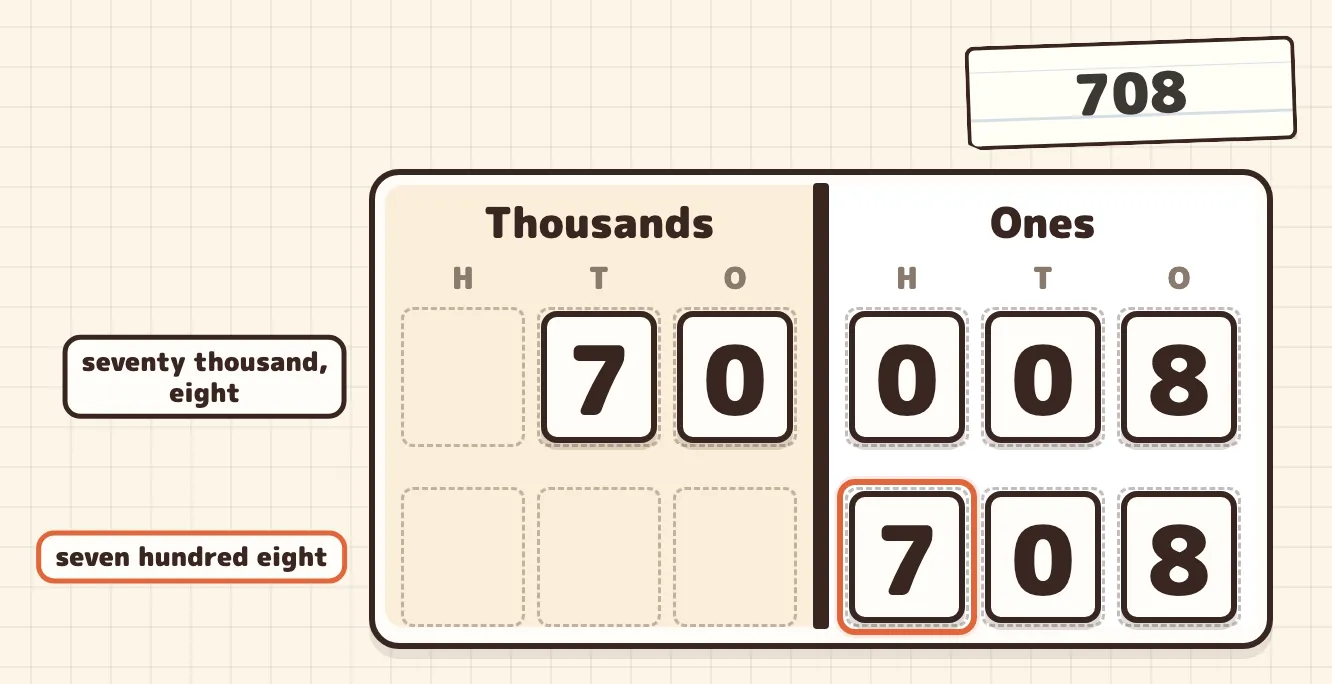
| Practice 2: seventy thousand, eight | 70,008 | 70,000 + 8 |
In both, the hundreds and tens places of the Ones house are empty, so each gets a 0. The Ones house holds only one digit, but it still has three places.
On your own
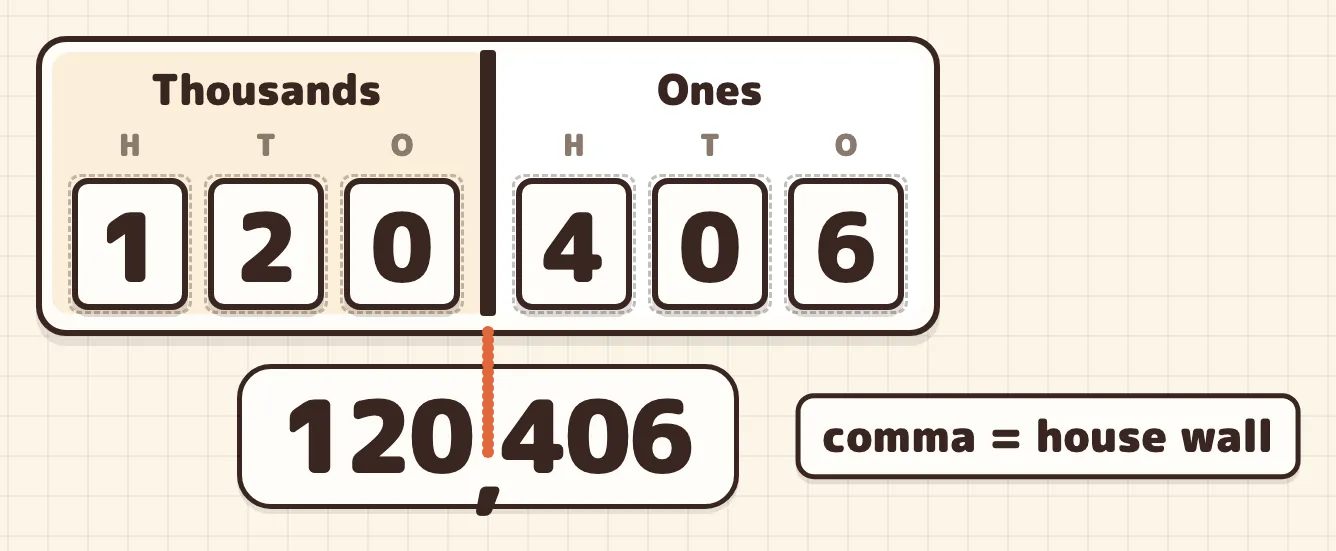
The answer is 120,406. One hundred twenty fills the Thousands house; four hundred six fills the Ones house. Four hundred six means four hundreds, no tens, and six ones, so it has a zero in the middle. The zero in 120 works the same way. This time every place already has a digit, so the new skill is keeping the zeros that live inside each part.
How to check
- Read it back one house at a time: 120,406 → one hundred twenty thousand, four hundred six.
- Count the digits. If the first digit is in the hundred thousands place, the number has six digits.
- Use expanded form: 100,000 + 20,000 + 400 + 6 = 120,406.
- The comma goes exactly where the wall between the houses is.
Common slips and how to fix them
In every case, putting the written number back into the chart and reading it aloud gives a different name, so children can catch the slip themselves. Instead of saying "wrong," try "Let's put it in the chart and read it."
Lining up the left end instead of the right end
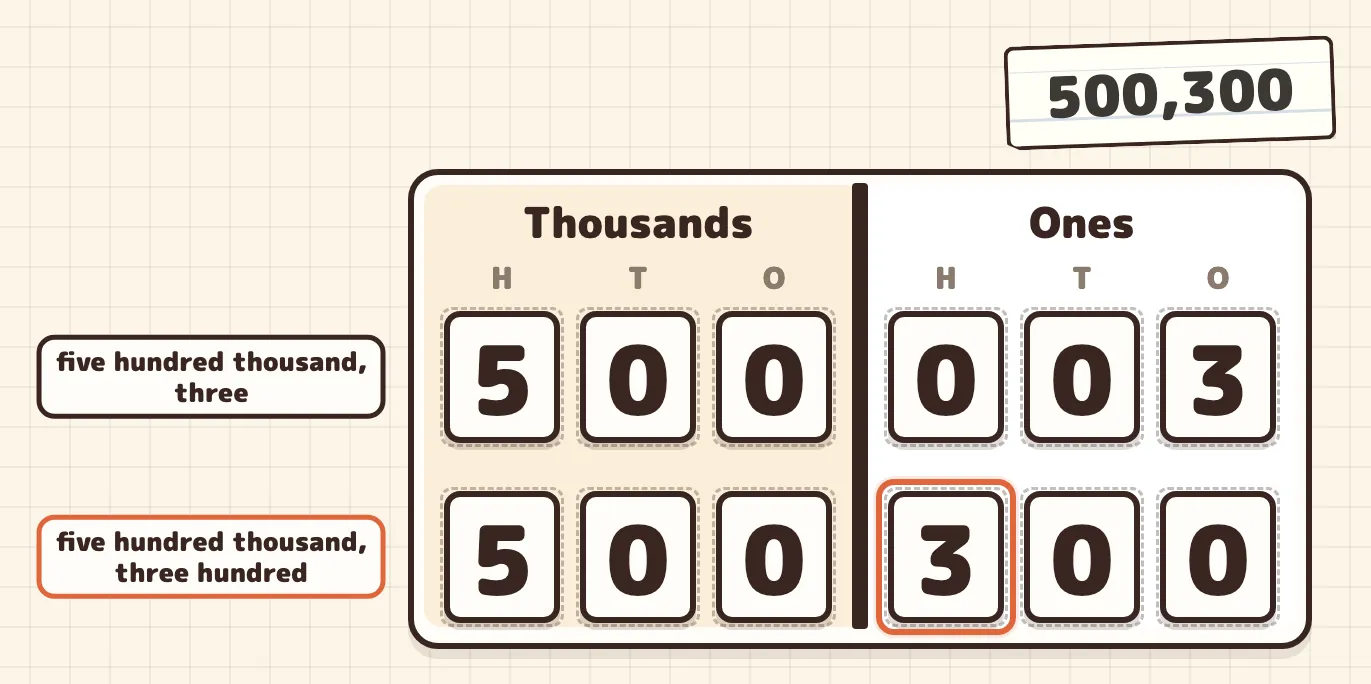
300,500 reads three hundred thousand, five hundred. In Practice 1, 500,300 reads five hundred thousand, three hundred. Ask: when you write fifty by itself, is the 5 in the hundreds place? No, it's in the tens place, and the Ones house works the same way.
Squeezing out an empty place
Skipping the zero makes every digit to its left slide one place to the right. 30,050 reads thirty thousand, fifty; in Practice 2, 708 reads seven hundred eight, a much smaller number.
Writing parts side by side, or losing a zero inside a part
Writing each part as it sounds gives numbers that are far too long: 30,000,050 for the main problem, or 1,204,006 when "On your own" is written as 120 followed by 4006. Leaving out the zero inside four hundred six gives 12,046, which reads twelve thousand, forty-six.
Another view: the place names inside the number name
In "three hundred thousand," the word "hundred" tells you the 3 is in the hundred thousands place. In "fif*ty*," the "-ty" means tens, so the 5 is in the tens place. A number name only mentions places that have digits, so the places it skips still need zeros.
Expanded form says the same thing: 300,000 + 50 = 300,050. It's a correct method too, but with bigger numbers it means counting zeros and lining up right ends by hand. The chart decides the places without counting.
More to try
- Write four hundred thousand, four, with digits.
- Write 300,000 + 50 as one number.
- Write one million with digits. (A new house appears!)
- Write 605,060 as a number name.
- In 300,050, the 5 moves one place to the left. How many times as much is it worth now?
Answers to More to try (contains answers)
- 400,004. Both the hundreds and tens places in the Ones house get zeros.
- 300,050, the same number as the main problem.
- 1,000,000. The 1 starts a new house to the left of the Thousands house (the Millions house).
- Six hundred five thousand, sixty.
- 10 times as much. The 5 moves from the tens place to the hundreds place, so 50 becomes 500 (a digit in one place represents ten times what it represents in the place to its right).
For parents and teachers
- Before telling your child how many zeros a number has, let them put the number into the chart and find where the zeros go.
- Even when the answer is right, encourage reading it back. Checking becomes a habit.
- When it's wrong, just put that number into the chart and read it together.
- A phrase to remember: "Places nobody says still need a zero." Try reading big numbers from a newspaper or a sign aloud, then writing them with digits.
Frequently asked questions
Why do kids leave out zeros?
When we say a number, we only name the places that have digits, so the empty places are never heard. That likely makes them easy to forget when writing.
Why do some kids write 300,500 or 30,000,050?
Some children who know a house has three places start "fifty" at the left end and fill the rest with a zero, which gives 300,500. Others write each part exactly as they hear it, side by side, which gives 30,000,050. Children have different reasons, so it helps to ask how they decided.
Should my child use commas?
Usually, yes. In American writing, large numbers get a comma every three digits, counting from the right. The comma sits exactly where the wall between two houses is, so it also helps your child read the number back one house at a time. In the hands-on activity, answers are accepted with or without commas.
How does this connect to expanded form?
The Grade 4 standard asks children to read and write numbers with base-ten numerals, number names, and expanded form. The chart links all three: each part of the name sits in its house, and each digit's place gives one term of the expanded form (300,000 + 50).
Try it in the "Find the Hidden Zeros" activity
In the hands-on activity at the top of this episode's page, children put each part of a number name into a place-value chart, write the zeros themselves, and work through six tasks: the main problem, Practice 1, Practice 2, On your own, explaining why, and fixing a notebook's slips. There are also "One more," "Make a puzzle," and a learning map. Time and scores are never recorded.
Sources
Where the facts and numbers in the video and on this page come from.
References
- Problems: all problems on this page are original problems by Tamelabo. Pictures and animations by Tamelabo (font: M PLUS Rounded 1c, SIL OFL 1.1).
Links
Voice, music, art
- Voice: Kokoro (synthetic voice) / Music (OpenTracks): “のんびり行こうよ” by zmino, “パステルハウス” by かずち / Sound effects: Tamelabo (made with code) / Font: M PLUS Rounded 1c (SIL OFL 1.1) / Art, problems, and animation: Tamelabo