Toshishun by Ryūnosuke Akutagawa: Why Does He Break His Silence? | Classics in 5 Minutes #10
The story in brief
- Toshishun, a young man who has been rich twice, becomes an immortal sage's disciple and vows never to make a sound.
- He stays silent even as his parents are whipped in hell, until his mother says he may keep silent, and he cries “Mother!”
- How did his mother's words sound to a man who had given up on people? That is the question the story leaves us.
Also calledToshishun summaryToshishun AkutagawaToshishun ending explainedAkutagawa short story summaryToshishun plot
Video

Pressing play loads the YouTube player on this page. Watch on YouTube
Explained
In the video
- 0:00One sound, and no immortality
- 0:27Gold twice, alone twice (Ch. 1–2)
- 1:37Giving up on people; the immortal sage (Ch. 3–4)
- 2:33Trials on Mount Emei (Ch. 4)
- 3:31The palace of the underworld (Ch. 5)
- 4:09Father and mother (Ch. 5)
- 5:23The same gate, a different answer (Ch. 6)
- 6:25One passage to reread, and the original
Toshishun (杜子春, pronounced "toh-shee-shoon") is a short story by the Japanese writer Ryūnosuke Akutagawa (1892–1927), first published in the magazine Akai Tori in July 1920. Set in Luoyang, a capital of Tang-dynasty China, it follows a young man who is offered the chance to become an immortal sage — on one condition: he must not make a single sound.
This article covers the whole story, including the ending. All facts come from the Japanese text on Aozora Bunko (modern spelling edition). Quotations are our own translations from the Japanese, with the chapter noted.
The story in 30 seconds
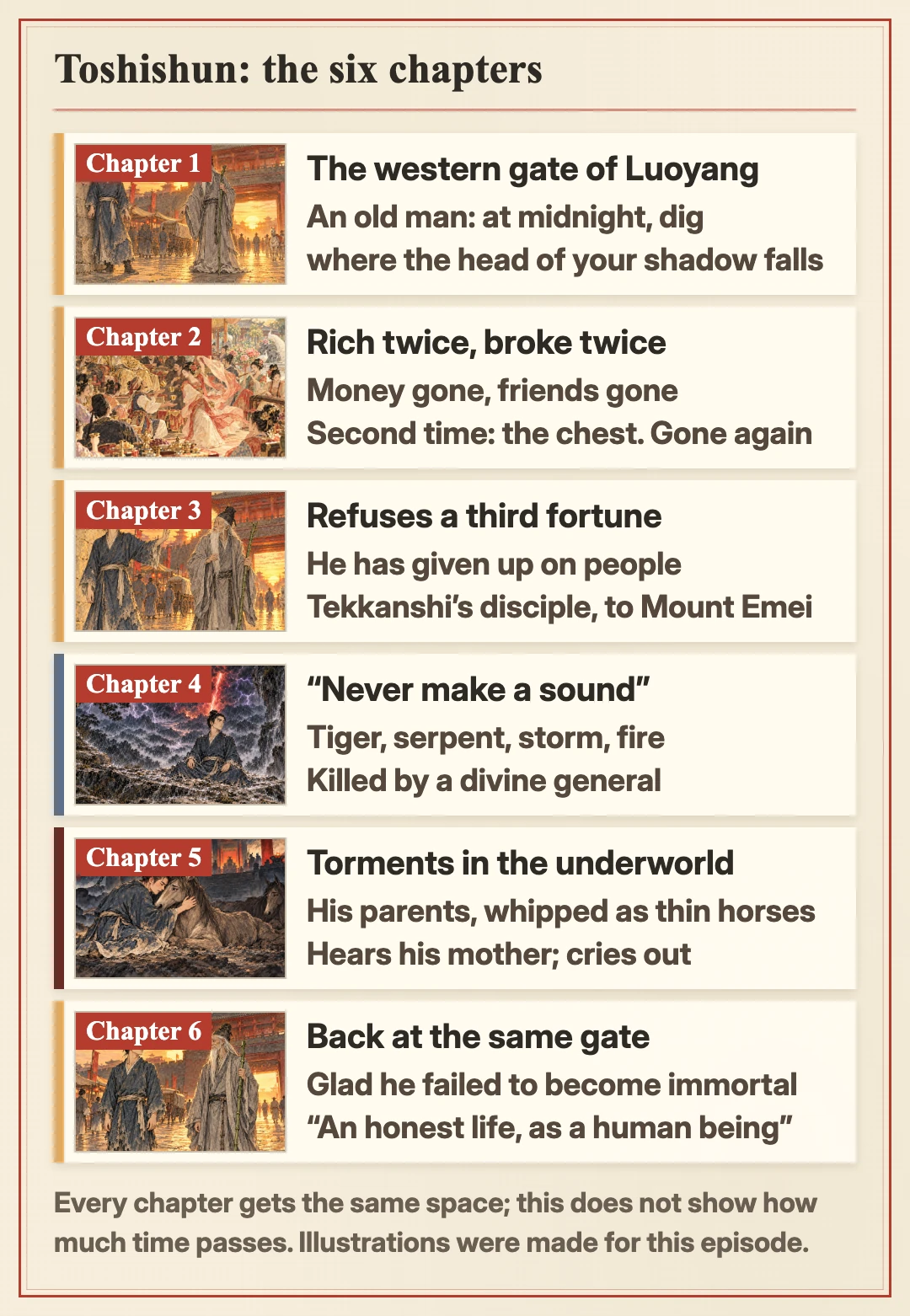
Penniless, Toshishun stands at the western gate of Luoyang. An old man tells him to dig at midnight where his shadow’s head falls. He finds gold, lives lavishly, goes broke and loses his friends. A second fortune runs out too.
The third time, he refuses: he has given up on people. The old man, the immortal sage Tekkanshi, makes him a disciple with one command: never make a sound. He stays silent through a tiger, a storm, death and hell, until his mother, whipped as a horse, says he may keep silent. He cries out: "Mother!" He never becomes immortal, and is glad: he will live an honest life.
Characters
- Toshishun — a young man from a once-wealthy family who has squandered everything.
- Tekkanshi — an immortal sage who lives on Mount Emei. He first appears as an old man squinting in one eye, and twice tells Toshishun where gold is buried.
- Toshishun's father and mother — both dead. In the underworld they appear as two thin horses with their own human faces.
- The divine general — a towering warrior in golden armor with a three-pronged halberd, commanding a host of heavenly soldiers.
- Enma — the ruler of the underworld, enthroned in a black robe and a golden crown.
- The demons — Enma's servants, who carry out his punishments.
The illustrations in our video and article were made for this episode. Faces, costumes and ages are design choices, not details from the text.
Chapter by chapter
Chapter 1: the western gate
One spring evening, Toshishun is staring at the sky beneath the western gate of Luoyang, with nowhere to sleep. An old man, squinting in one eye, asks what he is thinking about. When Toshishun answers honestly, the old man points to the evening light: stand in the sun, and at midnight dig where the head of your shadow falls. Then he vanishes.
Chapter 2: rich twice, poor twice
Toshishun digs and finds more gold than a cart can hold. Overnight he is the richest man in the city. He buys a grand house, lives in extravagant luxury and throws feasts every day; friends who never used to greet him now visit daily. But luxury drains the gold, and by the third spring he is penniless. Now the same friends walk past his gate without a word, and no one will give him even a bowl of water.
The old man appears again, this time naming the chest of the shadow. Toshishun becomes enormously rich a second time — and in about three years, it is all gone again. That is two fortunes in all.
Chapter 3: refusing the gold
The third time, the old man starts to name the belly of the shadow. Toshishun raises his hand and stops him. He does not want money anymore. It is not that he is tired of luxury:
"I have given up on people." (Chapter 3)
When he was rich, they flattered him; when he was poor, they would not even look kind. Asked whether he will now live poor but at peace, Toshishun hesitates — he cannot do that either, not yet — and asks to become the old man's disciple. The old man reveals that he is Tekkanshi, an immortal of Mount Emei, and agrees. The two of them straddle a green bamboo pole, which soars into the spring sky like a dragon.
Chapter 4: the vow of silence
On a broad, flat rock above a deep valley on Mount Emei, Tekkanshi seats Toshishun at the foot of a cliff before leaving for the heavens. His one command:
"Whatever happens, you must not make a sound." (Chapter 4)
Say a single word, and you will never become an immortal. Toshishun promises to stay silent even if it costs him his life.
A voice from the sky demands an answer. A tiger and a huge white serpent leap at him and vanish like mist. A storm of black clouds, lightning, rain and a pillar of fire comes and goes. Then a giant divine general in golden armor appears before the seated Toshishun and points a three-pronged halberd at his chest: answer, or die. Toshishun stays silent, and the general kills him with a single thrust. Under the Big Dipper, his body lies on its back on the rock.
Chapter 5: the underworld, his parents, and one word
Toshishun's soul sinks down to Enma's palace. Asked why he was sitting on Mount Emei, he remembers Tekkanshi's warning and says nothing. Thrown into a mountain of swords, a valley of fire and a sea of ice, he endures every torment without a word.
So Enma has Toshishun's dead parents brought in — as two thin horses with his parents' faces — and threatens to make them suffer. Toshishun still does not answer. The demons whip the horses until they collapse, while Toshishun squeezes his eyes shut.
Then a voice so faint it is hardly a voice reaches him. It is his mother. Whatever happens to us, she says, if only you can be happy, there is nothing better. And she ends:
"Whatever the king may say, if there is something you do not want to say, you may keep silent." (Chapter 5)
Toshishun opens his eyes and sees one of the horses lying on the ground, gazing sadly at him — showing no resentment at all, thinking only of her son. Forgetting the immortal's command, he runs to her, throws both arms around her neck and, in tears, cries out:
"Mother!" (Chapter 5)
Chapter 6: back at the gate
At the sound of his own voice, Toshishun finds himself standing under the western gate of Luoyang in the evening sun. The hazy sky, the pale crescent moon, the stream of people and carts: everything is just as it was before Mount Emei.
The ending: what he chooses
"You could never become an immortal," the old man says with a smile. Toshishun agrees — and says he is actually glad he failed. Taking the old man's hand, tears in his eyes, he explains that he could not stay silent while his parents were being whipped.
Then Tekkanshi's face turns stern:
"If you had stayed silent, I would have taken your life on the spot." (Chapter 6)
This is not a reward or a gentle pass mark. Asked what he will become now, Toshishun answers, with a new brightness in his voice:
"Whatever I become, I mean to live an honest life, the way a human being should." (Chapter 6)
As he leaves, Tekkanshi turns back: he owns a house at the southern foot of Mount Tai — a different mountain from Mount Emei — and gives it to Toshishun, fields and all. By now, he adds, the peach trees around it must be in full bloom. The story ends there; we are never told how Toshishun lives in that house.
Rereading his mother's words
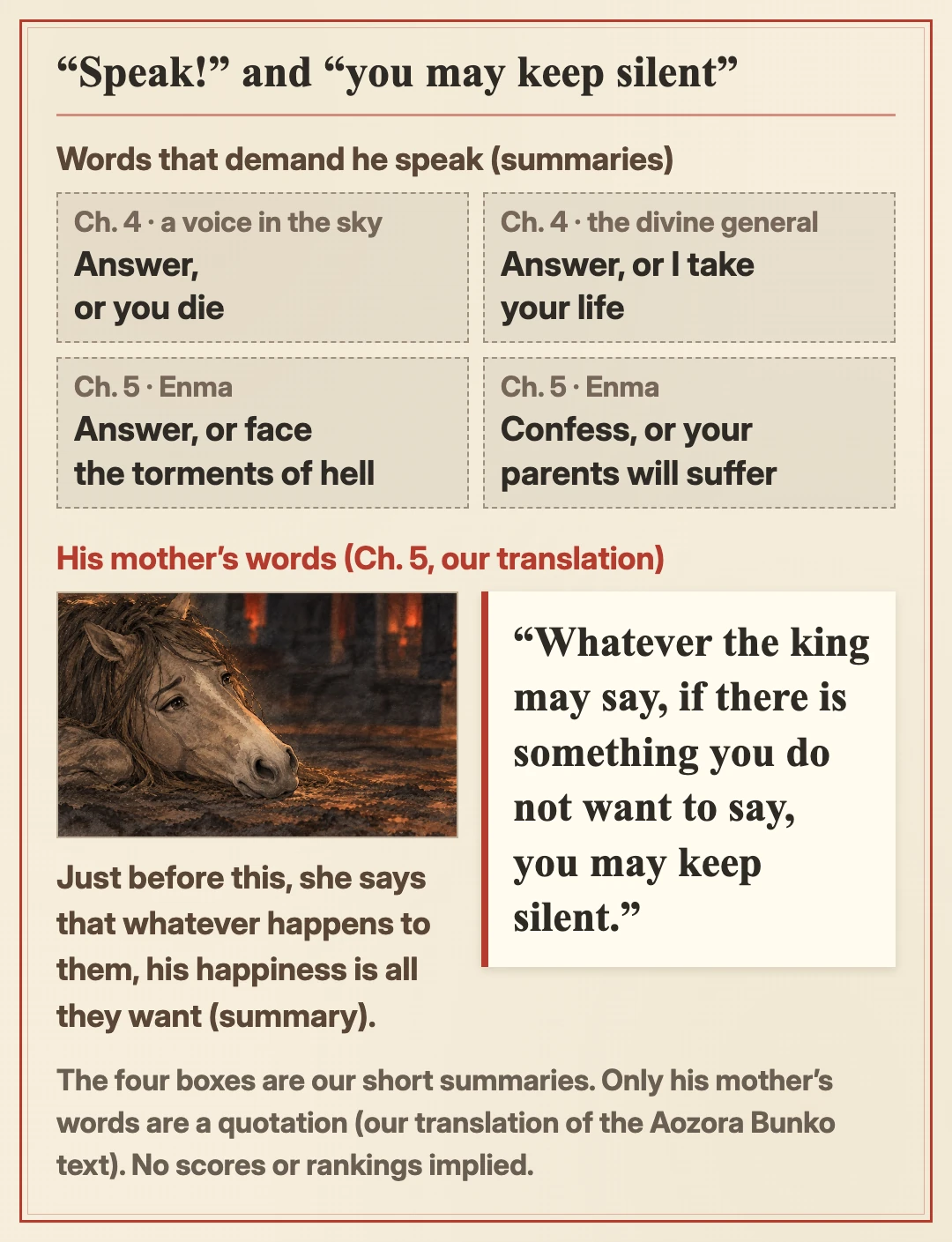
Again and again in the story, someone demands that Toshishun speak: the voice in the sky, the divine general, and Enma twice — first with hell's torments, then with his parents' pain. (The four boxes at the top of the figure are our summaries, not direct quotations.) Toshishun answers none of them.
His mother's words are the only ones that say the opposite: you may keep silent. And just before that, she has said that whatever happens to her and his father, his happiness is all she wants. The narrator sets her kindness directly beside "the people of the world" who flattered Toshishun when he was rich and would not speak to him when he was poor (Chapter 5).
Threats could not make him speak. Permission to stay silent did. That order of events is exactly as the text gives it.
Questions to think about
These are one way of reading the text, not a claim about Akutagawa's single intention.
- How do Chapter 3 and Chapter 5 connect? In Chapter 3, Toshishun says he has given up on people. In Chapter 5, the narrator compares his mother's kindness to those same fair-weather friends. How might her words have sounded to a man who had lost faith in people?
- What do you make of Tekkanshi's warning? "If you had stayed silent, I would have taken your life" comes right before Toshishun's answer about living honestly.
- What does Toshishun choose again? In Chapter 3 he could not yet live poor but at peace. In Chapter 6, neither rich nor immortal, he chooses an honest human life of his own accord.
FAQ
Why does Toshishun speak?
In the underworld, he stays silent while his parents — in the form of horses — are whipped. Then his mother tells him she wants only his happiness and that he may keep silent. He opens his eyes, runs to her, throws his arms around her neck and cries "Mother!" (Chapter 5). The text does not say he broke because of pain; he speaks after hearing his mother's words.
What does his mother tell him?
She tells him not to worry: whatever happens to her and his father, nothing could be better than his happiness. She ends: "Whatever the king may say, if there is something you do not want to say, you may keep silent" (Chapter 5). She is not asking him to save her.
How many times does Toshishun become rich?
Twice. The first time he digs where the head of his shadow falls, the second time the chest. The third time, he refuses the offer before the old man finishes (Chapters 1–3).
What animals do his parents become?
Two thin, worn-out horses — with the faces of his dead father and mother (Chapter 5).
Where is the house he is given?
At the southern foot of Mount Tai, together with its fields — not on Mount Emei, where he trained (Chapter 6). The story does not describe his life there.
Was it all a dream?
The text says that when he came to, he was standing at the western gate and everything looked just as it had before he left for Mount Emei (Chapter 6). It never says it was a dream, and it does not explain how the trials worked.
Reading the original
The full story is free to read online in Japanese on Aozora Bunko, Japan's public-domain digital library (modern spelling edition).
- Ryūnosuke Akutagawa, Toshishun — full Japanese text (Aozora Bunko)
- Aozora Bunko library card: edition and transcription details (in Japanese)
The story has just six short chapters. The climax is in Chapter 5 (五), beginning with the mother's words 「心配をおしでない」. The link opens at the start of the story.
Sources
Where the facts and numbers in the video and on this page come from.
References
- Ryūnosuke Akutagawa, Toshishun (杜子春), Aozora Bunko, modern spelling edition (in Japanese). Base text: Kumo no Ito / Toshishun, Shinchō Bunko, Shinchōsha (1968; 46th printing 1989). First published in the magazine Akai Tori, July 1920. Transcribed by 蒋龍; proofread by noriko saito. Translations of quoted lines are our own.
Links
- Ryūnosuke Akutagawa, Toshishun — full Japanese text (Aozora Bunko)aozora.gr.jp/cards/000879/files/43015_17432.html
- Aozora Bunko library card: edition and transcription details (in Japanese)aozora.gr.jp/cards/000879/card43015.html
Voice, music, art
- Voice: Kokoro (synthetic speech)
- Music (OpenTracks): “茶屋にて” by MATSU / “縁側” by siroimu / “百花繚乱” / “藁の記憶”
- Sound effects: synthesized in code by Tamelabo / Freesound “Whoosh” (CC0)
- Fonts: Shippori Mincho, IBM Plex Sans JP, M PLUS Rounded 1c (SIL Open Font License 1.1)