Takasebune by Mori Ōgai: Why Did the Exiled Man Look Happy? | Classics in 5 Minutes #12
The story in brief
- On a boat toward exile, Kisuke tells his story to the constable guarding him.
- Kisuke is content with his first money, but his account of his brother leaves the officer’s doubt unresolved.
- The story asks whether accepting a higher judgment is the same as feeling convinced.
Also calledTakasebune plot summaryThe Takase Boat endingMori Ogai Kisuke
Video

Pressing play loads the YouTube player on this page. Watch on YouTube
Explained
In the video
A prisoner is being taken toward exile, yet he looks almost ready to whistle. The constable watching him cannot understand why. In Mori Ōgai’s 1916 short story Takasebune, that puzzling expression opens a conversation about having enough, taking a life, and accepting a judgment one cannot quite believe.
This article follows the story to its ending. It discusses a death without graphic details or descriptions of the method. Our illustrated, narrated video takes about 8 minutes. Everything needed to follow the story is also explained below.
The story in brief
Kisuke, convicted of killing his younger brother, travels on a small boat under the watch of Haneda Shōbei. Unlike the prisoners Shōbei usually escorts, he looks happy. Asked why, Kisuke says that exile will give him somewhere he is allowed to stay. He also owns two hundred mon in copper coins, the first money he has ever had to keep as his own.
Shōbei recognizes the shape of his own finances: his income, too, goes straight out again. What he cannot share is Kisuke’s contentment. He unexpectedly addresses the prisoner with the respectful san, then asks why he killed his brother. Kisuke describes a desperate request from a gravely ill brother. Shōbei thinks killing must be a crime, yet cannot settle his doubt about this act. The boat carries its two silent men into the hazy night.
Who is who?
- Kisuke is about thirty, thin and pale, with no fixed address. He has no relatives to see him off. His courtesy toward the officer is described as sincere rather than a performance meant to flatter power.
- Haneda Shōbei is a low-ranking constable serving the Kyoto city magistrate. His household consists of seven people: himself, his wife, four children, and his elderly mother. The story places him near an age described by shorō, a word originally associated with forty; it does not give an exact age.
- Kisuke’s younger brother worked beside him until illness left him unable to earn a living. We hear his story through Kisuke’s account, not directly from an independent narrator at the scene.
- The elderly neighbor had been asked to give the brother medicine and help while Kisuke was out.
The illustrations’ clothing colors and hairstyles are production choices. They are not all details specified in the text.
A real Kyoto canal, and the boat to exile
The Takase is a narrow canal in Kyoto, running from the Nijō area toward Fushimi. It was about 24 feet (7 m) wide and roughly 6.4 miles (10.27 km) long. The latter figure comes from converting a length written on an old manuscript map; historical units make it an approximation. Flat-bottomed boats served the shallow waterway. Canal history (in Japanese), National Diet Library map.
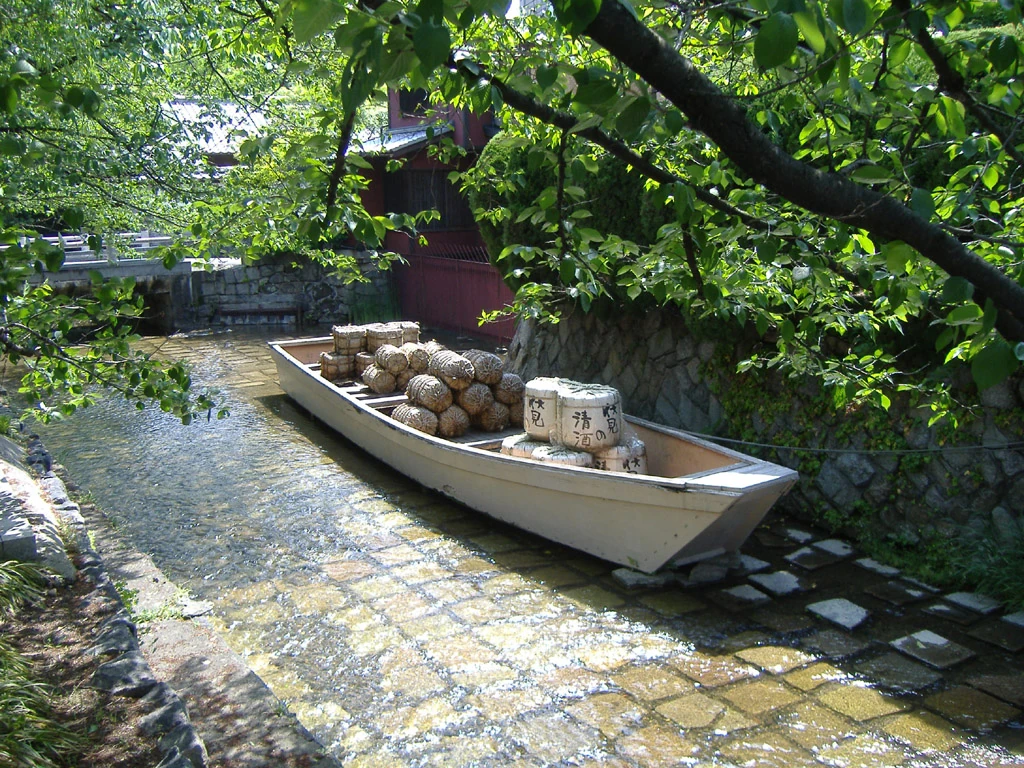
This is a replica cargo boat at Kyoto’s Ichino-funairi landing, not the boat from the fictional voyage. Photo: PRST / Wikimedia Commons, public domain. Image information.
In the days of the shoguns, island exile was a punishment heavier than banishment and lighter than death. The story says Kyoto prisoners sentenced to it were taken toward Osaka by Takase boat. It never names Kisuke’s destination island. Explanation of island exile (in Japanese).
Usually, one leading relative could ride along as far as Osaka. This was not an official right: the constables simply looked the other way. Those night voyages often meant listening to prisoners and relatives speak through tears. That is the background against which Kisuke’s expression seems so strange.
The route unfolds in a particular order: the evening bell, departure, houses along both banks, and then the crossing of the Kamo River, Kyoto’s main river. After leaving the town and crossing the Kamo, the surroundings grow quiet.
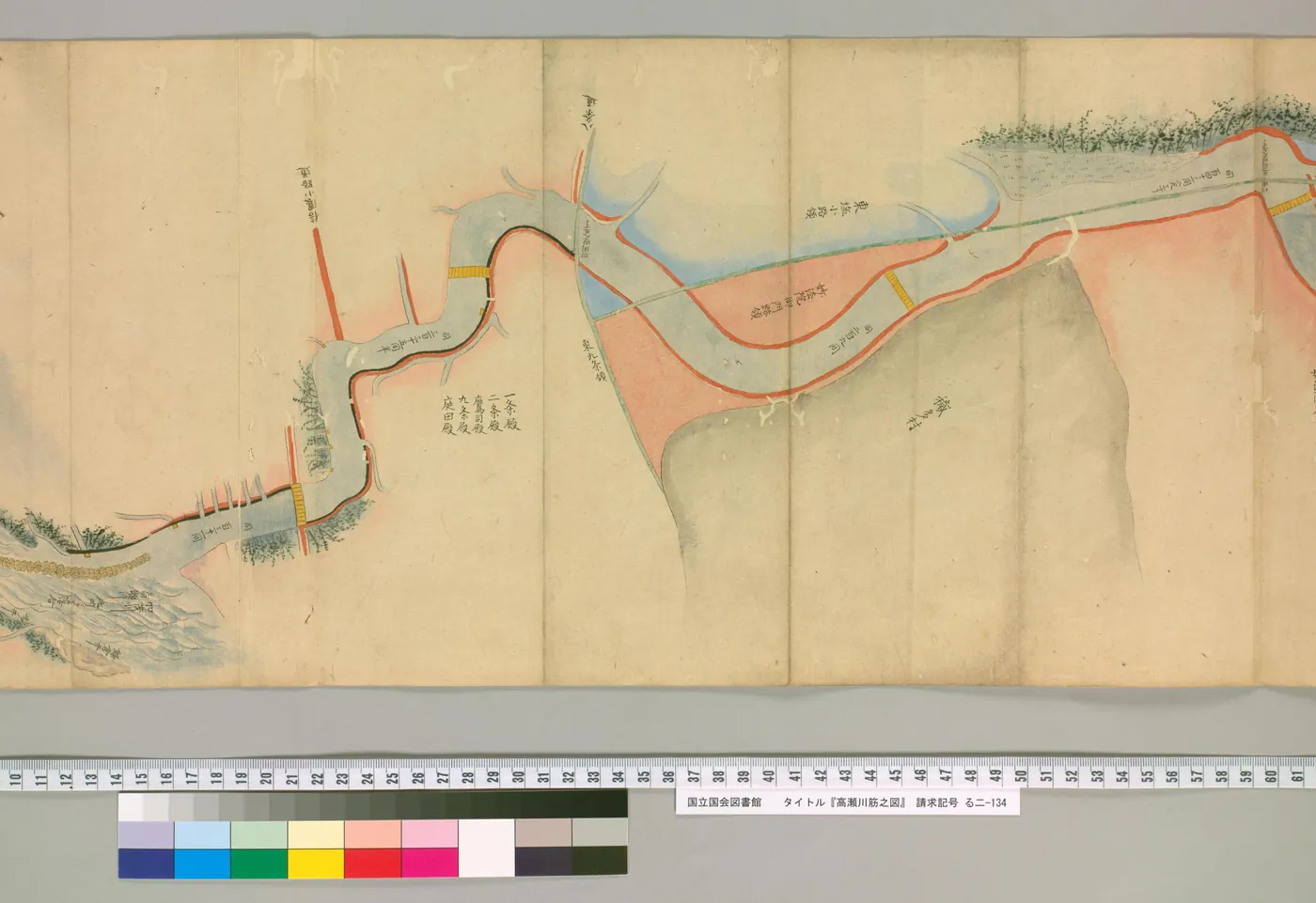
The undated manuscript Takasegawa Suji no Zu has an inscription meaning “the Kamo and Takase meet here,” continuing from the left edge of frame seven into frame eight. The reproduced image is reduced in size, without drawing over its lettering or changing its colors. National Diet Library Digital Collections, Public Domain Mark. View the original map.
The narrator places the story probably in the Kansei era, when Lord Shirakawa Rakuō, or Matsudaira Sadanobu, held power in Edo. Edo was today’s Tokyo, then the seat of the shogun’s government. Kansei lasted from 1789 to 1801, while Sadanobu led the government from 1787 to 1793. The wording therefore points to the early part of the era at most; it does not fix an exact year. Kansei (in Japanese), Sadanobu (in Japanese).
The plot, following the text’s four divisions
Ōgai did not number the story’s chapters. The four parts below follow the horizontal dividers in the Japanese text.
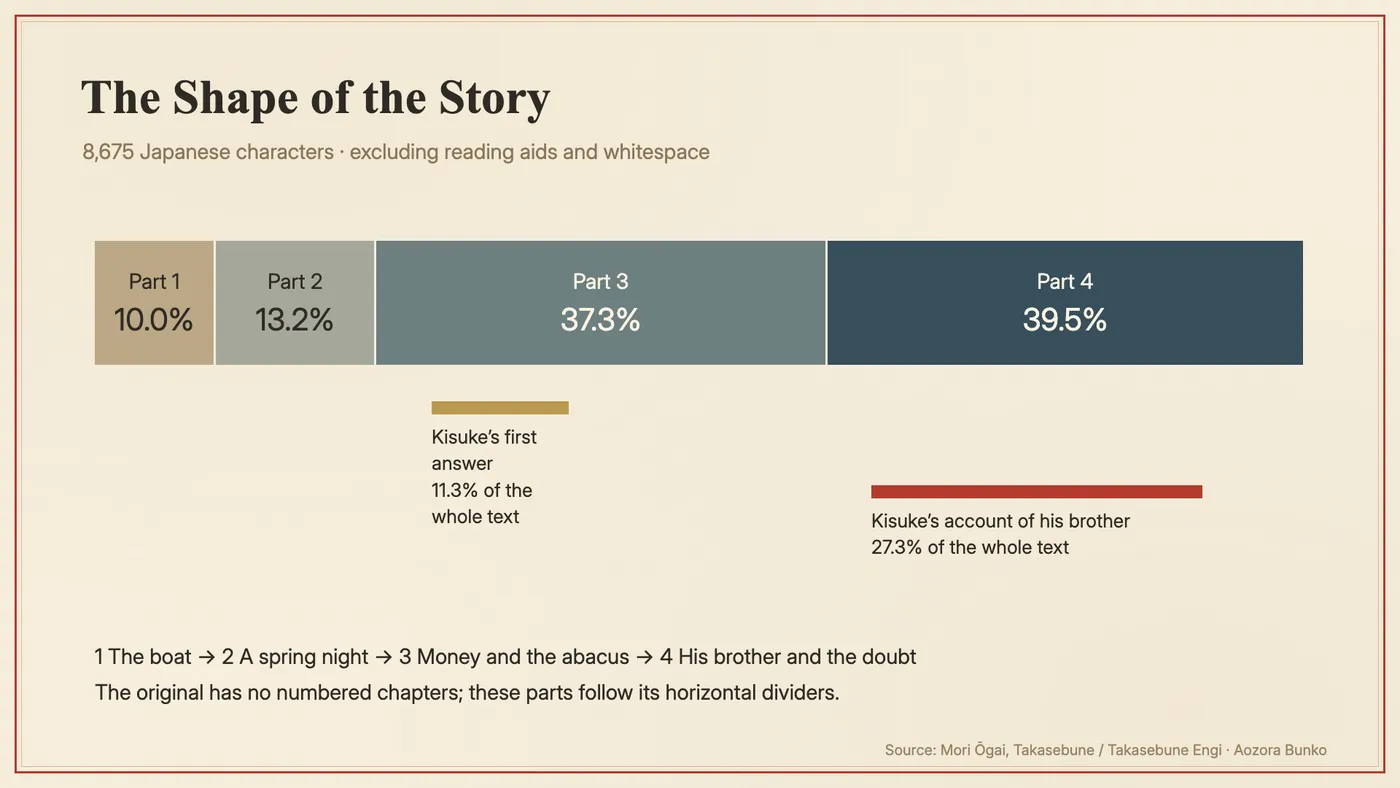
Removing reading aids and whitespace, but keeping punctuation, gives 8,675 Japanese characters. Kisuke’s account of his brother alone occupies 27.3% of the story. The explanation of the boat is short beside the space given to speaking and listening.
Part 1: what the escorts hear
The story begins with the boat and the escort’s duties. A constable hears things on these voyages that official statements and paperwork could never fully show. Some officers merely find the work tiresome; others privately feel the sorrow, even when their role keeps them from showing it. The escorts dislike this assignment.
Part 2: an unexpected prisoner
Kisuke quietly respects Shōbei’s authority. Yet he seems happy. Once the boat has left the town and crossed the Kamo, the wind has ceased and only water whispers around the bow. Kisuke stays upright, looking at a moon whose brightness changes as thin cloud passes over it.
Shōbei imagines that, without the constraint of an officer’s presence, this man might whistle or hum. He looks as though he were on a pleasure boat. Is he heartless? Is he out of his mind? Shōbei considers and rejects both possibilities. These are the officer’s passing thoughts, not diagnoses endorsed by the story.
Part 3: a place to stay, and money of his own
Only after Shōbei asks how he feels about going to the island does the text say Kisuke smiles.
“Until now, I have never had anywhere that I could call a place where I was allowed to stay.”
Our translation, part 3, in Kisuke’s first answer. The island may be hard, he says, but surely it is no place of demons. Being told to stay there means he can settle somewhere. He has never been ill, and believes he can work even at a difficult job.
There is also the money. Those sentenced to exile receive two hundred mon. Kisuke puts a hand to his chest. Before prison, he worked whenever he found a job, repaid debts, and borrowed again. His money always passed straight through his hands. In jail he is fed without having to work, which makes him feel undeserving. Now he can keep the coins. For the first time, he owns money, and looks forward to using it to begin work on the island.
Shōbei thinks of his household. His stipend is paid in rice. However hard he saves, the household sometimes runs short, and his wife secretly seeks money from her prosperous family. His income, too, passes straight out again. He realizes that the difference between them lies only in the columns of the soroban, the Japanese abacus: the size of the numbers.
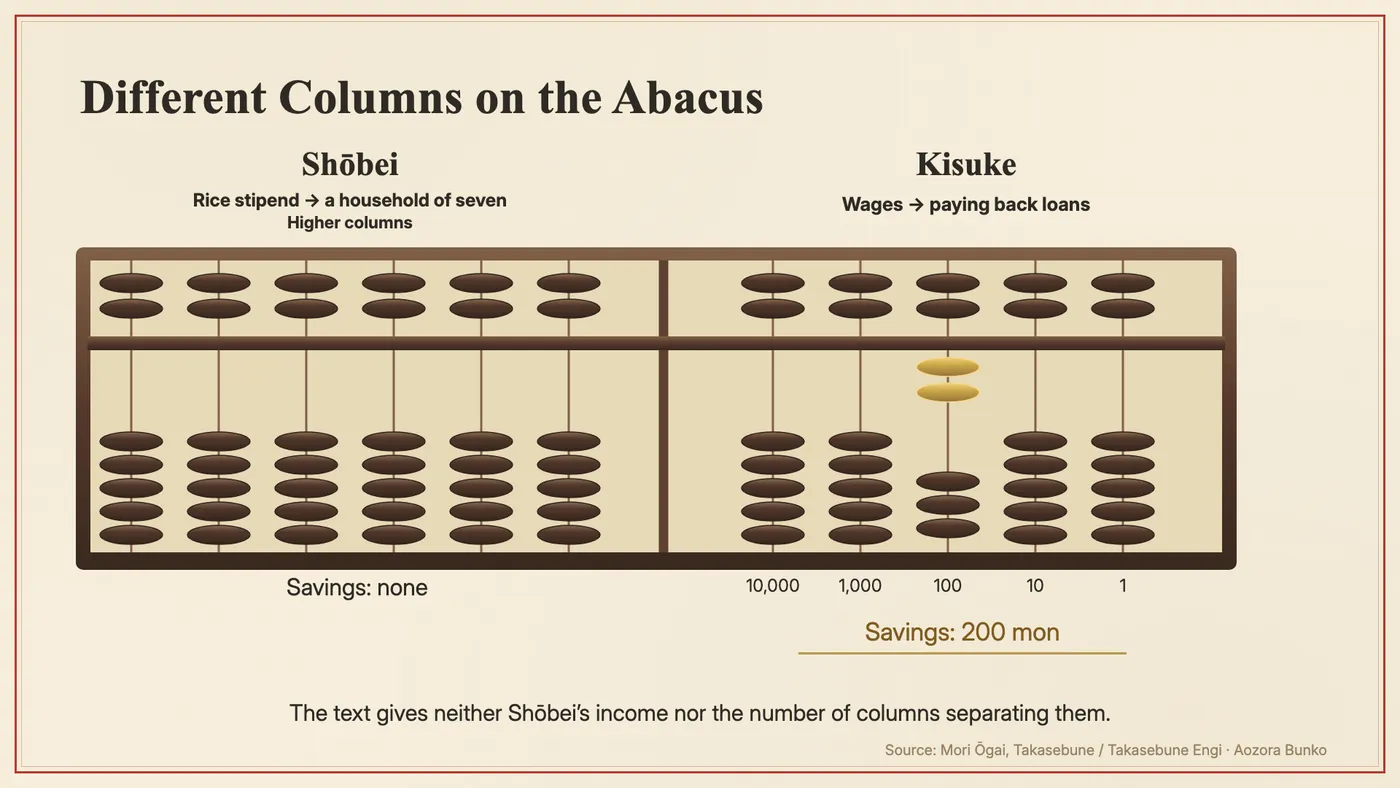
Yet Shōbei has no savings to match Kisuke’s two hundred mon. More startling than the amount is Kisuke’s ability to be content. Shōbei worries about losing his post or falling ill. Dependents do not explain everything: he thinks he could not feel as Kisuke does even if he lived alone.
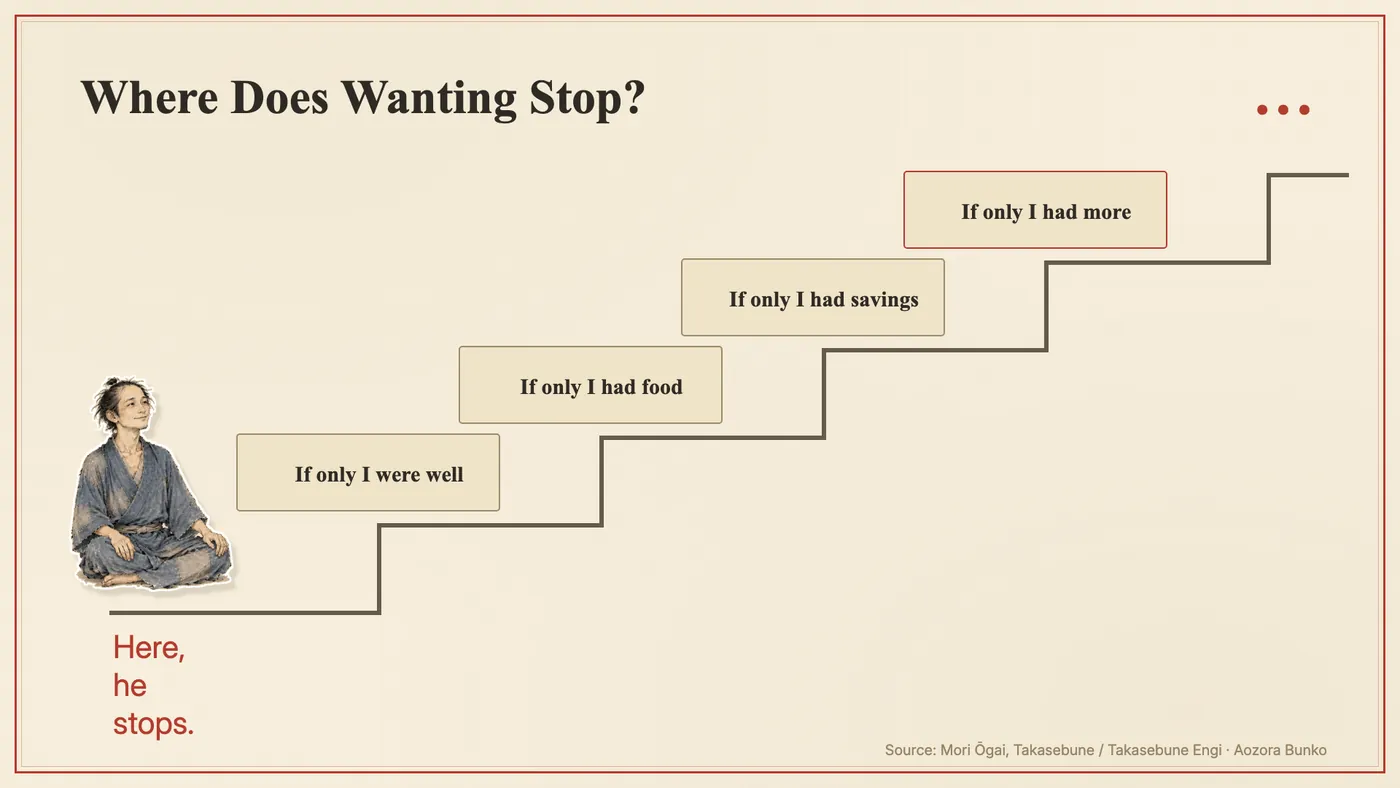
An ill person wishes for health. A hungry person wishes for food. Then come savings, then more savings. Where does this stop? Kisuke, before Shōbei’s eyes, shows him what stopping looks like.
At this moment Shōbei feels as though a radiance shines from Kisuke’s head, like the fine light said to shine from a Buddha’s brow. This is how it appears to Shōbei, not a confirmed supernatural event. It is not described here as a ring above the head. The Japanese term gōkō (in Japanese).
Part 4: “Kisuke-san,” and his brother
Shōbei calls him “Kisuke-san.” The suffix is respectful, rather like “Mr. Kisuke,” and an officer would not normally use it for a prisoner. He has not fully intended to change his address; as soon as he hears himself, he realizes it was improper. Kisuke too seems puzzled.
The constable asks why he took a life. Kisuke begins speaking quietly.
The brothers lost their parents to an epidemic as children. Neighbors helped them grow up. They tried to remain together and worked to support each other. In the previous autumn they found work in Nishijin, Kyoto’s silk-weaving district. They were drawboys, sitting above a loom and pulling cords to raise the threads that formed its pattern. Traditional drawlooms (in Japanese).
When his brother fell ill, Kisuke went to work alone. He crossed a bridge over the Kamiya River, a small river in western Kyoto, and brought food home to their poor shack in Kitayama, the hills on the city’s northern edge. His brother repeatedly apologized for leaving him to earn their living alone.
One day Kisuke returned to find that his brother had tried to take his own life but was still alive. His brother said he did not expect to recover and had wanted to ease Kisuke’s burden. He begged Kisuke to remove a blade. Kisuke said he would fetch a doctor, but his brother refused. His eyes seemed increasingly reproachful, then hateful, as if looking at an enemy.
Kisuke finally agreed. He says his brother’s eyes then changed completely and became clear and happy. As Kisuke removed it, the elderly neighbor entered, cried out, and ran away. His brother was no longer breathing. Kisuke stayed looking at his face until he was taken away. We leave the physical details to the original text rather than describe them here.
This is an account Kisuke has rehearsed in memory and repeated under questioning over about half a year. “The previous autumn” refers specifically to starting the weaving work, not to the whole flashback or to his parents’ deaths.
The ending: obedience without conviction
Shōbei thinks that Kisuke killed his brother, and that killing must be a crime. He also thinks the brother seemed beyond saving, begged to die because the suffering was unbearable, and that Kisuke meant to relieve that suffering. The two thoughts remain together.
Unable to settle the question, he turns to a higher judgment. Ōgai uses the borrowed word ōtoritē: authority. Shōbei will adopt the magistrate’s judgment as his own. But something still does not sit right, and he longs to ask the magistrate about it.
“As the hazy night deepened, the Takase boat, carrying its two silent men, glided across the black water.”
Our translation of the final sentence. The story gives no later scene on the island, and no moment when Shōbei’s doubt is resolved.
Questions worth taking back to the text
What is really different about their money? Start with Shōbei’s comparison in part 3. Both incomes pass out as soon as they arrive. The story never gives his rice stipend or tells us how many columns separate the amounts. The diagram is a comparison of their situation, not an invented household budget.
Where does wanting stop? Follow the sequence from health to food to savings to more. Shōbei’s response is an encounter with another person’s contentment. It need not be turned into advice that people should accept deprivation.
Why does “san” come out before he has decided to use it? Read the opening of part 4 alongside the radiance at the end of part 3. What has changed before Shōbei can put the change into words?
Why is the same word used for two different faces? Hareyaka, meaning clear or bright, occurs twice: for Kisuke’s brow on the boat and for his brother’s eyes in Kisuke’s account. What do those echoes do for you? The repetition is a reason to reread, not proof of a single correct interpretation.
Has Shōbei accepted the judgment? Read from the word ōtoritē to the ending. Following authority and feeling convinced are not the same movement in these paragraphs.
Ōgai’s own essay: two large problems
In Takasebune Engi, “How Takasebune Came About,” Ōgai says he found the earlier account in Okinagusa, an eighteenth-century collection of essays and records by Kanzawa Tokō, once an officer in the Kyoto magistrate’s office. About Okinagusa (in Japanese).
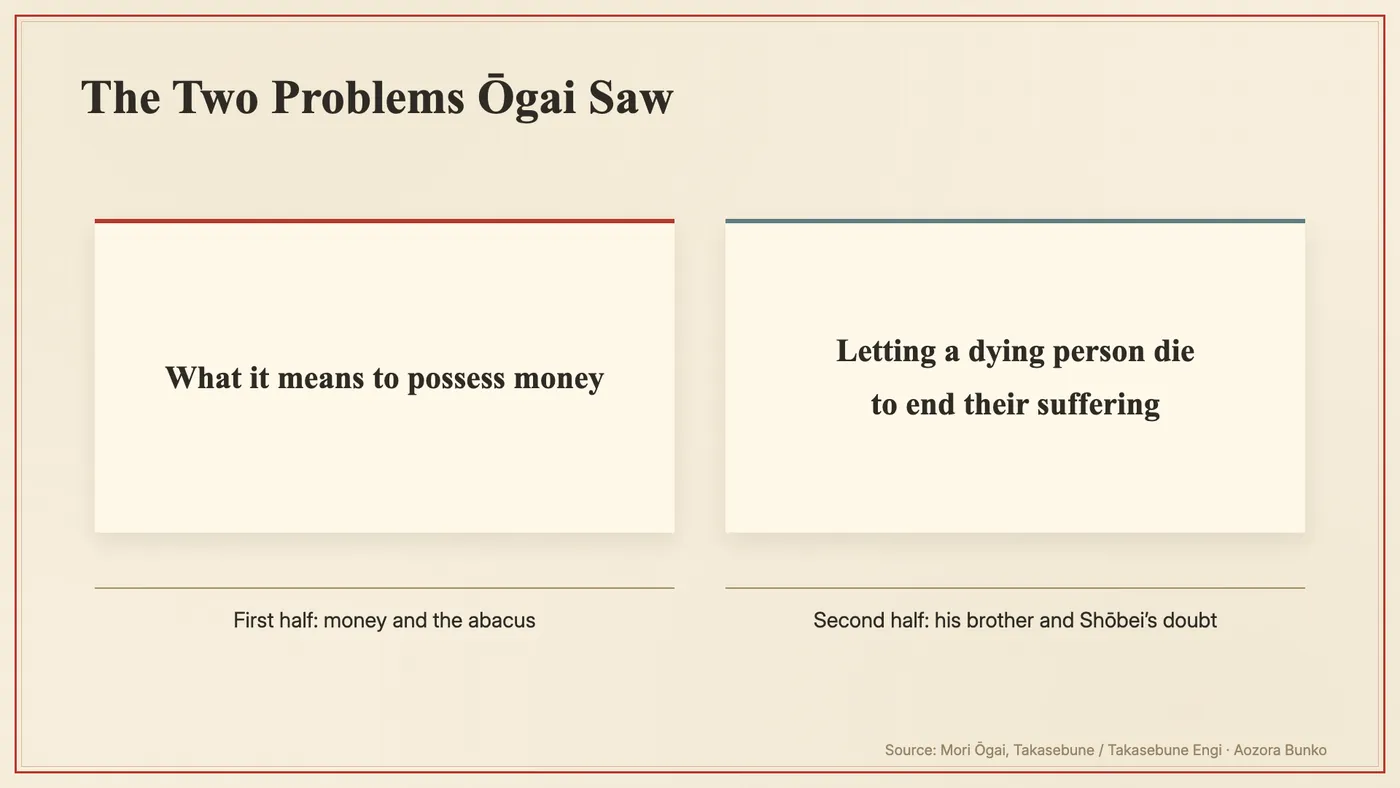
Ōgai sees one problem in the idea of property. For someone who has never had money to keep, the joy of possessing it does not depend on its amount. He is interested in Kisuke treating two hundred mon as a possession that brings satisfaction.
The second problem concerns letting a suffering, dying person die. Ōgai writes that one must not kill, then says that the question cannot so easily be settled by a rigid rule. The essay uses yūtanajī, which he explains as letting someone die easily: euthanasia.
These are the author’s stated concerns. They do not supply a simple verdict that Kisuke is innocent or that Ōgai endorses every act described by that term. Both the prohibition and his resistance to an easy rule matter.
The story and essay appeared in different magazines issued on January 1, 1916: Chūō Kōron and Kokoro no Hana. Ōgai was also an army doctor, which gives a useful context for his essay’s interest in medicine. Story bibliography (in Japanese), essay bibliography (in Japanese), National Diet Library author biography.
Frequently asked questions
Is Takasebune a story about euthanasia?
It includes that question, and Ōgai explicitly uses the corresponding term in his essay. It also concerns possession and contentment. The story itself ends with an unresolved doubt, and the essay says both that one must not kill and that this problem cannot easily be decided by one rigid standard. This article follows that tension rather than giving a verdict about present-day practice or law.
Why is Kisuke happy?
He says he will have a place where he is allowed to stay, and money he can keep as his own. He intends to use it to begin work on the island. Shōbei is especially struck by his contentment, not merely by the number of coins.
How much is 200 mon?
Very roughly, a carpenter’s pay for one day, by one historical comparison. The Bank of Japan Currency Museum gives a late-eighteenth-century example in which one ryō hired twenty-three carpenters for a day. Combining it with the shogunate’s official rate of one ryō to 4,000 mon gives a carpenter’s daily wage of about 174 mon. Two hundred mon is then about 1.15 days’ pay.
This is a calculation using an example and an official rate, not an observed wage in Kisuke’s Kyoto at that moment. Actual exchange rates changed daily. A separate example from the museum—an early-nineteenth-century cook’s daily wage of 300 mon in eastern Japan—would make it about two-thirds of a day. Different dates, places, and measures give different answers. We therefore do not convert it into a single modern dollar or yen amount, or describe it as inherently tiny or large. Currency Museum’s explanation and examples (in Japanese).
What does “Kisuke-san” mean?
San is a respectful form of address, loosely like “Mr.” Here its force comes from who says it to whom: a constable addressing his prisoner. Shōbei realizes at once that the usage is improper in their relationship, even though he has not fully intended the change.
When is the story set?
Probably in the Kansei era, 1789–1801. The narrator also mentions Sadanobu’s rule, 1787–1793, which points toward the early part of the era. The uncertainty belongs to the original wording and should remain part of the answer.
Who was Mori Ōgai?
Mori Ōgai, 1862–1922, was a Japanese novelist who also served as an army doctor and became surgeon general. Takasebune appeared in 1916. His medical career is useful context here, but it does not settle the moral question in the fiction. National Diet Library biography.
Where can I read Takasebune in English?
Torao Taketomo’s 1918 collection Paulownia: Seven Stories from Contemporary Japanese Writers includes “Takase Bune,” credited to “Mori Ogwai.” The period spelling and phrasing differ from those used in this article. The free LibriVox reading by Availle lasts about twenty-six minutes. Links follow below. All quotations translated in this article and our video are our own translations from the Japanese, not excerpts from the 1918 translation.
Read or listen to the original work
- Read the 1918 English translation in Paulownia at Internet Archive.
- Listen to Paulownia at LibriVox; choose “Takase bune”. The recording is listed as public domain in the USA; its duration is 26 minutes 20 seconds.
- Read the original Japanese at Aozora Bunko, a free online library of Japanese texts typed and proofread by volunteers. The story has about 8,700 Japanese characters.
- Read Takasebune Engi in Japanese.
For a return to the Japanese, useful search phrases are 「喜助はにっこり笑った」, 「十露盤の桁」, 「喜助さん」, and 「オオトリテエ」. They lead through the first answer, the comparison, the changed address, and the unresolved judgment.
If the story brings up difficult feelings
You can stop reading and take a break. If you are struggling, you do not have to manage it alone. Find A Helpline can help you find support in your country. Find support in the United States.
Sources
Where the facts and numbers in the video and on this page come from.
- Read the original Japanese at Aozora Bunkoaozora.gr.jp/cards/000129/files/45245_22007.html
- Read Takasebune Engi in Japaneseaozora.gr.jp/cards/000129/files/46234_22010.html
- Currency Museum’s explanation and examples (in Japanese)imes.boj.or.jp/cm/history/edojidaino1ryowa/index.html
- Read the 1918 English translation in Paulownia at Internet Archivearchive.org/details/paulowniasevenst00takeiala
- Listen to Paulownia at LibriVox; choose “Takase bune”librivox.org/paulownia-by-torao-taketomo
- Image informationcommons.wikimedia.org/wiki/File:Takase-bune.jpg
- National Diet Library mapdl.ndl.go.jp/pid/2540864
- Find a helpline in your countryfindahelpline.com
- In the US, call or text 988.findahelpline.com/countries/us
- Canal history (in Japanese)kotobank.jp/word/高瀬川
- Explanation of island exile (in Japanese)kotobank.jp/word/遠島-37961
- Kansei (in Japanese)kotobank.jp/word/寛政
- Sadanobu (in Japanese)kotobank.jp/word/松平定信
- The Japanese term gōkō (in Japanese)kotobank.jp/word/毫光
- Traditional drawlooms (in Japanese)kotobank.jp/word/空引機-1172493
- About Okinagusa (in Japanese)kotobank.jp/word/翁草-38803
- Story bibliography (in Japanese)aozora.gr.jp/cards/000129/card45245.html
- essay bibliography (in Japanese)aozora.gr.jp/cards/000129/card46234.html
- National Diet Library author biographyndl.go.jp/portrait/e/datas/342.html
Voice, music, art
- Voice: synthetic narration by Irodori-TTS (Japanese) / Kokoro (English), using the selected series narrator.
- Music (OpenTracks): “茶屋にて” by MATSU; “縁側” by siroimu; “百花繚乱” and “藁の記憶” (artist names not listed in the supplied catalog). Supplied by the producer and used under the source’s terms.
- Sound effects: water, wooden beads, paper, a sliding door, a parcel and a temple bell synthesized with code; not location recordings.
- Fonts: Shippori Mincho, IBM Plex Sans JP, Source Serif 4, Inter and M PLUS Rounded 1c (SIL Open Font License).