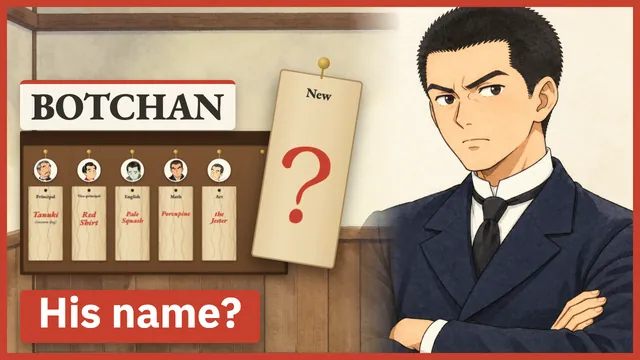
Lemon by Motojirō Kajii: Why Leave One Lemon in a Bookshop? | Classics in 5 Minutes #11
The story in brief
- A man weighed down by gloom buys one lemon, sets it on a pile of books in Maruzen, and walks out.
- After the gloom returns in the shop, he rebuilds the art books he dropped into a castle with the lemon on top.
- His rebuilt castle of books and his quiet exit leave readers asking why he left the lemon there at all.
Also calledLemon Kajii summaryLemon by Motojiro KajiiKajii Lemon plotLemon Kajii ending explainedRemon KajiiLemon Maruzen bomb
Video

Pressing play loads the YouTube player on this page. Watch on YouTube
Explained
In the video
- 0:00Why leave a lemon at Maruzen?
- 0:37When loved things feel heavy
- 1:19One lemon from a Teramachi fruit shop
- 1:48Cool, fragrant, yellow — and “this weight”
- 2:33Inside Maruzen, the gloom returns
- 3:20Rebuilding the books into a castle
- 4:07Leaving the lemon and walking out
- 4:54Down Kyōgoku, and an answer
Lemon (Remon, 檸檬) is a very short Japanese story by Motojirō Kajii, first published in 1925. A man weighed down by a gloom he cannot name buys a single lemon, carries it into Maruzen — a Kyoto shop of books and art books — stacks the art books into a "castle," sets the lemon on top, and walks out. This guide follows it from beginning to end.
Spoilers: this page covers the ending. Quotations are our own short translations from the Japanese text on Aozora Bunko. The story has no chapters, so we point to places by where they fall in the story.
The story in 30 seconds
The narrator's heart is pressed down by an ominous lump, and the music and poetry he once loved have become unbearable. One morning he wanders the streets of Kyoto and buys one lemon at a fruit shop. From the moment he holds it, the lump eases somewhat. Its coolness, scent, and color make him happy.
Then he walks into Maruzen, a shop he used to love, and the happiness slips away. He pulls out art books, opens them, and drops them in a heap. Remembering the lemon in his kimono sleeve, he rebuilds the books into a castle of colors and sets the lemon on top. A second idea follows: leave it there and walk out. Outside, he daydreams that the lemon is a bomb that will blow the shop sky-high — and walks on down Kyōgoku, a street brightened by painted movie signboards.
Who and where
- The narrator ("I"): The story never gives his name. He drifts from one friend's lodging to another, has no money, and often runs a fever. We treat him as the character in the text, not as the author.
- The fruit shop on Teramachi Street: His favorite shop in Kyoto. Fruit sits on a steep, old, black-lacquered stand. That day it has lemons, which he had rarely seen there.
- Maruzen: In the story, a shop of books and art books that also sells perfume bottles, pipes, small knives, soap, and tobacco. It was once his favorite place; now it feels heavy and oppressive.
What happens, step by step
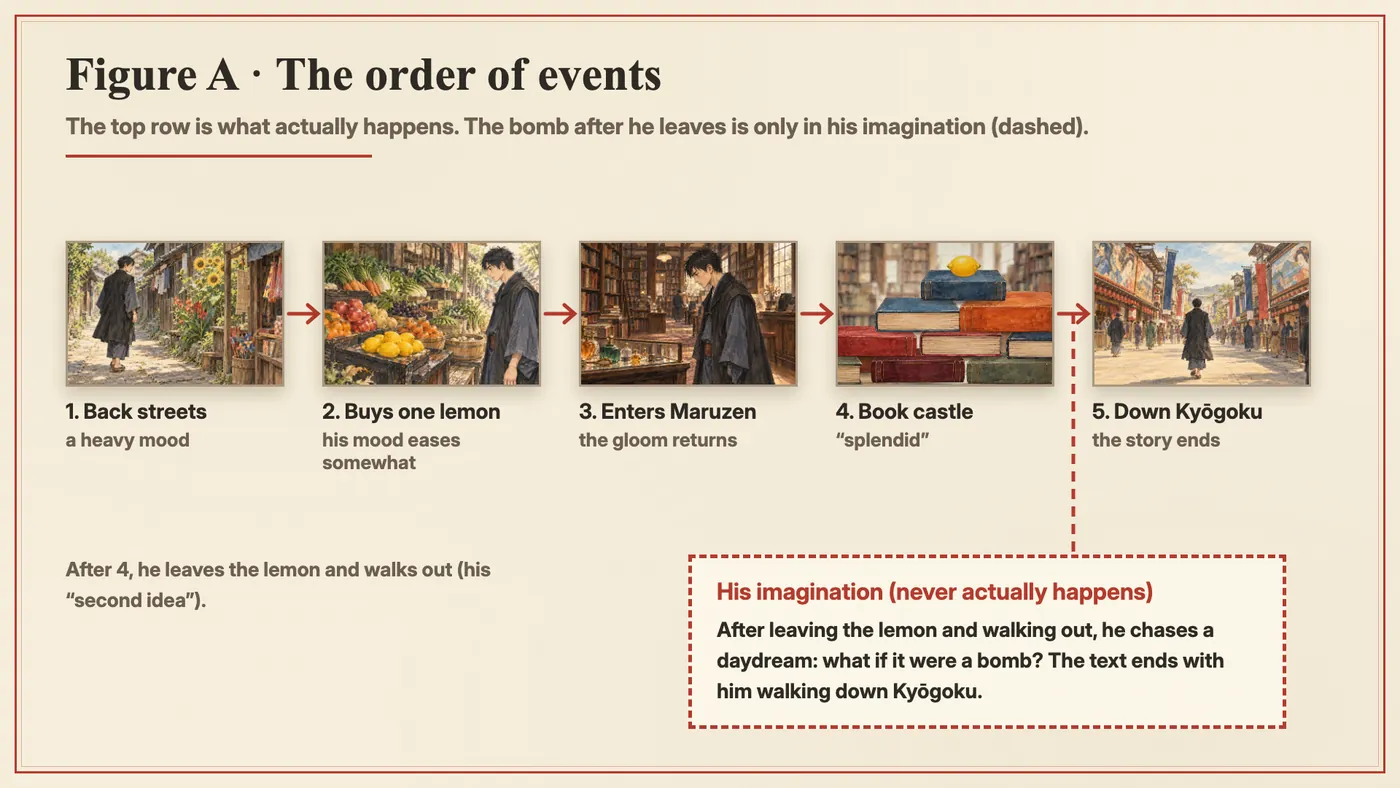
Figure A. The top row is what actually happens. The bomb after he leaves exists only in his imagination (dashed).
The weight, and the back streets
The story opens with "an ominous lump I couldn't name" pressing on the narrator's heart. Notably, the text lists a lung ailment, nervous exhaustion, and burning debts — and then says those are not what is wrong. What is wrong is the lump itself.
Music and poetry he once loved have become unbearable. Yet he is still drawn to things that are shabby and beautiful: back streets with crumbling earthen walls, leaning houses, and sunflowers and cannas growing wild. He likes cheap fireworks wrapped in red, purple, yellow, and blue stripes, and marbles of colored glass. With no money, he is comforted by small, beautiful luxuries that cost "two or three sen" (tiny coins). That phrase is not the price of the lemon.
The fruit shop, and the lemon in his palm
One morning, after his friend leaves for school, he is left alone in the empty lodging. Something drives him back out, and he drifts down Teramachi Street toward Nijō and stops at the fruit shop. The narrator pauses to describe it: fruit piled on a steep black stand, vegetables stacked higher toward the back, beautiful carrot leaves. He also describes how lovely the shop looks at night, lit by bare bulbs in a dark corner of a bright street — but that is a description of the shop. He buys the lemon that same day, the day that began "one morning."
He loves the lemon's simple yellow, "like lemon-yellow paint squeezed from a tube and hardened," and its short, spindle shape. He buys just one. From the moment he grips it, the lump that has pressed on him "seems to ease somewhat," and out on the street he is very happy.
At Maruzen, the gloom comes back
Wandering who knows where, he ends up in front of Maruzen. Today, for once, it feels easy to go in.
Inside, the happy feeling slowly drains away. The perfume bottles and pipes do nothing for him; gloom settles in. At the art-book shelves, he pulls out heavy volumes one by one, opens them, flips through them — and cannot bring himself to turn the pages properly. He sets each one down and cannot even put it back. At last he even drops a heavy orange book of Ingres, the French painter — a book he had always loved. He stands staring at the heap of books he has pulled out.
The book castle, and the second idea
Then he remembers the lemon in his kimono sleeve. Why not pile up the colors of the books, and try the lemon against them?
His light excitement returns. He stacks books at random, knocks them down, builds again, pulls out new ones, takes others away. Each time, "the strange, fantastic castle turned red, then blue." When it is finally done, he sets the lemon on top with great care.
"And it turned out splendidly." (no chapters; later part of the story, the end of the paragraph that begins "At last it was done")
To his eyes, the lemon seems to draw the clashing colors into its small spindle body and glow all the clearer. The dusty air feels strangely tense around it alone.
Then a second idea strikes him: leave it just like that, and walk out as if nothing had happened. The scheme startles even him. Feeling oddly tickled, he walks briskly out of the shop.
The ending: did Maruzen explode?
No. The order in the text is: he sets the lemon on top of the books, leaves it, walks out, and then imagines.
On the street, he catches himself smiling. What if he were a strange villain who had planted a terrible, golden bomb on Maruzen's shelves — and in ten minutes the whole shop blew up, art shelves first? How fun that would be. This is a what if, and the text says so plainly:
"I chased this fantasy eagerly." (no chapters; near the end, the paragraph that begins with this sentence)
The story ends with him walking down Kyōgoku, a street brightened by strange, painted movie signboards. Nothing tells us whether his illness, debts, or gloom are resolved.
Coolness, scent, color, and weight
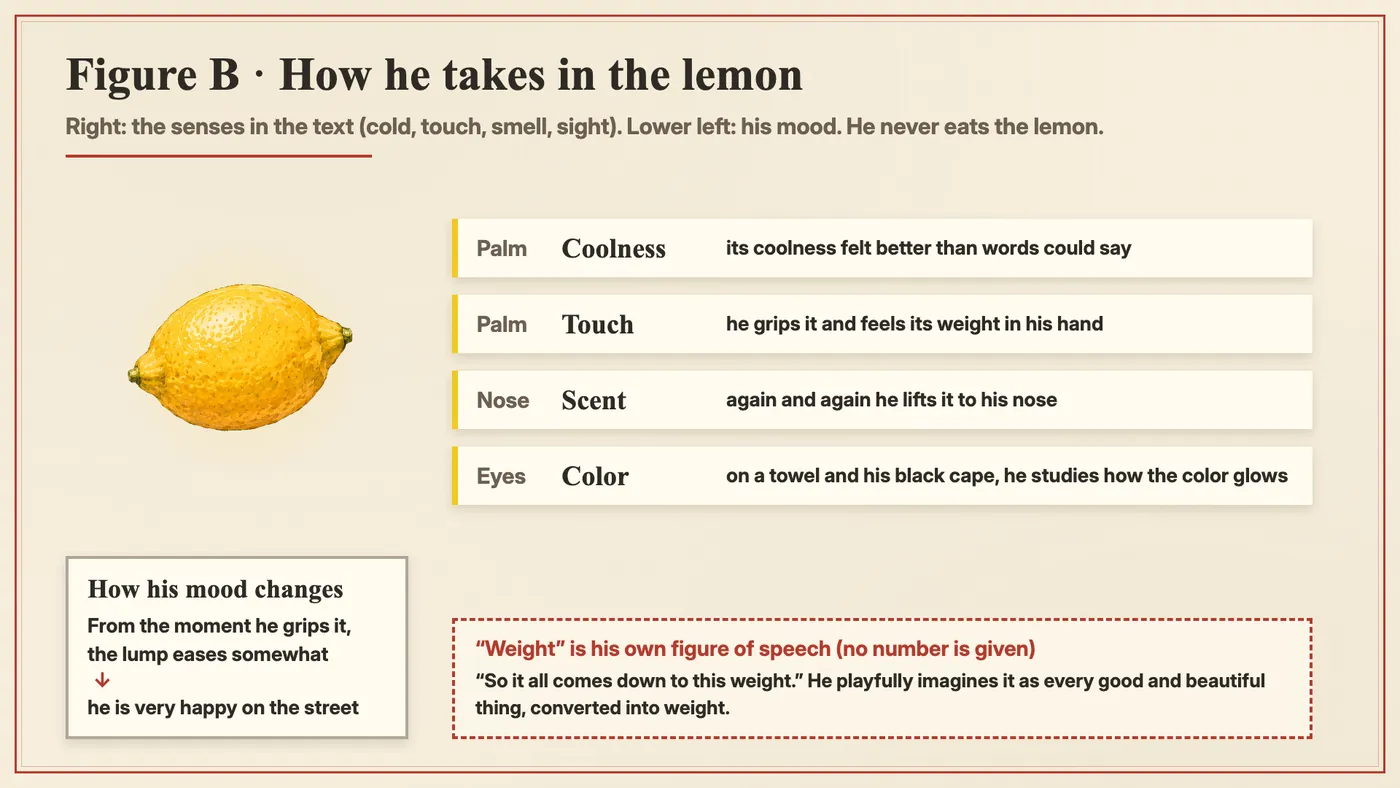
Figure B. The senses named in the text. His change of mood and the "weight" (his own figure of speech) each have their own box.
This is not a story about eating a lemon. He holds it, smells it, looks at it, and feels its weight.
- Coolness (palm): Its coolness "felt better than words could say." He often ran a fever, and his palms were hotter than any of his friends'; the cool seeped from his palm into his whole body.
- Scent (nose): He lifts it to his nose again and again. He pictures California, where it was grown, and breathes the scent deep into his chest until warm blood rises to his face.
- Color (eyes): He sets it on a dirty hand towel and against his black cape to see how the color glows.
- The text says these simple sensations of cold, touch, smell, and sight suited him so well it was as if he had been searching for them all along.
Then comes a single line, set apart as its own paragraph:
"So it all comes down to this weight." (no chapters; middle of the story, right after the paragraph about walking the street "bouncing with light excitement")
He playfully decides that this is the weight of every good and beautiful thing, converted into weight — and calls the thought silly himself. No number is ever given. The weight is a figure of speech, not a measurement.
When the same books become a castle
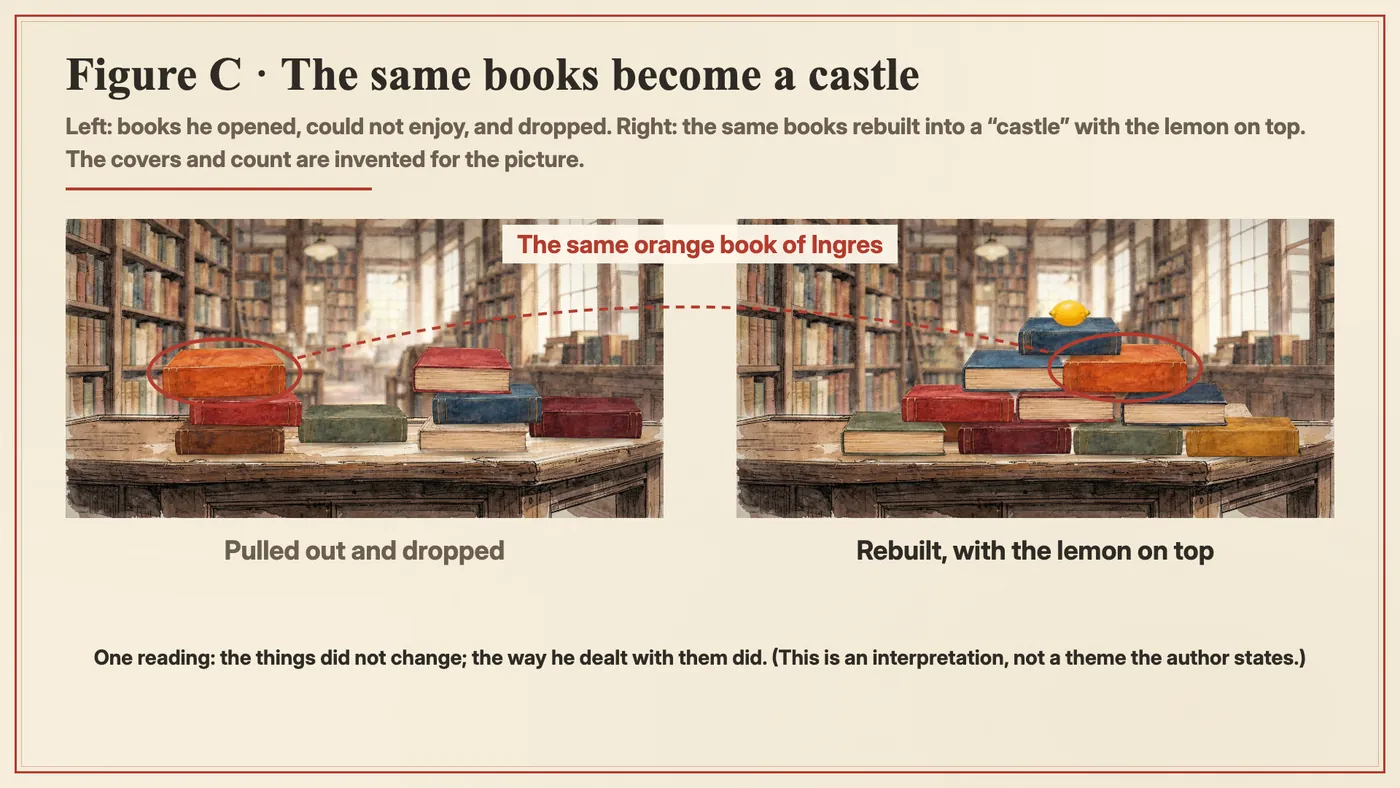
Figure C. Left: books he opened, could not enjoy, and dropped. Right: the same books rebuilt into a "castle" with the lemon on top. Covers and number of books are invented for the picture.
Look at what he does with the books at Maruzen, in two stages:
- Dropped books: He pulls them out, opens them, feels nothing, and leaves them where they fall. Here the books only add to his gloom.
- Rebuilt books: The same books, now stacked for their colors, knocked down, added to, taken away — until the castle is "splendid" with the lemon on top.
The books themselves never change. What changes is how he deals with them. Beyond feeling the lemon's coolness and color, arranging things and seeing them as something else seems to change his relationship to the weight he carries — or at least, the story can be read that way. This is one possible reading, not a theme the author spells out, and there is no need to decide that the lemon "stands for" one single thing.
Frequently asked questions
Why does he leave the lemon at Maruzen?
Follow the order in the text. First he wants to try the lemon among the colors of the books, so he builds them up and sets it on top. The arrangement turns out "splendidly." Only then does a second idea come to him: leave it there and walk out. The story does not say he bought the lemon planning to play bomb.
Does Maruzen really explode at the end?
No. The explosion is his daydream — "what if it were a bomb?" — and the text calls it "this fantasy." The story ends with him walking down Kyōgoku.
Does the lemon cure his gloom?
No. Holding it, the lump "eases somewhat," and he is happy for a while. Inside Maruzen the gloom returns. The story never says his illness or troubles are resolved.
What is Maruzen?
In the story, a shop of books and art books that also sells goods such as perfume bottles and pipes. In better days, the narrator would spend nearly an hour there just looking, then treat himself to one good pencil.
How much did the lemon cost, and how heavy was it?
The story gives neither. The "two or three sen" mentioned early on are about small comforting luxuries, not the lemon. The "weight" is his playful idea, not a number.
Read the original
Lemon is short and has no chapters. The full text is free on Aozora Bunko, Japan's public-domain library.
Read the original in Japanese (free) on Aozora Bunko
Note: this link is the Japanese original, not an English translation. The quotations on this page are our own translations. If you read Japanese, look for these spots: the lemon's coolness (「その檸檬の冷たさは」), the gloom inside Maruzen (「しかしどうしたことだろう」), and the moment he remembers the lemon (「あ、そうだそうだ」).
Sources
Where the facts and numbers in the video and on this page come from.
References
- First published in the magazine Aozora, first issue (Aozora-sha, January 1925).
- Base edition: Remon / Aru kokoro no fūkei hoka nijippen (Ōbunsha Bunko, 1972; 4th printing 1974). Transcribed by j.utiyama; proofread by Eiji Noguchi (Aozora Bunko).
- The summary, figures, translations of short quotations, and the suggested reading are Tamelabo's own work. No existing English translation was used.
Links
- Motojirō Kajii, "Remon" (Lemon), Aozora Bunko work ID 424, modern orthography (in Japanese)aozora.gr.jp/cards/000074/files/424_19826.html
- Aozora Bunko library card (in Japanese)aozora.gr.jp/cards/000074/card424.html
Voice, music, art
- Voice: Kokoro (synthetic speech)
- Music (OpenTracks): “茶屋にて” by MATSU / “縁側” by siroimu / “百花繚乱” / “藁の記憶”
- Sound effects: synthesized by Tamelabo in code
- Fonts: Shippori Mincho, IBM Plex Sans JP, M PLUS Rounded 1c, Source Serif 4, Inter (SIL Open Font License 1.1)