How Far Can You Trust Your Eyes on Direction? | Illusion Lab #10
How it works
- The cube’s lines stay fixed; the moving silhouette can fit opposite 3D rotations.
- Sparse depth cues leave ambiguity; researchers study attention and adaptation in perceptual switching.
- Overlay a dashed copy of the cube’s lines, then compare independently projected silhouettes at the same moment.
Also calledNecker cuberotating silhouette illusionspinning figure illusiondepth reversal
Video

Pressing play loads the YouTube player on this page. Watch on YouTube
Try it
Explained
In the video
- 0:00Which face of the cube is nearer?
- 0:11Checking the original lines
- 0:41Which way does the silhouette turn?
- 1:11Adding depth cues
- 1:49Overlaying silhouettes from opposite rotations
- 2:29Geometry and perceptual switching
- 3:13Looking at the silhouette alone again
- 3:27Try the direction experiments yourself
- 3:52Closing and where to try more
Which face of the Necker cube is nearer?
Look at this wireframe cube for a moment. Does the lower left face seem to be in front, or the upper right?
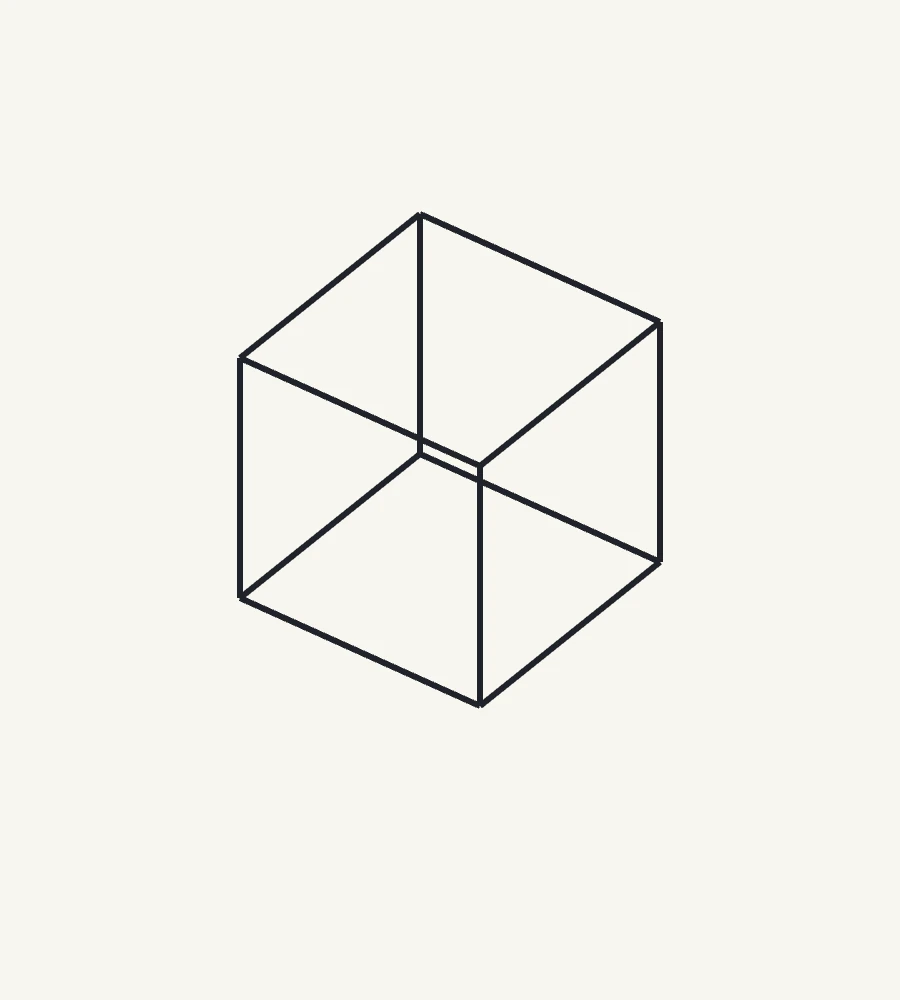
The perceived depth can reverse while you look. Here, “reverse” means that your interpretation of near and far changes. It does not mean flipping the screen upside down. It is also fine to see only one view, or simply a flat arrangement of lines. Making perception switch is not the goal of this experiment.
The Necker cube is an optical illusion named after Louis Albert Necker. In 1832, Necker reported changing depth interpretations of a drawing of a crystal. His original figure was a rhomboid, rather than today’s familiar cube. Gregory’s 1968 paper distinguishes the two. This historical account follows Gregory’s public text; it is not a direct quotation from Necker’s original paper. Gregory (1968)
The lines stay fixed
We can trace the original lines in blue and overlay the dashed copy on the current drawing. The small blue circles check the vertices.
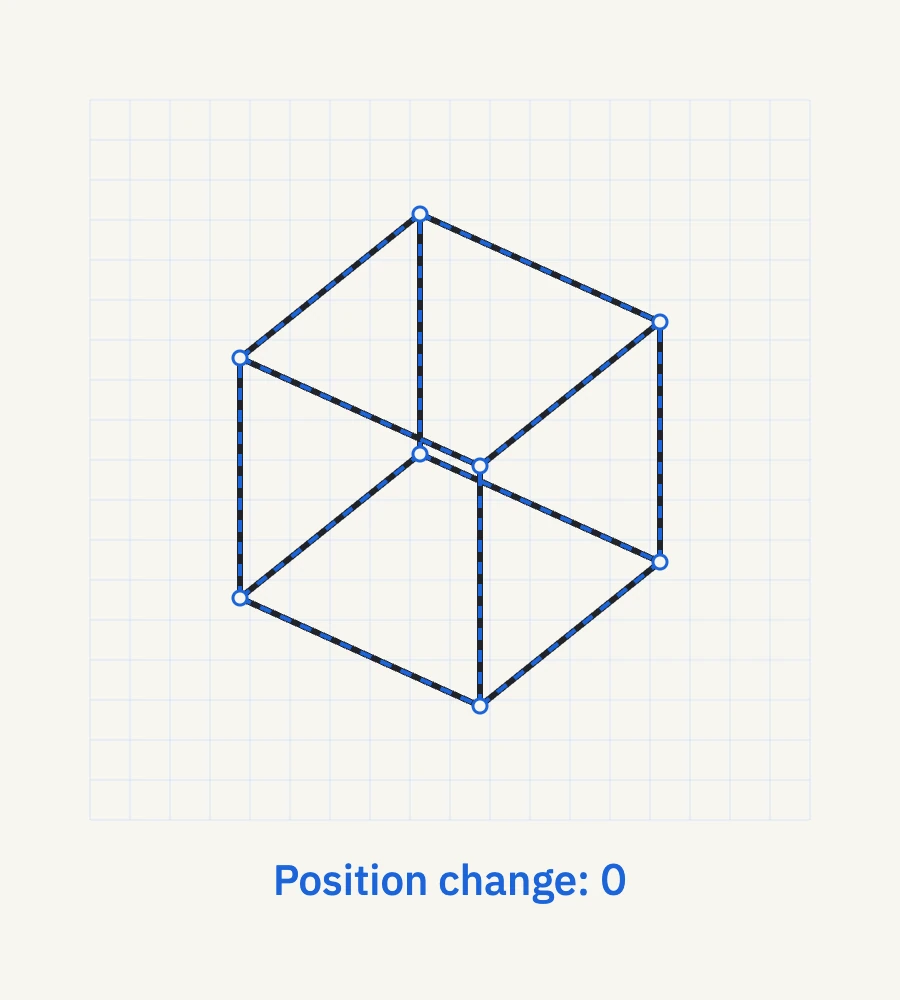
The original drawing has eight vertices and twelve edges. Neither their positions nor the camera depend on time. Adding the blue layer does not move the black lines. “Position change: 0” describes the original coordinates. It does not identify one face as the uniquely correct front face.
Our construction starts with a true cube of side length 300 in internal diagram units. We project it orthographically: distant parts are not made smaller. We then reflect its depth to construct another cube and project that cube independently. The maximum difference between corresponding screen coordinates is zero. Both cubes retain the same edge lengths within the calculation’s tolerance. These are diagram units, not screen pixels or physical inches.
The line drawing leaves the order of overlapping edges unresolved. More than one 3D depth interpretation can produce these lines. That is a geometric reason why another interpretation remains possible.
Can motion settle the direction?
Our next figure has a spherical head and smooth rod-like limbs. Removing the internal surfaces leaves a filled silhouette.

This image is one frame. In the interactive experiment, the silhouette really moves. The statement that the original drawing is static applies to the cube, not to the rotating figure.
The well-known spinning silhouette by Nobuyuki Kayahara was published in 2003, as discussed by Troje and McAdam in 2010. Their research examined the relationship between perceived rotation and viewing a figure from above or below. We use an original geometric figure rather than Kayahara’s artwork or model. The original study’s perceptual biases and response percentages are not measurements of our figure. Troje & McAdam (2010)
Pair opposite rotations with opposite viewpoints
Figure A is viewed from 12° above level; figure B from 12° below level. Viewed directly from above, A rotates clockwise and B counterclockwise. Both complete a turn in six seconds. Compare their silhouettes at the same moment and the same scale.
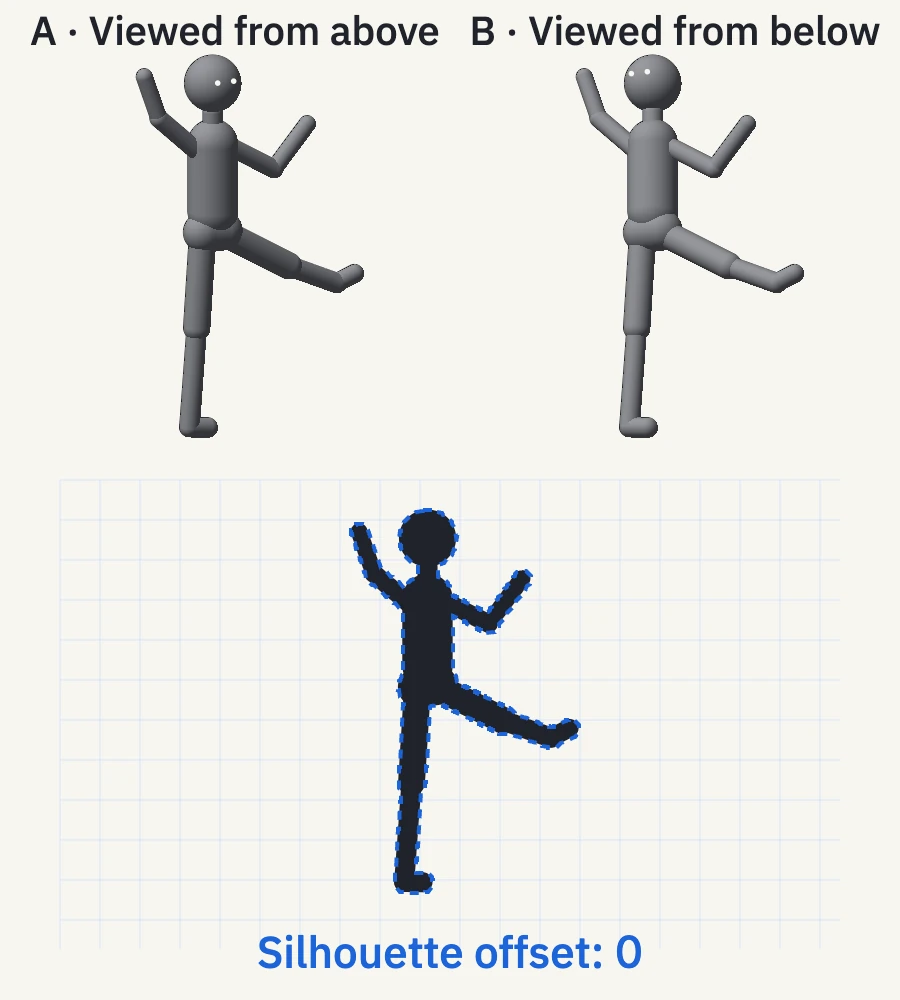
The figure is the union of one sphere and thirteen smooth capsules: rods with rounded ends. Its shape is symmetric from front to back. Under orthographic projection, reversing both the rotation angle and camera elevation maps corresponding front-to-back points to the same screen position, with opposite depths. The independently computed silhouettes therefore have matching outer contours and motion.
“Silhouette offset: 0” refers to this geometric match. It does not claim that the shading, face marks, or 3D depths are identical. Nor does it mean that silhouettes from different moments always match, or that every compressed video pixel has exactly the same RGB value.
Reversing rotation alone is not enough for an arbitrary model. Front-to-back symmetry, orthographic projection, and paired camera elevations are the conditions of this demonstration.
What changes when depth cues are added?
The boundary between an arm and the body can reveal which part is nearer. Face marks can suggest which way the head faces. These are examples of depth cues: clues to the ordering of parts in depth.
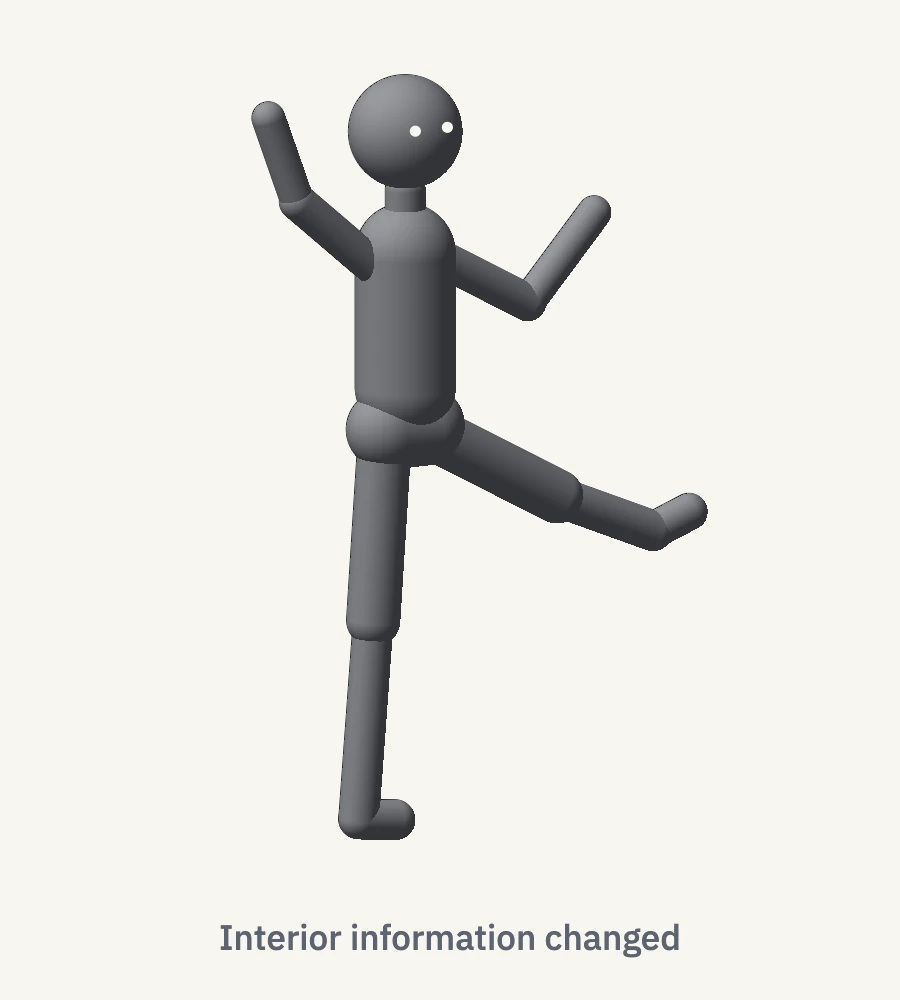
Adding these cues changes the picture’s interior while preserving its outer contour and speed at each moment. A change in perception after that operation should be distinguished from a spontaneous change while the stimulus stays the same.
Ward and Scholl’s 2015 experiments used brief internal occlusion cues to influence the perceived rotation of a silhouette. The gray surfaces and face marks here are a separate educational implementation. We do not reproduce their brief, difficult-to-notice cues, and we do not promise that adding cues will make everyone see a reversal. Ward & Scholl (2015)
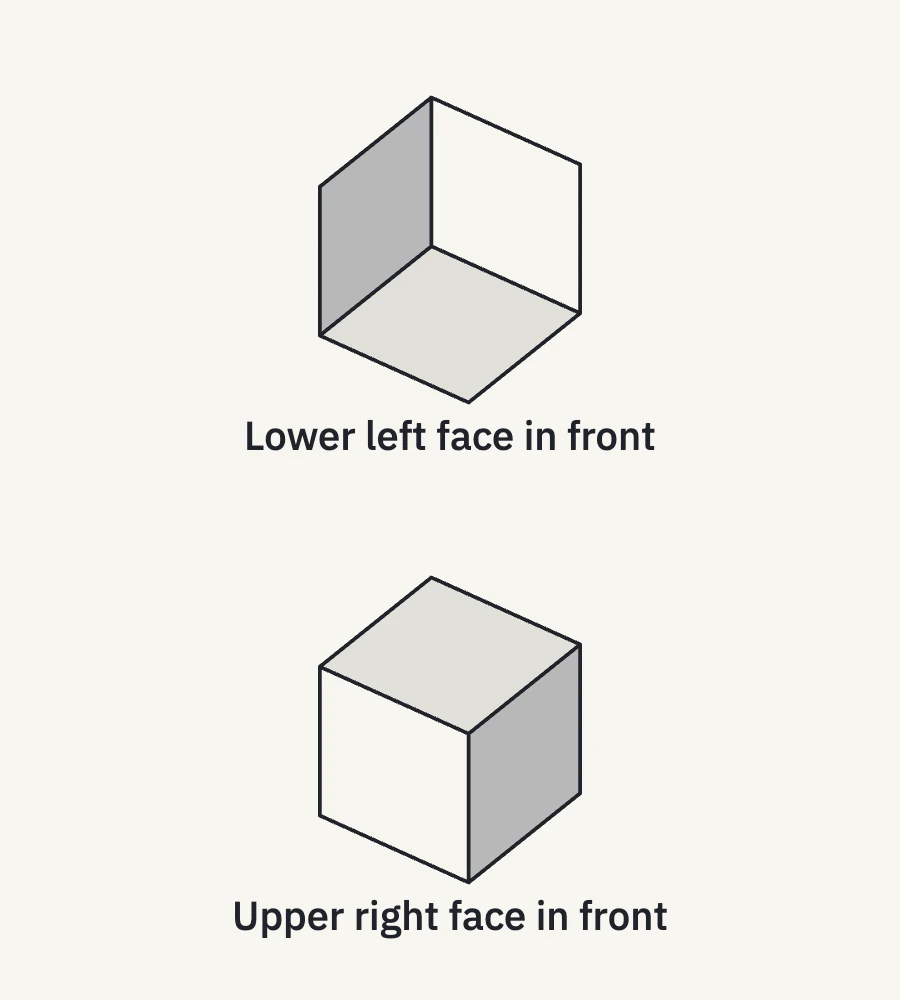
Opaque surfaces can also make one cube interpretation easier to read by hiding the appropriate edges. The vertices and camera remain fixed, but the drawn content changes.
Why does perception switch?
Geometry can establish that another depth interpretation is possible. Explaining when perception switches is a different task.
Attention can mean treating one face as nearer, rather than the other. Kornmeier, Hein, and Bach’s 2009 study found roles for both observers’ intentions and stimulus presentation conditions. Our experiment does not reproduce their intermittent presentation method or require you to intentionally reverse the view. Kornmeier et al. (2009)
Another proposed process is adaptation: a sustained interpretation can become less stable over time. Kornmeier and Bach’s 2012 review discusses an account combining stimulus-driven processes with influences such as attention and expectation. This is not a rule that everyone must switch after watching for a certain time. Kornmeier & Bach (2012)
Different moving displays need not switch through identical processes. Poom’s 2024 research compared spinning and wobbling shapes defined by moving dots. Those results cannot be transferred directly to this geometric figure. Whether one process alone explains a particular person’s switch at a particular moment remains unclear. Poom (2024)
Frequently asked questions
What if the view never flips for me?
That is fine. You can still check that different 3D figures produce matching silhouettes. No reversal is required, and your experience is not scored.
Is the silhouette secretly stationary?
No. The silhouette genuinely changes over time. The static original is the cube. For the figure, we check that the moving silhouette can leave the underlying 3D direction ambiguous.
Does choosing A or B change the picture?
Yes. It changes the internal surfaces and face marks. The outer contour at each moment and the motion speed stay the same. Changing camera elevation also changes the silhouette’s shape.
Does rotation reveal whether I am “left-brained” or “right-brained”?
This experiment provides no such assessment. It is not designed to diagnose personality, ability, eyesight, or health. A rotation response should not be treated as a diagnostic result.
Try changing the conditions yourself
Open Direction experiments. Start with Add depth cues, then return to Silhouette only. Next, try Overlay the two silhouettes to check the match without resizing them.
The presets change only elevation to 0° or only speed to 90°/s. At 0°, both camera views are level, while the physical rotations remain opposite. Setting cue strength to 0% shows only the silhouette even if A or B is selected. There is no universal threshold at which the illusion must disappear.
You can save conditions without choosing a percept. Notes stay on this device, can be deleted, and are not sent to a server. Settings links exclude your percept, notebook, and timestamps. If your device requests reduced motion, the figure starts paused. You can stop and take a break at any time.
Sources
Where the facts and numbers in the video and on this page come from.
References
- Troje & McAdam (2010), The viewing-from-above bias and the silhouette illusion
- Ward & Scholl (2015), Stochastic or Systematic?
- Kornmeier & Bach (2012), Ambiguous Figures
Links
- Author’s public textrichardgregory.org/papers/brainmodels/illusions-and-brain-…
- Kornmeier & Bach (2012) (; the original is not directly quoted here)frontiersin.org/journals/human-neuroscience/articles/10…
- doi:10.1068/i0408journals.sagepub.com/doi/10.1068/i0408
- Author-hosted paperperception.yale.edu/papers/15-Ward-Scholl-JEPHPP.pdf
- doi:10.1016/j.bandc.2008.06.005pubmed.ncbi.nlm.nih.gov/18682314
- doi:10.1371/journal.pone.0297963journals.plos.org/plosone/article
Voice, music, art
- Voice: Kokoro, af_bella (Bella, American English). Japanese version: Irodori-TTS, calm female narrator.
- Music (OpenTracks): "さみしいおばけと東京の月" by しゃろう; "日曜の午後" by KK.
- Sound effects: Kenney Interface Sounds (CC0). Air and movement sounds generated programmatically by Tamelabo.
- Fonts: IBM Plex Sans JP, IBM Plex Sans, Inter (SIL Open Font License). Thumbnails: M PLUS Rounded 1c ExtraBold (SIL Open Font License).