Gon, the Little Fox by Nankichi Niimi: What Does Hyoju See? | Classics in 5 Minutes #15
The story in brief
- A lonely fox called Gon tries to make amends by bringing food to the villager Hyoju.
- Hyoju discovers the giver only after he has shot Gon.
- The story asks us to consider the gap between a giver’s feelings and what another person can know.
Also calledGon the Little Fox summaryGongitsune endingNankichi Niimi Gon
Video

Pressing play loads the YouTube player on this page. Watch on YouTube
Explained
In the video
A little fox tries to make amends to a lonely villager. The food arrives, but the man never sees who brings it. Nankichi Niimi’s Gon, the Little Fox follows the painful distance between what someone does and what another person can know.
This article includes the full ending. It explains all six chapters, then separates the story’s events from possible interpretations. You do not need to know Japanese school lessons or folklore to follow it.
Our source is the modern-spelling Japanese text of Gongitsune (ごん狐), work 628 in Aozora Bunko, a free online library of Japanese texts. It is the same story introduced here as Gon, the Little Fox. Quotations below are our own translations of that Japanese text.
The story in half a minute
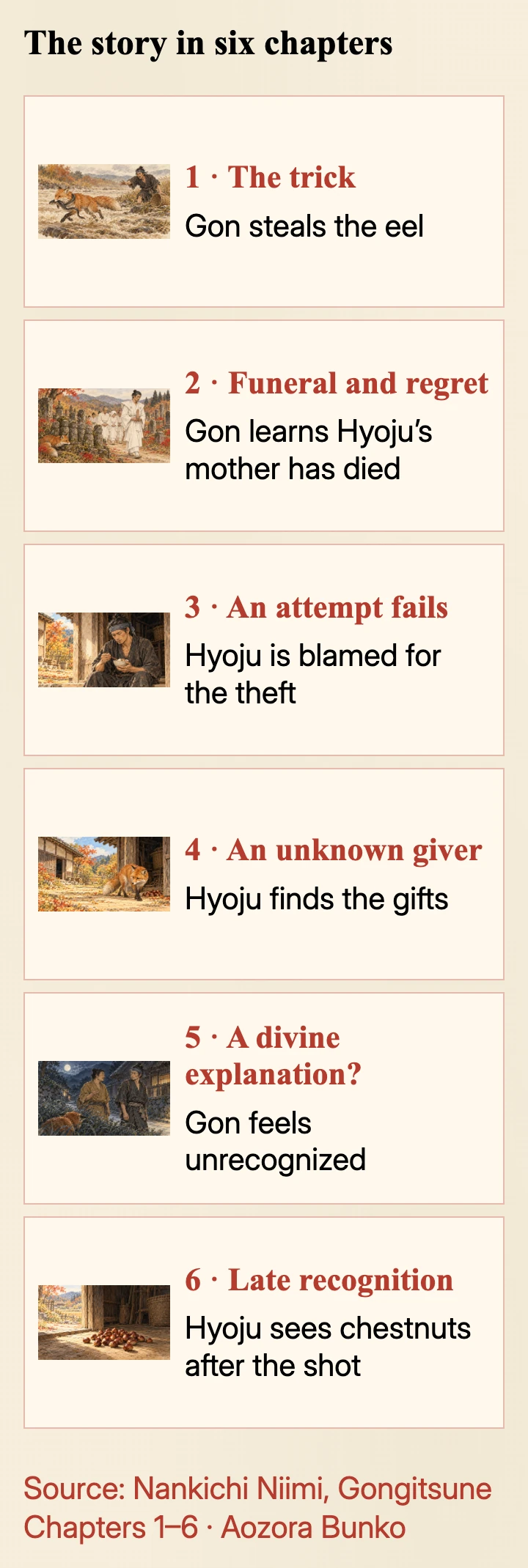
Gon is a little fox living alone in a forest den. After a rainstorm, he plays a trick on a villager named Hyoju: he throws the man’s catch back into the river and steals an eel. About ten days later, Gon sees the funeral of Hyoju’s mother. Imagining that she wanted the eel before she died, he bitterly regrets his trick.
Seeing that Hyoju is now as alone as he is, Gon begins bringing food to make amends. His first gift, stolen sardines, gets Hyoju mistaken for a thief. Gon then leaves chestnuts and sometimes mushrooms. Hyoju finds them but never discovers their source. One day, seeing Gon enter his house, he thinks the fox has come for more mischief and shoots him. Only afterward does he notice the chestnuts on the earthen floor. He asks whether Gon has been the giver. The fallen fox nods with his eyes closed. Hyoju drops his gun, and a thin trail of blue smoke rises from its muzzle. The story ends there.
The characters
- Gon is a small, solitary fox who repeatedly causes trouble in the village. Regret changes his behavior, but his attempts to help remain imperfect.
- Hyoju is a poor villager who lives with his mother until her death. He receives the gifts without knowing their giver.
- Kasuke is a farmer who walks with Hyoju one moonlit evening. He confidently offers a divine explanation for the gifts.
Hyoju’s mother matters profoundly to the plot, yet the text does not describe her final illness or give a cause of death. Gon’s solitude is stated, but the story does not explain what happened to his parents. The adult appearance and details of clothing in our illustrations are production choices, not stated ages or historical findings.
The opening also has a storytelling frame: the narrator says that he heard this tale as a child from an old villager named Mohei. That frame is not a claim that Niimi personally witnessed the events.
The six chapters
Chapter One: The stolen eel
After several rainy days, Gon comes out of his den into an autumn landscape. The river is swollen and muddy, with reeds pressed sideways by the current. Hyoju is standing in the water, using a fishing net. His catch goes into a fish basket on the bank.
When Hyoju leaves the basket unattended, Gon takes out the fish and throws them downstream. He cannot grasp the slippery eel, so he takes its head in his mouth. The eel coils around his neck just as Hyoju returns and shouts at the thieving fox. Gon flees with it still wrapped around him. Later he bites through its head to get it off.
This is not an animal-rescue episode: Gon takes away the result of Hyoju’s work. The incident also establishes the information Hyoju will carry into the final chapter. To him, Gon is the fox who stole his eel.
Chapter Two: A funeral and an imagined loss
About ten days later, Gon notices a crowd at Hyoju’s home and realizes there is a funeral. He hides behind six Jizo figures, stone statues by the graves, and watches the procession approach. The mourners in this story wear white. Hyoju wears formal white mourning clothes and carries a memorial tablet for his mother, a wooden tablet used to remember the person who has died. Red spider lilies grow in the graveyard, and some are trampled as the procession passes.
That night, alone in his den, Gon imagines why Hyoju had been fishing. Perhaps his mother had wanted eel. Perhaps Gon’s theft meant she died without tasting it. He wishes he had not played the trick.
The distinction matters: these thoughts belong to Gon. The text does not confirm that the mother asked for eel, nor does it establish a connection between the missing eel and her death. Gon’s remorse is real within the story; the imagined explanation for the death is not independently established.
Chapter Three: Helping makes things worse
Gon watches Hyoju washing barley at a red well. Hyoju formerly lived with his mother in poverty, and now he is alone. Gon recognizes something of his own life in him:
“Hyoju is all alone, just like me.” Nankichi Niimi, Gongitsune, Chapter Three. Our translation.
Hearing a sardine seller, Gon runs toward the lane. While the seller is inside a customer’s house, he steals fish from the basket, takes them back, and throws them into Hyoju’s home. He believes he has done something good to make up for the eel.
The following day, he gathers chestnuts in the hills and returns. Hyoju is eating, but there is a scratch on his cheek. He mutters that the sardines made the seller think he was the thief, and that the seller treated him badly. Gon realizes his gift has brought Hyoju more trouble.
The story gives us the injury and Hyoju’s account afterward; it does not stage a scene in which Gon witnesses the attack. Quietly, Gon goes around to the storage shed and leaves the chestnuts at its entrance. He continues bringing chestnuts and, on another occasion, matsutake mushrooms. The text identifies the hills as the source of the chestnuts. It does not say where he obtained the mushrooms.
Chapter Four: Hyoju knows about the gifts
One moonlit evening, Gon hides beside a narrow path and overhears Hyoju talking to Kasuke. Hyoju describes the chestnuts and mushrooms that someone has been leaving since his mother died. Asked who it is, he says he cannot tell: the gifts appear while he is unaware.
The food has reached him. He notices it, talks about it, and offers to show Kasuke the chestnuts. What has not reached him is the giver’s identity.
Gon follows the men. Kasuke turns around, making the fox shrink back, but does not notice him. The men go into a house for a Buddhist prayer gathering. Gon waits by the well outside. The warm paper windows, a monk’s silhouette, and a wooden prayer percussion instrument locate the gathering without turning it into a different religious ceremony.
Chapter Five: A confident explanation, and disappointment
On the way home, Kasuke insists that the gifts must be a god’s doing. He says a god must pity Hyoju now that he is alone. Hyoju is surprised and wonders whether this could be so. Kasuke insists again and recommends giving thanks every day. Hyoju agrees.
This is Kasuke’s explanation, stated with conviction. The narrator does not confirm that a god has intervened, and the story does not identify a particular deity as the source of the gifts.
Gon feels it is unfair. He has been carrying the chestnuts and mushrooms, but the thanks will go to a god. That response complicates any picture of him as a perfectly selfless benefactor. He cares about Hyoju, yet he also wants his own actions to be recognized.
Chapter Six: Seeing the fox before seeing the chestnuts
Even after that disappointment, Gon brings more chestnuts the next day. Hyoju is twisting rope in the storage shed. Gon quietly enters the house through the rear doorway.
Hyoju looks up and sees him. The sight brings back the earlier theft: the fox who took the eel must have come for more mischief. He takes a matchlock gun, an old gun fired using gunpowder and a burning match cord, from the barn and loads it. He approaches quietly and shoots Gon as the fox is leaving the doorway.
Gon falls. Hyoju runs over. Looking into the house, he sees the chestnuts piled on the earthen floor just inside the doorway. Only then does the connection become visible to him.
The ending: recognition comes after the shot
The sequence is the heart of the ending: the shot, the fallen fox, the chestnuts, the question, the nod, the dropped gun, the smoke. Hyoju does not recognize the giver and then shoot him. Recognition arrives after he has acted.
“Gon, was it you who kept bringing me the chestnuts?” Nankichi Niimi, Gongitsune, Chapter Six. Our translation.
Gon nods weakly with his eyes closed. Hyoju drops the matchlock. The final sentence describes blue smoke still rising thinly from the muzzle.
There is no later conversation, declaration of forgiveness, medical confirmation, burial, or account of Hyoju’s life afterward. The text also gives no basis for replacing the shooting with an explanation that Gon is merely asleep. We can attend to the terrible event and the response that follows without adding an unwritten sequel.
Two viewpoints on the same events
The following is a reading of the story, not a declaration of the author’s stated intention.
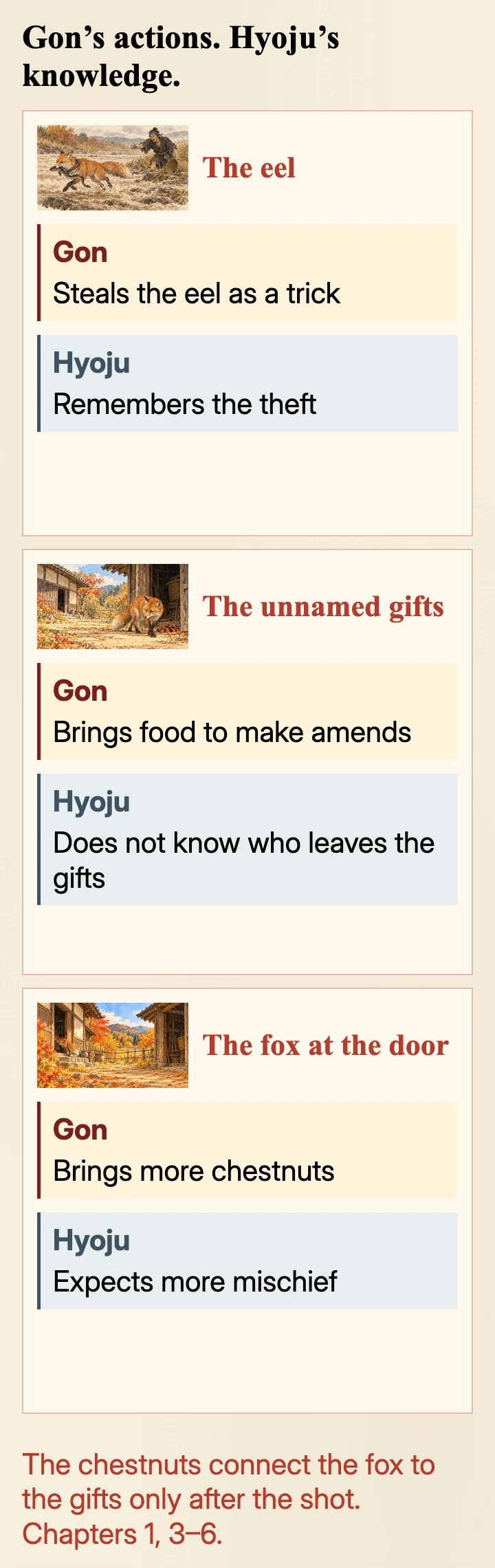
From Gon’s side, the events form a connected chain: mischief, regret, an attempted repayment, an unexpected failure, and repeated gifts. From Hyoju’s side, the theft and the mysterious food remain separate. When the fox enters the house, the older, harmful encounter supplies his explanation.
Readers have been allowed to follow Gon, so they bring knowledge to the doorway that Hyoju lacks. What they see as another delivery, Hyoju reads as another intrusion. The chestnuts reveal the missing connection only after the gun has been fired.
Saying that “nothing got through” loses a useful distinction. The gifts did arrive, and the ending contains both a question and an answering nod. The harder issue is what was received, what remained unknown, and how late recognition came.
Can Gon’s motives be reduced to one thing?
Chapter Two gives remorse. Chapter Three gives the thought that Hyoju is alone, just like Gon. Chapter Five gives resentment when someone else will receive the thanks. Chapter Six shows another visit despite that resentment.
One possible reading holds these feelings together: a wish to make amends, sympathy with another lonely being, and a desire to be recognized. None has to cancel the others. Calling Gon purely selfless overlooks his disappointment. Saying he only wanted praise overlooks the fact that he returns anyway.
The story does not explicitly answer why he never introduces himself as the giver. Nor does it tell us everything Hyoju thinks after discovering the chestnuts. Those gaps can support careful questions, but invented answers should not be presented as plot facts.
Frequently asked questions
Did Gon cause Hyoju’s mother to die?
The text does not give her cause of death. Gon imagines that she wanted eel and died without eating it, but this is his thought in the den. His guilt does not establish a medical or factual cause.
Why does Gon bring chestnuts?
He regrets stealing the eel and recognizes Hyoju’s new loneliness as like his own. These provide grounds for reading the deliveries as attempts to make amends and to help. His later wish for thanks adds another feeling without explaining away the others.
Why does Hyoju shoot Gon?
He recognizes the fox who stole his eel and thinks Gon has returned to cause trouble. He has not seen the deliveries and does not notice the chestnuts inside the house until after the shot.
What does Gon’s final nod mean?
It answers Hyoju’s immediately preceding question about who brought the chestnuts. The text does not describe the nod as forgiveness or tell us that Gon feels happy or at peace.
Does the story describe what happens to Gon afterward?
After he is shot and falls, he nods with his eyes closed. The story ends with Hyoju dropping the gun and blue smoke remaining at the muzzle. It does not narrate subsequent events.
Is the linked original available in English?
The Aozora Bunko link is the complete original in Japanese. This page supplies a full English plot summary and ending commentary. The Niimi Nankichi Memorial Museum link provides a short English synopsis; it is not presented here as a full translation.
Where to read next
- Full original text in Japanese — Gongitsune (ごん狐), Aozora Bunko. This is the same story introduced here as Gon, the Little Fox. The link opens at the beginning. In Chapter Six, look at where the chestnuts are found and what Hyoju does after the question. Chapters Four and Five let you revisit the conversation that precedes it.
- Bibliographic record — Aozora Bunko (in Japanese). First publication was in January 1932 in Akai Tori (Red Bird), a Japanese children’s literary magazine. The source edition used by Aozora Bunko is Niimi Nankichi Dōwashū from Iwanami Bunko, a Japanese paperback series published by Iwanami Shoten. Its spelling follows that edition; we do not claim it reproduces every feature of the first magazine printing or a manuscript.
- Short English synopsis — Niimi Nankichi Memorial Museum. This also supplies the English names used here. Our plot details and translations are based on the Japanese original, and we have not reproduced the museum’s prose or artwork.
The illustrated video at the top of this episode’s page follows the same events. Hyoju’s age appearance, his blue-gray headband outside the river scene, and the exact arrangement of the buildings are visual production choices. Story: Nankichi Niimi. Japanese source: Aozora Bunko. English summary, translations, and diagrams: Tamelabo.
Sources
Where the facts and numbers in the video and on this page come from.
- Full original text in Japanese — Gongitsune (ごん狐), Aozora Bunkoaozora.gr.jp/cards/000121/files/628_14895.html
- Bibliographic record — Aozora Bunko (in Japanese)aozora.gr.jp/cards/000121/card628.html
- Short English synopsis — Niimi Nankichi Memorial Museumnankichi.gr.jp/English/englishpage.html
Voice, music, art
- Voices: Japanese — Irodori-TTS (selected meisaku narrator); English — Kokoro (bm_fable).
- Music (OpenTracks): “茶屋にて” by MATSU; “縁側” by siroimu; “百花繚乱” and “藁の記憶” (artists not listed in the supplied catalog).
- Fonts: Shippori Mincho, IBM Plex Sans JP, Source Serif 4, Inter, M PLUS Rounded 1c (SIL Open Font License).