How Does a Refrigerator Make Things Cold? | How It Works Inside #03
Short answer
- The refrigerant carries heat out of the fridge interior and releases it into the room — that is why the back feels warm.
- It loops through the compressor, condenser, expansion device, and evaporator, changing state as it moves the heat.
- Where a fridge releases heat, and how much clearance it needs, varies by model — the diagrams are simplified illustrations.
Video

Pressing play loads the YouTube player on this page. Watch on YouTube
Explained
In the video
- 0:00Why is the back warm when the inside is cold?
- 0:30Where does the refrigerant go?
- 1:15What does the compressor do?
- 2:10What happens in the condenser?
- 3:10What does the expansion device do?
- 4:10What happens in the evaporator?
- 5:15How does heat travel from the fridge to the room?
- 6:10Can you cool a room by opening the door?
- 7:00Do all fridges release heat the same way?
- 7:40So, why is the back warm?
Why is the back of a fridge warm when the inside is cold? The fridge is moving heat from its interior into the room. The electrical energy used to run it eventually reaches the room as heat too. The warm surface is connected to the work of keeping the food compartment cold.
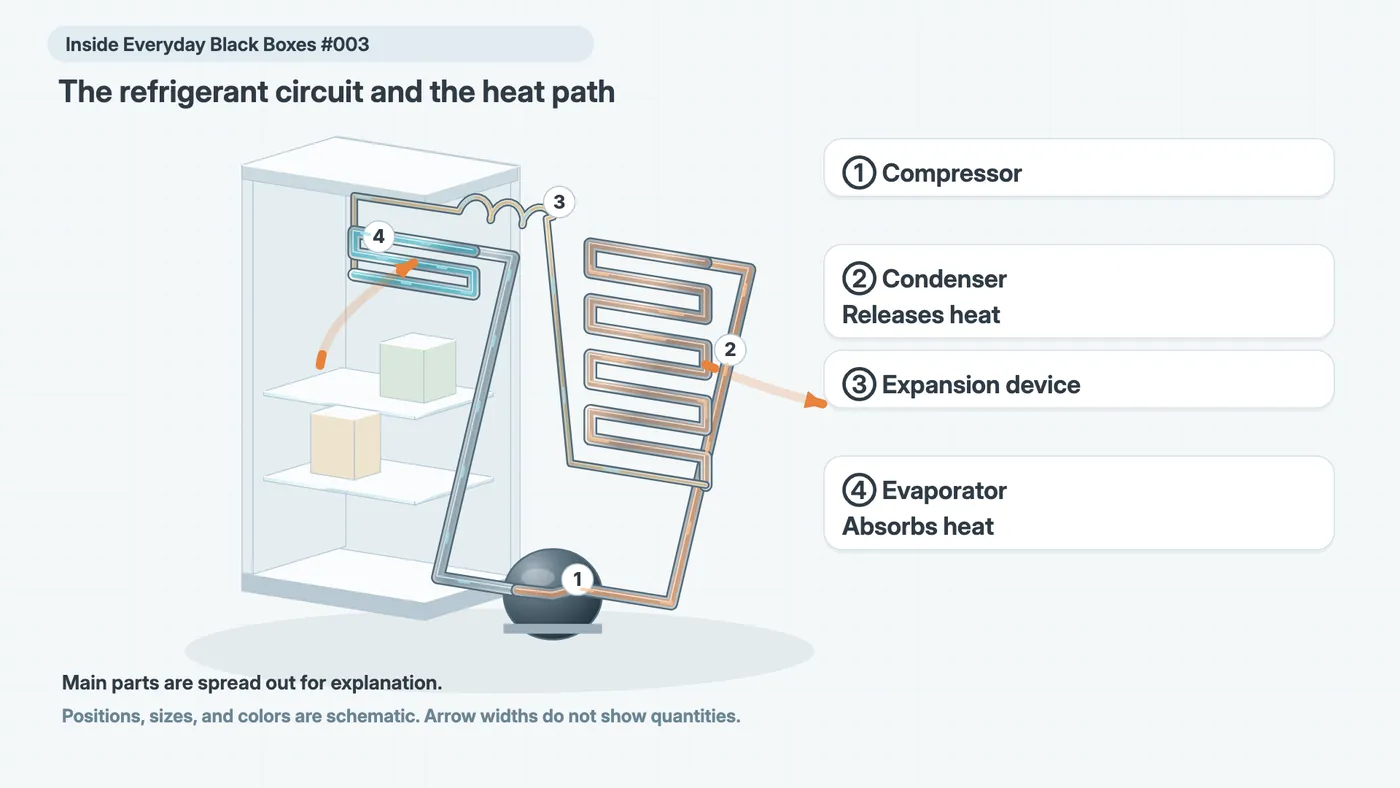
This article follows a typical compressor-based refrigeration circuit. The diagrams spread out the main parts for clarity, using a piston compressor and a capillary tube as examples. They are schematics, not drawings of a particular product: pipe positions, sizes, colors, and liquid–gas proportions are explanatory. Actual appliances may release heat through their sides, front, or other surfaces as well as the back.
The cooling circuit at a glance
Inside the sealed pipes is refrigerant, the fluid that carries energy through the system. A typical circuit takes it through four main parts:
- The compressor squeezes the gas, raising its pressure and temperature.
- The condenser passes heat to the room as the gas changes into liquid.
- The expansion device lowers the pressure, producing a cold mixture of liquid and gas.
- The evaporator absorbs heat from the fridge interior as the remaining liquid turns into gas.
The gas returns to the compressor and the process repeats. That repeating sequence is the refrigeration cycle. The refrigerant travels around a closed loop; energy removed from the food compartment is passed into the room as heat.
What the warm surface tells you
In this model, the rounded housing near the bottom contains the compressor. The winding pipe drawn away from the back is the condenser. A narrow section leads from there toward the evaporator, the pipe that takes in heat from the food compartment. The parts have been moved apart so their connections are visible.
The condenser is where refrigerant gives up heat to the room. Its warm pipe is part of the same circuit as the cold evaporator inside. Cooling the interior and warming the surroundings are connected stages of the process.
Your fridge may look different. Some models have heat-release pipes built into the sides or front, rather than an exposed rear coil. Warm pipes in the sides or between compartments can also help prevent condensation, meaning moisture forming on a surface. To compare an appliance with the diagram, follow the roles of the parts: where heat enters the circuit, and where it leaves.
Keep the refrigerant separate from the air
The air around the food and the refrigerant in the pipes follow separate paths. During normal operation, refrigerant stays in its sealed circuit. Even when it becomes gas, it continues along the pipe to another part of the system. It is not the air blown around the shelves.
Heat crosses the pipe wall without the two fluids mixing. At the condenser, the path is refrigerant → pipe wall → room air. At the evaporator, it is inside air → pipe wall → refrigerant. This lets the appliance take heat from one place and pass it to another while keeping the refrigerant contained.
Read the orange arrows as heat transfer. They do not show refrigerant escaping from a pipe. The thinner arrows indicate flow direction. Arrow widths, bubble sizes, and liquid levels help explain the process; they are not measurements of heat quantities or real flow patterns.
Follow the refrigerant through four parts
Two questions help at each stop: is the refrigerant liquid or gas, and is it on the high- or low-pressure side? Pressure describes how strongly the fluid pushes. Here, “high” and “low” compare different parts of the circuit, not the refrigerant with atmospheric pressure. Vapor means refrigerant in its gas state.
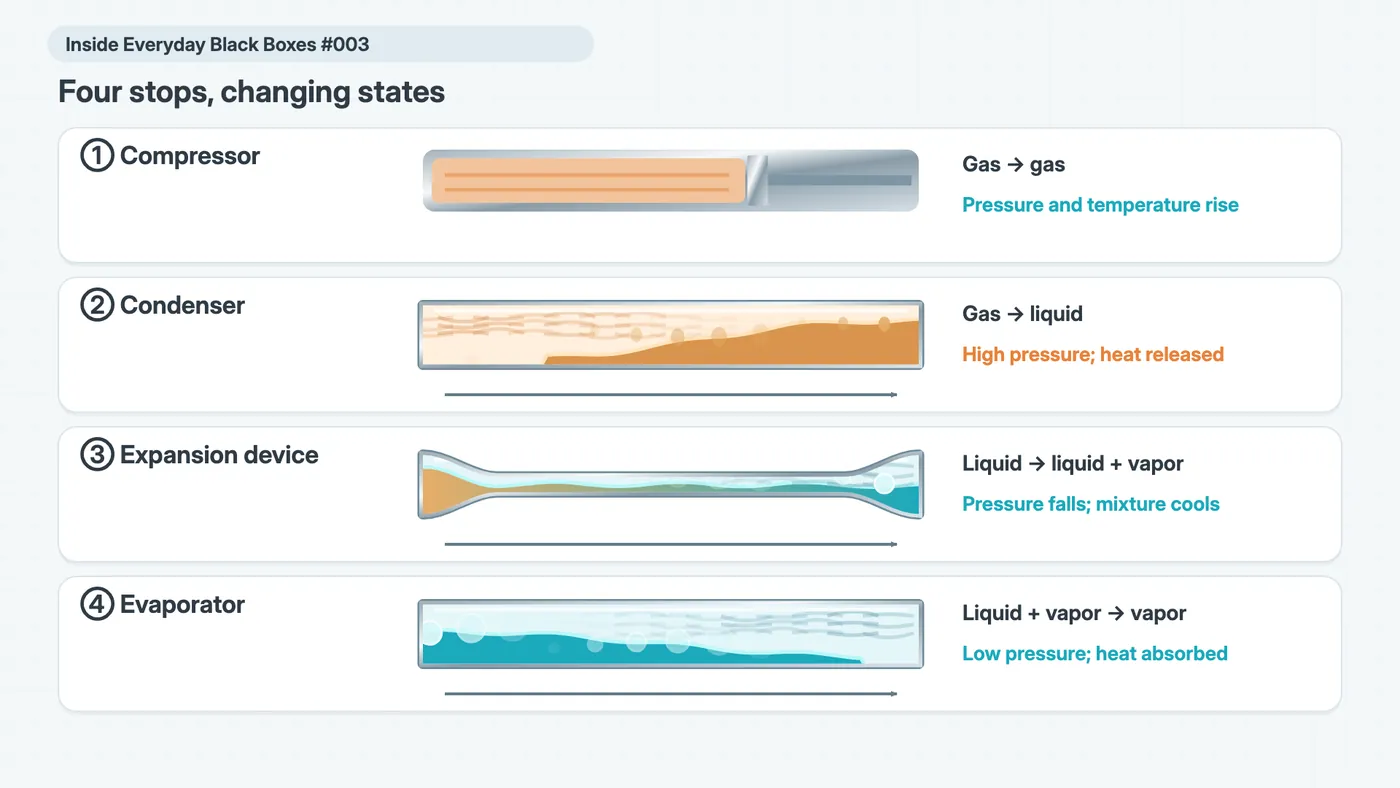
| Part | Entering | Leaving | Main change |
|---|---|---|---|
| 1. Compressor | Gas | Gas | Pressure and temperature rise |
| 2. Condenser | Gas | Liquid | Heat passes to the room |
| 3. Expansion device | Liquid | Liquid + vapor | Pressure falls; mixture cools |
| 4. Evaporator | Liquid + vapor | Vapor | Heat enters from inside |
These are the inlet and outlet states for normal operation of our model. The condenser is on the high-pressure side and the evaporator on the low-pressure side. Being gas or liquid does not, by itself, tell you which pressure side the refrigerant is on.
1. Compressor: make the gas hotter to help release heat
Gas returning from the evaporator enters the compressor. In our piston example, an electric motor moves a piston back and forth. As the piston pushes into a smaller space, it compresses the gas. Pressure rises, and so does temperature. The compressor also drives refrigerant around the circuit.
Heating something up may seem an odd step in cooling your food. But the next part has to pass heat to the surrounding room air. The refrigerant needs to be warmer than that air for heat to flow outward. Compression prepares it for that stage.
The key distinction is that the compressor still sends out gas. It does not turn the refrigerant into liquid just by squeezing it. That change happens in the condenser. The piston mechanism is one example used to make compression visible; it does not represent every compressor design.
2. Condenser: give up heat and return to liquid
The hot, high-pressure gas reaches the condenser. Because the refrigerant is warmer than the room air, heat passes outward through the pipe wall. As it releases heat, the refrigerant changes from gas to liquid. This change is called condensation.
Here is the connection to the warm back of the fridge: the room is receiving heat from the refrigerant. The fluid itself remains inside the pipe. At the outlet, our model has high-pressure liquid. Becoming liquid does not mean it is already cold enough to cool the food compartment. It still needs the pressure reduction at the next stage.
The diagram simplifies what happens along a real condenser. There can be sections where incoming gas cools before condensing, and where the resulting liquid cools further. The entire condenser is not necessarily at one temperature. Its central role here is releasing heat and returning the refrigerant to liquid.
3. Expansion device: lower the pressure while leaving some liquid
Our example uses a capillary tube, a long tube with a very narrow passage. It restricts refrigerant flow. During operation, that restriction and the compressor's action together maintain the difference between the high- and low-pressure parts of the circuit.
As pressure falls along the tube, some liquid turns into vapor. This evaporation cools the liquid that remains. The result is a cold liquid–vapor mixture, ready to enter the evaporator. Some liquid is still present; the expansion stage has not turned it all into gas.
The change should not be pictured as happening magically at a single point at the outlet. Pressure falls along the tube. Its enlarged shape in the diagram makes the process easier to see, but does not give an actual pipe diameter, length, or proportion of vapor to liquid.
4. Evaporator: use heat from inside to evaporate the remaining liquid
The refrigerant entering the evaporator is colder than the air in the fridge. Heat therefore passes from that air, through the pipe wall, into the refrigerant. As it absorbs heat, the remaining liquid changes into vapor. This liquid-to-gas change is evaporation.
The liquid left after the expansion stage gradually disappears. The inside air gives up heat and cools. In normal operation of this model, the refrigerant leaves the evaporator as gas and returns through the pipe to the compressor.
The condenser and evaporator both exchange heat across a pipe wall. What differs is the temperature relationship and the direction of transfer. The evaporator's refrigerant is colder than the inside air and receives heat. The condenser's refrigerant is warmer than the room and releases heat. Compression and pressure reduction connect those two jobs.
How can liquid boil in a cold fridge?
Bubbles may bring a boiling saucepan to mind, but boiling does not always mean a high temperature. The boiling temperature depends on the substance and its pressure. Refrigerant is used at a pressure that allows it to evaporate below the temperature of the fridge interior.
Absorbing energy does not always mean a continuing rise in temperature, either. While liquid evaporates, its temperature can stay nearly constant: the incoming energy goes into the change from liquid to gas.
Air that is already cold can still transfer heat to colder refrigerant. That relative temperature is what matters in the evaporator. Follow the arrow from inside air to refrigerant alongside the liquid-to-vapor change. This explanation depends on the refrigerant and its operating pressure; lowering the pressure does not make every substance reach the same temperature.
Electrical input joins the heat leaving the fridge
When the refrigerant completes a circuit, it returns to where it started. Energy taken from inside has meanwhile been passed to the room as heat. The energy supplied as electricity also eventually leaves the appliance as heat.
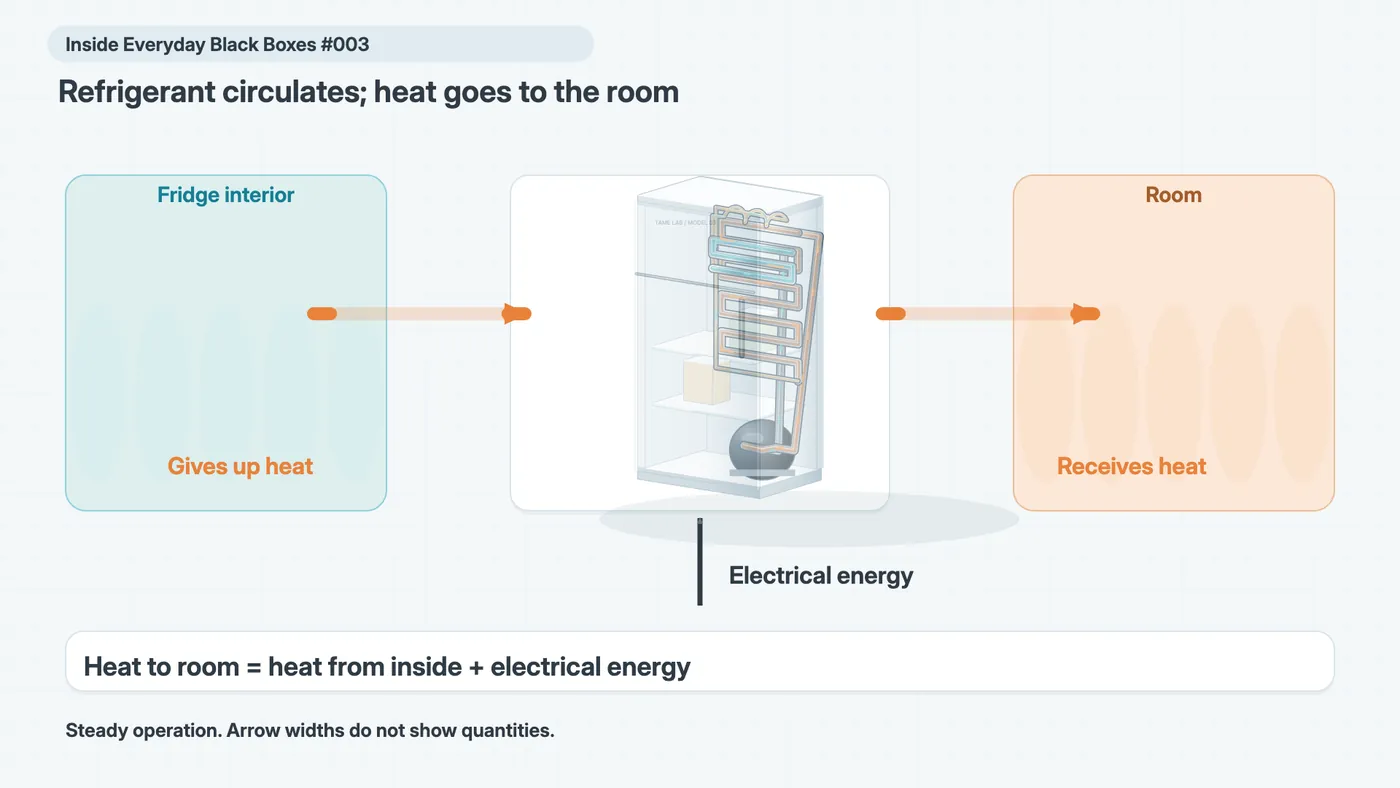
Heat to the room = heat removed from inside + electrical energy supplied
This is an energy balance: an accounting of energy entering and leaving over the same period. It applies to steady, repeating operation, with no net change in energy stored in the circuit after a complete cycle. When considering the whole appliance, include electrical input to fans and other loads as well as the compressor, including energy that becomes heat within the machinery.
Under these conditions, the room receives the energy taken from the interior plus the electrical input. The diagram shows their relationship, not a measured ratio. It does not specify an appliance's efficiency or power consumption.
Would leaving the door open cool the room?
Cold air may come out of the open door. To judge the effect on the whole room, keep the warm outlet in the picture too.
Imagine the fridge taking heat from the room through its open compartment, then releasing heat back into that same room. The returned heat includes the electrical energy used to run the machine. Subtract what the fridge took from the room from what it returned, and the electrical input remains.
Net energy added to the room = electrical energy supplied
This comparison assumes steady operation, with heat taken from and rejected into the same room. It excludes heat exchange through walls or with outdoors, and changes in energy stored in food or other contents that were already cold. It distinguishes a cold patch of air near the door from the energy balance of the room as a whole.
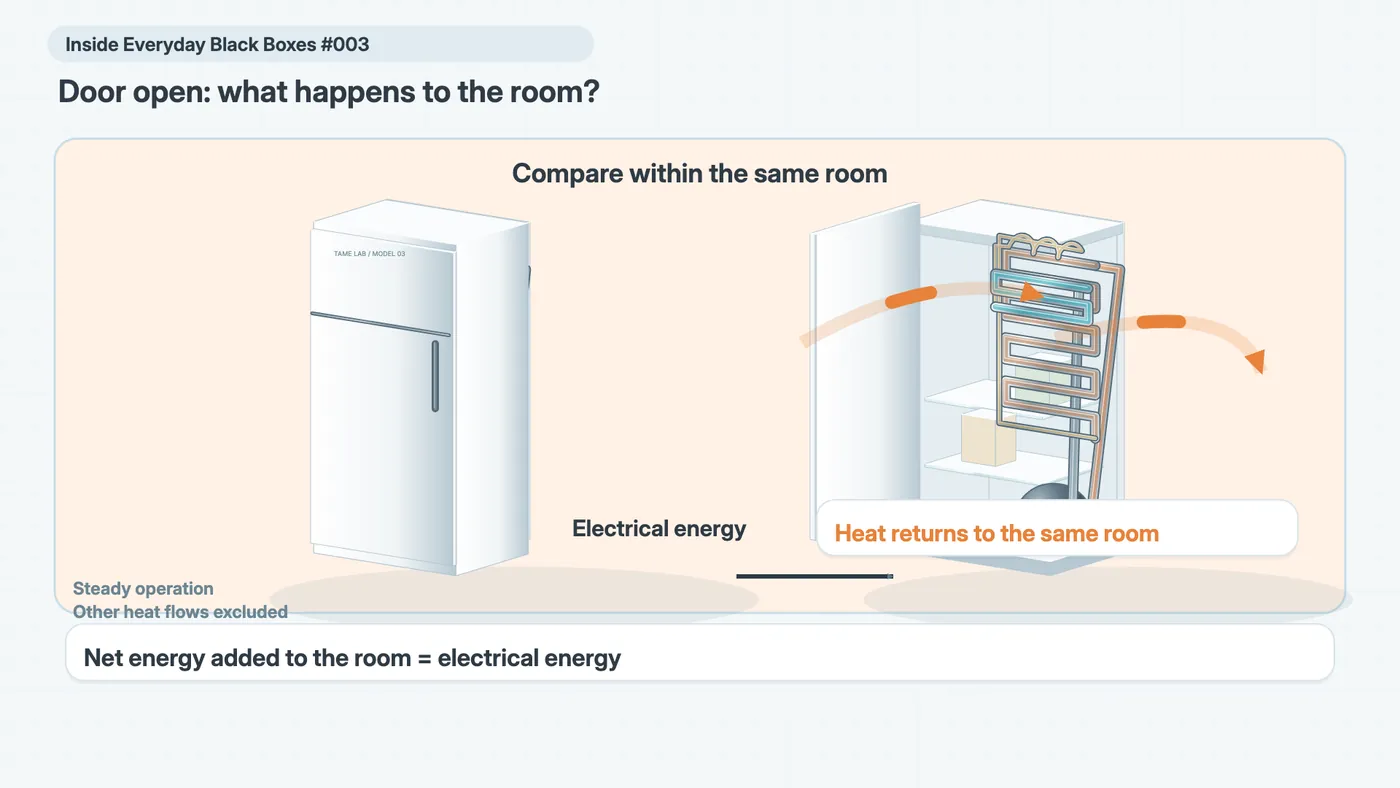
The result follows from the energy balance above. It does not tell us how many degrees the room temperature changes, or how fast. You can work through the question by drawing a boundary around both heat paths; there is no need to leave a real fridge door open as an experiment.
Air circulation and other design differences
Getting heat from the food compartment to the evaporator can involve different air paths. Some designs use natural air circulation. Others use a fan to send air cooled at the evaporator around the interior.
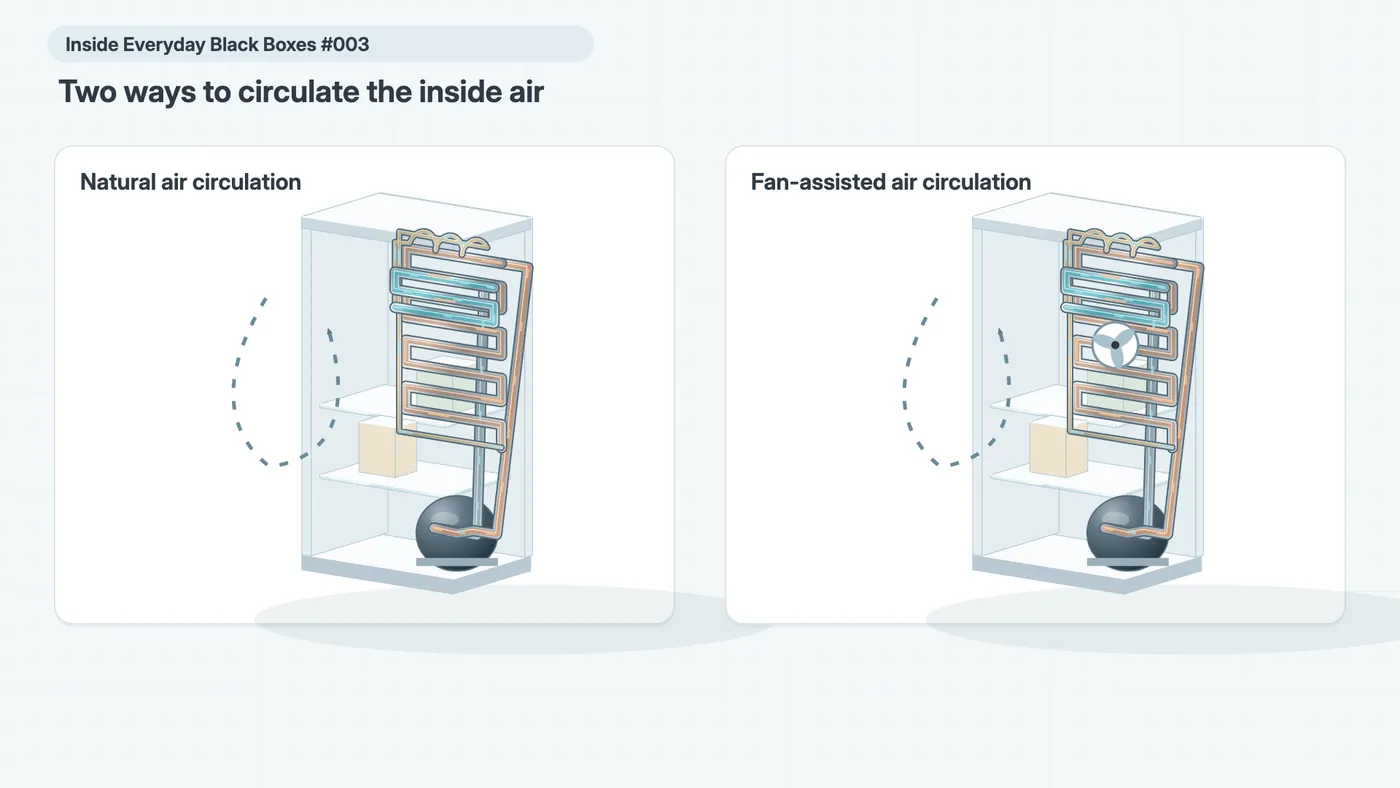
Both compressor-based examples shown here move heat out using refrigerant. The fan changes how the inside air circulates. Other refrigeration technologies also exist, including absorption refrigeration, so the four-part circuit is not a description of every possible fridge.
Heat-release surfaces vary by model too. Check your appliance's manual for the space it needs around it rather than treating this diagram as an installation drawing. Do not touch or damage the real compressor or pipes, or take the appliance apart. Some products contain flammable refrigerants.
FAQ
Does a warm side mean my fridge is faulty?
Some models release heat through pipes built into their sides, and some have warm pipes that help prevent condensation. Those functions can make the exterior warm. Warmth alone does not establish whether an appliance is working correctly; consult the instructions and support information for your model.
Is refrigerant the cold air blowing around the food?
No. Refrigerant circulates inside sealed pipes, separately from the air around the food. During normal operation, heat passes through the pipe wall without the fluids mixing. An interior fan moves air, not refrigerant.
Does the compressor turn the refrigerant into liquid?
In this circuit, refrigerant leaves the compressor as gas at higher pressure and temperature. It becomes liquid in the condenser as it releases heat to its surroundings. Compression and condensation are separate stages.
How much space should I leave between a fridge and the wall?
The required clearance depends on the model and its heat-release arrangement. Follow the installation instructions for your appliance. The schematic does not provide installation dimensions, and there is no single clearance value supplied here for every fridge.
Where to go deeper
Danfoss's basic introduction and Apiste's refrigeration-cycle explanation are useful starting points for following the whole loop. Apiste discusses industrial cooling equipment; this article uses the cycle principles rather than applying its example temperatures or performance figures to a household fridge.
The more detailed Danfoss articles on capillary tubes and evaporators also concern commercial refrigeration. Here they support the flow restriction and evaporation explanations. For the energy accounting, OpenStax Section 4.3 gives the conservation relationship. Applying that relationship to heat taken from and returned to the same room gives the open-door result.
The manufacturers' support pages cover air circulation, warm surfaces, and installation. Several are in Japanese and describe particular product ranges. The Panasonic NR-FZ121A manual is for a household freezer and provides a concrete safety example; it is not an installation guide or specification for every refrigerator.
Diagrams and models: Tamelabo. Fonts in the diagrams: Noto Sans JP / Inter (SIL Open Font License). Source illustrations and logos have not been reproduced.
Shorts
Sources
Where the facts and numbers in the video and on this page come from.
- Danfoss (“How a refrigerator works”. Introduction to the circuit and main components)danfoss.com/en/about-danfoss/our-businesses/cooling…
- Apiste (“Refrigeration cycle” (in Japanese). Sections (1) and (2), including the four processes. Refrigerant states and changes)apiste.co.jp/enc/technical/detail/id=4103
- Danfoss Design Center (“Hermetic Reciprocating Compressors”. Motor-driven piston and cylinder principles; commercial product information)designcenter.danfoss.com/en-us/products/climate-solutions-for-co…
- Danfoss (“Choosing the right component: thermostatic expansion valve vs capillary tube in glass door merchandisers” (2015), “The alternatives.” Capillary tubes and flow restriction)danfoss.com/en/service-and-support/case-stories/dcs…
- Danfoss (“Selecting the right evaporator injection algorithm makes a world of difference” (2018), “What happens in the evaporator?” Evaporation and the gas outlet in the model used here)danfoss.com/en-gb/service-and-support/case-stories/…
- OpenStax (“University Physics Volume 2” (2016), Section 4.3, “Refrigerators and Heat Pumps.” The energy-conservation relationship W = Qh − Qc in the text, and Figures 4.6–4.7)openstax.org/books/university-physics-volume-2/pages…
- Panasonic (“Why the sides of a refrigerator get hot” (in Japanese). Built-in pipes and heat-release surfaces)jpn.faq.panasonic.com/app/answers/detail/a_id/9818
- General (“The sides of the refrigerator are hot” (in Japanese). Heat-release and condensation-prevention pipes in the sides and compartment divider)generalww.com/jp/support/faq/er/0005/index.html
- Iris Ohyama (“How direct cooling and fan-assisted cooling differ” (in Japanese). Natural and fan-assisted interior air circulation)irisohyama.co.jp/support/faq/detail.php
- Dometic Group (“Dometic Adds New Models to its Popular 10 Series RV Fridge” (2020), “Compressor version.” Evidence of absorption and compressor refrigerator designs)dometicgroup.com/en-us/press-media/news/emea/dometic-add…
- Panasonic (“Refrigerator and freezer dimensions, installation, and delivery guide” (in Japanese). Checking installation space)panasonic.jp/store/guide/price/reizo.html
- Panasonic (“NR-FZ121A operating instructions” (in Japanese), printed pages 2–3. Safety guidance on refrigerant, pipes, and disassembly for a household freezer)panasonic.jp/manualdl/p-db/p_/p_nr_fz121a_2012071111…
- Inter (SIL Open Font License). Video music: “なんでしょう?” by KK; “ちょっと楽しい” by 天野 七祈; “ensolarado” by Kyaai (OpenTracksopentracks.com
Voice, music, art
- Music: “なんでしょう?” by KK / “ちょっと楽しい” by 天野 七祈 / “ensolarado” by Kyaai (OpenTracks).