Where Do Escalator Steps Go? | How It Works Inside #02
Short answer
- The step that vanishes at the top flips upside down, travels back beneath the floor, and comes out again at the bottom.
- A rail keeps each step level, so the stairs become one flat floor and slip into a gap at the landing.
- The handrail is another loop — that is why the steps never run out.
Video

Pressing play loads the YouTube player on this page. Watch on YouTube
Explained
At the top of an escalator, the stairs become a flat moving surface. You step onto the stationary floor, and the step that carried you disappears beneath its edge. Yet the supply of steps never runs out. Follow one step underneath, and the whole machine starts to make sense.
The internal drawings are simplified diagrams of a typical arrangement, rather than plans for a particular model. Shapes and rail layouts vary. We follow an upward-running escalator, with the entrance at the bottom and the exit at the top. All step counts and timings below are example calculations under stated assumptions.
The whole mechanism in 30 seconds
The missing step returns underneath the escalator, upside down. At the bottom it turns right side up and emerges again. Each step is a separate little cart on wheels, connected to the others by a chain. Together they travel around a continuous loop.
On the passenger side, separate tracks for the front and back wheels keep each tread—the surface you stand on—level. The carts sit at different heights on the slope and at the same height at the landings. That change in their arrangement makes stairs become a flat moving floor.
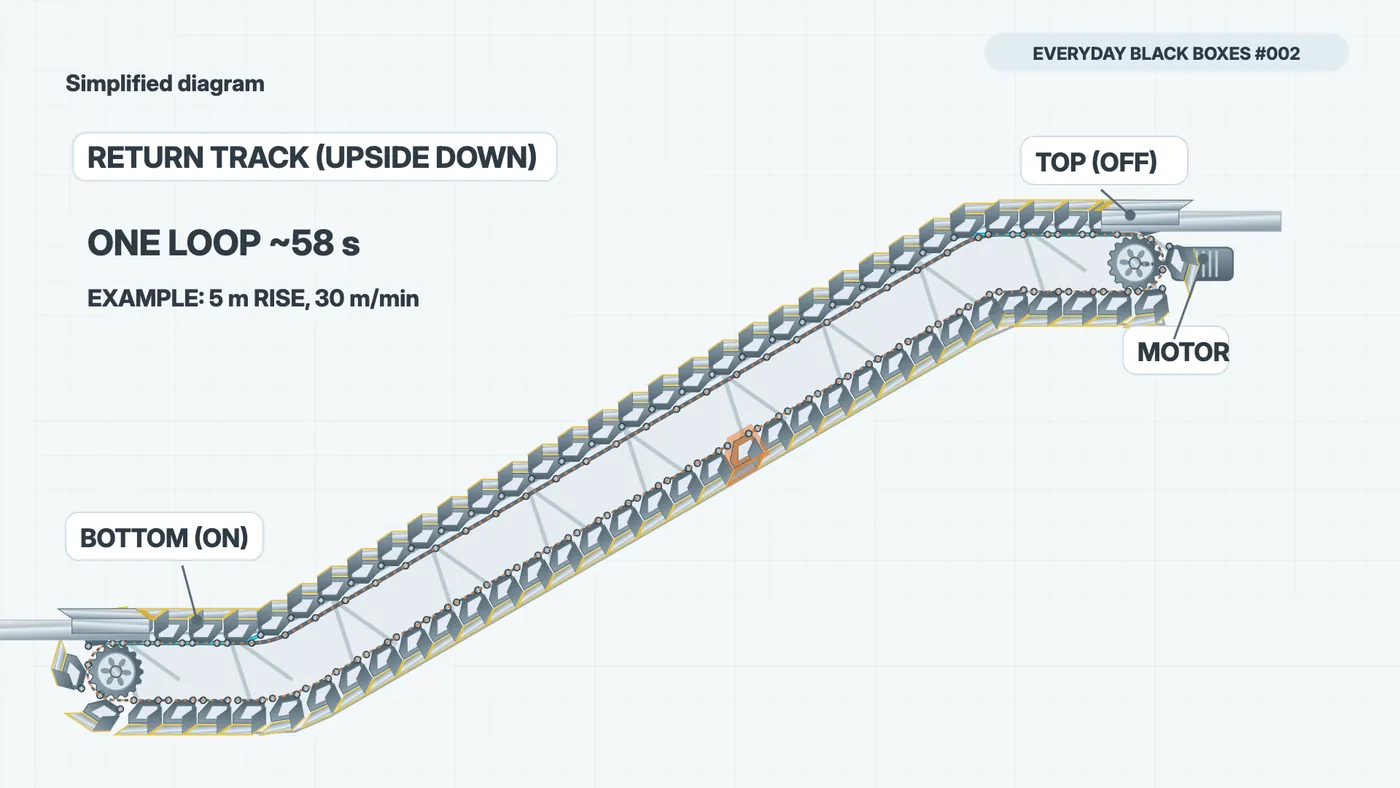
Figure 1. Follow the upper path uphill and the lower path back down. The “one loop ~58 s” label is an example for a 5 m rise at 30 m/min, not a time shared by all escalators.
| In order | Where the step goes | What happens |
|---|---|---|
| 1 | Bottom entrance | It emerges right side up, level with its neighbors |
| 2 | Incline | Its tread stays level as neighboring steps move at different heights |
| 3 | Top exit | Neighboring treads line up into a flat surface |
| 4 | Comb at the floor edge | The grooved step passes beneath the fixed comb |
| 5 | Upper turnaround | The step turns upside down |
| 6 | Hidden return path | It travels back down, inverted |
| 7 | Lower turnaround | It turns right side up and approaches the entrance again |
Start with the part you can see
At the bottom, several steps emerge with their surfaces level with one another. Farther along, they separate in height and form stairs. At the top, that sequence reverses: the stairs become a flat surface before the steps disappear.
Watch one step separately from the whole row. A single tread stays horizontal while carrying passengers, even on the incline. What changes is its height relative to the next step. “Level tread” describes the individual step; “flat floor” describes neighboring steps lined up at the same height.
At the exit, the moving steps meet a stationary floor. The plate with comb-shaped teeth marks that boundary. The hidden route begins beyond it.
A step is a four-wheeled cart
What sits beneath your feet
A typical step has a tread on top and an upright back face called a riser. Underneath are two front wheels and two back wheels, four altogether. Manufacturers also call these wheels rollers.
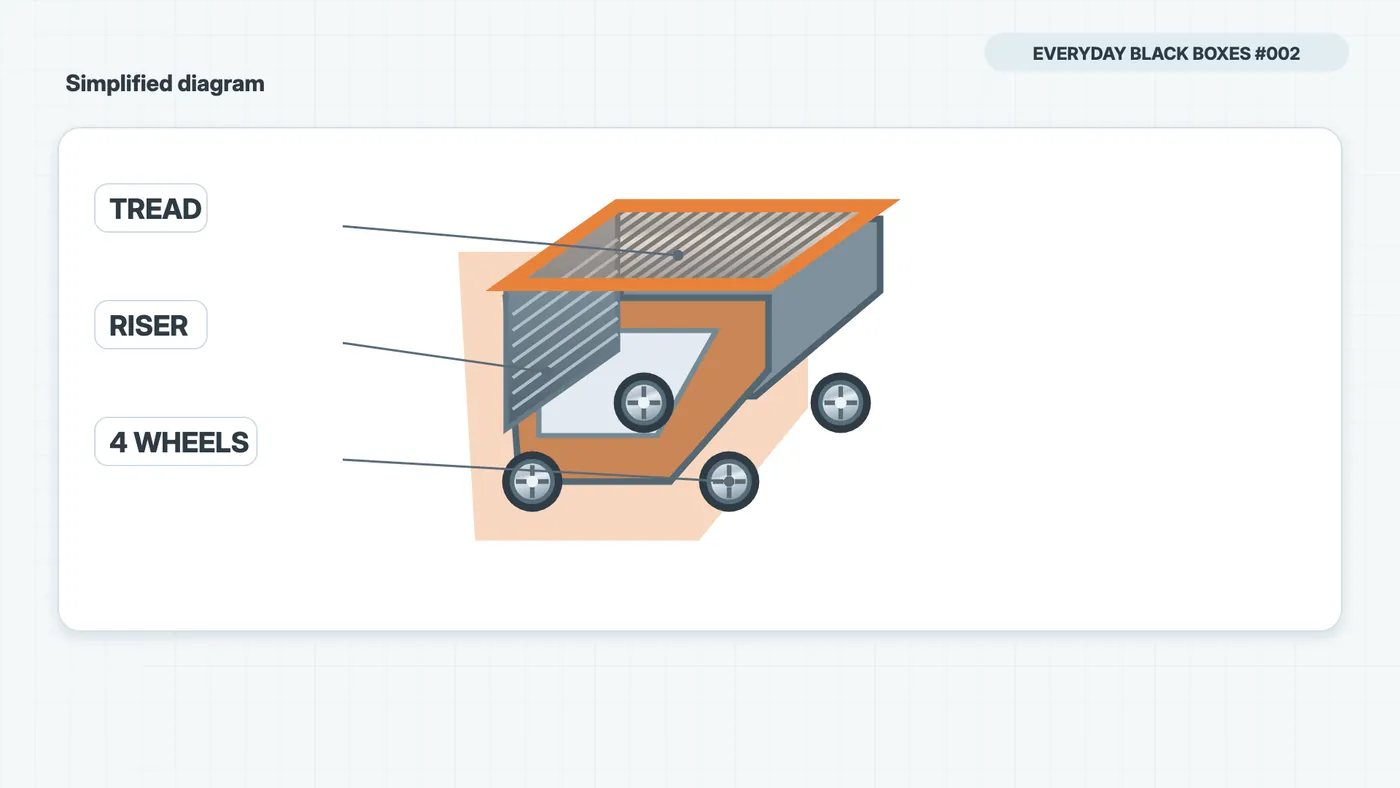
Figure 2. Each side has a front wheel and a back wheel. A side view shows one pair.
A chain connects the separate steps and pulls the line along its route. The wheels follow the rails. It helps to keep those jobs in mind: the chain moves the row, and the tracks guide the steps' position and orientation.
Real steps, taken out of the machine
These steps were removed during repairs at a station in Seattle, United States. They are individual components that can be taken out one at a time.
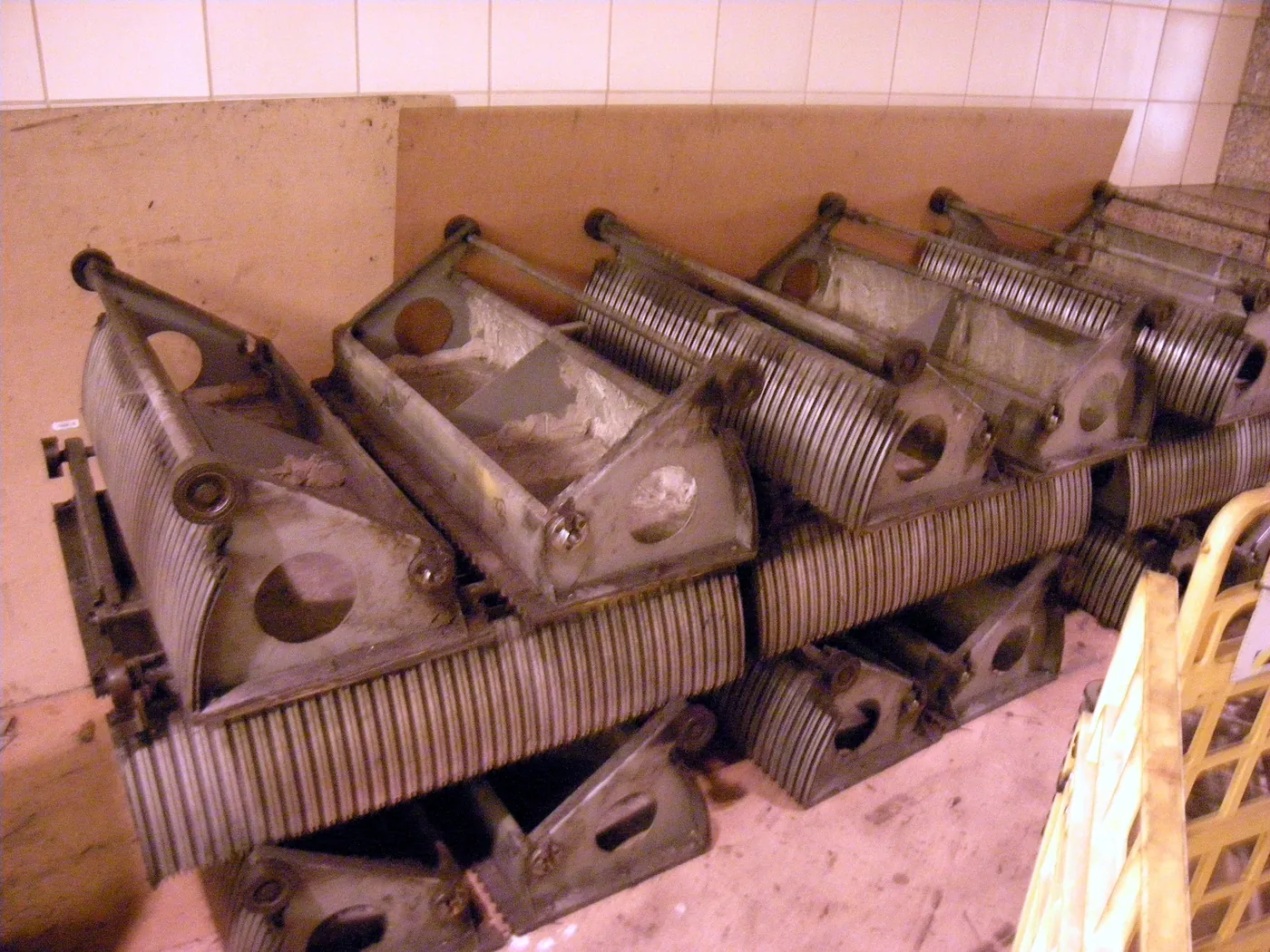
Photo: Joe Mabel, “Escalator steps 01.jpg,” Wikimedia Commons, CC BY-SA 3.0. Photograph unaltered; the original file page is listed under Sources.
The second photograph shows an escalator at a station in Melbourne, Australia, with its steps removed. A long supporting frame occupies the space where the moving staircase appeared. The familiar staircase shape comes from the arrangement of the carts traveling through it.
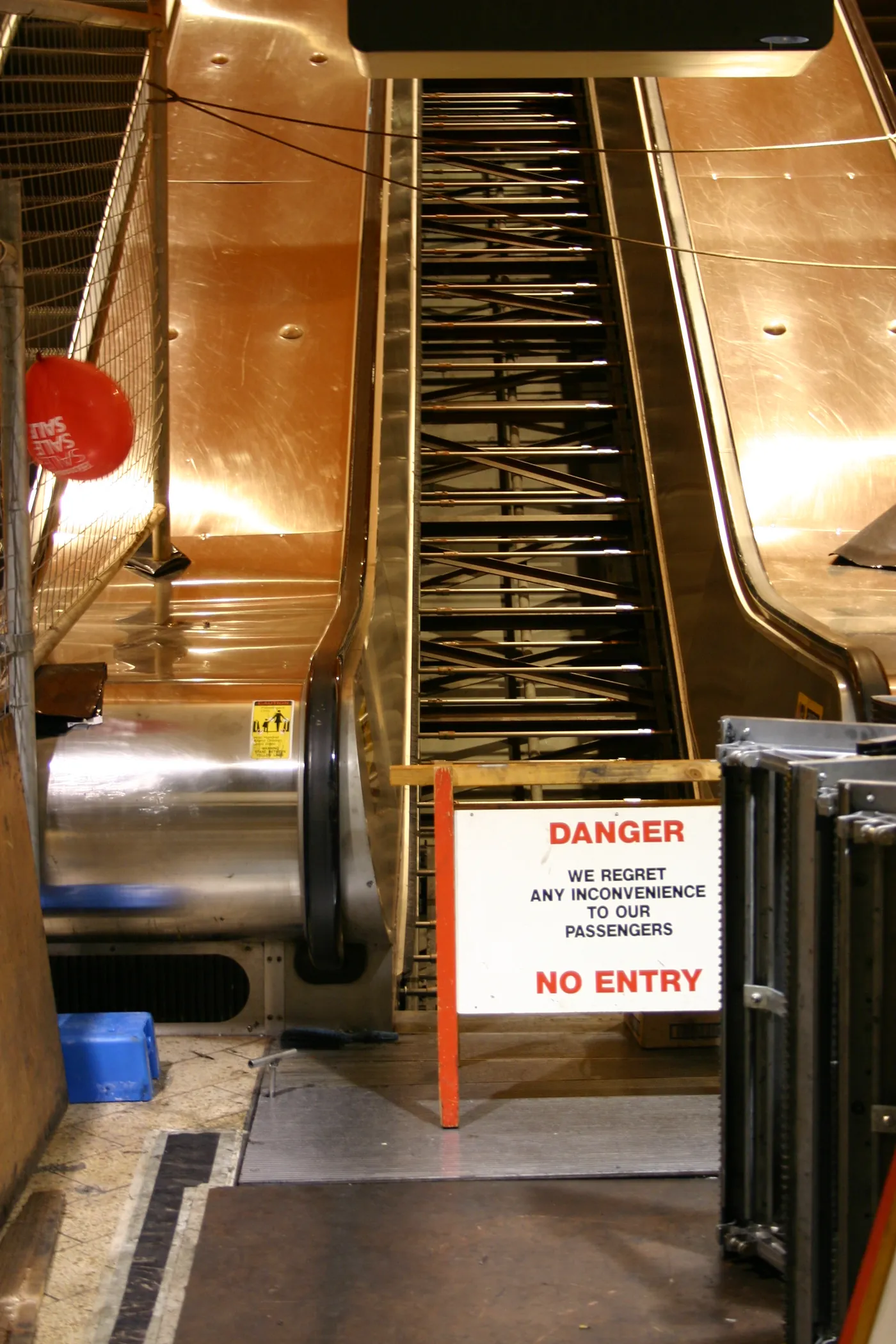
Photo: Josh Parris, “Escalator receiveing maintenance (from bottom).JPG,” Wikimedia Commons, public domain. Photograph unaltered.
How two tracks keep a step level
Moving uphill with a horizontal tread
The front and back wheels follow separate tracks. Our drawings use gray for the front-wheel track and blue for the back-wheel track. Blue is an explanatory color, rather than a required color on real machines. There is a pair on each side, making four rails in total; the side-view explanation follows one pair.
Imagine putting both wheels on the same sloping rail. In our 30-degree model, the tread would tilt by 30 degrees too. Giving the back wheel its own track lets that track support the step in a level position.

Figure 3. A thought experiment using one side of the model. The single-track arrangement illustrates why the second track matters.
Why level steps still look like stairs
Every tread can be horizontal while sitting at a different height from its neighbor. That is the arrangement on the incline. The height differences between separate steps create the staircase.
In this simplified model, the front and back wheels are at the same height and 0.30 m apart horizontally. The blue track follows the gray track's shape shifted backward by 0.30 m. On the 30-degree incline, comparing the tracks at the same horizontal position gives a vertical separation of about 17 cm.
That 17 cm belongs to this model. It compares two track lines at the same horizontal position; it does not describe the height difference between the two wheels of one step, or between neighboring treads. It is not a universal escalator dimension.
How the staircase becomes a floor
Near the upper landing, the route becomes horizontal. In this diagram, the blue track comes down to the gray track's height. The lines overlap in side view, while the front and back wheels continue to follow their respective paths.
The tread stays level because it is now traveling along a horizontal section. Neighboring treads gradually reach the same height and line up into a flat moving floor. Kodansha Cocreco explains the purpose: a flat surface makes boarding and leaving easier.
At the bottom, the process runs in reverse. Steps emerge side by side at the same height, then follow the tracks into a stair formation. Actual track arrangements vary; this drawing follows the arrangement used in Kodansha Cocreco and the English Wikipedia explanation.
What the comb does at the landing
The comb plate sits at the edge of the stationary floor. Its teeth fit into the grooves in the moving steps, which pass beneath it.
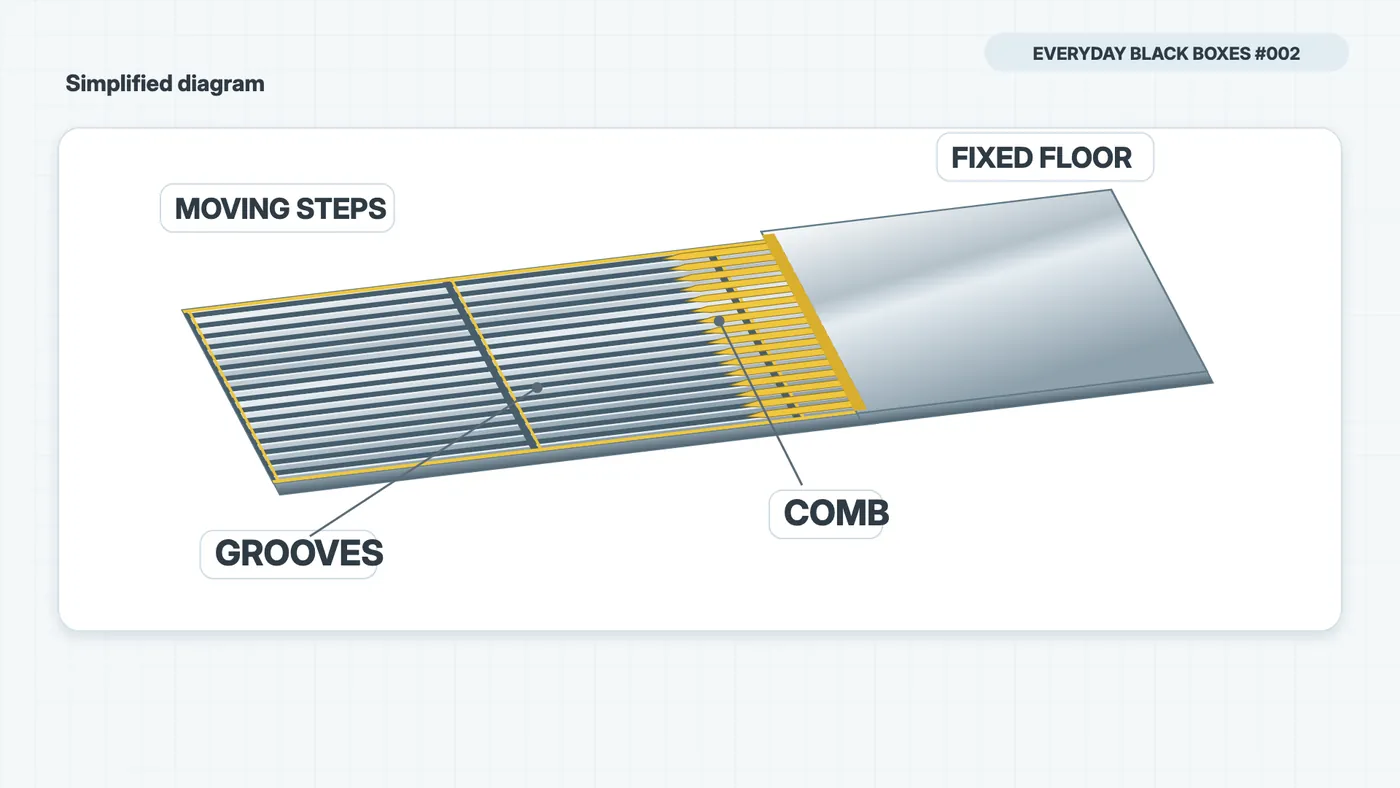
Figure 4. The steps on the left move. The floor and comb on the right stay fixed. The grooves and comb teeth run in the same direction.
This interlocking shape keeps the gap between the step and the floor small, reducing the chance of something getting caught. The Japanese Wikipedia article also describes a comb-plate impact switch that stops the escalator when something is trapped at this boundary.
Japan provides a useful example of how landings are specified. Its accessibility standards for designated barrier-free routes in passenger facilities, such as railway stations, require at least three steps in the same plane at each landing. Here, a barrier-free route means a route intended to make movement accessible. The same provisions require contrasting colors so that step boundaries and the comb edge are easy to distinguish.
Those requirements have a defined scope. They do not establish a worldwide three-step rule or a rule for every store escalator and older machine in Japan. The color requirement concerns a visible contrast; the wording does not prescribe yellow alone.
The hidden return trip and the motor that drives it
After passing under the upper comb, a step travels around the top turnaround and becomes inverted. It heads back down beneath the passenger route. At the lower turnaround it rotates right side up, then emerges at the entrance. The two rows in Figure 1 are parts of one continuous route.
In the typical arrangement described by Toshiba Elevator, an upper machinery space contains the motor and a drive wheel, a gear-like component. A lower machinery space contains the return wheel, which turns with the chain. The step chain runs around these wheels, with the steps attached to it. Turning the upper drive wheel moves the chain and the row of steps.
Hitachi Building Systems likewise describes a common arrangement with the motor and drive equipment beneath the upper landing. The tread is held level on the passenger side; on the hidden return path, the steps are upside down and line up along the incline. The step that carried you keeps traveling after you leave it.
Step counts and timing: a worked example
A 5 m rise at 30 m/min
These are Tamelabo's approximate calculations for an assumed machine, rather than measurements of a real installation. “Rise” means the vertical difference between the lower and upper floors, not the length of the incline.
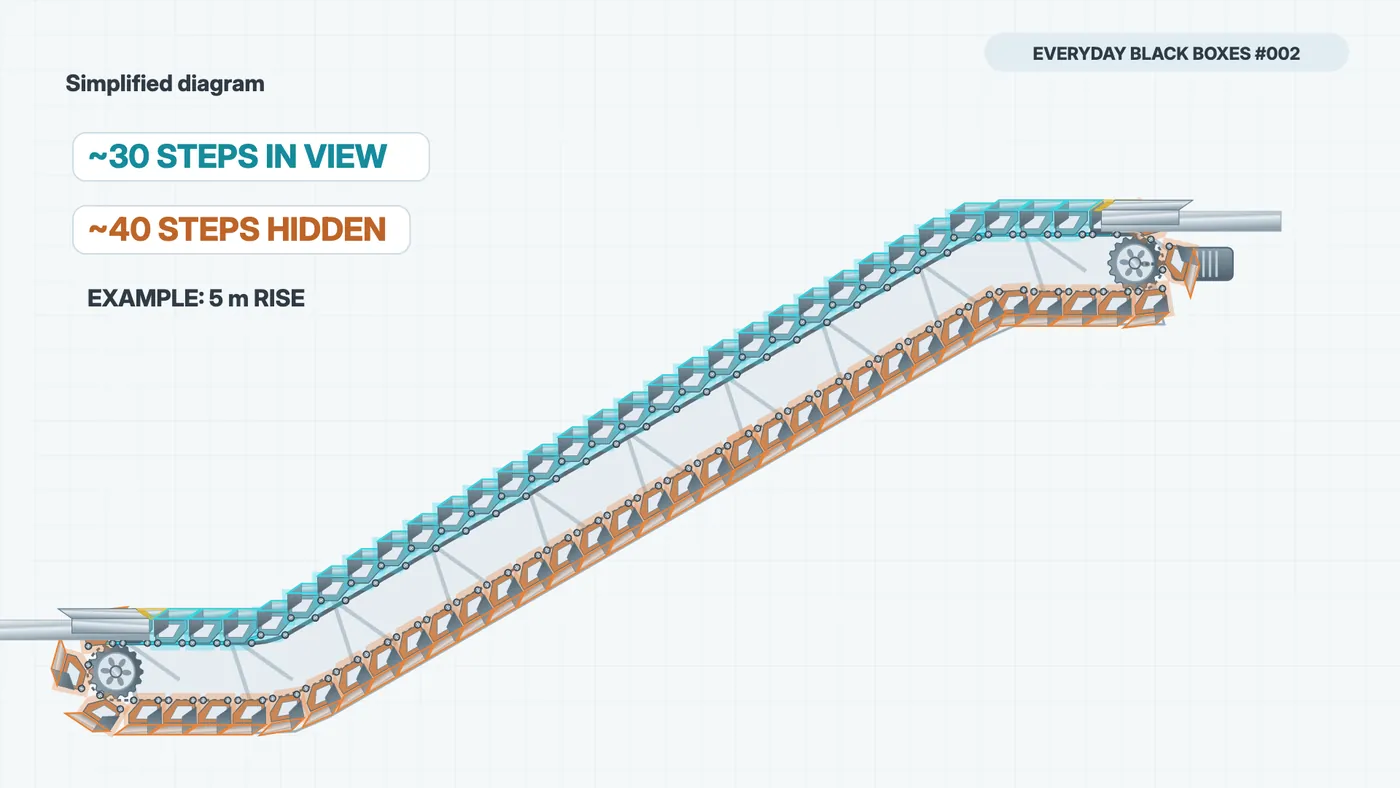
Figure 5. In the 5 m example, about 30 steps are visible and about 40 are hidden. The colors show which sections are being counted.
| Quantity | Example: 5 m rise, 30 m/min |
|---|---|
| Visible steps | About 30 |
| Hidden steps | About 40 |
| Total steps | About 70 |
| Fraction visible | About 43% |
| Length of the complete step route | About 28.8 m |
| Time to return to the same point after a full loop | About 58 s |
| Riding time from the entrance to the exit | About 25 s |
| From passing under the upper comb to emerging at the bottom | About 33 s |
The last timing and the full-loop timing have different endpoints. About 33 seconds gets a vanished step back to the bottom. About 58 seconds includes the passenger-side journey too, taking it back to the same point where the clock started.
Which dimensions come from sources, and which are assumptions?
| Input | Value | Basis |
|---|---|---|
| Vertical rise | 5 m | Chosen for this example |
| Step speed | 30 m/min, or 0.5 m/s | A common speed in Japan, according to the Japan Private Railway Association |
| Incline | 30 degrees | A typical angle described by the JSME and manufacturers |
| Step spacing along the route | 0.41 m | Calculated from Hitachi's 205 mm step rise at 30 degrees |
| Flat steps | Three at each landing | The designated Japanese accessibility requirement, adopted as a model assumption |
| Distance from each comb to its turning-wheel center | 0.41 m | Assumed; model dependent |
| Turn radius | 0.35 m | Assumed; model dependent |
The 0.41 m spacing is measured along the inclined route. It is derived from Hitachi's 205 mm vertical step rise at 30 degrees, rather than being a tread-depth specification. Toshiba describes tread depths of around 40 cm. Neither dimension should be treated as a universal specification.
Travel time is route length divided by speed. Step count is route length divided by step spacing, giving an approximate count that we round. The angle is also an assumption: the manufacturers explain that Japan permits inclines up to 35 degrees under specified conditions.
Why more steps are hidden than visible
In this typical layout, the return path is roughly as long as the passenger path. The turns at both ends and the concealed sections beneath the landings add more hidden route. Consequently, less than half the step loop is in view.
The episode's calculations also explored 54 combinations for a 5 m rise: two to four flat steps per landing, hidden extensions of 0–0.82 m, turn radii of 0.30–0.45 m, and step spacings of 0.40 or 0.41 m. They produced about 61–81 steps in total, a visible fraction of 40–47%, and loop times of 50.2–65.3 seconds. Hidden steps numbered at least 1.14 times the visible steps across those combinations.
This checks how the result changes when the assumptions change. It is not a survey of 54 real escalators.
A taller or faster machine changes the answer
The following approximate times retain the model's other assumptions and change its rise and speed. The Japan Private Railway Association also describes machines running at 40 m/min.
| Vertical rise | Full loop at 30 m/min | Full loop at 40 m/min |
|---|---|---|
| 3 m | About 42 s | About 31 s |
| 4 m | About 50 s | About 37 s |
| 5 m | About 58 s | About 43 s |
| 6 m | About 66 s | About 49 s |
| 8 m | About 82 s | About 61 s |
There is no single “one minute” return time to memorize. It depends on the length of the route and how fast the steps travel.
For another sense of scale, suppose an escalator runs at 30 m/min for 18 hours in a day. Each step travels 32.4 km—about 77%, or three quarters, of a 42.195 km marathon. Eighteen hours is a hypothetical operating period, not an observed daily schedule.
The handrail has its own loop
The handrail is a rubber belt that enters the machine at each end and returns through a concealed path. Steel cables or flat steel tape inside carry the pulling force. It uses power from the same motor, but follows a separate loop from the steps.
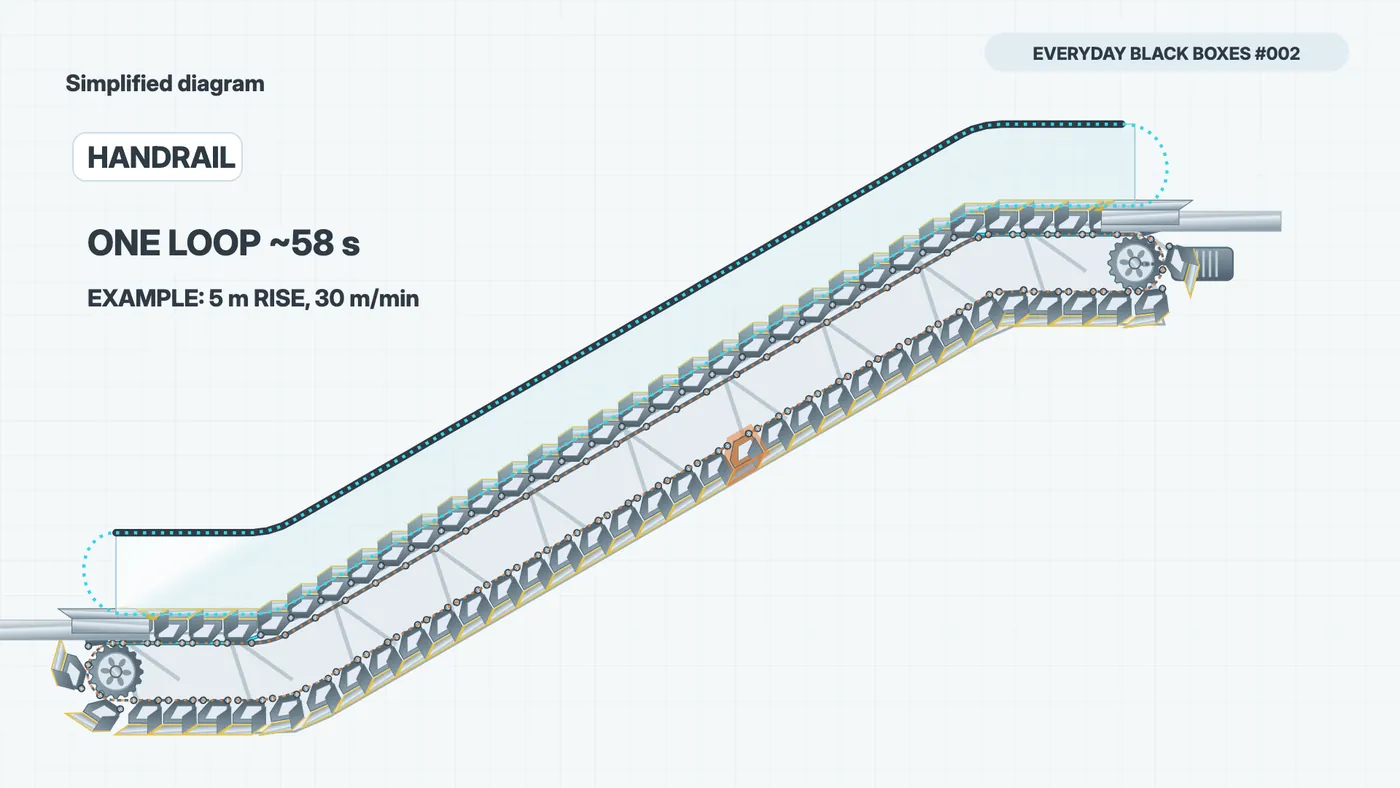
Figure 6. The handrail has a return path too. The “one loop ~58 s” label refers to the step calculation; it is not a calculated handrail-loop time.
The sources discuss several aspects of handrail speed. Japan's Building Standards Act Enforcement Order, Article 129-12, requires the upper handrail to move in the same direction and at the same speed as the steps. Toshiba explains that stretch and wear tend to slow the belt, so it adjusts the handrail to run slightly ahead. English Wikipedia describes small speed differences caused by slip and wear.
La Grazia's explanation gives a handrail-speed tolerance of 0–2% relative to the steps' nominal speed—the machine's specified operating speed. The page does not identify the underlying standard. That figure should be read as the source's explanation, rather than assumed to be a Japanese legal tolerance or a setting shared by all machines.
Three things to notice on your next ride
- At the entrance, look at the flat steps. Several surfaces line up before the row takes on its staircase shape.
- While riding, look at the steps ahead. Each tread is level, with neighboring steps at different heights. A second row is returning upside down underneath.
- As you leave, notice your step. It lines up with the floor and passes beneath the comb. Beyond that boundary, it turns toward the hidden return path.
For a longer observation, stand to the side of the entrance, clear of other passengers, and identify a step by an existing scratch or mark. Watch for it to emerge again. Do not add a mark yourself. The rise-and-speed table gives a sense of the possible waiting time.
FAQ: Frequently asked questions
Are escalator steps really level while I ride?
Yes. In a typical arrangement, separate tracks for the front and back wheels keep the tread level on the passenger side. Neighboring treads sit at different heights. Underneath, the steps return inverted, so they do not keep the same orientation throughout the loop.
How many steps does an escalator have?
It depends on the rise and model. Our 5 m example has about 30 visible steps and about 40 hidden steps, roughly 70 in total. Those are calculated estimates, not a count from a particular installation.
How soon does a step return to the bottom after I step off?
In the 5 m, 30 m/min example, about 33 seconds elapse between passing beneath the upper comb and emerging at the lower entrance. A full loop back to the same point takes about 58 seconds.
Does an escalator recognized as the world's shortest still have a return path?
Yes. Hitachi Building Systems and Kawasaki MORE'S describe the Petit Escalator in Kawasaki, Japan, with five visible steps and a vertical rise of 83.4 cm. Kawasaki MORE'S says it was recognized in the 1991 Guinness Book. Even with so few steps in view, there is a concealed return path.
A brief note on observing safely
Stand still, hold the handrail, and stay inside the yellow lines. These are the recommendations of the Japan Elevator Association and Japan's National Consumer Affairs Center. The latter points out that an escalator may stop suddenly, including during an emergency stop.
Keeping one side clear for walkers is a custom found in Japan and elsewhere. Hitachi illustrates how spacing changes the number of riders: in a 20-step section, standing with one empty step between people allows ten people per side; walking with two to four steps between people gives about 5.4 per side. Those figures describe the stated spacing assumptions.
In the Japan Elevator Association's fiscal 2024 survey, over 90% thought walking on escalators should stop, while 60% said they sometimes walked. Observation should be done while standing still.
Hitachi advises pressing the emergency stop button if you witness a fall or similar emergency, first calling out “Hold the handrail!” Its explanation of Japan's statutory inspections describes checks roughly every six months to a year by a nationally qualified inspector, with results reported to the responsible local authority. These inspection arrangements are specific to Japan.
Where to look more closely
Start with Fujitec's illustrated explanation for the continuous step loop. Toshiba goes into wheels, the drive, and handrail adjustment. Kodansha Cocreco and the Journal of the JSME explain how track positions produce level treads and flat landings.
For the Japanese three-flat-step requirement, read the passenger-facility accessibility ordinance and its scope. For riding advice, use the Japan Elevator Association and the National Consumer Affairs Center. The source list below identifies what each reference contributes; Japanese-language sources are marked.
Shorts
Sources
Where the facts and numbers in the video and on this page come from.
- Fujitec (, “How an escalator works.” Separate steps, the chain, and the continuous loop. In Japanese)fujitec.co.jp/sustainability/social_contribution/kids…
- Toshiba Elevator (, “The mysteries of escalators, Part 1: mechanism and safe riding.” Wheels, tracks, inverted return, drive components, and handrail adjustment. In Japanese)toshiba-elevator.co.jp/elv/column/new-sales/wonder_escalator
- Kodansha Cocreco / MOVE (, “Why do escalator stairs become flat?” (2023). Wheel and track arrangements and the purpose of flat landings. In Japanese)cocreco.kodansha.co.jp/move/news/katachi/rmH1N
- Japan Society of Mechanical Engineers (, Journal of the JSME, June 2005, Vol.108 No.1039, “Mechalife: Escalators.” Tracks, horizontal treads, and landing transitions. In Japanese)jsme.or.jp/mechalife/jp/student/mechaland/0506.pdf
- Japanese Wikipedia / Wikimedia Foundation (, “Escalator.” Supplementary explanations of the comb-plate impact switch and standing-side customs. In Japanese)ja.wikipedia.org/wiki/エスカレーター
- English Wikipedia / Wikimedia Foundation (, “Escalator.” Supplementary explanations of tracks, comb plates, grooves, and handrails)en.wikipedia.org/wiki/Escalator
- e-Gov / Japan's Ministry of Land, Infrastructure, Transport and Tourism (, ordinance on accessibility standards for passenger facilities and vehicles, Article 4(9). Three flat steps and contrasting boundaries on designated routes. In Japanese)laws.e-gov.go.jp/law/418M60000800111
- Hitachi Building Systems (, “Escalator facts.” The 205 mm step rise at 30 degrees, typical drive layout, safety, inspections, rider-spacing comparison, and Petit Escalator. In Japanese)hbs.co.jp/ad/escalator-walk-risks/trivia
- Japan Private Railway Association (, “Railway glossary: Escalators and elevators.” Common 30 m/min operation in Japan and 40 m/min machines. In Japanese)mintetsu.or.jp/knowledge/term/16340.html
- Japan Elevator Association (, news release, October 13, 2015. Safe riding advice. In Japanese)n-elekyo.or.jp/docs/20151013_Newsrelease.pdf
- e-Gov / Government of Japan (, Building Standards Act Enforcement Order, Article 129-12. Handrail direction and speed. In Japanese)laws.e-gov.go.jp/law/325CO0000000338
- Japan Elevator Association (, Elevator Journal No.56, October 2025, article on Elevator Day. Fiscal 2024 survey about walking on escalators. In Japanese)n-elekyo.or.jp/about/elevatorjournal/pdf/Journal56_05.…
- La Grazia (, “Article 32 - Escalator Handrail Safety Requirements” (2024). Rubber handrails and a stated speed tolerance; no underlying standard is identified)la-grazia.com/e-learning/escalator-handrail-safety-re…
- National Consumer Affairs Center of Japan (, “Hold the handrail firmly: beware of escalator accidents,” information bulletin No.488, August 8, 2024. Sudden stops and safe riding. In Japanese)kokusen.go.jp/mimamori/mj_mailmag/mj-shinsen488.html
- Kawasaki MORE'S (, “Petit Escalator.” The 83.4 cm rise, five visible steps, and recognition in the 1991 Guinness Book. In Japanese)kawasaki-mores.jp/petit
- Wikimedia Commons / Joe Mabel (, “Escalator steps 01.jpg.” Removed-step photograph, CC BY-SA 3.0)commons.wikimedia.org/wiki/File:Escalator_steps_01.jpg
- Wikimedia Commons / Josh Parris (, “Escalator receiveing maintenance (from bottom).JPG.” Photograph with steps removed, public domain)commons.wikimedia.org/wiki/File:Escalator_receiveing_maintena…
- CC BY-SA 3.0creativecommons.org/licenses/by-sa/3.0
Voice, music, art
- Music (OpenTracks): “なんでしょう?” by KK / “ちょっと楽しい” by 天野 七祈 / “探偵推理中” by 田中芳典 / “ensolarado” by Kyaai.
- Fonts: Noto Sans JP / Inter (SIL Open Font License 1.1). Narration: Irodori-TTS / Kokoro, using the selected series voices. Diagrams, animation, and HVAC sound: Tamelabo.