How Do Vending Machines Catch Fake Coins? | How It Works Inside #01
Short answer
- Inside the machine, three checkpoints — shape, material, and a final match against real coins and notes — send fakes straight back.
- Each alloy has an "electrical fingerprint" read through eddy currents, so the material gives fakes away.
- Banknotes are read with light and magnetism; 25-plus years ago, the 500-won "twin coin" once fooled the machines.
Video

Pressing play loads the YouTube player on this page. Watch on YouTube
Explained
Drop in a fake coin, and it comes straight back. A real one goes through. The difference is decided at three checkpoints inside the machine. In this article, we follow a coin and a bill through those checkpoints, using the diagrams from the video.
From the moment a coin drops in to the moment a drink comes out, everything happens in a flash. In that short time, the coin passes three checkpoints: shape, material, and a match against the machine's memory of real money. Let's go through them one by one.
*The diagrams of the machine's insides are simplified illustrations of a typical layout. Real machines vary.*
1. A three-story building with a checkpoint in the middle
Let's picture a vending machine as a three-story building. Drinks sit on the top floor, change on the bottom floor, and the middle floor holds the "checkpoint" where money is examined.
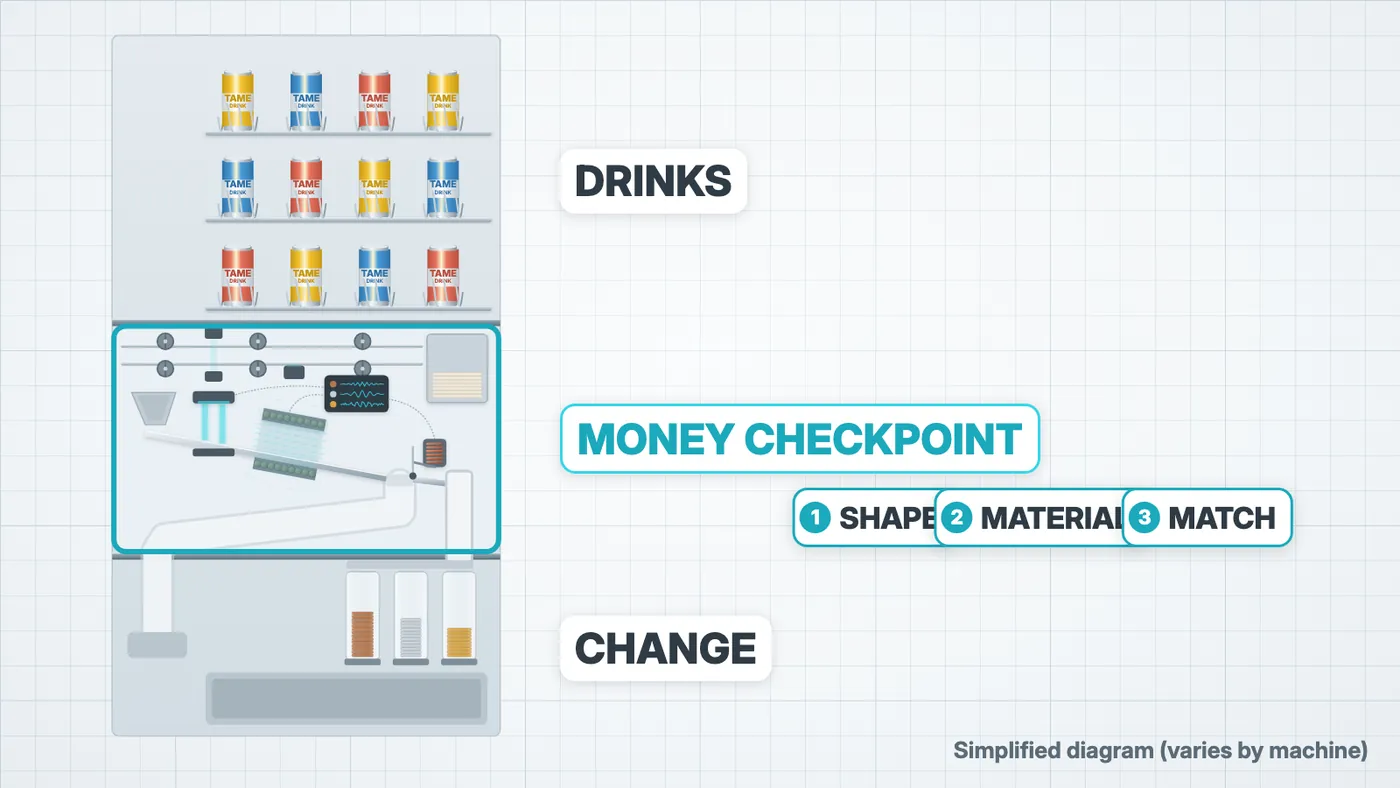
Japan has 2,178,800 drink vending machines (end of December 2025, Japan Vending System Manufacturers Association), and 2,585,200 vending machines of all kinds.
Divided by Japan's population of 122.98 million (January 1, 2026, final estimate by the Statistics Bureau of Japan), that works out to:
- about one drink machine for every 56 people (2,178,800 ÷ 122.98 million = one per 56.44 people)
- about one vending machine of any kind for every 48 people (2,585,200 ÷ 122.98 million = one per 47.57 people)
(The machine count is for the end of December 2025 and the population for January 1, 2026 — almost the same point in time.) Machines that take cash all have this checkpoint inside.
2. Checkpoint 1: Shape — a ¥10 coin is bigger than a ¥100 coin?
According to the industry association, a vending machine's coin selector checks "material, diameter, thickness, weight and more, all together." At the first checkpoint, the machine measures a coin's width, thickness and weight as it rolls down a rail.
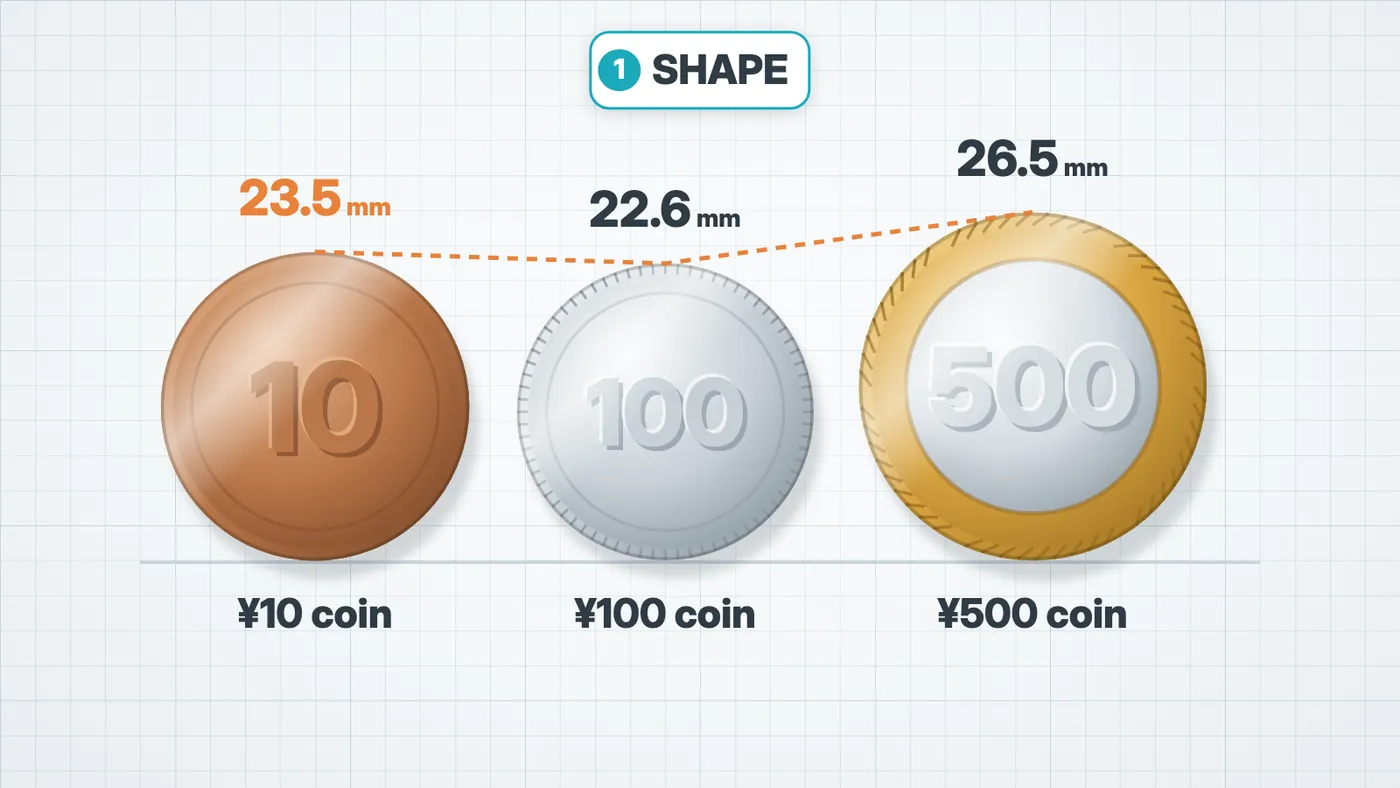
Here are the specifications of Japanese coins:
| Coin | Diameter | Weight | Material |
|---|---|---|---|
| ¥1 | 20 mm | 1 g | Aluminum |
| ¥5 | 22 mm | 3.75 g | Brass |
| ¥10 | 23.5 mm | 4.5 g | Bronze |
| ¥50 | 21 mm | 4 g | Cupronickel |
| ¥100 | 22.6 mm | 4.8 g | Cupronickel |
| ¥500 (current) | 26.5 mm | 7.1 g | Bicolor clad (overall 75% copper, 12.5% zinc, 12.5% nickel) |
Source: Wikipedia (Japanese), "Coins of Japan" specification table
Look at the ¥10 and ¥100 coins. The ¥10 coin is 23.5 mm across; the ¥100 coin is 22.6 mm. The ¥10 coin is a little bigger. Size and value just don't match.
And coins slowly wear down with use. Shape alone can't sort coins all day without a single mistake. So the coin rolls on to the next checkpoint.
3. Checkpoint 2: Material — the "electrical fingerprint" of an alloy (eddy currents)
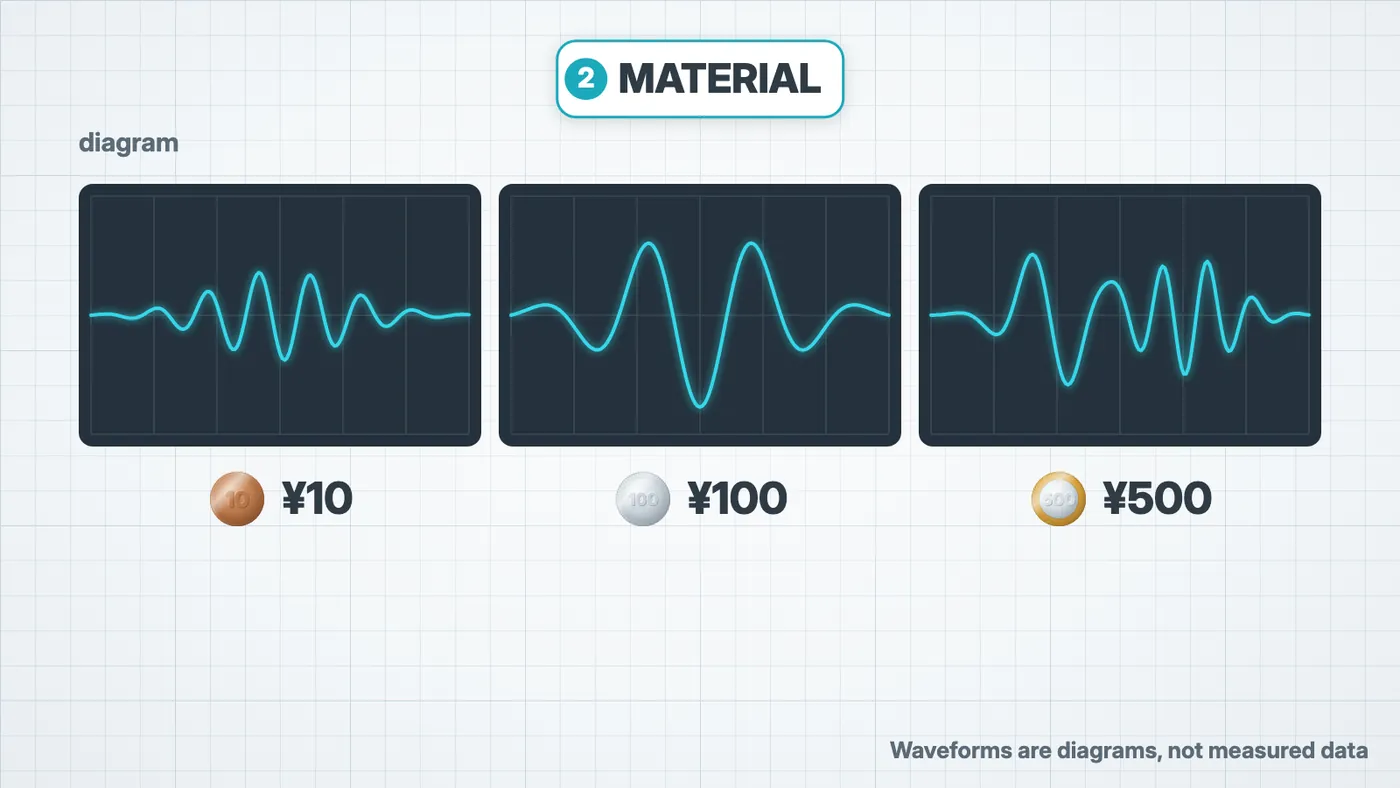
The second checkpoint looks like an empty, narrow tunnel. But coils inside the walls keep making a changing magnetic field.
When metal passes through that field, electricity starts to swirl inside the metal. This is called an eddy current. How it swirls depends on the alloy, because metals differ in how easily they conduct electricity (conductivity) and how well they get along with magnets (permeability). As a result, the coil's signal takes a different shape for each coin, and the machine compares it with the real data in its memory — like an alloy fingerprint, read with electricity. Telling coins apart with eddy currents at several frequencies has even been patented (US Patent US7537099B2).
Today's ¥500 coin is a "sandwich"
The ¥500 coin introduced in 2021 is a bicolor clad coin: the outer ring and the center disc are different metals. The outer ring is nickel brass, and the center disc has three layers — copper sandwiched between cupronickel.
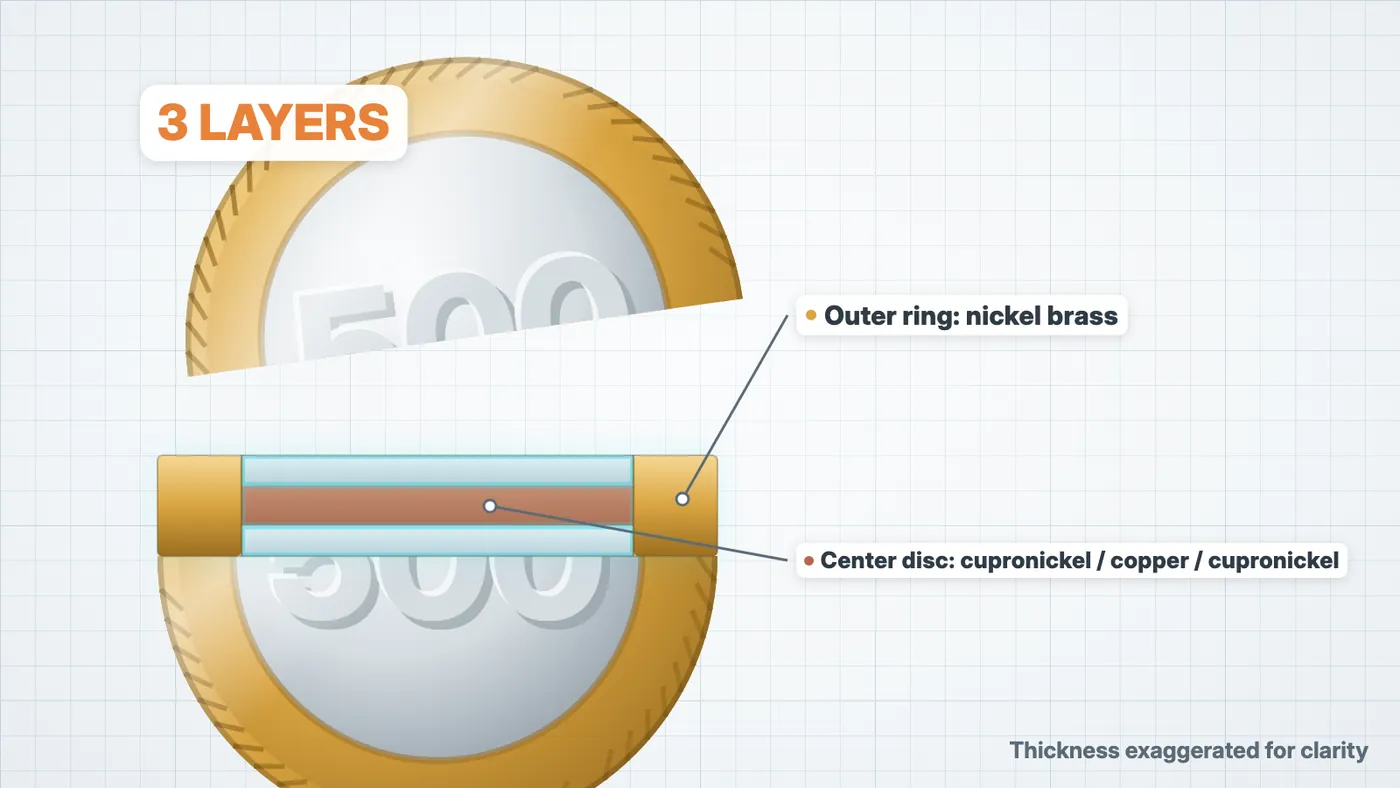
That layering is one more way to make the coin hard to copy. Today's ¥500 coin also uses other anti-counterfeiting features: a latent image ("500YEN" and "JAPAN"), micro-lettering, uneven slanted reeding (said to be a world first on a circulating coin), and undisclosed micro-characters.
4. The day machines were fooled by a near-perfect twin (the 500-won incident)
Why are the checkpoints so strict? It goes back more than twenty-five years.
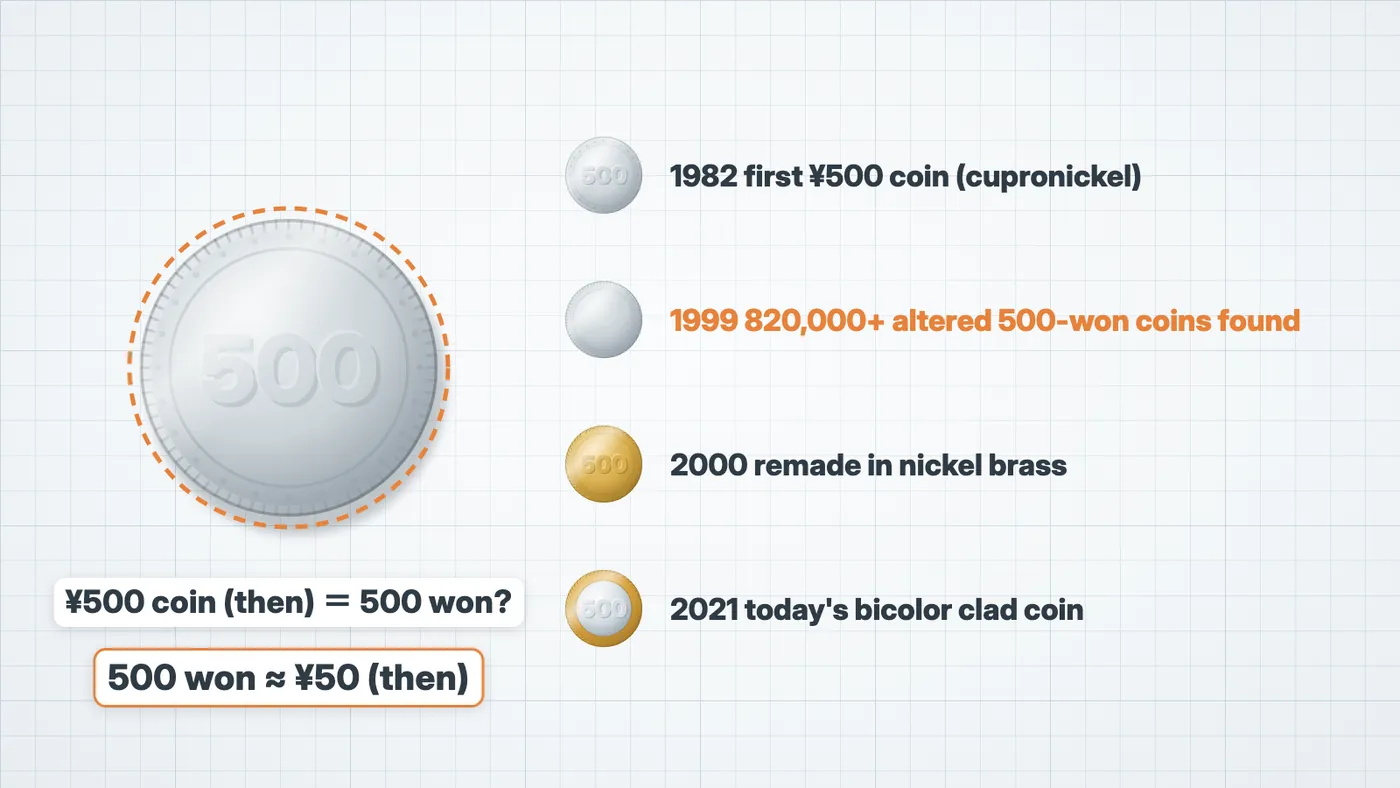
- April 1, 1982 — The first ¥500 coin is issued (cupronickel, 26.5 mm, 7.2 g). The Korean 500-won coin, made from 1982, was also 26.5 mm and cupronickel — nearly the same specification.
- From 1998 — 500 won was worth about ¥50, roughly a tenth of ¥500. (¥500 is about three US dollars.)
- 1999 — In the worst year, 821,654 altered 500-won coins were found in Japan. Measures such as better sensors did not work.
- August 1, 2000 — The ¥500 coin is urgently remade in nickel brass. As vending machines and ATMs were replaced, altered coins imitating the cupronickel coin gradually decreased.
- November 1, 2021 — Today's bicolor clad ¥500 coin is introduced.
Today's checkpoint is built on that long battle.
5. What happens to a fake?
At the third checkpoint, the "fingerprint" is compared with the machine's memory of real coins. When it matches, a gate worked by an electromagnet opens and the coin drops down. The coin you put in might become someone's change.
If the fingerprint doesn't match, the machine refuses to treat it as money. The gate stays shut, and the coin slides back out through the return slot. There is no inspector inside a vending machine; every decision is automatic.
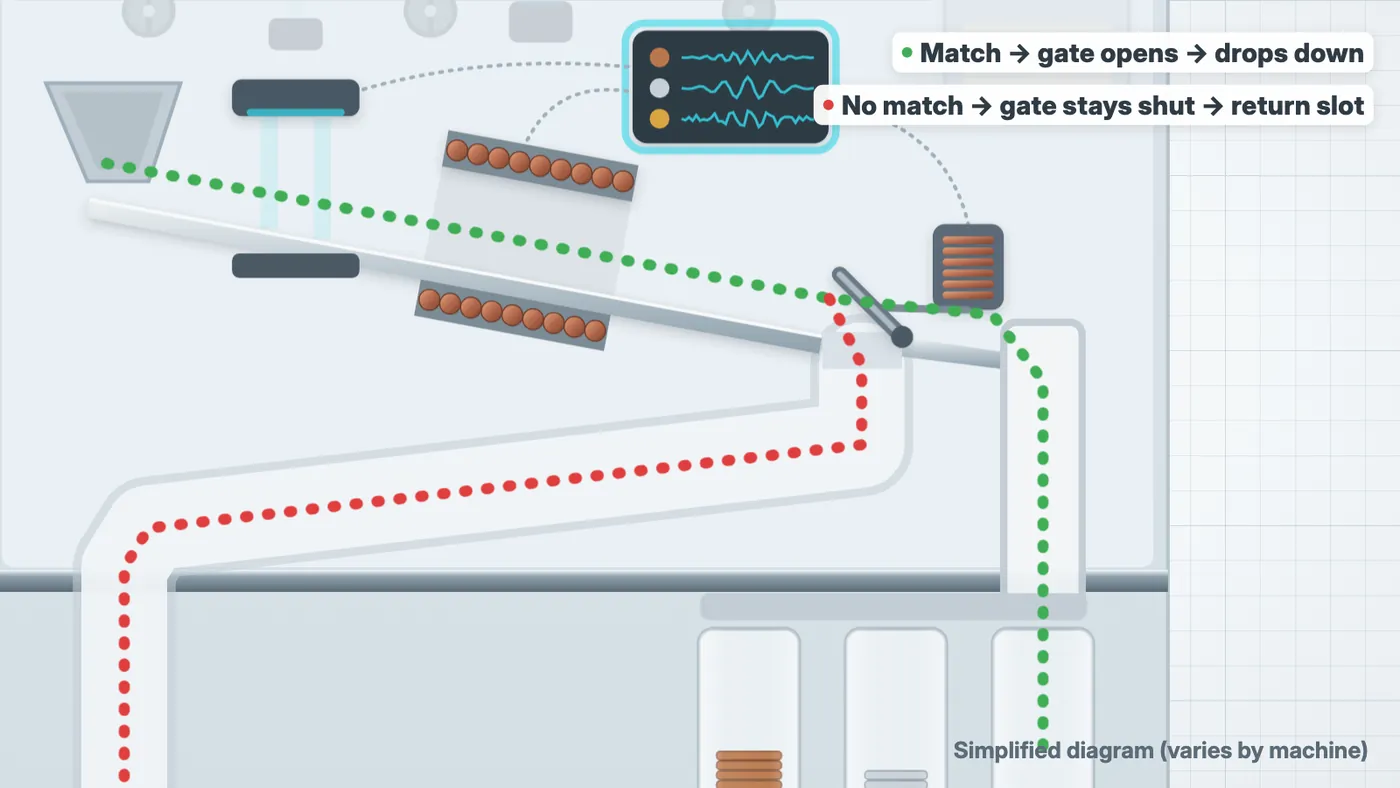
By the way, worn or dirty real coins are sometimes rejected by mistake.
6. The banknote checkpoint: light and magnetism
Banknotes go through the same kind of checkpoint. According to the industry association, a bill validator detects the magnetic and optical properties of the inserted bill and compares them with real banknote data registered in advance.
- Light: it shines through the paper to check features like the watermark and the pattern.
- Magnetism: banknote ink contains magnetic material, and each denomination has its own magnetic pattern. The machine reads it.
- Match: if the reading matches the memory of a real bill, the bill is accepted; if not, it comes straight back out.
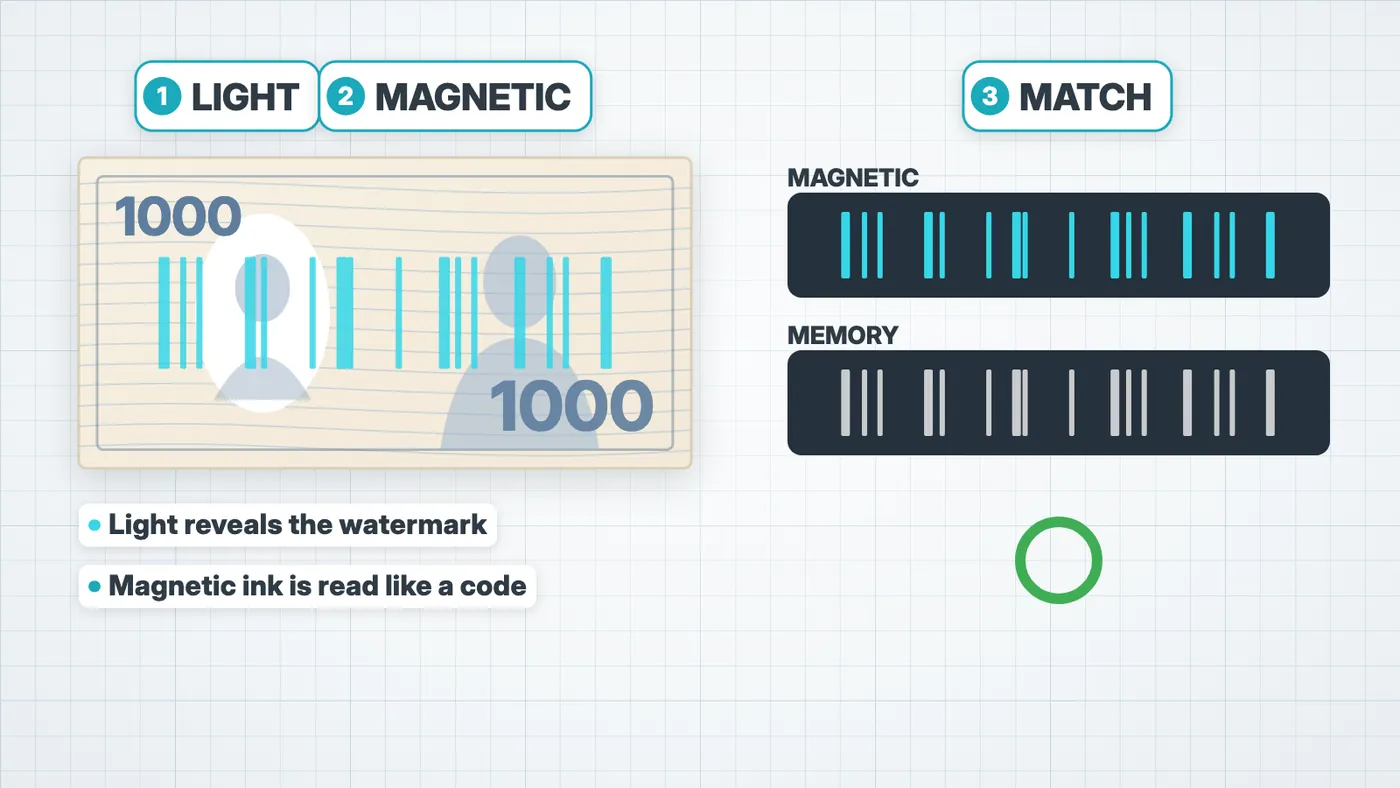
7. New bills meant "brain surgery" for many machines
On July 3, 2024, Japan issued new banknotes (Series F): the ¥10,000 note shows Eiichi Shibusawa (Tokyo Station on the back), the ¥5,000 note Umeko Tsuda (wisteria), and the ¥1,000 note Shibasaburo Kitasato (Hokusai's "The Great Wave off Kanagawa"). The previous series (Series E) was issued on November 1, 2004, so these were the first new bills in about twenty years. Series E bills remain valid.
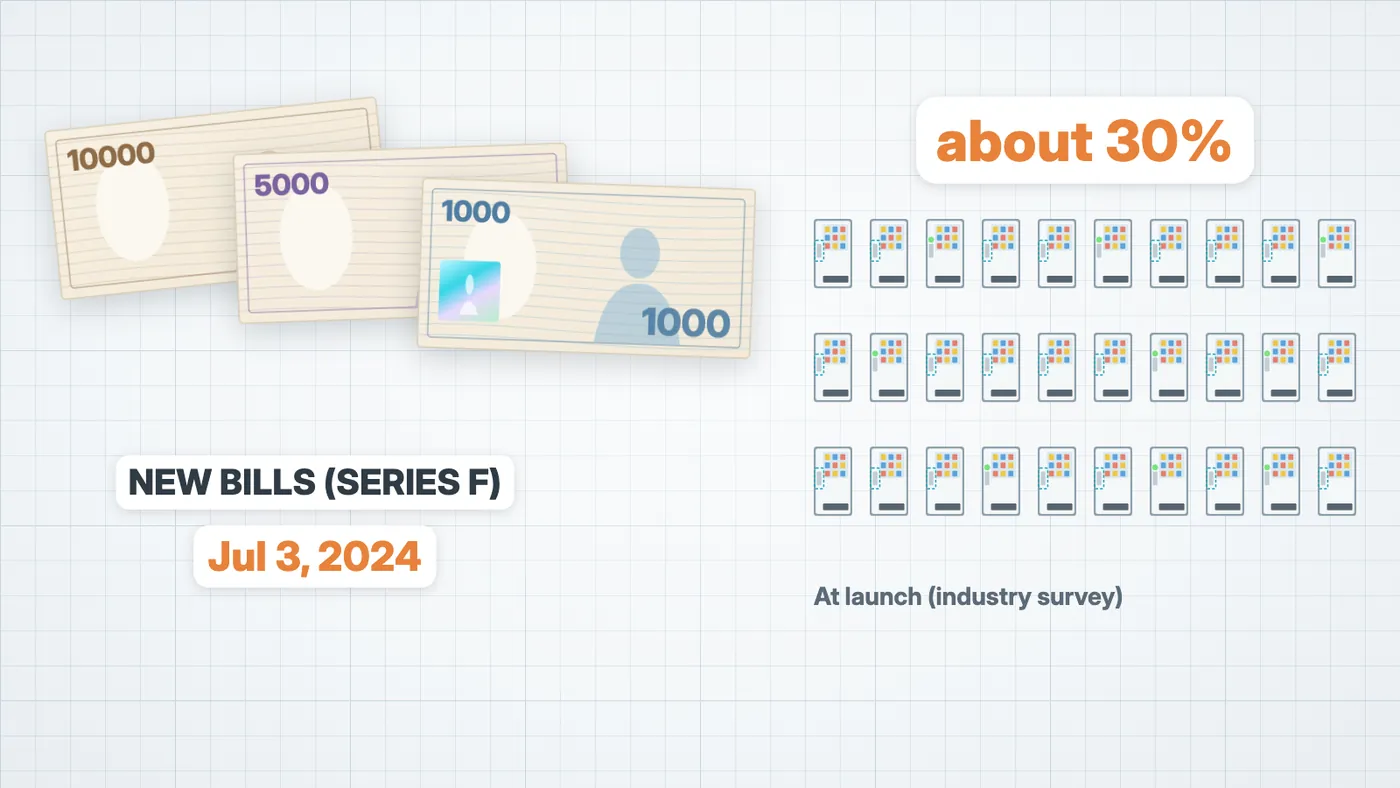
The new bills use a 3D hologram in which the portrait seems to turn (a world first for paper money), along with high-definition watermarks, pearl ink and special luminescent ink. The hologram is an anti-counterfeiting feature that helps people check a bill with their own eyes. Machines, on the other hand, judge by comparing with registered real-bill data, so to accept the new bills they had to be updated for that data.
According to an industry survey, only about 30% of vending machines could take the new bills at launch (as of the end of June, including cigarette machines and others; Nikkei, July 4, 2024).
8. Summary in one picture
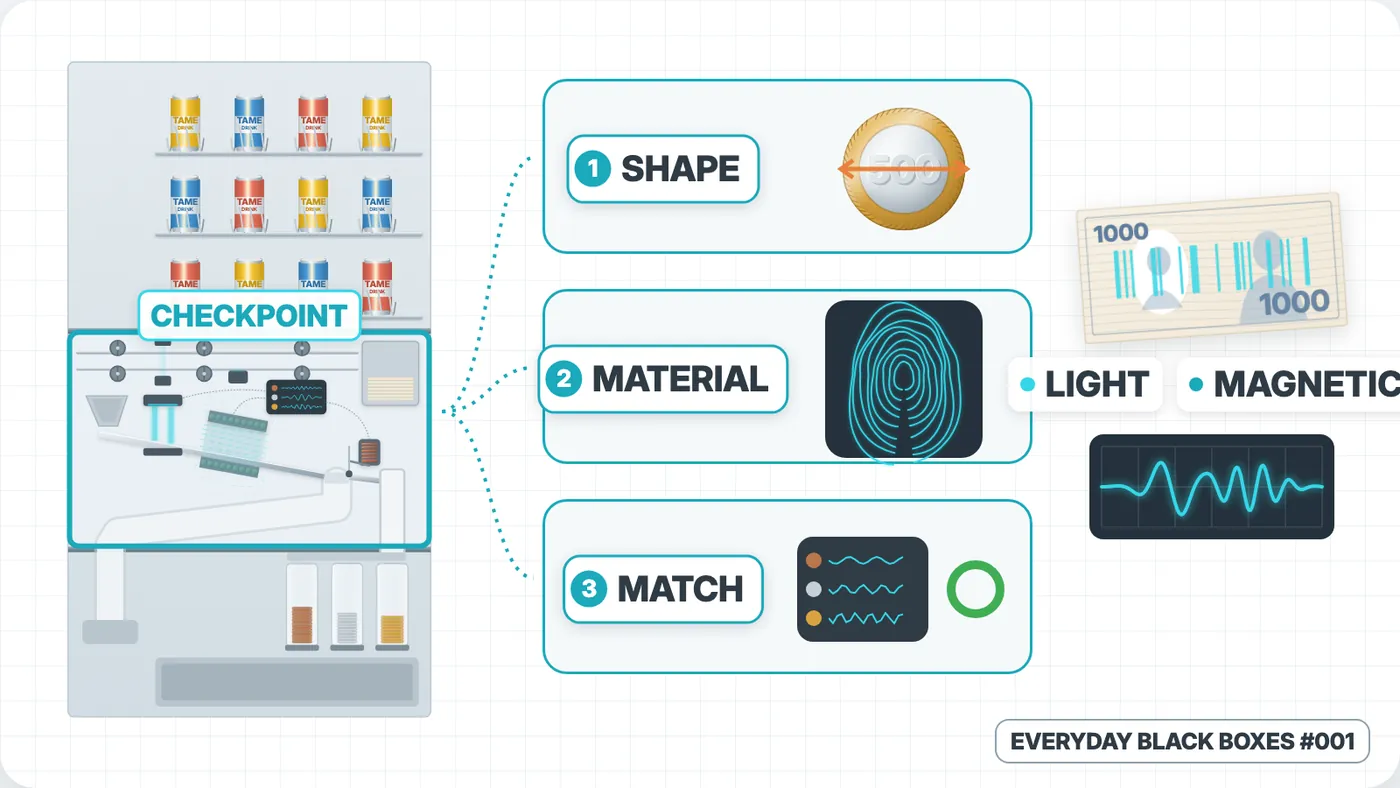
- Checkpoint 1, Shape: width, thickness and weight. But size doesn't match value, and coins wear down.
- Checkpoint 2, Material: a coil's magnetic field creates eddy currents, giving each alloy its own signal — an "electrical fingerprint."
- Checkpoint 3, Match: the fingerprint is compared with memory. A match opens the gate; anything else goes back to the return slot.
Banknotes are read with light and magnetism, and matched against memory.
9. FAQ
Q. Why was my worn coin rejected? A. Wear and dirt can make even a real coin drift away from the real data stored in the machine. Worn or dirty real coins are sometimes rejected by mistake.
Q. Does the machine keep a fake coin? A. In the simplified mechanism shown here, the gate stays shut and the coin comes back out through the return slot (actual behavior varies by machine).
Q. Can I still use the old ¥500 coins and old bills? A. As money, both are still valid by law. However, the first ¥500 coin (the 1982 cupronickel coin) is increasingly not accepted by vending machines, because machines have become more precise or have been replaced.
Shorts
Sources
Where the facts and numbers in the video and on this page come from.
- Japan Vending System Manufacturers Association, installed machine data (end of December 2025)jvma.or.jp/information/information_3.html
- Japan Vending System Manufacturers Association, FAQ (how machines tell real and fake bills and coins apart)jvma.or.jp/information/information_5.html
- Wikipedia (Japanese), "Coins of Japan" (specification table)ja.wikipedia.org/wiki/日本の硬貨
- Wikipedia (Japanese), "500-yen coin" (history, the 500-won problem, the first ¥500 coin today)ja.wikipedia.org/wiki/五百円硬貨
- Worldwide Vending, "Detecting Fake Coins: The Mechanisms Inside Vending Machines"worldwidevending.com.au/2024/09/05/detecting-fake-coins-the-mec…
- US Patent US7537099B2, "Coin discriminator" (multi-frequency eddy-current coin validation)patents.google.com/patent/US7537099B2/en
- Apex Magnets, "Vending Machines & Magnets Deliver Favorite Treats"apexmagnets.com/news-how-tos/vending-machines-magnets-d…
- Wikipedia (Japanese), "1000-yen note" (Series F ¥1,000 note, the world-first 3D hologram)ja.wikipedia.org/wiki/千円紙幣
- Wikipedia (Japanese), "Bank of Japan notes" (issue dates of Series F and E, portraits, validity of Series E)ja.wikipedia.org/wiki/日本銀行券
- Nikkei, July 4, 2024, "Vending machines can't take the new bills? Only 30% switched"nikkei.com/article/DGKKZO81837310T00C24A7TB1000
- Statistics Bureau of Japan, Population Estimates, June 2026 (final figure for January 1, 2026; used for the "one per 48 / 56 people" calculation)stat.go.jp/data/jinsui/pdf/202606.pdf
Voice, music, art
- Music (OpenTracks): “なんでしょう?” by KK / “ちょっと楽しい” by 天野 七祈 / “探偵推理中” by 田中芳典 / “ensolarado” by Kyaai