What If You Drop a Ball Through Earth? We Calculated Spin and Air | What If, Calculated #06
Short answer
- From New York, a straight-down tunnel 3.3 ft (1 m) wide ends at the eastern wall after about 14 seconds.
- With no spin or air, the real interior gives a trip of 38 minutes 11 seconds to the opposite surface.
- With sea-level air throughout a polar tunnel, the ball reaches the center after about 59 hours and settles around 68 hours.
Also calledgravity tunneldig a hole through Earthdig to China
Video

Pressing play loads the YouTube player on this page. Watch on YouTube
Try it
Explained
In the video
- 0:00A hole through the whole Earth
- 0:41The deepest hole ever drilled, and our assumptions
- 1:05Fall time through a uniform Earth
- 2:09Fall time with the real interior
- 2:57What Earth’s spin does to the ball
- 3:55A curved tunnel and a western exit
- 4:52What air does to the fall
- 6:05How the answer changes with the conditions
- 6:25Try it from your own city
If you grew up in the United States, you may have heard the joke about digging a hole to China. A hole through New York would actually lead to the Indian Ocean. A hole through Beijing would lead to Argentina.
But geography is only the first surprise. Drop a baseball into a tunnel through Earth, and its destination depends on which Earth you build: a simple interior, the real interior, a spinning Earth, or an Earth with air.
The result in 30 seconds
| Conditions | Result | What that means |
|---|---|---|
| Uniform interior, no spin, no air | 42 minutes 10 seconds | Reaches the opposite surface, stops, then falls back |
| Real interior, no spin, no air | 38 minutes 11 seconds | About four minutes faster |
| Spin on, straight down from New York | Hits the eastern wall in 14 seconds | A tunnel 3.3 feet (1 m) wide; about 3,000 ft (920 m) down |
| Polar tunnel, sea-level air throughout | Reaches the center after about 59 hours | Still moving; the swing falls under 3.3 ft (1 m) after about 68 hours |
A tunnel curved to follow the freely moving ball has an exit about 380 miles (610 km) west of New York’s antipode, the exact opposite point. Real compressed air would change things again: a rough estimate suggests the baseball could float around 50 km (30 miles) down.
The Earth we put into the calculation
We use a sphere with radius 6,371 km. Both interiors have the same total mass. The simple version has the same density everywhere. The real version uses PREM, a standard model of the average Earth inferred from earthquake waves. It does not represent every local geological structure.
Our density table is EarthScope EMC’s PREM_1s.csv, retrieved on October 22, 2026. We checked the density formulas against all 199 rows: the largest difference was below 0.000005 g/cm³. Integrating that density gives a mass of about 5.9732 × 10²⁴ kg.
The tunnel stays cool and never collapses. The baseball weighs about 5.1 ounces (145 g) and is about 2.9 inches (7.37 cm) across. In the no-air radial experiment, the ball’s mass and size do not change its travel time. In a narrow tunnel, its radius does matter: collision happens when the edge reaches the wall.
For perspective, Russia’s Kola Superdeep Borehole reached about 7.6 miles (12,262 m) in vertical depth, in 1989. That is only about 0.2% of Earth’s radius. Some angled oil wells are longer along their path, but none reaches as deep. A Qatari well drilled in 2008 was about 7.64 miles (12,289 m) long along its path and only about 4,550 ft (1,387 m) deep vertically. Length and depth are different records.
Experiment 1: a uniform Earth
Inside a spherical Earth, the pull from the shells outside your radius cancels out. If M(r) is the mass closer to the center than radius r, the gravitational acceleration is:
g(r) = G M(r) / r²
Here G = 6.67430 × 10⁻¹¹ m³ kg⁻¹ s⁻². In a uniform Earth, enclosed mass is proportional to r³, so gravity is proportional to r. It becomes weaker as the ball approaches the center, reaching zero right at the middle.
That makes the motion equivalent to a mass on an ideal spring: simple harmonic motion. The time to the opposite surface is π√(R³ / GM). With our Earth’s radius and mass, that gives 2,530.205 seconds, or 42 minutes 10 seconds. The numerical simulation agrees.
Zero gravity at the center does not mean zero speed. By then, the ball has accumulated its maximum speed: 7.9 km/s, about 17,700 mph. After it passes the center, gravity points backward relative to its motion and slows it down. It reaches the far surface with zero speed. Without an extra push, it cannot rise above its starting height, so it does not fly out.
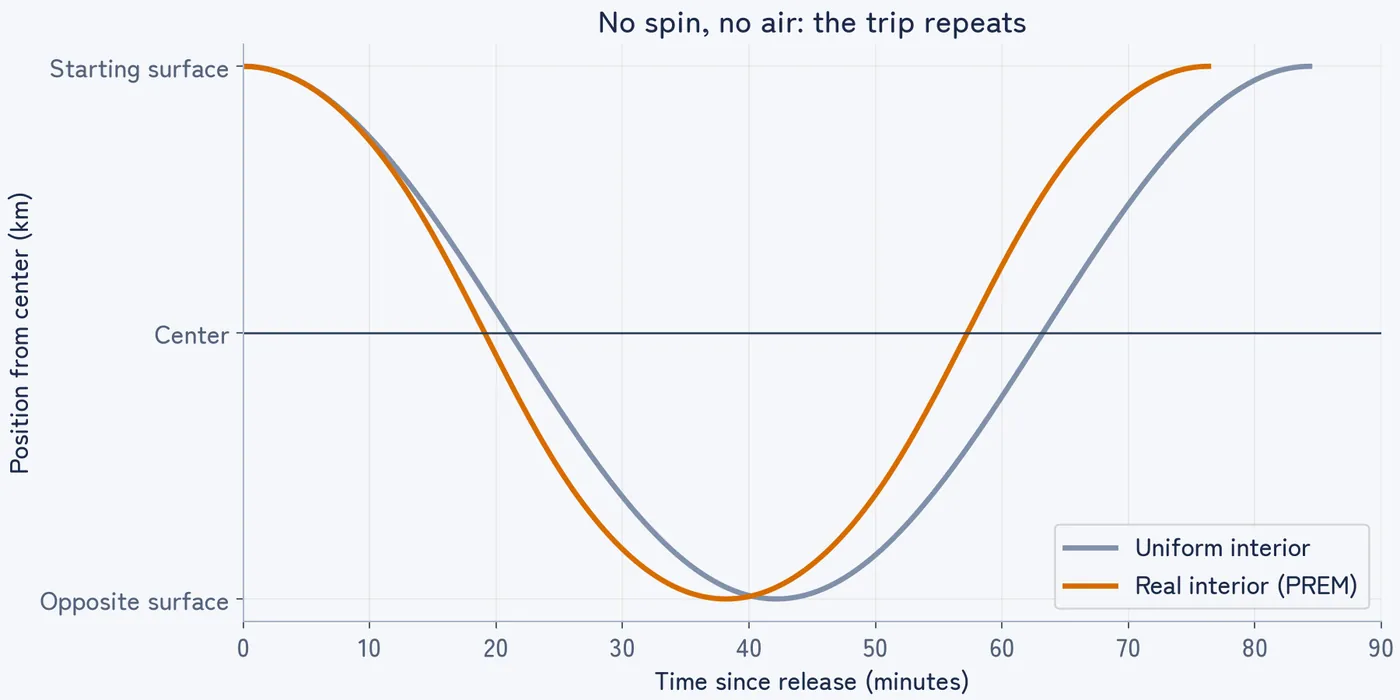
With no resistance to remove energy, it falls back and repeats the trip. A round trip takes 84 minutes 20 seconds. An imagined satellite orbiting just above the surface of this same Earth would have that exact orbital period. Project its circular motion onto the tunnel line, and its shadow matches the ball’s position.
That satellite is a mathematical comparison, with terrain and atmosphere ignored. The real International Space Station is roughly 370–460 km high and orbits about every 90 minutes, so it is a different case.
Experiment 2: give Earth its real interior
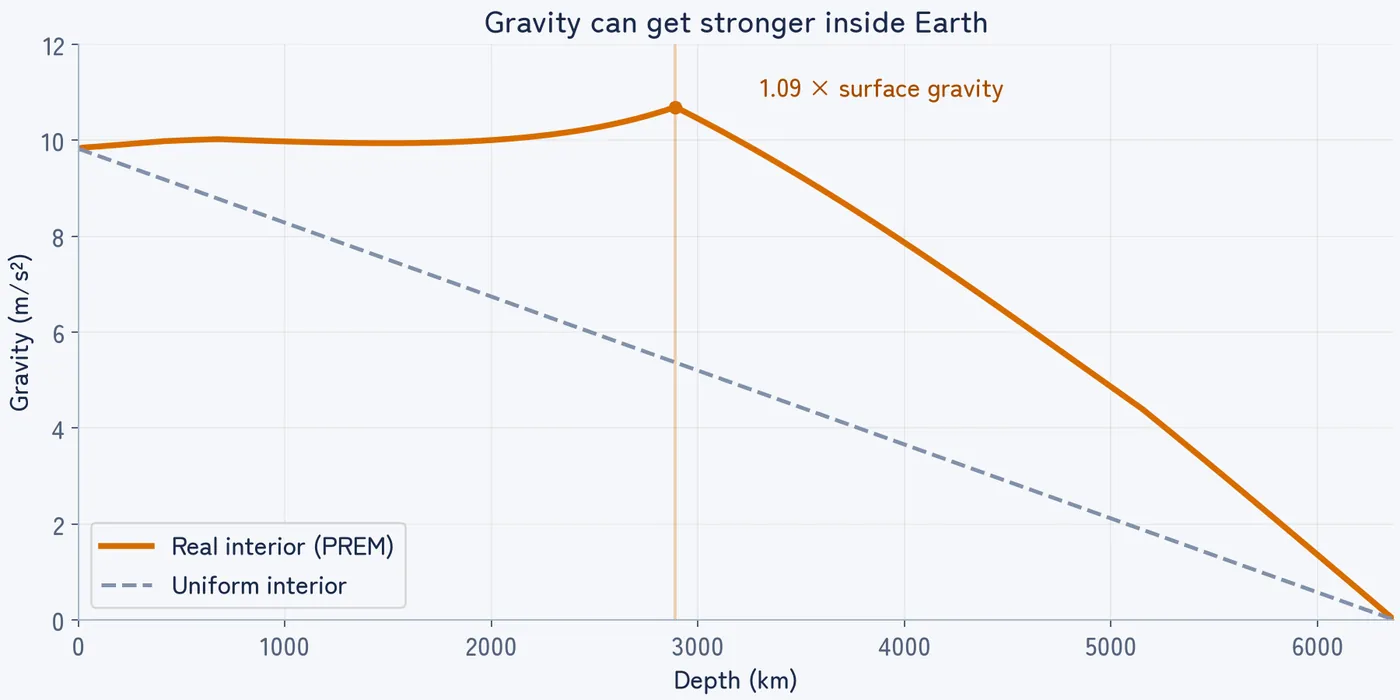
Earth is much denser near the center. Near-surface rock is about 2.6 g/cm³; the center is about 13.1 g/cm³, around five times as dense.
Gravity therefore does not simply decrease all the way down. Partway through the descent, it gets stronger. At the core–mantle boundary, 2,891 km deep, it reaches about 1.09 times surface gravity. From there it falls toward zero at the center. This boundary is not the boundary between the inner and outer core.
Using this gravity profile, the ball reaches 9.9 km/s at the center, about 22,200 mph. The opposite surface comes after 38 minutes 11 seconds. We obtained the same result by integrating the energy relation v(r)² = 2∫ᵣᴿ g(s) ds and then integrating travel time.
Alexander Klotz’s 2015 paper also gives 38 minutes 11 seconds for PREM. Its uniform-Earth comparison is 42 minutes 12 seconds, rather than our 42 minutes 10 seconds. The difference comes from the adopted surface gravity: 9.81 m/s² gives the former, while our integrated PREM mass gives about 9.82 m/s². The exact published match is the PREM arrival time.
Experiment 3: turn on Earth’s spin
The ground in New York is moving east at about 790 mph (352 m/s). A ball released gently from your hand already has that sideways motion. Deeper parts of the tunnel are closer to Earth’s spin axis and travel around smaller circles. The ball gets ahead of the eastern wall.
“Straight down” here means the direction a hanging weight points at the starting location. We include both gravity and centrifugal acceleration when defining that direction.
| Tunnel width | Time to the wall | Depth |
|---|---|---|
| 3.3 ft (1 m) | 14 seconds | About 3,000 ft (920 m) |
| 33 ft (10 m) | 30 seconds | About 2.8 miles (4.5 km) |
| 330 ft (100 m) | About 1 minute, or 65 seconds | About 13 miles (21 km) |
A quick check comes from the short-time estimate eastward drift ≈ Ω g cos(latitude) t³ / 3. Our spin rate is Ω = 7.2921150 × 10⁻⁵ rad/s. The ball hits before its center reaches the tunnel radius, because the baseball itself has a radius.
A tunnel aimed exactly at Earth’s center is slightly different from a plumb-line tunnel. From New York, a 3.3-foot-wide center-directed tunnel produces a collision after about seven seconds, with an equatorward component too. Defining “down” matters.
Why does an eastward drift produce a western exit?
Remove the walls, calculate the free path, then imagine a tunnel curved to match it. The ball arrives at the far surface in 38 minutes 12 seconds: about the same 38 minutes as before. But the exit is about 380 miles (610 km) west of the antipode. It is still in the Indian Ocean, about 1,000 miles (1,600 km) from Australia.
Look down from above the North Pole. East follows the direction of Earth’s rotation. At opposite points, two arrows labeled “east” point opposite ways on the page. The ball keeps moving to the same side of the original straight line throughout the trip. That side is east at the starting point and west at the far point. It does not reverse its drift halfway through.
If there were no walls and the ball made another leg, it would come back up in Illinois, about 760 miles (1,230 km) west of New York, on land. It would not return to its starting city.
There is a straight route through the center with no sideways drift: the North Pole to the South Pole. It lies on the spin axis. Our calculation gives the same 38 minutes 11 seconds as the no-spin case.
Experiment 4: air changes the destination
Use the polar tunnel to remove sideways drift. First, hold air density at its sea-level value throughout the tunnel: 1.225 kg/m³. This is deliberately favorable to the ball compared with a deeply compressed atmosphere.
The drag force is F = ½ρ Cd A v², where ρ is air density, A is the ball’s cross-sectional area and Cd describes drag. At higher speeds we use Cd = 0.3, based on NASA Glenn’s baseball discussion. Near the center, where the ball moves very slowly, we compare this with the Schiller–Naumann sphere relation and use the larger drag. This also captures viscous resistance at low speeds.
Balancing drag with gravity gives a limiting speed of √(2mg / (ρ Cd A)). Near the surface it is about 95 mph (153 km/h). Stronger gravity deeper down raises the peak to about 100 mph (160 km/h). Then the ball slows as it approaches the center.
| Event | Time since release | Motion |
|---|---|---|
| First arrival at the center | About 59 hours | About 8 inches (20 cm) per second |
| First overshoot | After crossing the center | About 230 ft (70 m) before reversing |
| Swing below 3.3 ft (1 m) | About 68 hours | Our operational definition of “settled” |
The turning distances shrink from roughly 69 to 33, 20, 14 and 10 m. Reaching the center is not the same as stopping there. Raising the higher-speed drag coefficient to 0.4 or 0.5 increases the first-arrival time to about 68.2 or 76.3 hours. The exact result depends on the ball and drag assumptions.
Would real air let the ball reach the center?
Air deeper in the tunnel supports more air above it and becomes denser. As a rough estimate, keep it at 15°C and treat it as an ideal gas. Integrating dP/dz = ρg gives a density equal to the baseball’s average density at about 53.2 km depth and 565 times sea-level pressure.
At that point, a ball-sized volume of air weighs as much as the ball. Both have an average density of about 0.69 g/cm³. Buoyancy can balance the ball’s weight, so it cannot keep sinking toward the center in this estimate.
The baseball is assumed to keep its size under pressure. This is an estimate of the floating depth, not a full motion simulation. Real compressed air is not an ideal gas at all pressures, and underground temperature would not stay fixed. Those changes would move the floating depth. The robust point is that the far surface is out of reach.
What if both spin and air are on?
Let the air rotate with Earth, keep its density at sea level, and use New York’s straight-down tunnel. Drag slows the fall and delays the impact, but the ball still reaches a wall.
| Tunnel width | Time to the wall | Depth |
|---|---|---|
| 3.3 ft (1 m) | 29 seconds | About 3,700 ft (1,130 m) |
| 33 ft (10 m) | About 4 minutes | About 6.5 miles (10.5 km) |
| 330 ft (100 m) | About 41 minutes | About 65 miles (105 km) |
Air does not make every tunnel end at the center.
The Web experiment calculates this combination too. The only unavailable combination is air plus the curved tunnel, because that tunnel is specifically defined as the path calculated without air.
Where this model differs from reality
No such tunnel could really be dug or kept open. Laboratory estimates put the inner-core boundary around 5,000–6,000°C (9,000–11,000°F). The ESRF research discussion gives 6,230 ± 500 K for pure iron and around 5,500 K after allowing for lighter elements; it does not state an uncertainty range for the latter estimate. These are laboratory-based extrapolations, not a thermometer reading at Earth’s center.
Integrating PREM gives a central pressure near 364 GPa, about 3.6 million times sea-level air pressure. Our walls ignore this pressure and heat.
Earth is also slightly flattened rather than perfectly spherical. Klotz estimates a travel-time correction of about ten seconds from this effect. We omit local variations, the Moon and Sun, and everything that happens after impact with a wall. Changing the numerical time step three times preserved every rounded result shown here. That checks numerical stability within the model; it does not make the assumptions physically achievable.
Frequently asked questions
If I dig from the US, do I reach China?
From New York, the antipode is in the Indian Ocean, about 660 miles (1,070 km) from Australia. Beijing’s antipode is in Argentina. London faces the Pacific near New Zealand’s Antipodes Islands, and Sydney faces the Atlantic near the Azores. Your actual starting point matters.
Why does the ball not fly out?
In the no-air, no-spin experiment, it has only the energy associated with its starting height. It reaches the same height on the opposite side, with zero speed. Giving it an extra initial push would be a different experiment.
Is the ball weightless at the center?
The gravitational acceleration is zero at the center of the spherical model. The ball still has its mass and momentum. With no air, it passes the center at its maximum speed; with sea-level air throughout, it passes very slowly.
Does every straight tunnel take the same time?
Only for a uniform Earth, with no spin or air and frictionless sliding. From New York to Los Angeles, the uniform model gives 42 minutes 10 seconds. The real interior gives 41 minutes 51 seconds. The surface separation is about 2,444 miles (3,933 km); the tunnel reaches about 301 km (187 miles) deep. A shallow tunnel never reaches the dense core.
Where should a straight tunnel go on a spinning Earth?
Along the spin axis, from one pole to the other. It is the straight route through the center that avoids sideways drift.
Who first asked this question?
We have not identified the first person to imagine it. Paul W. Cooper published “Through the Earth in Forty Minutes” in 1966, and Klotz published the non-uniform-Earth calculation in 2015. We checked Cooper’s bibliographic details, not the paywalled full text, so no numerical claim here relies on its contents.
Try your own city
Open Gravity Tunnel Lab. Your first drop uses the real interior with spin and air off. Then “Turn on spin and drop again” takes you directly into the wall experiment. Follow with a curved tunnel, then add air to the polar tunnel.
Find a city whose antipode is on land: Beijing and Madrid are useful places to start. Try a straight tunnel between New York and Los Angeles. Save a result image or share a URL containing your conditions. The calculations run on your device; optional location coordinates are not sent to a service.
Sources
Where the facts and numbers in the video and on this page come from.
- EarthScope EMC PREM table (, retrieved October 22, 2026. Density data and polynomial model)data.earthscope.org/archive/seismology/products/emc/data/PR…
- Natural Earth (, 10m land, coastlines, countries and populated places. Public domain. Used for antipodes, land/sea and nearest-coast checks)naturalearthdata.com
- NASA Earth Observatory, Blue Marble: Next Generation (, July 2004 surface imagery)earthobservatory.nasa.gov/features/BlueMarble
- Klotz, The Gravity Tunnel in a Non-Uniform Earth (, American Journal of Physics 83, 231 (2015))arxiv.org/abs/1308.1342
- Cooper, Through the Earth in Forty Minutes (, American Journal of Physics 34, 68–70 (1966). Title and publication year only)doi.org/10.1119/1.1972773
- NASA Earth Fact Sheet (, radius, gravity and sidereal rotation period. The)nssdc.gsfc.nasa.gov/planetary/factsheet/earthfact.html
- IERS angular velocity (also agrees with the rate derived from NASA’s 23.9345-hour period)hpiers.obspm.fr/eop-pc/models/constants.html
- NIST CODATA gravitational constant (, 2018 recommended value)physics.nist.gov/cgi-bin/cuu/Value
- NASA Glenn, Drag on a Baseball (, drag equation, baseball diameter and higher-speed drag coefficient. At low speeds we compare with the Schiller–Naumann sphere relation Cd=24/Re×(1+0.15Re^0.687))www1.grc.nasa.gov/beginners-guide-to-aeronautics/drag-on-…
- Baseball (ball) (, regulation mass and circumference ranges)en.wikipedia.org/wiki/Baseball_(ball)
- U.S. Standard Atmosphere 1976 table (, sea-level density and viscosity at 15°C)engineeringtoolbox.com/standard-atmosphere-d_604.html
- ESRF research highlight (and)esrf.fr/home/UsersAndScience/Publications/Highl…
- 2013 announcement (, laboratory-based estimates of inner-core-boundary temperature)esrf.fr/news/general/Earth-Center-Hotter
- NASA International Space Station overview (and)nasa.gov/reference/international-space-station
- Facts and Figures (, altitude and orbital period)nasa.gov/international-space-station/space-stati…
- Kola Superdeep Borehole (, vertical-depth record and distinction from angled oil wells)en.wikipedia.org/wiki/Kola_Superdeep_Borehole
- Mental Floss / Atlas Obscura, The Hole Truth About Why We “Dig to China” (, the childhood saying)mentalfloss.com/article/71712/hole-truth-about-why-we-d…
- Antipodes Islands (, the name’s connection with London)en.wikipedia.org/wiki/Antipodes_Islands
Voice, music, art
- Voices: Irodori-TTS (Japanese, fixed series voice); Kokoro am_puck (English).
- Music (OpenTracks): “Shall we meet?” by MATSU
- Music (OpenTracks): “楽しく軽快に” by yuki
- Music (OpenTracks): “突破口の手がかり的なBGM” by 鷹尾まさき
- Music (OpenTracks): “考え中” by 鷹尾まさき
- Sound effects: original synthesized Tamelabo sounds; rock impact: Kenney Impact Sounds, CC0 (https://kenney.nl/assets/impact-sounds).
- Fonts: Zen Maru Gothic, Inter and M PLUS Rounded 1c ExtraBold, SIL Open Font License.